
USPS Announces New Shipping Rates and Service Changes
Author:XTransfer2025.04.29Shipping Rates
The U.S. Postal Service has recently unveiled significant updates to its pricing and services for 2025, with notable changes to PR/PRC (price) structures. These adjustments will affect shipping options such as Priority Mail, Priority Mail Express, Ground Advantage, and Parcel Select. For instance, USPS Ground Advantage PR/PRC (price) will increase by an average of 3.9%, while retail PR/PRC (price) will experience a 4.9% average hike. Furthermore, the fee for overweight or oversized items will double, rising from $100 to $200. These PR/PRC (price) changes are part of the Postal Service's strategy to tackle financial challenges and enhance operational efficiency. The new rates will be implemented on January 19, 2025, for some services and July 13, 2025, for others.
Overview of 2025 USPS Rate Changes

First-Class Mail Pricing Updates
The U.S. Postal Service has announced changes to First-Class Mail pricing for 2025. These updates reflect ongoing efforts to address financial challenges and align with global trends. Over the years, the price of a Forever Stamp has steadily increased. For example:
|
Time Period |
Price of Forever Stamp |
Percentage Increase |
Comparison with Other Countries |
|---|---|---|---|
|
June 2018 - June 2023 |
$0.50 to $0.63 |
26% |
Lower than 26 out of 30 countries |
|
January 2021 - July 2024 |
$0.68 to $0.73 |
7.35% |
N/A |
Since January 2000, the price of First-Class Mail has risen 18 times. Between January 2021 and January 2024 alone, there were five price adjustments. Despite these increases, the U.S. Postal Service still offers some of the most affordable rates globally. However, the volume of First-Class Mail has dropped by 68% from 2007 to 2023. This decline has prompted USPS to adjust its pricing structure to maintain service quality and financial stability.
Priority Mail and Priority Mail Express Rate Hikes
If you rely on Priority Mail or Priority Mail Express services, you’ll notice rate hikes in 2025. These increases aim to offset rising operational costs while ensuring reliable delivery. Here’s a comparison of shipping services prices between 2024 and 2025:
|
Service Type |
2024 Retail Price |
2025 Retail Price |
Rate Increase (%) |
|---|---|---|---|
|
Priority Mail Express |
$30.45 |
$31.40 |
3.1% |
|
Flat Rate Envelope |
$9.85 |
$10.10 |
2.5% |
|
Small Flat Rate Box |
$10.40 |
$10.65 |
2.4% |
|
Medium Flat Rate Box |
$18.40 |
$19.15 |
4.1% |
|
1lb Package to Zone 1 |
$9.25 |
$9.35 |
1.1% |
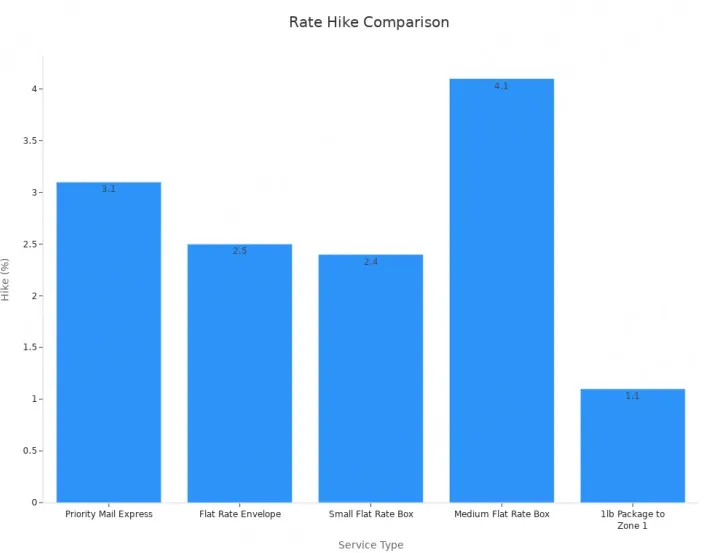
The Priority Mail service remains a popular choice for fast and affordable shipping. However, these rate hikes may require you to reassess your shipping strategies, especially if you frequently use Priority Mail Express service for time-sensitive deliveries.
Changes to Parcel Select and Ground Advantage Rates
Parcel Select and USPS Ground Advantage services will also see price adjustments in 2025. Parcel Select service, often used by businesses for bulk shipments, will experience a moderate increase. Meanwhile, USPS Ground Advantage, introduced as a cost-effective option for non-urgent deliveries, will see an average price hike of 3.9%. These changes reflect USPS’s commitment to balancing affordability with operational efficiency.
For oversized or overweight items, the fee will double from $100 to $200. This significant increase highlights USPS’s focus on optimizing shipping services for standard-sized packages. If you frequently ship large items, you may need to explore alternative options or adjust your pricing strategy to accommodate these changes.
International Shipping Rate Modifications
If you frequently ship packages internationally, you’ll notice significant changes to USPS international shipping rates in 2025. These updates aim to align pricing with global market trends while addressing the rising costs of international logistics. Here’s what you need to know about the upcoming modifications.
Key Changes to International Shipping Rates
-
Global Express Guaranteed (GXG): Rates for GXG, USPS’s fastest international shipping option, will increase by an average of 4.5%. This service remains ideal for urgent shipments to over 190 countries.
-
Priority Mail International (PMI): Expect an average rate hike of 3.8% for PMI services. This option balances speed and affordability for international deliveries.
-
First-Class Package International Service (FCPIS): Rates for FCPIS will rise by 3.2%. This service is popular for lightweight packages under 4 pounds.
-
International Flat Rate Boxes and Envelopes: Prices for flat-rate options will increase by an average of 3.6%. These are convenient for shipping items that fit within standard dimensions.
Note: The rate increases vary depending on the destination country and package weight. You can use USPS’s online calculator to estimate costs for specific shipments.
Why Are Rates Increasing?
USPS faces growing challenges in international shipping. Rising fuel prices, increased customs processing fees, and higher transportation costs contribute to these changes. Additionally, USPS must comply with international postal agreements, which often dictate pricing structures.
How Will This Impact You?
If you run a small business that ships products overseas, these rate changes may affect your pricing strategy. You might need to adjust shipping fees or explore alternative carriers for certain destinations. For individual mailers, sending gifts or personal items abroad will become slightly more expensive. Planning ahead and consolidating shipments can help you save money.
Comparison of 2024 vs. 2025 Rates
|
Service Type |
2024 Average Rate |
2025 Average Rate |
Rate Increase (%) |
|---|---|---|---|
|
Global Express Guaranteed (GXG) |
$67.50 |
$70.55 |
4.5% |
|
Priority Mail International (PMI) |
$45.20 |
$46.92 |
3.8% |
|
First-Class Package Intl. (FCPIS) |
$15.75 |
$16.25 |
3.2% |
|
Intl. Flat Rate Box (Medium) |
$83.65 |
$86.65 |
3.6% |
These changes reflect USPS’s efforts to maintain service quality while addressing financial challenges. By understanding these updates, you can better prepare for the impact on your international shipping needs.
Effective Date and Implementation Details
Timeline for Rate Changes
The USPS has outlined a clear timeline for implementing the new shipping rates and service changes. These updates will roll out in two phases. The first phase begins on January 19, 2025, and the second phase follows on July 13, 2025. This staggered approach allows customers and businesses to adjust gradually to the new pricing structure.
The implementation process typically involves four stages. It starts with exploratory and planning activities, where USPS evaluates the changes and prepares for execution. The third stage introduces the new rates and services, allowing USPS to review and refine the process. Full implementation occurs in the final stage, ensuring all updates are operational and effective.
Historical data also supports the need for these changes. For example, the Consumer Price Index (CPI) has steadily increased over the years, reflecting rising costs. Between 2020 and 2022, the CPI rose from 258.811 to 287.504, highlighting inflation's impact on operational expenses. These adjustments help USPS align its pr/prc(price) structure with current economic realities.
Transition Period for Businesses and Customers
USPS recognizes that changes to shipping rates and services can disrupt routines. To ease the transition, they have provided a six-month adjustment period between the two implementation phases. During this time, businesses can update their pricing strategies, and customers can explore alternative shipping options.
For businesses, the transition involves reviewing shipping budgets and communicating changes to clients. Small businesses, in particular, may need to adjust their pricing models to account for the higher pr/prc(price). Customers can use this period to familiarize themselves with the new rates and plan their shipments accordingly.
By providing a structured timeline and transition period, USPS aims to minimize disruptions while ensuring a smooth implementation of the 2025 updates.
Rationale Behind the Updates
Addressing Financial Challenges
The USPS faces significant financial hurdles that require immediate attention. You may not realize it, but the organization incurred a $3.9 billion deficit last year. This financial strain stems from a sharp decline in mail volume, which has dropped by over 25% and shows no signs of recovery. Costs consistently exceed revenues, creating unsustainable operations. To make matters worse, USPS has reached its borrowing limit, relying on loans to cover daily expenses. Its total debt now stands at approximately $120 billion, highlighting the urgency of these updates.
To address these challenges, USPS is implementing rate increases across various services. These adjustments aim to ensure financial sustainability while keeping U.S. postage rates among the most affordable globally. For example, the price of a forever stamp remains competitive compared to international standards. Additionally, USPS plans to reduce postal insurance costs by 12%, demonstrating a strategic approach to financial management.
Supporting USPS's 'Delivering for America' Plan
The "Delivering for America" plan serves as a roadmap for USPS's future. This initiative focuses on modernizing operations, improving service reliability, and achieving financial stability. By adjusting rates and services, USPS aligns its pricing structure with the goals outlined in this plan. You’ll notice that these changes prioritize long-term sustainability over short-term fixes.
One key aspect of the plan involves maintaining affordable mailing options, such as the forever stamp, while addressing operational inefficiencies. The updates also support investments in infrastructure and technology, ensuring USPS can meet evolving customer needs. These efforts reflect a commitment to delivering reliable and cost-effective services for years to come.
Enhancing Operational Efficiency
Operational efficiency remains a cornerstone of USPS's strategy. The Retail Standardization process, initiated in 2005, focuses on improving customer experience and streamlining operations. You benefit from better lobby conditions, enhanced merchandise displays, and more accurate transaction data through the POS ONE retail system. These improvements help USPS make informed decisions and optimize its services.
Performance metrics further highlight USPS's progress. First-Class Mail achieves on-time delivery rates above 94%, while Marketing Mail exceeds 95%. National service performance continues to improve, showcasing USPS's dedication to operational excellence. However, challenges persist, such as inconsistent city carrier route performance and machine efficiency issues. Addressing these areas will enhance overall service quality and reliability.
|
Metric Type |
Performance Details |
|---|---|
|
S&DC Implementation Goals |
Met goals for 3 out of 17 metrics; within 5 percentage points for 8 additional metrics. |
|
Comparison to Nationwide Average |
Performed better than the nationwide average for 8 out of 14 key metrics. |
|
Carrier Efficiency Issues |
Did not consistently achieve city carrier route performance goals, incurring $1.4 million in overtime. |
|
Machine Efficiency |
Did not consistently meet the mailpieces per hour goal. |
|
Post Office Box Availability |
Failed to meet scheduled goals for mail availability. |
|
Rural Route Overburden |
Experienced longer than standard hours on rural routes. |
These updates aim to refine USPS's operations, ensuring you receive reliable and efficient service. By focusing on continuous improvement, USPS strives to meet your expectations while addressing internal challenges.
Additional Service Changes for 2025
Adjustments to Delivery Times
USPS plans to adjust delivery times for certain services in 2025. These changes aim to improve efficiency and reduce operational costs. While 75% of First-Class Mail will maintain its current delivery schedule, some rural areas may experience longer wait times. This adjustment reflects USPS’s efforts to balance service quality with financial sustainability.
The updated delivery framework could save USPS approximately $3.6 billion annually. However, the price increases for key services like Priority Mail (3.2%) and USPS Ground Advantage (3.9%) highlight the need for careful planning. If you live in a rural area, you may need to account for these potential delays when scheduling shipments.
Elimination of Business Reply Mail (BPM)
Starting in 2025, USPS will discontinue Business Reply Mail (BPM). This service, once popular for prepaid return mail, has seen a decline in usage due to digital alternatives. By eliminating BPM, USPS aims to streamline its offerings and focus on services with higher demand.
If you rely on BPM for business operations, consider transitioning to other USPS options like prepaid shipping labels or exploring digital solutions. This change aligns with USPS’s broader goal of modernizing its services to meet evolving customer needs.
Introduction of New Features, Including Redesigned Money Orders
USPS will introduce redesigned money orders in February 2025. These updates include enhanced security features to protect against fraud. The new design incorporates a bank routing number, watermarks, and a security thread. A QR code will also allow you to verify the money order on the USPS website.
|
Feature |
Description |
|---|---|
|
New Bank Routing Number |
Enhances security and reduces fraud risks. |
|
Watermarks |
Deters counterfeiting and builds trust. |
|
Security Thread |
Adds another layer of protection. |
|
QR Code |
Links to USPS’s website for verification. |
|
Color Change |
Features a patriotic red, white, and blue design. |
These updates reflect USPS’s commitment to improving customer experience. The redesigned money orders not only enhance security but also modernize the service with a fresh look and user-friendly features.
Impact on Customers and Businesses
Implications for Small Businesses
The new USPS rate changes will directly impact your business operations, especially if you rely on shipping to deliver products to customers. Adjusting to these changes requires strategic planning to minimize costs and maintain customer satisfaction. Here are five actionable steps you can take to adapt effectively:
-
Optimize shipping methods: Analyze your shipping data to identify the most cost-effective USPS services for your needs. For example, switching to USPS Ground Advantage for non-urgent deliveries could save money.
-
Negotiate with carriers: Discuss bulk shipping discounts with USPS or other carriers. Flexible contract terms can help you manage costs during peak seasons.
-
Leverage technology: Use shipping software to automate service selection and monitor trends. These tools can help you identify cost-saving opportunities and streamline operations.
-
Enhance operational efficiency: Consolidate shipments and optimize packaging to reduce costs. Smaller, lighter packages often incur lower fees.
-
Explore alternative carriers: Consider regional or hybrid carriers for competitive rates. Diversifying your shipping options can provide flexibility and cost savings.
Note: Consumer expectations for free shipping have evolved. According to the AlixPartners 2023 Annual Home Delivery Survey, most customers now expect delivery within three days, compared to five-and-a-half days a decade ago. Additionally, 96% of consumers prioritize free delivery when making purchasing decisions. Adapting your shipping strategy to meet these expectations is crucial for retaining customers.
Changes for Individual Mailers
If you frequently send letters or packages, the USPS rate changes will affect your mailing habits. The shift to electronic communication has reduced mail volume, which has led to higher costs for traditional services. Here are some key trends that highlight the impact on individual mailers:
-
First-Class Mail volume has dropped by 50%, from 92 billion pieces in FY 2008 to 46 billion in FY 2023.
-
Marketing Mail volume decreased by 40%, from 99 billion pieces to 59 billion during the same period.
-
Periodicals volume saw the steepest decline, falling by 65%, from 9 billion pieces to 3 billion.
These declines reflect the growing preference for digital communication, which has made traditional mail less profitable. As a result, USPS has adjusted its pricing to maintain financial stability. For you, this means higher costs for sending letters and packages. If you live in rural areas, you may also experience longer delivery times due to operational changes.
Strategies to Adapt to New Rates and Services
Adapting to USPS's new rates and services requires clear communication and proactive planning. Whether you're a business owner or an individual mailer, these strategies can help you navigate the changes effectively:
-
Develop standard templates for customer communications to ensure consistency.
-
Create an educational content library with FAQs, tutorials, and guides to explain the new rates and services.
-
Use multiple channels to update customers on changes, including email, social media, and in-store notices.
-
Train staff to communicate clearly and effectively about USPS updates.
-
Implement a feedback mechanism to gather customer insights and improve communication strategies.
-
Benchmark against industry best practices to ensure transparency and clarity in your messaging.
By adopting these strategies, you can minimize disruptions and maintain trust with your customers. Whether you're adjusting your shipping methods or educating your audience, proactive measures will help you adapt to USPS's evolving landscape.
The 2025 USPS updates bring notable changes to shipping rates and services. You’ll see price increases for Priority Mail, Ground Advantage, and international shipping, along with the elimination of Business Reply Mail. These adjustments aim to address financial challenges while improving operational efficiency.
USPS’s focus remains on balancing affordability with reliability. By modernizing services and enhancing customer experience, they strive to meet evolving needs.
Stay informed about these updates and plan your shipping strategies early. Preparing now will help you adapt smoothly and avoid disruptions in 2025.
FAQ
What are the key dates for the USPS rate changes in 2025?
The new rates will take effect in two phases: January 19, 2025, and July 13, 2025. Use this timeline to plan your shipping strategies and adjust budgets accordingly.
How can I calculate the new shipping costs for my packages?
Use USPS’s online shipping calculator. Enter your package details, including weight, dimensions, and destination, to get an accurate cost estimate based on the updated rates.
Will delivery times change for all services?
Most First-Class Mail delivery times will remain unchanged. However, rural areas may experience slight delays. Check USPS’s updated delivery schedule for specific details.
What alternatives exist for Business Reply Mail users?
You can switch to prepaid shipping labels or explore digital solutions like QR codes for returns. These options offer convenience and align with modern business practices.
Are the redesigned money orders safer than the current ones?
Yes, the new money orders include enhanced security features like watermarks, security threads, and QR codes. These updates reduce fraud risks and improve verification processes.
Related content