
Tax Authority Trends Shaping 2025 Policies
Author:XTransfer2025.12.12Tax Authority
The tax authority has introduced several updates for 2025, reflecting a transformative period in tax policy. Notable adjustments include inflation adjustments for tax year 2025 and revised capital gains tax brackets. The IRS reported a 1.5% increase in processed returns, totaling 138,057,000, alongside a 3.2% rise in refunds issued, amounting to $253.116 billion. These changes highlight the evolving tax landscape, which directly impacts individuals and businesses. For example, research underscores how tax policy ideas, such as reducing tax rates, can boost business activity by 1% to 5%. Staying informed helps taxpayers navigate upcoming changes in tax law effectively.
Key Updates in Tax Laws 2025

Changes in Individual Taxation
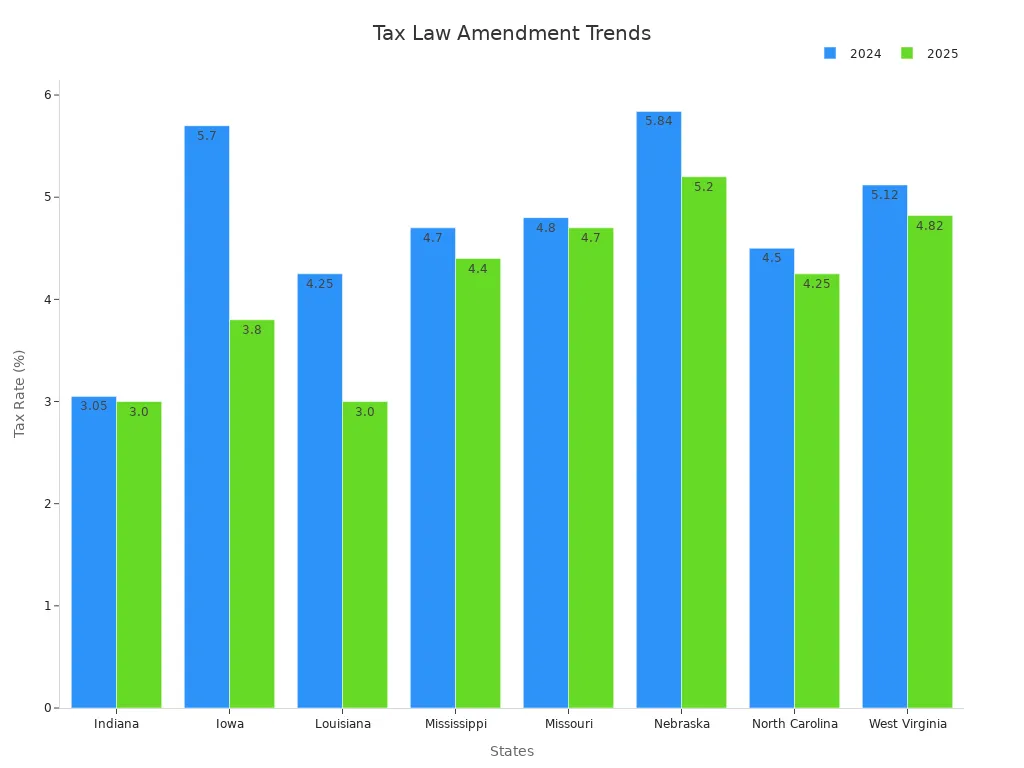
The tax authority has introduced significant updates to individual taxation for 2025. Without congressional action, individual taxes are projected to increase by approximately $2 trillion. This change will impact taxpayers across various income levels, emphasizing the importance of understanding new tax brackets. For example, states like Indiana, Iowa, and Louisiana have revised their tax rates for 2025, with Louisiana consolidating its brackets to a flat 5.5%.
|
State |
2024 Rates |
2025 Rates |
|---|---|---|
|
Indiana |
3.05% |
3.00% |
|
Iowa |
5.70% |
3.80% |
|
Louisiana |
4.25% |
3.00% |
|
Mississippi |
4.70% |
4.40% |
|
Missouri |
4.80% |
4.70% |
|
Nebraska |
5.84% |
5.20% |
|
North Carolina |
4.50% |
4.25% |
|
West Virginia |
5.12% |
4.82% |
These adjustments reflect a broader trend toward simplifying tax brackets and reducing rates in certain states. However, empirical studies suggest that while tax cuts may boost short-term output, they have minimal impact on long-term growth. Tax planning strategies will be essential for individuals to navigate these changes effectively.
Corporate Tax Reforms
Corporate tax reforms for 2025 aim to address global competitiveness and revenue generation. The top rates on Global Intangible Low-Taxed Income (GILTI) and Foreign-Derived Intangible Income (FDII) will rise from 13.125% to approximately 16.4% in 2026. Additionally, the Base Erosion and Anti-Abuse Tax (BEAT) rate will increase from 10% to 12.5%. These changes highlight the need for businesses to adopt proactive tax planning strategies to mitigate potential financial impacts.
|
Title |
Source |
|---|---|
|
2025 Corporate Tax Department Technology Report |
Thomson Reuters |
|
Considering Potential International Corporate Tax Reforms in the US |
Tax Foundation |
Corporate taxpayers must also prepare for technological advancements in tax compliance, as highlighted in the 2025 Corporate Tax Department Technology Report. These reforms underscore the importance of aligning business strategies with upcoming tax law changes.
International Taxation Policies
International taxation policies for 2025 reflect the growing complexity of cross-border transactions. The World Economic Outlook April 2025 notes that effective tariff rates are at historic levels, influencing global economic conditions. Updated taxation policies are expected to impact growth and inflation, requiring multinational corporations to reassess their tax planning strategies.
The 2024 Annual Report on Taxation provides insights into EU countries' tax systems, focusing on challenges and reforms. It emphasizes the importance of understanding various tax bases and types to navigate international tax obligations effectively. These reports highlight the need for businesses to stay informed about global tax trends and adapt their strategies accordingly.
Legal Developments and IRS Adjustments for 2025
New Compliance Requirements
The IRS adjustments for 2025 introduce stricter compliance measures to address tax fraud and financial crimes. These measures aim to enhance transparency and accountability in the tax landscape. Recent data highlights the effectiveness of these initiatives:
-
87.3% of IRS-CI’s criminal investigations recommended for prosecution involved subjects with related Bank Secrecy Act filings.
-
A 97.3% conviction rate was achieved in adjudicated cases, with average prison sentences of 37 months.
-
Investigations uncovered $21.1 billion in fraud tied to tax and financial crimes.
-
Authorities seized $8.2 billion in assets linked to criminal activity.
-
Restitution efforts recovered $1.4 billion for crime victims.
These compliance metrics underscore the tax authority's commitment to combating fraud and ensuring adherence to upcoming tax law changes. Taxpayers must remain vigilant and align their practices with these new requirements to avoid penalties.
Court Rulings and Precedents
Court rulings play a pivotal role in shaping the tax landscape. Legal databases provide valuable insights into historical and statistical evidence relevant to 2025.
|
Database Name |
Description |
|---|---|
|
Supreme Court Database |
Extensive data on U.S. Supreme Court cases from 1791 to 2018. |
|
Judicial Research Initiative |
Datasets on court cases and judicial phenomena, including foreign high courts. |
|
FastCase |
Access to federal and state caselaw, statutes, and regulations since 2008. |
|
Harvard Caselaw Access Project |
Official U.S. case law from state and federal courts. |
|
ICPSR |
Archive of digital social science data, including legal data. |
|
TRACFed |
Detailed data on U.S. federal judicial performance and enforcement actions. |
|
Judicial Business of the United States Courts |
Annual reports on the Federal Judiciary's workload. |
These resources provide a foundation for understanding precedents that influence potential tax law changes. Businesses and individuals must monitor court decisions to anticipate their impact on tax obligations.
Legislative Changes
Legislative proposals for tax year 2025 reflect efforts to modernize revenue generation and align with global economic trends. The EU Commission's proposal for new own resources introduces three key revenue streams:
-
30% of revenues from auctioning ETS allowances.
-
75% of revenues from selling CBAM certificates.
-
A temporary national contribution based on 0.5% of gross operating surplus for corporations.
These changes highlight the evolving tax landscape and its implications for international trade and corporate taxation. Staying informed about legislative developments will help taxpayers adapt to shifting policies and prepare for upcoming tax law changes effectively.
Implications of Upcoming Tax Law Changes

Financial Planning for Individuals
The upcoming tax law changes for tax year 2025 will significantly impact individual financial planning. Taxpayers must adapt their strategies to align with new regulations, including adjustments to deductions and standard tax brackets. For instance, the IRS adjustments for 2025 may alter the standard deduction amounts, which could influence how individuals approach their tax filings. Understanding these changes is crucial for optimizing tax savings.
To prepare effectively, individuals should focus on the following areas:
-
Maximizing Deductions: Reviewing eligible deductions, such as those for medical expenses or charitable contributions, can help reduce taxable income.
-
Evaluating Standard vs. Itemized Deductions: Taxpayers should calculate whether the standard deduction or itemizing provides greater benefits under the new rules.
-
Retirement Contributions: Increasing contributions to retirement accounts, such as 401(k)s or IRAs, can lower taxable income while building long-term savings.
Tax professionals play a vital role in guiding individuals through these changes. Insights into potential adjustments by the tax authority for 2025 highlight the importance of strategic planning. By staying informed, taxpayers can make informed decisions and avoid unexpected liabilities.
Strategic Planning for Businesses
Businesses face unique challenges as they navigate potential tax law changes in 2025. Strategic planning is essential to mitigate risks and capitalize on opportunities. Corporate taxpayers must address changes in deductions, compliance requirements, and international tax policies.
Case studies illustrate how companies can adapt effectively:
-
Tech Innovators Inc. shifted its R&D investments to areas with better tax credits, enhancing both innovation and tax efficiency.
-
Global Manufacturing Ltd. relocated production closer to markets, reducing logistics costs and leveraging local tax benefits.
These examples underscore the importance of proactive planning. Businesses should implement the following strategies:
-
Continuous Monitoring: Establish systems to track regulatory changes and ensure compliance.
-
Proactive Scenario Planning: Regularly update financial models to reflect the evolving tax environment.
-
Invest in Training: Provide ongoing education for staff on tax compliance and deductions.
The relationship between tax changes and risk management highlights the need for resource allocation. As tax volatility increases, companies must dedicate more resources to managing risks effectively. By aligning their strategies with upcoming tax law changes, businesses can maintain competitiveness and financial stability.
The tax authority has introduced significant changes for tax year 2025, including updates to individual and corporate taxation, international policies, and compliance requirements. These adjustments reflect a dynamic tax landscape that demands proactive planning. The House Ways and Means Committee highlighted the potential burden on taxpayers due to new regulations, emphasizing the need for awareness. Concerns about IRS workforce reductions and leadership changes further underscore the importance of staying informed about irs adjustments for 2025.
Taxpayers should seek professional advice to navigate potential tax law changes effectively. Understanding these updates ensures compliance and helps individuals and businesses optimize their financial strategies.
FAQ
What are the key tax changes for individuals in 2025?
The 2025 tax changes include revised tax brackets and adjustments to standard deductions. Some states have shifted to flat tax rates, simplifying the process for taxpayers. Individuals should review these updates to understand their impact on annual filings.
How will corporate tax reforms affect businesses?
Corporate tax reforms will increase rates for GILTI, FDII, and BEAT. These changes aim to enhance global competitiveness and revenue generation. Businesses must adjust their strategies to manage higher tax obligations effectively.
What compliance measures should taxpayers expect in 2025?
The IRS has introduced stricter compliance requirements to combat fraud. These include enhanced reporting standards and increased scrutiny of financial transactions. Taxpayers should ensure their filings align with these measures to avoid penalties.
How do international tax policies impact multinational corporations?
International tax policies for 2025 focus on cross-border transactions and tariff adjustments. Multinational corporations must reassess their tax planning strategies to address these changes and maintain compliance with global regulations.
Why is professional advice important for navigating 2025 tax changes?
Tax laws for 2025 involve complex updates across individual, corporate, and international taxation. Professional advice helps taxpayers understand these changes, optimize financial strategies, and ensure compliance with evolving regulations.
Related content