
How to Secure Your Savings with Deposit Insurance
Author:XTransfer2025.05.21deposit
Deposit insurance ensures the security of your savings if a bank failure occurs. It protects your deposits up to the FDIC coverage limits. Banks with higher risks pay higher premiums, reducing the likelihood of failures. This system has proven effective, as riskier banks are over 35 times more likely to fail within five years.
Understanding Deposit Insurance

What Is Deposit Insurance
Deposit insurance is a financial safeguard designed to protect your money in the event of a bank failure. It ensures that your deposits at insured banks are secure up to a specific limit, currently set at $250,000 per account by the Federal Deposit Insurance Corporation (FDIC). This system was established in 1933 during The Great Depression, a time when widespread bank failures caused millions of Americans to lose their savings. By guaranteeing the safety of insured deposits, deposit insurance restores trust in the banking system and prevents panic during financial crises.
Understanding deposit insurance is essential for managing your savings effectively. It helps you identify which accounts are covered and ensures you know the limits of protection. Without this knowledge, you risk leaving your money vulnerable to unforeseen events.
How Deposit Insurance Works to Protect Depositors
Deposit insurance operates as a safety net for your savings. When you deposit money into an FDIC-insured bank, the FDIC guarantees that your funds are protected up to $250,000 per account ownership category. If the bank fails, the FDIC steps in to ensure you receive your insured deposits promptly.
Here’s how the process works:
-
The FDIC collects fees from banks to fund the insurance system.
-
If a bank fails, the FDIC either sells the bank to another institution or pays off insured deposits directly.
-
Uninsured depositors may recover their funds based on the value of the bank’s remaining assets.
This mechanism ensures that your money remains safe, even in the worst-case scenario. By understanding how deposit insurance works, you can make informed decisions about where to deposit your savings and how to maximize your coverage.
Why FDIC Insurance Matters for Your Savings
FDIC insurance plays a crucial role in safeguarding your financial future. It provides peace of mind by guaranteeing the safety of your deposits, allowing you to focus on other aspects of financial planning. Without FDIC insurance, you would face significant risks, especially during economic downturns or banking crises.
Public awareness of deposit insurance remains a challenge. Surveys show that lower-income and less-educated households are more likely to be unbanked or underbanked, often due to concerns about fees, trust, and privacy. By understanding FDIC insurance, you can overcome these barriers and take advantage of the protection it offers.
Historically, FDIC insurance has evolved to meet the needs of depositors. For example:
These milestones highlight the importance of FDIC insurance in maintaining stability and confidence in the financial system. By leveraging this protection, you can secure your savings and navigate the complexities of modern banking with confidence.
FDIC Coverage Limits and What’s Protected
FDIC Coverage Limits Explained
FDIC insurance protects your deposit accounts by covering up to $250,000 per account holder, per bank, and per ownership category. This insurance limit applies to both the principal and any accrued interest, ensuring full protection within the coverage limits. If your bank fails, the FDIC will either transfer your insured accounts to another bank or issue a check for the insured amount.
Here’s how FDIC coverage works in practice:
-
If you have $200,000 in a savings account and $50,000 in a checking account at the same bank, both accounts are fully insured.
-
However, if your total deposits exceed $250,000 in one ownership category, the excess amount is uninsured.
The table below illustrates how FDIC coverage applies to different account balances:
Types of Accounts Covered by FDIC Insurance
FDIC insurance covers a wide range of deposit accounts, ensuring your savings are protected. These include:
-
Checking accounts
-
Savings accounts
-
Money market deposit accounts
-
Certificates of deposit (CDs)
-
Certain retirement accounts, such as IRAs
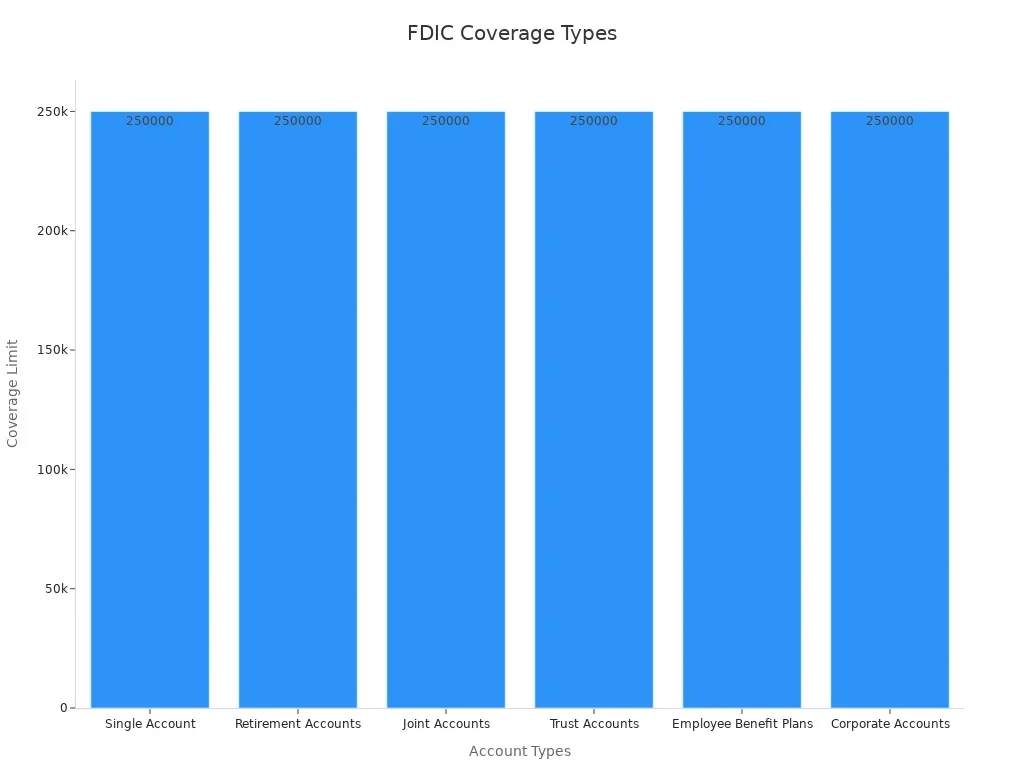
The chart below provides a visual breakdown of FDIC coverage limits for various account types:
What Is Not Covered by FDIC Insurance
While FDIC insurance offers robust protection for deposit accounts, it does not cover all financial products. The following are not insured:
-
Investments like stocks, bonds, and mutual funds
-
Crypto assets
-
Life insurance policies and annuities
-
Municipal securities
-
Contents of safe deposit boxes
Understanding these exclusions helps you make informed decisions about where to place your money. Always verify whether your financial products fall under FDIC protection to avoid unexpected risks.
Securing Savings Beyond FDIC Coverage Limits

Strategies to Protect Savings Over the Limit
When your savings exceed the FDIC insurance limit of $250,000, you need to explore strategies to safeguard the excess amount. These methods help you insure more than $250,000 and ensure your financial security remains intact.
Here are some effective strategies:
-
Open accounts at multiple banks to distribute your deposits. This ensures each account remains within the FDIC insurance limit.
-
Use different ownership categories, such as joint accounts or trust accounts, to increase your coverage.
-
Consider deposit networks that divide large sums into multiple FDIC-insured accounts.
-
Explore brokerage deposit accounts that offer FDIC insurance for cash balances.
By diversifying your deposits across these options, you can protect your savings beyond the standard limit. Each approach provides an additional layer of security, ensuring your money remains safe even in uncertain times.
Using Multiple FDIC-Insured Banks
Opening accounts at multiple FDIC-insured banks is one of the simplest ways to insure more than $250,000. By spreading your deposits across different institutions, you can maximize your coverage while maintaining peace of mind.
Recent financial reports highlight the effectiveness of this strategy. Banks have expanded coverage through reciprocal deposits, which distribute excess funds among participating institutions. This approach has proven especially beneficial for smaller and midsize banks. Between late 2022 and 2023, banks using reciprocal deposits saw a significant increase in insured and total deposits compared to those that did not. This innovation has strengthened banking stability, particularly after the 2023 regional banking crisis.
When choosing this strategy, ensure each bank is an FDIC-insured institution. You can verify a bank’s status through the FDIC’s BankFind tool. This step guarantees your deposits remain protected under the deposit insurance system.
Maximizing Coverage with Ownership Categories
Another effective way to insure more than $250,000 is by leveraging different ownership categories. The FDIC provides separate insurance coverage for accounts based on ownership types, allowing you to extend your protection.
For example, you can open accounts under categories such as individual, joint, or trust accounts. Each category receives its own $250,000 insurance limit per insured bank. The FDIC also recognizes specific categories for trusts, including revocable and irrevocable trusts. By understanding these distinctions, you can strategically structure your accounts to maximize coverage.
This approach requires careful planning. Ensure you understand the rules for each ownership category and how they apply to your deposits. By doing so, you can take full advantage of FDIC insurance and protect your savings effectively.
Verifying FDIC Insurance and Preparing for Bank Failures
How to Check If a Bank Is FDIC Insured
Verifying whether a bank is FDIC insured is essential for protecting your deposits. The Federal Deposit Insurance Corporation provides a simple way to check a bank’s status. Use the FDIC’s BankFind tool, available online, to search for your bank. Enter the bank’s name or location, and the tool will confirm its FDIC insurance status.
You can also look for the FDIC logo at your bank’s branch or website. Banks insured by the FDIC display this logo prominently. If you don’t see it, ask the bank directly about its insurance status. Ensuring your bank is FDIC insured guarantees that your deposits are protected under deposit insurance.
What to Do If Your Bank Fails
A bank failure can be stressful, but knowing what to do helps you stay prepared. If your bank fails, the FDIC steps in to protect insured deposits. You don’t need to take immediate action. The FDIC will either transfer your accounts to another FDIC-insured bank or issue a check for the insured amount.
Monitor communication from the FDIC and your bank. You’ll receive instructions on accessing your funds. If you have uninsured deposits, the FDIC will provide information about recovering them through the bank’s remaining assets. Staying informed ensures you can navigate a bank failure with confidence.
Filing a Claim for Insured Deposits
Filing a claim for insured deposits is straightforward. The FDIC automatically processes claims for insured accounts, so you won’t need to file a separate request. However, if you believe there’s an error or need clarification, contact the FDIC directly.
Use the FDIC’s online resources or call their customer service for assistance. Provide your account details and any relevant documentation. The FDIC prioritizes depositors’ claims, ensuring you receive your insured funds promptly. Understanding this process ensures you can recover your deposits without unnecessary delays.
Deposit insurance protects your savings and ensures financial security. You can insure your money beyond FDIC limits by using strategies like multiple banks or ownership categories. Always verify your bank’s FDIC status to avoid risks. Understanding your rights as a depositor helps you make informed decisions about safeguarding your deposit.
FAQ
What is the deposit insurance fund?
The deposit insurance fund is a reserve managed by the FDIC. It ensures your deposits are protected if a bank fails, providing financial security for account holders.
Can I insure more than $250,000 in one bank account?
No, FDIC insurance covers up to $250,000 per ownership category. To protect more, you can use multiple banks or ownership categories.
How does the FDIC pay depositors if a bank fails?
The FDIC uses the deposit insurance fund to reimburse insured deposits. It may transfer accounts to another bank or issue checks directly to depositors.
Related content