
E-commerce Evolution: Trends to Watch in 2025
Author:XTransfer2025.09.02E-commerce Evolution
The future of e-commerce is evolving rapidly, and staying ahead is essential for success. Businesses that adapt to emerging trends can thrive in this competitive landscape. Global e-commerce sales are expected to hit $7.4 trillion by 2025, with online retail accounting for 24% of total retail sales. Mobile commerce is also growing, projected to represent 44% of U.S. e-commerce sales the same year. This shift reflects a clear message: customers increasingly prefer online shopping, and businesses must meet their expectations. By embracing these changes, you can create seamless shopping experiences and build stronger connections with your audience.
AI and Personalization in the Future of E-commerce
Tailored shopping experiences powered by AI
Artificial intelligence is revolutionizing the way you shop online. By analyzing your preferences, browsing history, and past purchases, AI creates personalized shopping experiences that feel tailor-made for you. For example, platforms like Amazon use collaborative filtering to suggest products you might like, increasing cross-selling opportunities. This approach not only enhances your user experience but also builds stronger connections between you and the brands you trust.
Studies show that 67% of consumers desire personalized interactions while shopping. Retailers are responding by implementing AI-powered tools that recommend products in real-time. Brick-and-mortar stores are also joining the trend, using digital screens to suggest complementary items based on what you’re browsing. These innovations demonstrate how AI is bridging the gap between online and offline commerce, making your shopping journey seamless and enjoyable.
The impact of AI on personalization is undeniable. According to McKinsey, personalization can lift revenue by as much as 15%. Additionally, 65% of shoppers are more likely to stay loyal to companies that offer personalized experiences. As AI technology continues to evolve, you can expect even more hyper-personalization in the future of e-commerce.
Predictive analytics for smarter decision-making
Predictive analytics is another game-changer in the future of ecommerce. By leveraging data, businesses can anticipate your needs and offer solutions before you even realize you need them. This proactive approach improves your customer experience and helps companies optimize their operations.
For instance, predictive analytics allows businesses to manage inventory more effectively. By analyzing trends and forecasting demand, companies can avoid stockouts and ensure that the products you want are always available. It also enables marketers to create campaigns that resonate with your preferences, increasing the likelihood of engagement.
The benefits of predictive analytics extend beyond marketing and inventory. Businesses can reduce costs and boost profitability by optimizing logistics and supply chains. This data-driven approach ensures that you receive your orders faster and with fewer errors, enhancing your overall shopping experience. As the adoption of artificial intelligence grows, predictive analytics will play an even bigger role in shaping the future of e-commerce.
Real-world examples of AI-driven personalization
Many companies are already reaping the rewards of AI-driven personalization. Amazon, for example, introduced "Rufus," an AI-powered shopping assistant that helps you find products and offers tailored recommendations. This innovation is projected to generate over $700 million by 2025. Similarly, Verizon integrated a Google AI assistant to support customer service representatives, resulting in a nearly 40% increase in sales.
Retailers are also using AI to improve marketing campaigns and customer segmentation. Marketplace O achieved a 25% improvement in marketing effectiveness by leveraging AI to understand customer behavior. Brand N saw a 20% increase in repeat customers through personalized in-store promotions. These success stories highlight the transformative power of AI in creating personalized shopping experiences.
The market for AI in e-commerce personalization is growing rapidly. By 2025, it is projected to reach $8.65 billion, doubling to $17.1 billion by 2030. This growth reflects the increasing demand for personalized interactions and the rise of social commerce. As more businesses invest in AI, you can look forward to a future where every shopping experience feels uniquely yours.
AR/VR Transforming the Future of Ecommerce

Immersive shopping experiences with AR/VR
AR (Augmented Reality) and VR (Virtual Reality) are reshaping how you shop online. These technologies create immersive experiences that make online shopping feel more interactive and engaging. Imagine walking through a virtual store, browsing shelves, and examining products as if you were there in person. This level of immersion bridges the gap between physical and digital commerce, giving you a more realistic shopping experience.
A recent study shows that 83% of users are familiar with VR technology, and 96% feel comfortable using AR/VR interfaces. These numbers highlight the growing acceptance of these tools in e-commerce. By 2030, AR/VR is expected to contribute $1.5 trillion to the global economy, showcasing its transformative potential.
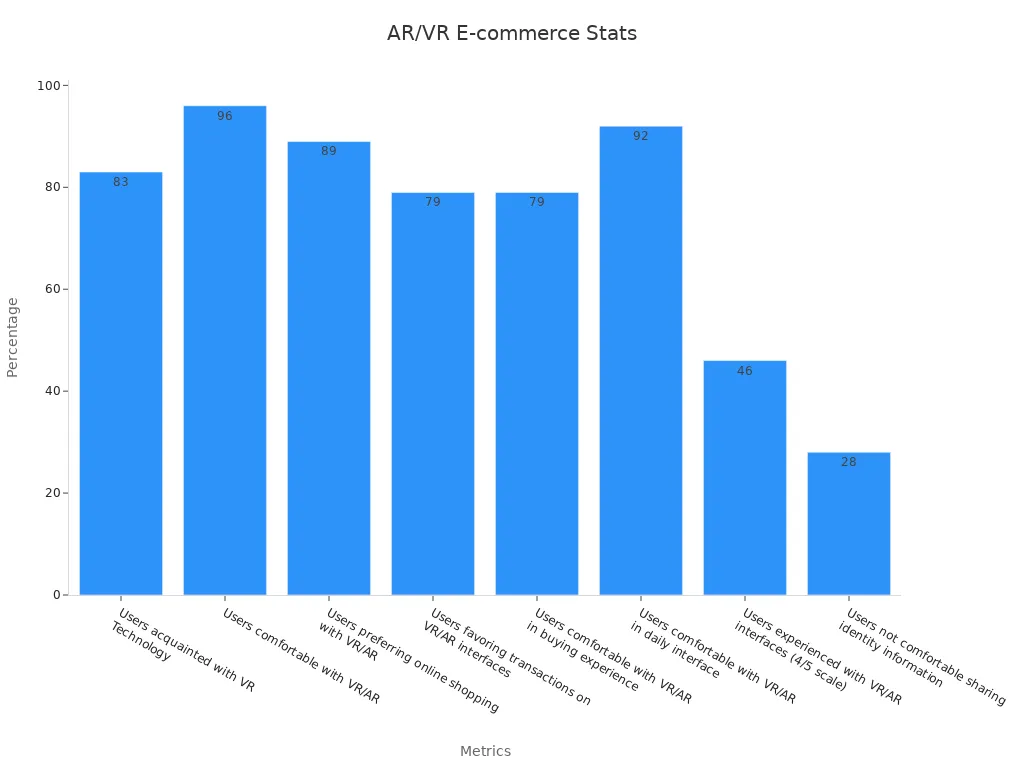
Virtual try-ons and product visualization
Virtual try-ons are revolutionizing how you shop for clothes, accessories, and even furniture. This technology allows you to see how a product will look on you or in your home before making a purchase. For example, you can try on glasses or shoes virtually or visualize how a couch fits in your living room. These tools boost your confidence in buying decisions and reduce the chances of returns.
-
Virtual try-ons enhance customer confidence by letting you see how products will look on you.
-
Accurate visualizations reduce return rates, as you're more likely to be satisfied with your purchase.
-
Retailers use data from virtual try-ons to optimize inventory and marketing strategies.
-
AR mirrors and apps make shopping more interactive, increasing engagement and purchase likelihood.
IKEA has seen a 30% increase in online sales thanks to AR visualization tools. Additionally, AR apps have improved customer engagement by 40%, proving their effectiveness in enhancing the shopping experience.
Industries leading AR/VR adoption in e-commerce
Several industries are at the forefront of AR/VR adoption in e-commerce. Fashion brands like Converse and beauty companies like Sephora use virtual try-ons to help you find the perfect fit or shade. Furniture retailers like IKEA and Wayfair let you visualize products in your space, making it easier to decide. Even automotive companies are using VR to give you virtual test drives.
|
Aspect |
Details |
|
Market Growth Rate |
Over 25% CAGR from 2021 to 2026 |
|
Leading Region |
North America |
|
Key Players |
IKEA, eBay, Converse, Amazon |
|
Impact of COVID-19 |
Shift towards online purchases, increasing AR/VR adoption to resolve customer pain points |
|
User Experience Enhancement |
Technological advancements in online platforms to improve profitability and consumer retention |
These industries demonstrate how AR/VR can transform the future of ecommerce by creating more engaging and personalized shopping experiences. As these technologies evolve, you can expect even more industries to adopt them, making your online shopping journey more seamless and enjoyable.
Voice Commerce Trends in E-commerce
Growth of voice-activated shopping
Voice commerce is rapidly transforming how you shop online. With over 4.2 billion digital voice assistants in use globally, this technology is becoming a key part of your daily life. The voice commerce market is projected to grow from $116.83 billion in 2024 to $151.39 billion in 2025, reflecting a CAGR of 29.6%. By 2029, it is expected to reach $421.7 billion. This remarkable growth highlights the increasing role of voice-activated shopping in the future of ecommerce.
Consumers value convenience more than ever. In the United States, 60% of e-commerce shoppers use voice assistants for daily or weekly purchases. Similarly, 48% of UK consumers used voice search for purchases in 2022, a 12% increase from the previous year. Major platforms like Amazon and Walmart are leading this shift by integrating voice commerce capabilities, making your shopping experience faster and more seamless.
Optimizing for voice search and smart assistants
To stay competitive, businesses must optimize for voice search and smart assistants. Over 52% of U.S. consumers used voice search in 2022, and 71% prefer voice assistants over typing. This trend emphasizes the need for e-commerce platforms to adapt. Strategies for optimization include understanding user intent through keyword research, creating conversational content, and focusing on local SEO. These steps help businesses rank higher in voice search results and improve your user experience.
Smart speakers are also driving this shift. By 2025, over 200 million smart speakers are expected to ship globally. This growth presents an opportunity for businesses to enhance the customer experience by integrating voice capabilities into their platforms.
Opportunities and challenges in voice commerce
Voice commerce offers exciting opportunities but also presents challenges. Many consumers use voice assistants for basic tasks, such as checking the weather or setting reminders. Expanding their use for complex transactions remains a hurdle. Trust and privacy concerns also pose challenges. Nearly 46% of consumers do not trust voice assistants to interpret orders correctly, and 45% feel uncomfortable sending payments through them.
Despite these challenges, the potential is immense. Eighty percent of consumers who shop using voice assistants report satisfaction, leading to increased loyalty and spending. As businesses address these barriers, voice commerce will continue to shape the future of ecommerce, offering you a more convenient and personalized shopping experience.
Sustainability Driving the Future of E-commerce
Consumer demand for eco-friendly practices
Sustainability is no longer just a buzzword; it’s a priority for many shoppers. You may have noticed that more consumers are actively seeking out eco-friendly products. This shift is driven by growing awareness of environmental issues and the desire to make ethical choices.
-
Sustainable products now hold a 17% market share and are growing 32% faster than non-sustainable ones.
-
78% of consumers consider sustainability important, and 55% are willing to pay more for eco-friendly brands.
-
Searches for sustainable products have surged by 130% globally since 2017, reflecting a clear demand for greener options.
As a shopper, you likely prefer brands that align with your values. In fact, 84% of customers avoid companies with poor environmental practices. This trend highlights the importance of sustainability in shaping the future of ecommerce.
Innovations in sustainable packaging and shipping
E-commerce companies are rethinking packaging and shipping to reduce their environmental impact. You’ve probably seen recyclable or biodegradable packaging becoming more common. These innovations not only reduce waste but also meet your expectations for eco-friendly practices.
|
Metric |
Description |
|
Recyclability |
Using recyclable materials supports a circular economy and reduces reliance on new resources. |
|
End-of-Life Disposal |
Ensures packaging won’t end up in landfills, aligning with consumer expectations. |
|
Carbon Footprint |
Measures greenhouse gas emissions throughout the product lifecycle, from production to delivery. |
|
Biodiversity Impact |
Considers how material production affects ecosystems and biodiversity. |
|
Water System Impact |
Reduces stress on water systems by minimizing water consumption during production. |
These metrics guide companies in creating sustainable solutions. For example, carbon-labeled products generated $3.4 billion in sales in 2021, doubling from the previous year. This shows how sustainability can drive both environmental and economic growth.
Strategies for integrating sustainability into e-commerce
To meet your expectations, businesses are adopting strategies that prioritize sustainability. Transparent supply chains, carbon reduction campaigns, and eco-friendly packaging are leading the way.
|
Strategy |
Data Supporting Evidence |
Success Case |
|
Transparent Supply Chain Storytelling |
94% of consumers prefer brands with supply chain transparency. |
Patagonia increased engagement by 30% through transparent practices. |
|
Carbon Footprint Reduction Campaigns |
67% of shoppers consider carbon footprint in purchases. |
Allbirds grew 40%, with 35% of new customers drawn by carbon transparency initiatives. |
|
Sustainable Packaging Solutions |
N/A |
Switching to eco-friendly packaging significantly reduces waste and emissions in e-commerce. |
These strategies not only help the planet but also strengthen your trust in the brands you support. As sustainability becomes a cornerstone of ecommerce trends, you can expect more companies to adopt ethical and eco-conscious practices.
Omnichannel Strategies Shaping the Future of Ecommerce
Seamless integration of online and offline shopping
Omnichannel strategies are transforming how you shop by seamlessly connecting online and offline platforms. This integration ensures that your shopping journey feels consistent, whether you browse products on a website, visit a physical store, or use a mobile app. For example, you might start by exploring a product online, check its availability in a nearby store, and then pick it up in person. This approach eliminates friction and makes your experience more convenient.
Retailers achieve this seamless integration by unifying customer data across all channels. This allows them to understand your preferences and shopping habits better. Real-time inventory updates ensure that stock levels are accurate, so you can trust the information you see online. Consistent branding across platforms also builds trust and recognition, making your interactions with the brand feel cohesive.
|
Metric |
Description |
|
Unified Customer Data |
Provides a holistic view of customer behaviors across online and offline channels. |
|
Real-time Inventory |
Ensures that stock levels are accurately reflected across all shopping platforms. |
|
Consistent Branding |
Maintains a uniform brand image, enhancing customer trust and recognition. |
|
Customer Experience |
Focuses on delivering a personalized shopping journey, regardless of the channel used. |
This seamless integration places you at the center of the shopping experience. It empowers retailers to tailor their services and products to your needs, ensuring that every interaction feels personalized and efficient.
Enhancing the customer journey through omnichannel
Omnichannel strategies enhance your shopping journey by creating a connected and personalized experience. When businesses integrate their platforms, you can transition effortlessly between channels. For instance, you might receive a personalized email about a product you viewed online, visit the store to see it in person, and then complete your purchase through a mobile app. This level of connectivity ensures that your experience is smooth and enjoyable.
Personalization plays a key role in improving your journey. By analyzing your preferences, businesses can offer tailored recommendations and promotions. Consistency across channels also fosters trust, making you more likely to return. Studies show that companies with strong omnichannel strategies retain 89% of their customers, compared to just 33% for those with weak strategies.
-
76% of customers expect companies to understand their needs.
-
73% of consumers use multiple channels during their shopping journey.
-
Buy Online, Pick Up In-Store (BOPIS) services have grown by 28% year-over-year.
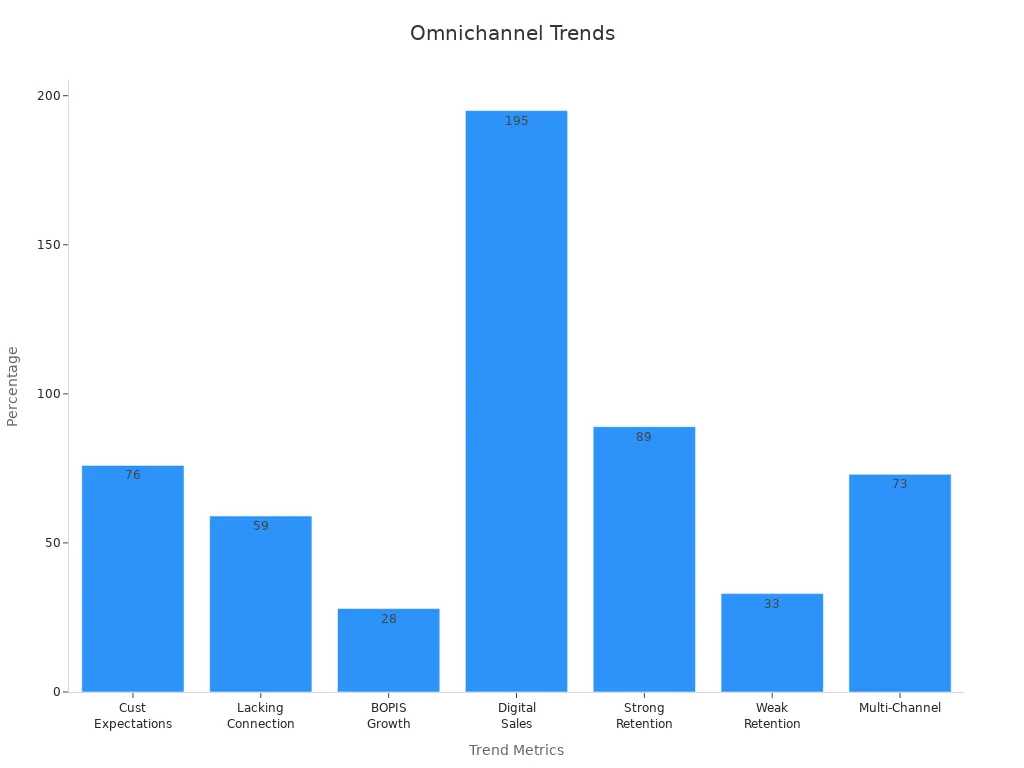
Metrics like Customer Lifetime Value (CLTV) and Net Promoter Score (NPS) highlight the effectiveness of omnichannel strategies. High CLTV indicates that you’re likely to stay loyal to a brand, while a strong NPS reflects your satisfaction with the experience. These metrics show how omnichannel solutions create value for both you and the business.
Successful examples of omnichannel strategies
Several companies have successfully implemented omnichannel strategies, setting benchmarks for the future of ecommerce. For example, Target’s integrated fulfillment options, such as BOPIS and same-day delivery, led to a 195% growth in digital sales during Q2 2020. Similarly, fashion retailer NA-KD increased customer lifetime value by 25% through personalized omnichannel experiences.
|
Company |
Result |
|
NA-KD |
Increased customer lifetime value by 25% |
|
Slazenger |
Achieved a 49x ROI in just eight weeks |
|
Vogacloset |
Attained a 30x ROI |
|
Matahari |
Achieved a 356x ROI |
|
Chow Sang Sang |
23.5% Uplift in Conversion Rates |
Burberry’s Series B campaign is another great example. By offering limited-edition products exclusively on social media, they created excitement and engagement among customers. Disney’s MagicBand system also stands out, providing a seamless experience across its parks, hotels, and apps. These examples demonstrate how omnichannel strategies can enhance your shopping experience and drive business success.
Omnichannel strategies are shaping the future of ecommerce by prioritizing your needs and preferences. As more businesses adopt these approaches, you can expect even more personalized and connected shopping experiences.
Advanced Logistics and Delivery Innovations in E-commerce

Same-day delivery and drone technology
The demand for faster delivery services has grown significantly. Same-day delivery and drone technology are transforming how you receive your orders. Drones, in particular, are becoming a game-changer in e-commerce. They improve delivery times in urban areas and make it possible to reach remote locations. Major retailers are adopting drones to enhance efficiency and reduce costs. These flying devices also contribute to sustainability by lowering fuel consumption and carbon emissions.
The global e-commerce market is projected to grow by 8.1% in 2024, reaching $1,192.6 billion. Rising consumer expectations for same-day delivery are driving this growth. Advancements in drone technology, such as better battery life and navigation systems, make these solutions more reliable. As a result, you can expect faster and more eco-friendly deliveries in the near future.
Automation in warehousing and fulfillment
Automation is revolutionizing warehousing and fulfillment processes. Robots and AI-powered systems now handle tasks like sorting, packing, and inventory management. This reduces human error and speeds up operations. For example, automated systems improve order accuracy and ensure that your packages arrive on time. They also optimize warehouse space and reduce labor costs, making e-commerce more efficient.
Performance metrics highlight these advancements. The fill rate measures how well companies manage inventory, while the perfect order rate evaluates the accuracy and condition of shipments. On-time shipping builds trust by ensuring your orders arrive as promised. Automation also enhances workplace safety and improves employee satisfaction. These innovations create a smoother experience for you as a customer.
|
Metric |
Description |
|
Fill Rate |
Percentage of customer orders fulfilled without stockouts. |
|
Order Accuracy |
Measures correctness of orders shipped. |
|
Order Cycle Time |
Average duration from order placement to receipt. |
|
On-Time Shipping |
Proportion of orders shipped on or before the expected date. |
|
Perfect Order Rate |
Evaluates orders shipped without issues, including accuracy, condition, and timeliness. |
Meeting consumer expectations for fast delivery
Fast delivery has become a standard expectation in e-commerce. Around 90% of consumers now expect their orders within two to three days. Clear tracking information also plays a crucial role in keeping you satisfied. When you can see where your package is at every step, it builds trust and reduces anxiety.
Interestingly, many consumers prioritize price and free shipping over speed. You might even accept longer delivery times if it means saving money. For commoditized products, this trade-off is common. However, meeting delivery estimates remains critical. Companies that deliver on time earn your loyalty and trust. By balancing speed, cost, and transparency, e-commerce businesses can meet your expectations effectively.
The future of e-commerce in 2025 will be defined by key trends like AI-driven personalization, sustainability, and omnichannel strategies. Companies like Amazon and Zara are already leveraging these innovations to enhance your shopping experience and build stronger connections. With global e-commerce sales projected to reach 24.5% of total retail sales, adaptability is essential. Businesses that embrace flexible technologies and ethical practices will thrive in this dynamic landscape. By staying innovative, you can meet customer expectations, drive growth, and secure long-term success in the ever-evolving world of digital commerce.
FAQ
What is the biggest trend shaping ecommerce in 2025?
AI-driven personalization is the most significant trend. It allows businesses to tailor shopping experiences based on your preferences, improving satisfaction and loyalty. This technology is transforming how you interact with online stores.
How does AR/VR improve online shopping?
AR/VR creates immersive experiences. You can try products virtually or visualize them in your space before buying. This reduces uncertainty and enhances your confidence in making purchases.
Why is sustainability important in ecommerce?
Sustainability matters because consumers like you prefer eco-friendly practices. Businesses adopting sustainable packaging and reducing carbon footprints align with your values, building trust and loyalty.
How does voice commerce make shopping easier?
Voice commerce simplifies shopping by letting you use voice commands to search for products or place orders. It saves time and offers convenience, especially when multitasking.
What is omnichannel ecommerce?
Omnichannel ecommerce connects online and offline shopping. You can browse products online, check store availability, and pick them up in person. This seamless integration enhances your shopping experience.
Related content