
Breaking Down Inbound and Outbound Logistics Activities for Better Insights
Author:XTransfer2025.05.08Inbound and Outbound
Inbound and outbound logistics are essential components of supply chain management, and each logistics activity plays a crucial role in this process. Inbound logistics focuses on receiving and storing raw materials or goods from suppliers, while outbound logistics centers on delivering finished products to customers. These logistics activities differ in their direction of goods flow and the stakeholders they involve. For example, inbound logistics emphasizes supplier relationships, whereas outbound logistics prioritizes customer satisfaction.
The significance of these logistics activities lies in their impact on business performance. Metrics such as perfect order rate, inventory turnover, and customer order cycle time highlight how well these logistics activities function. Efficient logistics systems ensure faster delivery times, reduce transportation costs, and improve inventory turnover. This drives customer satisfaction and overall operational success.
Understanding Inbound Logistics
Definition and Purpose
Inbound logistics refers to the process of managing the flow of goods, materials, and resources from suppliers to your business. This logistics activity ensures that your company has the necessary inputs to maintain smooth operations. According to industry definitions, inbound logistics involves tasks like transportation, receiving, and storage of goods. Its primary purpose is to create a steady supply of materials while minimizing costs and delays.
Efficient inbound logistics plays a critical role in reducing operating expenses. For example, localized storage solutions, such as micro-warehouses, can shorten delivery distances, leading to faster service and lower costs. Similarly, advanced technologies like smart route planning software optimize delivery routes, reducing fuel consumption and labor expenses. These strategies not only save money but also improve the overall efficiency of your supply chain.
|
Aspect |
Definition |
|---|---|
|
Inbound Logistics |
The management of the flow of products from suppliers to a company, essential for maintaining a steady goods supply. |
|
Efficiency |
Impacts a company’s ability to supply goods in time and meet customer demands. |
|
Effective Management |
Ensures undisrupted operations, lower production and delivery expenses, and better customer services. |
Key Inbound Logistics Activities
Inbound logistics involves several key activities that ensure the smooth movement of goods into your business. These activities include:
-
Procurement: Sourcing raw materials or products from suppliers.
-
Transportation: Managing the shipment of goods from suppliers to your facilities.
-
Receiving and Inspection: Checking the quality and quantity of goods upon arrival.
-
Storage: Organizing and storing materials in warehouses or other facilities.
-
Inventory Management: Monitoring stock levels to avoid shortages or overstocking.
Each of these activities contributes to the overall efficiency of your supply chain. For instance, companies that invest in digital platforms for inventory management and order tracking can enhance transparency and reduce errors. This leads to better coordination and faster lead times.
Role in Supply Chain Management
Inbound logistics is a cornerstone of effective supply chain management. It ensures that your business has the right materials at the right time, enabling you to meet production schedules and customer demands. By optimizing inbound logistics, you can improve reliability, reduce costs, and enhance client satisfaction.
For example, a global automated material handling company used predictive analytics and AI tools to streamline its inbound logistics. This approach improved inventory management, reduced costs, and enhanced operational efficiency. Similarly, research on the Steel Force Company in Namibia highlights how effective inbound logistics practices, such as transportation and inventory control, can boost supply chain performance.
Technological advancements like AI and IoT are also transforming inbound logistics. These tools help businesses optimize routing and scheduling, leading to reduced lead times and improved operational efficiency. As a result, companies can better manage their resources and respond quickly to market demands.
Exploring Outbound Logistics
Definition and Purpose
Outbound logistics refers to the process of managing the movement of finished goods from your business to the end customer. This logistics activity focuses on ensuring that products are delivered accurately, on time, and in good condition. It encompasses tasks like order fulfillment, transportation, and distribution. The primary goal of outbound logistics is to meet customer expectations while optimizing costs and efficiency.
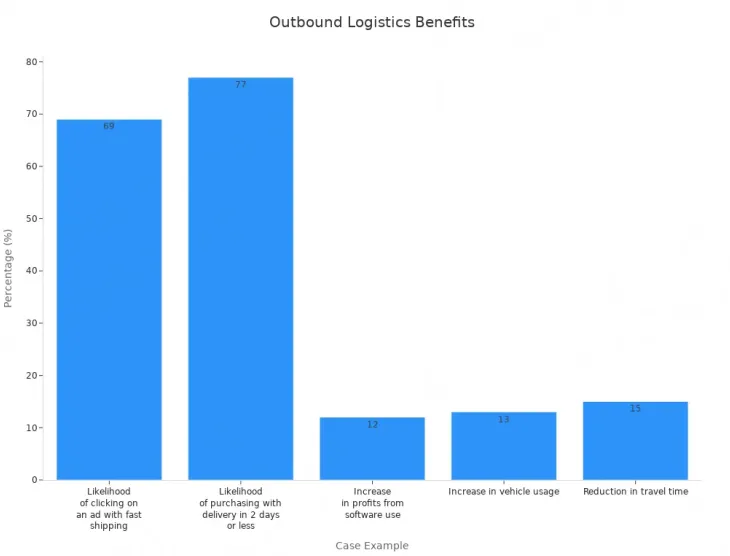
In supply chain management, outbound logistics plays a vital role in maintaining customer satisfaction. When you deliver products quickly and reliably, you build trust and loyalty. For instance, studies show that 77% of customers are more likely to purchase when delivery times are two days or less. This demonstrates how effective outbound logistics can directly impact your business's success.
Key Outbound Logistics Activities
Several activities form the backbone of outbound logistics. These include:
-
Order Processing: Managing customer orders, from receipt to confirmation.
-
Picking and Packing: Selecting the right products from inventory and preparing them for shipment.
-
Transportation: Coordinating the movement of goods to customers through various modes like trucks, ships, or planes.
-
Distribution: Delivering products to distribution centers, retailers, or directly to customers.
-
Returns Management: Handling product returns efficiently to maintain customer satisfaction.
Each of these activities contributes to the overall efficiency of your logistics operations. For example, optimizing transportation routes can reduce travel time by up to 15% and save fuel costs by 20% to 40%. Similarly, using software for order processing can increase profits by 12% and improve vehicle usage by 13%. These improvements highlight the importance of streamlining outbound logistics activities.
|
Statistic/Case Example |
Value |
|---|---|
|
Likelihood of clicking on an ad with fast shipping |
69% |
|
Likelihood of purchasing with delivery in 2 days or less |
77% |
|
Increase in profits from software use |
12% |
|
Increase in vehicle usage |
13% |
|
Reduction in travel time |
15% |
|
Fuel savings from logistics optimization |
20% to 40% |
Role in Supply Chain Management
Outbound logistics serves as the final step in the supply chain, connecting your business to the customer. It ensures that products reach their destination on time and in perfect condition. This logistics function directly impacts customer satisfaction, brand reputation, and overall business performance.
Metrics like on-time delivery rates, transit times, and error rates help measure the effectiveness of outbound logistics. For example:
|
Metric |
Description |
|---|---|
|
On-time delivery rates |
Percentage of shipments delivered on schedule |
|
Transit times |
Average time taken for shipments to reach customers |
|
Error rates |
Frequency of mistakes in order fulfillment |
Regularly analyzing these metrics can help you identify areas for improvement. By optimizing outbound logistics processes, you can reduce costs, enhance delivery speed, and stay competitive in the market. For instance, tracking data can reveal inefficiencies in transportation routes or packing methods, allowing you to make data-driven decisions.
Outbound logistics also benefits from technological advancements. Tools like route optimization software and real-time tracking systems improve visibility and efficiency. These technologies enable you to respond quickly to customer demands and adapt to changing market conditions. As a result, your business can maintain a strong position in the competitive landscape of supply chain management.
Comparing Inbound and Outbound Logistics
Direction of Goods Flow
Inbound and outbound logistics differ in the direction goods move. Inbound logistics focuses on bringing raw materials or products into your business. These goods flow from suppliers to your warehouses or production facilities. Outbound logistics, on the other hand, moves finished products from your business to customers. This flow typically involves distribution centers, retailers, or direct deliveries.
Understanding this distinction helps you manage each logistics activity effectively. For example, inbound logistics ensures your production processes have the necessary inputs, while outbound logistics guarantees timely delivery to customers. By optimizing both, you can create a seamless supply chain that supports your business goals.
Stakeholders and Relationships
The stakeholders involved in inbound and outbound logistics also differ. In inbound logistics, you work closely with suppliers. Building strong supplier relationships ensures a steady flow of materials and reduces disruptions. Outbound logistics involves customers, retailers, and distributors. Maintaining positive relationships with these stakeholders enhances customer satisfaction and strengthens your brand reputation.
You should prioritize communication and collaboration with all stakeholders. For inbound logistics, tools like supplier portals can improve transparency and coordination. For outbound logistics, real-time tracking systems allow customers to monitor deliveries, increasing trust and loyalty.
Metrics and Performance Indicators
Measuring the performance of inbound and outbound logistics requires different metrics. For inbound logistics, metrics like supplier lead time and inventory management efficiency are crucial. These indicators show how well your business handles incoming goods. Outbound logistics relies on metrics such as on-time delivery rates, order accuracy, and transit times. These metrics reflect your ability to meet customer expectations.
Tracking these metrics helps you identify areas for improvement. For example, analyzing supplier lead times can reveal delays in inbound logistics. Similarly, monitoring on-time delivery rates highlights inefficiencies in outbound logistics. By addressing these issues, you can enhance overall supply chain management and boost operational performance.
Challenges in Logistics Activities
Common Inbound Logistics Challenges
Inbound logistics often presents several hurdles that can disrupt your operations. One major challenge involves finding reliable suppliers who consistently deliver quality materials. Sourcing affordable suppliers and manufacturers adds another layer of complexity. Balancing the inflow and outflow of goods is equally critical. You need to maintain adequate materials without overstocking, which can lead to increased storage costs.
Transportation delays also pose significant risks. These delays can disrupt your production schedules and reduce supply chain resilience. Additionally, managing receiving and quality control processes requires precision. Any lapse in these areas can result in defective materials entering your production line. Outdated logistics practices further exacerbate these issues. Modernizing your logistics activity is no longer optional; it is a strategic necessity for staying competitive.
Common Outbound Logistics Challenges
Outbound logistics comes with its own set of challenges. High costs associated with inventory management and distribution systems can strain your budget. Achieving cost-efficiency in your logistics network is essential to maintaining service quality. Smooth coordination across the entire logistics network is another critical factor. This involves managing multiple stakeholders, including distributors, retailers, and customers.
You may also face difficulties in optimizing transportation routes and ensuring timely deliveries. These challenges with outbound logistics can directly impact customer satisfaction. For instance, delays or errors in order fulfillment can harm your brand reputation. Addressing these issues requires a proactive approach and the use of advanced technologies to streamline operations.
Impact on Supply Chain Management
Logistics challenges significantly affect supply chain management performance. Disruptions in inbound or outbound logistics can lead to delays, increased costs, and reduced efficiency. A comprehensive review of supply chain disruptions highlights how these challenges can weaken your supply chain resilience. For example, epidemic outbreaks have shown how logistics disruptions can ripple through the entire supply chain, affecting production and delivery timelines.
Research also categorizes logistics challenges as a major risk to supply chain performance. These challenges can hinder your ability to meet customer demands and maintain operational efficiency. Strengthening your logistics capabilities is essential for building a resilient and efficient supply chain.
Optimizing Logistics Activities
Strategies for Inbound Logistics Efficiency
Improving inbound logistics efficiency begins with building strong supplier relationships. Engaging proactively with suppliers ensures a steady flow of materials and reduces delays. You can also implement compliance standards to maintain quality and consistency. Technology plays a vital role here. Automated systems like barcode scanners streamline receiving processes, saving time and reducing errors. Warehouse Management Systems (WMS) help you track inventory accurately, enabling better decision-making.
Transportation planning is another critical factor. Optimizing routes and consolidating shipments can lower costs and improve delivery times. For example, using smart route planning software reduces fuel consumption and enhances efficiency. Additionally, leveraging data analytics allows you to monitor supplier performance and identify areas for improvement. These strategies not only cut costs but also enhance the overall reliability of your supply chain management.
Strategies for Outbound Logistics Efficiency
Outbound logistics efficiency focuses on delivering products to customers quickly and accurately. Start by re-evaluating your shipping and delivery methods. Partnering with a third-party logistics provider (3PL) can help you scale operations and reduce costs. Managing inventory with an order management system ensures you always have the right products available for shipment.
Enhancing customer communication tools is equally important. Real-time tracking systems allow customers to monitor their orders, building trust and satisfaction. Shipment consolidation and carrier selection also play a key role. By combining smaller shipments into larger ones, you can reduce transportation costs and improve delivery times. Companies like Amazon have achieved remarkable efficiency by investing in their transportation networks and offering fast delivery options.
|
Company |
Strategic Adjustments |
Improvements in Efficiency |
|---|---|---|
|
Amazon |
Fast and free delivery, own transportation |
Reduced costs, increased efficiency |
|
Zara |
Centralized warehouse, responsive supply chain |
Minimized inventory costs, timely delivery |
|
Starbucks |
Mobile ordering, loyalty programs |
Enhanced customer experience, better logistics operations |
Role of Technology in Logistics Optimization
Technology has revolutionized logistics by improving efficiency and reducing costs. Advanced distribution strategies in retail have cut inventory costs by 10% while boosting product availability. In the pharmaceutical industry, end-to-end supply chain visibility has reduced transportation costs by 15% and achieved a 99.8% on-time delivery rate. Automation, such as using robots in warehouses, has doubled picking productivity and reduced errors by 40%.
Artificial intelligence (AI) and machine learning also play a significant role. AI-powered loading optimization improves container utilization, saving costs and reducing emissions. Advanced WMS algorithms optimize inventory placement, cutting picking time by up to 30%. These innovations not only enhance operational efficiency but also help you meet customer demands more effectively.
|
Industry |
Innovation |
Result |
|---|---|---|
|
Retail |
Advanced distribution strategies |
Reduced inventory costs by 10%, improved availability |
|
Pharmaceutical |
End-to-end supply chain visibility |
15% reduction in transportation costs, 99.8% on-time delivery |
|
Logistics |
Automation with robots |
200% increase in picking productivity, 40% fewer errors |
|
E-commerce |
Advanced WMS algorithms |
30% reduction in picking time |
|
Shipping |
AI-powered loading optimization |
5-8% better container utilization, cost savings, reduced emissions |
By adopting these technologies, you can transform your logistics activity into a more efficient and cost-effective operation. This not only strengthens your supply chain management but also ensures you stay competitive in a rapidly evolving market.
Inbound and outbound logistics differ in their focus and objectives. Inbound logistics ensures the availability of raw materials, while outbound logistics delivers finished products to customers. The table below highlights these distinctions:
|
Aspect |
Inbound Logistics |
Outbound Logistics |
|---|---|---|
|
Definition |
Managing the flow of goods from suppliers to the business |
Moving goods from the business to customers |
|
Focus |
Ensuring availability of raw materials for production |
Delivering finished products to customers efficiently |
|
Key Performance Indicators |
On-time delivery rate, average lead time, damaged goods rate |
Order accuracy rate, average order processing time, average delivery time |
|
Challenges |
Lack of visibility, supplier reliability, inventory management |
Inefficient transportation management, varying customer expectations, regulatory compliance |
Optimizing logistics activities strengthens supply chain efficiency. Predictive analytics, for example, improves inventory accuracy by up to 25%, reducing overstock and understock scenarios. Additionally, logistic regression models enhance on-time delivery metrics by 10-20%, ensuring better customer satisfaction.
Adopting advanced strategies and technologies fosters continuous improvement. By doing so, you can reduce costs, enhance performance, and maintain a competitive edge in the market.
FAQ
What is the main difference between inbound and outbound logistics?
Inbound logistics focuses on bringing raw materials or goods into your business, while outbound logistics deals with delivering finished products to customers. Each process has distinct goals, stakeholders, and performance metrics.
Why is optimizing logistics activities important?
Optimizing logistics improves efficiency, reduces costs, and enhances customer satisfaction. It ensures timely deliveries, minimizes errors, and strengthens your supply chain's overall performance.
How can technology help in logistics management?
Technology streamlines logistics by automating processes, improving visibility, and reducing errors. Tools like route optimization software, warehouse management systems, and AI-powered analytics enhance efficiency and decision-making.
What are common challenges in inbound logistics?
Inbound logistics often faces issues like supplier delays, inventory mismanagement, and transportation disruptions. Addressing these challenges requires strong supplier relationships, efficient inventory tracking, and advanced planning tools.
How do you measure the success of outbound logistics?
You can measure outbound logistics success using metrics like on-time delivery rates, order accuracy, and transit times. These indicators reflect how well you meet customer expectations and manage delivery operations.
Related content