
Private Sector Development Through the Ministry of Commerce's Initiatives
Author:XTransfer2025.12.16Ministry of Commerce
The Ministry of Commerce actively shapes the economy by empowering the private sector through strategic initiatives. These efforts create a thriving business environment that fosters innovation and sustainability. For example:
-
CATL, a leading EV battery manufacturer, reduced greenhouse gas emissions intensity by 25% within a year while recovering over 99.3% of materials from spent batteries.
-
China's ambitious 2060 carbon-neutralization goals inspire industries to innovate, driving significant advancements in technology and sustainability.
-
The environment, conservation, and wildlife organization market size grew from USD 28.99 billion in 2024 to USD 31.4 billion in 2025, reflecting an 8.3% CAGR.
By promoting policies that align with global economic trends, the Ministry of Commerce strengthens the private sector and accelerates economic growth.
Ministry of Commerce's Key Initiatives for Economic Growth

Policy Reforms to Boost Private Sector Growth
The Ministry of Commerce (MOFCOM) has implemented significant policy reforms to create a favorable environment for private sector investment. These reforms simplify regulatory frameworks, reduce bureaucratic hurdles, and enhance transparency. By streamlining business registration processes and offering tax incentives, the government encourages private owners in China to invest in diverse industries.
One notable reform includes the establishment of free trade zones (FTZs), which provide businesses with tax benefits and simplified customs procedures. These zones attract both domestic and foreign investment, fostering economic development and growth. Additionally, MOFCOM collaborates with other state agencies to ensure that policies align with the needs of the private economy, promoting sustainable development.
Expanding Market Access for Domestic and Global Trade
Expanding market access remains a cornerstone of MOFCOM's strategy to boost private sector growth. By negotiating trade agreements and fostering international partnerships, the ministry enables businesses to access new markets and diversify their revenue streams. For instance, the Comprehensive Strategic Partnership Agreement between China and South Africa has enhanced cooperation in infrastructure and agriculture, contributing to economic growth.
Access to foreign markets benefits private sector enterprises by increasing their customer base and reducing reliance on domestic markets. It also stimulates economic development through job creation and investment opportunities. The table below highlights the trade growth achieved through MOFCOM's initiatives:
|
Country Pair |
Trade Growth (USD) |
Key Initiatives |
|---|---|---|
|
Brazil - China |
11.6B to 64.2B |
Strategic partnerships, preferential trade agreements |
|
Russia - India |
N/A |
Joint ventures in energy, defense, and technology sectors |
|
China - South Africa |
43.2B |
Comprehensive Strategic Partnership Agreement enhancing cooperation in infrastructure and agriculture |
|
India - Brazil |
N/A |
Collaboration in agriculture and pharmaceuticals contributing to economic growth |
|
Russia - China |
N/A |
East Route Natural Gas Pipeline project exemplifying mutual benefits from trade and investment |
These initiatives demonstrate MOFCOM's commitment to strengthening the state-connected private sector and driving economic growth.
Financial Support Mechanisms for Enterprises
MOFCOM provides robust financial support mechanisms to empower private sector enterprises. These mechanisms include low-interest loans, grants, and subsidies aimed at reducing financial barriers for businesses. By collaborating with state-owned banks, the ministry ensures that private sector investment receives adequate funding for expansion and innovation.
For small and medium-sized enterprises (SMEs), MOFCOM offers targeted financial programs to address their unique challenges. These programs include credit guarantees and venture capital funding, which enable SMEs to scale their operations and contribute to the broader economy. The government also facilitates access to international funding sources, further enhancing the financial stability of private enterprises.
Through these financial initiatives, MOFCOM strengthens the private economy and fosters development across various sectors. This approach not only supports individual businesses but also contributes to the overall resilience of the economy.
Promoting Innovation and Technology in the Private Sector
The Ministry of Commerce recognizes the transformative power of innovation and technology in driving private sector growth. By fostering an ecosystem that encourages technological advancements, the ministry ensures businesses remain competitive in an ever-evolving global market. This approach not only enhances productivity but also creates opportunities for new industries to emerge.
One of the key strategies involves enforcing competition laws that stimulate innovation. When businesses compete, they are more likely to invest in research and development, leading to groundbreaking technologies.
Historical trends further highlight the impact of such policies. Rigorous enforcement of competition laws has consistently resulted in technological breakthroughs that reshape industries. These advancements are then applied in the marketplace, improving the competitive landscape for businesses. For example, the rise of artificial intelligence and automation has revolutionized manufacturing, enabling companies to produce goods more efficiently and at a lower cost.
Looking ahead, the innovation ecosystem will require effective mechanisms to bring new products to market. Policies that encourage entrepreneurs to explore opportunities will play a crucial role in enhancing competitiveness across various sectors. The Ministry of Commerce actively supports these initiatives by providing grants for research and development, establishing innovation hubs, and facilitating partnerships between academia and industry.
Strengthening Small and Medium-Sized Enterprises (SMEs)
Small and medium-sized enterprises (SMEs) serve as the backbone of any economy, and the Ministry of Commerce has implemented targeted measures to strengthen their role in economic development. These businesses drive job creation, foster innovation, and contribute significantly to GDP. Recognizing their importance, the ministry has introduced programs that address the unique challenges faced by SMEs.
Access to financing remains a critical issue for many SMEs. To tackle this, the ministry collaborates with financial institutions to offer credit guarantees and low-interest loans. These financial tools enable SMEs to expand their operations, invest in new technologies, and compete effectively in both domestic and international markets. Additionally, the ministry provides training programs to help SME owners develop essential skills in management, marketing, and digital transformation.
Another significant initiative involves integrating SMEs into global value chains. By connecting these businesses with larger corporations and international markets, the ministry ensures they benefit from increased demand and exposure to advanced practices. For instance, SMEs in the renewable energy sector have gained access to global markets through partnerships facilitated by the ministry, contributing to sustainable economic growth.
The Ministry of Commerce also prioritizes digital transformation for SMEs. By adopting digital tools, these businesses can streamline operations, reach a broader customer base, and improve efficiency. The ministry offers subsidies for digital adoption and organizes workshops to educate SME owners about the benefits of technology.
Through these comprehensive measures, the Ministry of Commerce empowers SMEs to thrive, ensuring they remain vital contributors to the economy.
Impact of Ministry of Commerce's Initiatives on the Private Sector
Encouraging Innovation and Entrepreneurship
The Ministry of Commerce has played a pivotal role in fostering innovation and entrepreneurship within the private sector. By implementing policies that reduce barriers to entry and providing financial incentives, the ministry has created an environment where businesses can thrive. Entrepreneurs now have access to resources such as research grants, innovation hubs, and mentorship programs, which enable them to bring groundbreaking ideas to market.
A key performance indicator of the ministry's success lies in its ability to streamline patent application processes. The table below highlights significant improvements in reducing backlogs and pendency times, which directly benefit innovators:
|
Metric Description |
Target |
Result |
|---|---|---|
|
First Action Pendency |
< 14 months by 2017 |
Not met in FY 16 |
|
Total Pendency |
< 23 months by 2017 |
Met in FY 16 |
|
Patent Application Backlog Reduction |
764,000 to 558,091 |
27% reduction |
|
RCE Backlog Reduction |
111,924 to 27,394 |
75.5% reduction |
These advancements demonstrate the ministry's commitment to fostering a culture of innovation. By reducing bureaucratic delays, the ministry ensures that entrepreneurs can focus on developing products and services that contribute to the rise of the private sector.
Enhancing Competitiveness in International Markets
The Ministry of Commerce has significantly enhanced the competitiveness of China's private sector in global markets. Through strategic trade agreements and export promotion programs, businesses now have greater access to international opportunities. These initiatives not only diversify revenue streams but also position Chinese enterprises as leaders in various industries.
One notable example is the ministry's focus on integrating advanced technologies into manufacturing and supply chains. By encouraging the adoption of automation and artificial intelligence, the ministry has enabled businesses to improve efficiency and reduce costs. This technological edge has allowed Chinese companies to compete effectively on the global stage, contributing to the economic transformation of China.
The rise of the private sector in international markets also reflects the ministry's efforts to align domestic policies with global standards. By fostering partnerships between the state and private sectors, the ministry ensures that businesses can navigate complex international regulations and seize growth opportunities.
Supporting SMEs as Catalysts for Economic Growth
Small and medium-sized enterprises (SMEs) serve as vital contributors to economic growth and job creation. The Ministry of Commerce has implemented targeted measures to strengthen the role of SMEs as catalysts for economic development. These measures include financial support, training programs, and initiatives to integrate SMEs into global value chains.
Globally, micro, small, and medium-sized enterprises account for 90% of businesses and contribute up to 70% of all jobs. They are also responsible for 50% of global GDP. In China, the ministry's Design for Growth initiative has further demonstrated the economic impact of SMEs. By September 2022, this program achieved a combined Gross Value Added (GVA) of £1.49 million, with projections to reach £116 million by 2031.
The ministry also prioritizes digital transformation for SMEs, enabling them to adopt technologies that streamline operations and expand market reach. By offering subsidies for digital tools and organizing workshops, the ministry ensures that SMEs remain competitive in both domestic and international markets. These efforts underscore the ministry's commitment to fostering the rise of the private sector as a cornerstone of economic growth.
Building Stronger Public-Private Partnerships (PPPs)
Public-private partnerships (PPPs) play a crucial role in fostering collaboration between government entities and private enterprises. These partnerships leverage the strengths of both sectors to address complex challenges, improve infrastructure, and drive economic growth. By combining public oversight with private sector efficiency, PPPs create innovative solutions that benefit communities and businesses alike.
Several documented cases highlight the impact of PPPs in transforming industries and addressing critical needs:
-
In Huntsville, Alabama, a private partner ensured timely construction and performance standards for a plant, while the state provided financing and guaranteed waste flow to the facility.
-
Mount Vernon, Illinois overcame wastewater treatment restrictions by contracting with a private company to upgrade its facility, lifting sewer bans after the first phase.
-
Edgewater, New Jersey utilized favorable state laws to collaborate with a private company for financing, designing, constructing, and operating wastewater treatment plants.
-
Millbury, Massachusetts and Bristol, Connecticut partnered with a private company in a regional effort to build resource recovery facilities, demonstrating the power of regional cooperation.
These examples illustrate how partnerships can address pressing infrastructure needs while fostering economic resilience. Governments provide regulatory frameworks and financial support, while private entities contribute expertise, innovation, and operational efficiency. Together, they create solutions that neither sector could achieve independently.
The Ministry of Commerce actively promotes PPPs as a strategy to enhance private sector development. By facilitating partnerships in sectors such as energy, transportation, and technology, the ministry ensures that businesses can access new opportunities while contributing to national progress. For instance, PPPs in renewable energy projects have accelerated the adoption of sustainable practices, reducing environmental impact and boosting economic growth.
A key advantage of PPPs lies in their ability to share risks and rewards. Governments mitigate financial risks for private partners, while private entities bring technical expertise and innovation to the table. This collaborative approach ensures that projects are completed efficiently and meet performance standards. Additionally, PPPs often attract investment from international stakeholders, further strengthening the state’s economic position.
The Ministry of Commerce also emphasizes transparency and accountability in PPPs. Clear contractual agreements and performance metrics ensure that both parties fulfill their obligations. This approach builds trust and encourages long-term collaboration, paving the way for future partnerships that drive economic development.
By fostering stronger public-private partnerships, the Ministry of Commerce creates a foundation for sustainable growth. These collaborations not only address immediate challenges but also lay the groundwork for innovation, competitiveness, and resilience in the private sector.
Broader Economic Growth Driven by Private Sector Development

Creating Jobs and Developing the Workforce
The private sector plays a pivotal role in job creation and workforce development, particularly in developing economies. It generates 90% of jobs globally, significantly improving living standards and fostering economic security. In China, private sector expansion has contributed to substantial employment growth, with 177,000 jobs added in April 2025 alone, surpassing economists' projections of 130,000. The unemployment rate dropped to 4.2%, while average hourly earnings increased by $0.06, reflecting the sector's positive impact on income levels.
|
Statistic |
Value |
|---|---|
|
Jobs Added in April 2025 |
177,000 |
|
Economists' Projections |
130,000 |
|
Unemployment Rate |
4.2% |
|
Average Hourly Earnings Increase |
$0.06 (0.2%) |
The service-producing sector, leisure and hospitality, and professional business services led job creation efforts, demonstrating the diverse contributions of private enterprises. By prioritizing workforce development, the private sector ensures sustainable economic development and long-term growth.
Advancing Technology and Digital Transformation
Digital transformation has emerged as a cornerstone of economic advancement, with the private sector driving innovation across industries. In China, businesses have embraced digitalization to enhance efficiency and competitiveness. The global digital transformation market is projected to reach $1,009.8 billion by 2025, growing at a compound annual rate of 16.5%. This growth underscores the sector's ability to revolutionize business processes, customer interactions, and transactions.
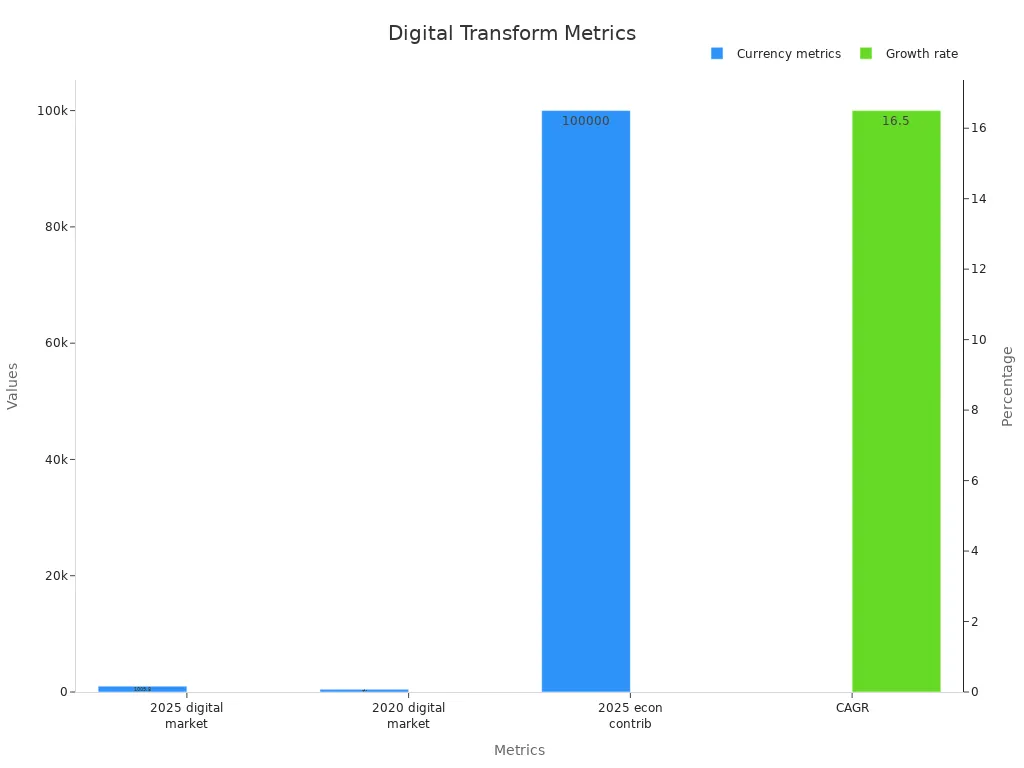
Private enterprises in IT, finance, and professional services have adopted advanced technologies to streamline operations and meet evolving consumer demands. By fostering innovation, the private sector contributes to China's transformation into a global leader in technology-driven industries.
Promoting Sustainable and Inclusive Economic Growth
Sustainable economic development remains a central focus of private sector initiatives. Green financing, driven by private investments, has promoted environmentally friendly projects and capital accumulation. A 1% increase in the green financing market correlates with a 0.019% rise in green growth rates among OECD countries. In China, private enterprises have championed renewable energy projects, aligning with national goals for carbon neutrality by 2060.
|
Evidence Description |
Findings |
|---|---|
|
Impact of Green Financing Market Size |
A 1% increase in the green financing market correlates with a 0.019% increase in green growth rate in OECD countries. |
|
Role of Private Sector Investments |
Green financing contributes to capital accumulation through private sector investments, promoting environmentally friendly projects. |
By integrating social inclusion and sustainability into their operations, private enterprises ensure equitable growth that benefits all segments of society. These efforts not only strengthen China's economy but also position it as a model for sustainable economic development globally.
Strengthening Economic Resilience in China and Beyond
Economic resilience ensures a nation can withstand and recover from financial disruptions. The Ministry of Commerce has implemented strategies to strengthen resilience in China and extend its influence globally. These efforts focus on diversifying industries, fostering innovation, and building robust trade networks.
China's private sector plays a pivotal role in achieving economic stability. By encouraging businesses to adopt advanced technologies, the Ministry reduces dependency on traditional industries. For instance, renewable energy projects and digital transformation initiatives have created new revenue streams. These measures enhance the economy's ability to adapt to global challenges, such as fluctuating commodity prices or geopolitical tensions.
Trade diversification also bolsters resilience. The Ministry of Commerce has expanded partnerships with emerging markets, reducing reliance on a single trading partner. Agreements with countries in Africa, South America, and Southeast Asia have opened new opportunities for Chinese enterprises. This approach mitigates risks associated with economic downturns in specific regions.
Public-private partnerships (PPPs) further contribute to resilience. Collaborative projects in infrastructure, energy, and technology ensure sustainable development. For example, renewable energy PPPs have reduced environmental impact while creating jobs and fostering innovation. These partnerships demonstrate how cooperation between the public and private sectors can address complex challenges effectively.
The Ministry also prioritizes workforce development. Training programs equip workers with skills needed for evolving industries, ensuring a steady supply of talent. This focus on human capital strengthens the economy's foundation, enabling it to recover quickly from disruptions.
China's efforts to build economic resilience serve as a model for other nations. By fostering innovation, diversifying trade, and investing in human capital, the Ministry of Commerce ensures long-term stability and growth.
Challenges and Solutions in Implementing Ministry of Commerce Initiatives
Overcoming Regulatory and Bureaucratic Barriers
Regulatory and bureaucratic barriers often hinder private sector growth by increasing operational costs and delaying business processes. The Ministry of Commerce addresses these challenges through targeted reforms aimed at enhancing governance and transparency. Key strategies include granting sufficient authority to eliminate unreasonable barriers, enacting laws to empower local institutions to analyze inefficiencies, and proposing rules to streamline administrative procedures.
For example:
-
Granting authority to remove illegal bureaucratic barriers fosters a more efficient business environment.
-
Empowering local institutions to identify and address inefficiencies ensures tailored solutions.
-
Proposing legislation to simplify processes reduces delays and operational costs.
A closer look at the impacts of regulatory oversight reveals both positive and negative outcomes:
|
Aspect |
Positive Impacts |
Negative Impacts |
|---|---|---|
|
Regulatory Oversight |
Increases trust and reduces fraud |
May lead to monopolistic protectionism |
|
Business Permitting |
Ensures safety and quality standards |
Causes delays and raises operational costs |
|
Market Stability |
Protects against systemic risks |
Limits flexibility and rapid responses |
In Bolivia, businesses spend approximately 1200 hours annually on conventional procedures, with over 2600 hours required to open a new business. These figures highlight the urgency of addressing bureaucratic inefficiencies to support private sector development.
Ensuring Effective Policy Implementation
Effective policy implementation is crucial for achieving the intended outcomes of Ministry of Commerce initiatives. Monitoring adherence to policies ensures compliance, while data-driven evaluations assess their effectiveness. Adjustments based on evaluation results further refine strategies to meet evolving needs.
The Ministry employs these metrics to evaluate the success of its initiatives. For instance, adherence monitoring ensures that policies align with their objectives, while feasibility assessments identify potential obstacles. By leveraging data-driven insights, the Ministry adapts its strategies to enhance governance and transparency across the state.
Bridging Public-Private Collaboration Gaps
Collaboration between public and private sectors is essential for addressing complex challenges and driving economic growth. The Ministry of Commerce fosters partnerships by creating platforms for dialogue, aligning goals, and sharing resources. Successful case studies illustrate the impact of these efforts:
|
Case Study |
Outcome Description |
|---|---|
|
Room for the River (Netherlands) |
50% reduction in flood risk and new recreational spaces |
|
Regional Workforce Development (Ontario) |
Employment rates for graduates rose from 60% to 85% |
|
Gavi (Global Alliance for Vaccines) |
Immunized over 888 million children since 2000 |
These examples demonstrate how collaboration bridges gaps and achieves shared objectives. In Ontario, workforce development initiatives increased employment rates for graduates, showcasing the potential of public-private partnerships to address labor market challenges. Similarly, the Netherlands reduced flood risks while creating recreational spaces, highlighting the versatility of collaborative approaches.
By fostering partnerships, the Ministry ensures that private enterprises contribute to national progress while benefiting from government support. This approach strengthens the state’s economic foundation and promotes sustainable development.
Adapting to Global Economic Trends and Challenges
The global economy faces rapid changes, requiring adaptive strategies to address emerging challenges. The Ministry of Commerce has implemented policies that align with these trends, ensuring the private sector remains resilient and competitive. By analyzing global economic shifts, the ministry identifies areas where businesses can adapt and thrive.
A variety of challenges influence the global economic landscape. These include disruptions caused by pandemics, shifts in consumer behavior, and geopolitical tensions. The table below outlines key economic challenges and their implications:
|
Economic Challenge |
Description |
|---|---|
|
Pandemic Aftershocks |
Disruption of supply chains and employment due to COVID-19, revealing systemic vulnerabilities. |
|
Shifts in Consumer Behavior |
Digital transformations altering market dynamics and consumer preferences. |
|
Geopolitical Tensions |
Conflicts and trade wars affecting global markets significantly. |
|
Cybersecurity Risks |
Increased vulnerability of financial institutions to cyber-attacks, destabilizing market functions. |
|
Climate Change |
Environmental disruptions necessitating reevaluation of sectors reliant on stable weather. |
|
Debt Burdens |
High levels of debt limiting fiscal policy options during crises. |
|
Adaptive Monetary Policies |
Central banks using flexible, data-driven adjustments to respond to economic changes. |
|
Fiscal Stimulus Innovation |
Targeted fiscal interventions to stimulate demand during downturns. |
|
Quantitative Easing (QE) |
Incorporating risk management strategies to prevent market distortions. |
The Ministry of Commerce ensures that the private sector adapts to these challenges by fostering innovation and encouraging digital transformation. For instance, businesses are incentivized to adopt technologies that enhance efficiency and meet evolving consumer demands. This approach strengthens the state’s ability to compete in global markets.
Geopolitical tensions and climate change also require proactive measures. The ministry promotes trade diversification to reduce reliance on specific regions. Additionally, it supports sustainable practices, enabling businesses to align with global environmental goals. These strategies not only mitigate risks but also position the state as a leader in sustainable economic development.
By addressing cybersecurity risks, the ministry ensures financial stability within the private sector. It collaborates with businesses to implement robust security measures, safeguarding critical infrastructure. This focus on resilience allows the state to navigate uncertainties and maintain economic growth.
The Ministry of Commerce’s adaptive policies demonstrate its commitment to supporting the private sector. By aligning with global trends, the ministry ensures that businesses remain competitive while contributing to the state’s long-term economic stability.
The Ministry of Commerce has demonstrated its pivotal role in advancing private sector development and driving sustainable economic growth. Its initiatives, such as e-commerce expansion, have transformed rural economies. For instance, studies by Zhang et al. (2022) and Chen et al. (2024) revealed significant income growth and structural changes in rural industries due to government-led projects.
|
Study |
Findings |
Link |
|---|---|---|
|
Zhang et al. (2022) |
Highlighted income growth and structural changes in rural industries. |
Link |
|
Chen et al. (2024) |
Showed the impact of e-commerce on rural household income. |
Link |
Continued collaboration between the government and private enterprises remains essential for sustained progress. Adaptive policies and innovative strategies will ensure long-term resilience, enabling the private sector to thrive in an evolving global economy.
FAQ
What is the role of the Ministry of Commerce in private sector development?
The Ministry of Commerce creates policies and initiatives that support private businesses. These include financial aid, market access, and innovation programs. By fostering a favorable business environment, the ministry ensures sustainable growth and competitiveness for enterprises.
How do small and medium-sized enterprises (SMEs) benefit from these initiatives?
SMEs gain access to low-interest loans, training programs, and digital transformation subsidies. These resources help them expand operations, adopt new technologies, and compete in global markets. The ministry also integrates SMEs into international value chains, boosting their growth potential.
Why are public-private partnerships (PPPs) important for economic growth?
PPPs combine government oversight with private sector efficiency. They address infrastructure needs, create jobs, and foster innovation. By sharing risks and resources, these partnerships deliver sustainable solutions that benefit both businesses and communities.
How does the Ministry of Commerce promote innovation in the private sector?
The ministry funds research and development, enforces competition laws, and establishes innovation hubs. These efforts encourage businesses to invest in new technologies, enhancing productivity and global competitiveness.
What challenges does the Ministry face in implementing its initiatives?
The ministry encounters regulatory barriers, bureaucratic inefficiencies, and global economic shifts. It addresses these issues through policy reforms, streamlined processes, and adaptive strategies to ensure effective implementation and sustained progress.
Related content