
Understanding the Evolution of Fnac
Author:XTransfer2025.09.17Fnac
Fnac began as a members-only discount club in 1954, focusing on providing affordable products to its customers. Over the decades, the company demonstrated remarkable growth and adaptability.
-
In its first year, Fnac generated 50 million old francs in revenue.
-
By 1969, Fnac had 580 employees and opened its second store in Paris.
-
In 1980, the company employed over 2,700 people and achieved a turnover of FFr 2.2 billion.
-
By 1996, revenues exceeded FFr 10 billion, reflecting its expanding presence in the retail sector.
Fnac captured significant market shares in France, including four percent of record sales and ten percent of photo equipment sales.
This evolution of Fnac highlights its ability to adapt to market changes and meet customer needs.
The Origins of Fnac

Founding and Early Vision
Fnac began its journey in 1954 when Max Théret and a group of individuals founded the company. Their vision was to create a retail experience that prioritized consumer advocacy and accessibility. The founders believed in fostering a relationship of freedom and responsibility between vendors and consumers. This principle shaped the company’s early operations and set the foundation for its growth.
"Freedom and responsibility" became more than just a slogan; it defined the company’s approach to customer service and product offerings.
The founders aimed to challenge traditional retail practices by offering transparency and fairness. This innovative mindset attracted attention and established Fnac as a unique player in the market.
|
Year |
Founder(s) |
Purpose |
Key Principles |
|
1954 |
Max Théret and a group of individuals |
To create a retail experience focused on consumer advocacy and accessibility |
Freedom and responsibility in vendor-consumer relationship |
Initial Business Model
Fnac’s initial business model revolved around a members-only discount club. Customers paid a membership fee to access discounted prices on a range of products. This approach allowed the company to build a loyal customer base while maintaining competitive pricing.
The company also emphasized quality control. Products underwent rigorous testing to ensure they met high standards before being sold. This commitment to quality helped Fnac gain trust among its members and differentiate itself from other retailers.
Early Customer Base
Fnac’s early customer base consisted of individuals who valued affordability and transparency. Many of these customers were professionals and enthusiasts seeking reliable products at fair prices. The company’s focus on consumer advocacy resonated with this audience, fostering a sense of community among its members.
As the company grew, its reputation attracted a broader demographic. Fnac became a go-to destination for cultural and electronic products, appealing to customers from various backgrounds. This diverse customer base played a crucial role in the company’s expansion and success.
Key Milestones in the Evolution of Fnac
Expansion into New Product Categories
Fnac's growth has been marked by its ability to diversify its offerings. Initially focused on cultural products like books and music, the company expanded into electronics, photography equipment, and home appliances. This strategic move allowed Fnac to cater to a broader audience and meet the evolving needs of its customers.
In the 1990s, Fnac introduced computer products and software, recognizing the growing demand for technology. This decision positioned the company as a leader in the retail sector, offering a mix of cultural and electronic products under one roof. By the early 2000s, Fnac had also ventured into gaming, further solidifying its reputation as a comprehensive retailer.
Fnac's ability to adapt its product categories to market trends has been a cornerstone of its success.
The company's focus on quality and innovation ensured that each new category met customer expectations. This approach not only attracted new customers but also strengthened loyalty among existing ones.
Technological Advancements
Technology has played a pivotal role in the evolution of Fnac. The company embraced digital transformation early, leveraging technology to enhance its operations and customer experience.
One of the most notable advancements was the formation of SplitGames between 2005 and 2008. This online marketplace allowed Fnac to compete with e-commerce giants like Amazon. In 2012, the founding of Mirakl marked another significant milestone. Mirakl enabled businesses to launch their own marketplaces, showcasing Fnac's commitment to innovation.
|
Year |
Innovation Description |
|
2005-2008 |
Formation of SplitGames, an online marketplace acquired by Fnac to compete with Amazon. |
|
2012 |
Founding of Mirakl to enable businesses to launch their own marketplaces. |
|
2013 |
Launch of the first dropship platform with El Corte Inglès. |
|
2014 |
Launch of the first B2B marketplace with Retif. |
|
2015 |
Establishment of U.S. office to prioritize North American markets. |
|
2019 |
Launch of Mirakl Connect to enhance seller and partner ecosystems. |
|
2022 |
Launch of Mirakl Payout and acquisition of Octobat and Target2Sell for digitization support. |
|
2023 |
Launch of Mirakl Ads, a solution for retail media in eCommerce. |
These advancements highlight Fnac's proactive approach to staying ahead in the competitive retail landscape. By integrating technology into its business model, the company has enhanced its efficiency and customer engagement.
Strategic Partnerships and Mergers
Strategic collaborations have been instrumental in Fnac's growth. The company has formed partnerships and pursued mergers to strengthen its market position and expand its reach.
In 2016, Fnac merged with Darty, a leading electronics retailer in France. This merger created one of the largest retail groups in Europe, combining the strengths of both companies. The partnership allowed Fnac to offer a wider range of products and services, enhancing its value proposition to customers.
The Fnac-Darty merger exemplifies how strategic alliances can drive growth and innovation.
Additionally, Fnac has collaborated with various technology providers to improve its digital capabilities. These partnerships have enabled the company to offer cutting-edge solutions, ensuring it remains competitive in the ever-changing retail environment.
Fnac's strategic approach to partnerships and mergers underscores its commitment to growth and innovation. By aligning with like-minded organizations, the company has successfully navigated challenges and capitalized on opportunities.
Transformation in the Digital Era
Adapting to E-Commerce
The evolution of fnac in the digital era showcases its ability to adapt to the rapidly changing retail landscape. As e-commerce gained prominence, fnac embraced online platforms to meet consumer demands. The company launched initiatives to attract new users and enhance its digital presence.
-
A recent campaign by fnac Darty brought over 400,000 new visitors to its website.
-
More than 70% of this traffic came from first-time internet users.
-
The cost per visit remained under 0.25€, demonstrating the efficiency of its digital marketing strategies.
The French e-commerce market is projected to grow significantly, from 500 billion USD in 2024 to 1,200 billion USD by 2035, with an annual growth rate of 8.284%. Fnac's proactive approach positions it to capitalize on this trend. The company also recognizes the importance of convenience, as 67% of French consumers prioritize ease of shopping online. Personalized shopping experiences further enhance customer satisfaction, aligning with modern consumer expectations.
The French Competition Authority (FCA) highlighted the merging of online and in-store sales channels. This shift compelled fnac to integrate e-commerce strategies into its operations. The company adapted by combining online and offline sales data, reflecting the growing trend of omnichannel shopping. Consumers often research products online before purchasing them in-store or vice versa. Fnac's ability to align with these behaviors underscores its commitment to staying relevant in the digital age.
Overcoming Retail Challenges
The retail sector has faced numerous challenges in recent years, including increased competition from e-commerce giants and changing consumer habits. Fnac tackled these obstacles by evolving its business model and embracing innovation.
The analysis of consumer behavior revealed a shift towards omnichannel shopping. Many customers engage in "Research Online, Purchase Offline" (ROPO) and "showrooming" behaviors. Fnac responded by integrating its in-store and online sales models. This approach ensures a seamless shopping experience, catering to customers who use both channels.
Additionally, fnac focused on maintaining competitive pricing and offering exclusive deals. These strategies helped the company retain its customer base while attracting new shoppers. By leveraging its strong brand reputation and adapting to market trends, fnac successfully navigated the challenges of the retail industry.
Innovations in Customer Engagement
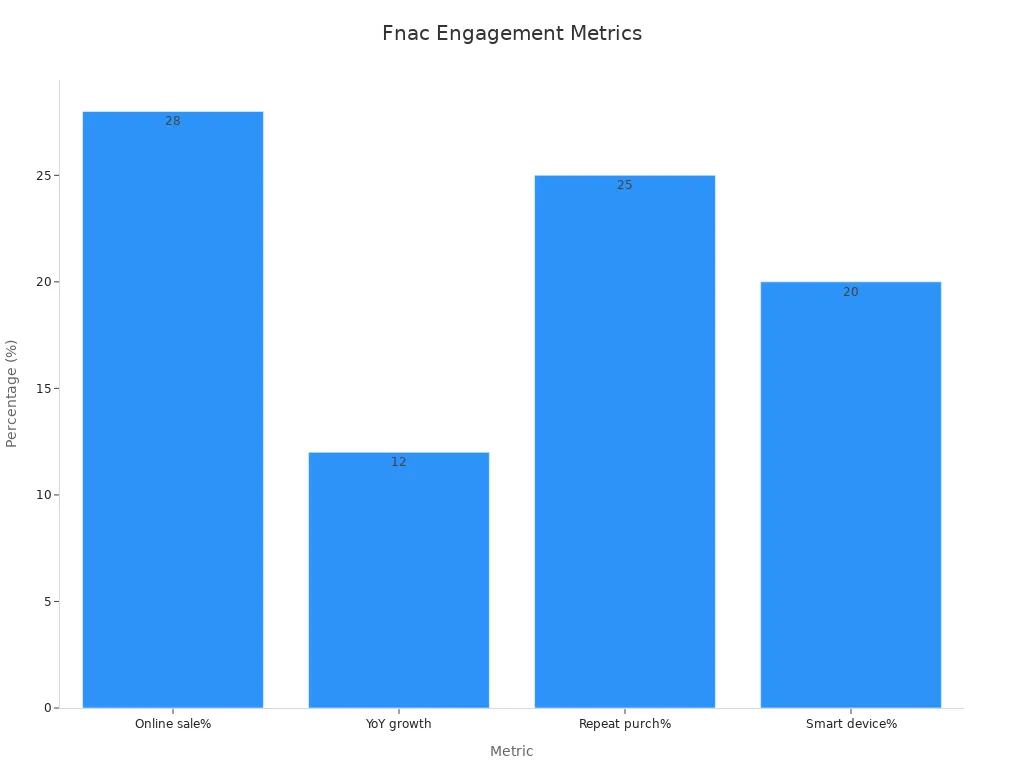
Fnac has introduced several innovations to enhance customer engagement. The company leverages technology to create personalized experiences and foster loyalty.
|
Metric |
Value |
|
Online sales percentage |
28% (up from 21% in 2022) |
|
Monthly online users |
4 million (2023) |
|
Year-on-year growth in online revenue |
12% |
|
Loyalty program members |
1.2 million (first year) |
|
Increase in repeat purchases |
25% |
|
Additional revenue from loyalty program |
€70 million (2023) |
|
Smart devices sales percentage |
20% (in electronics division, 2022) |
Fnac's loyalty program has been a key driver of customer retention. In its first year, the program attracted 1.2 million members, generating €70 million in additional revenue. Repeat purchases increased by 25%, highlighting the program's effectiveness.
The company also collaborated with tech giants like Google and Amazon to integrate voice recognition and smart device compatibility. Smart devices accounted for over 20% of total sales in the electronics division in 2022. These partnerships demonstrate fnac's commitment to staying at the forefront of technological advancements.
By embracing digital tools and fostering innovation, fnac has strengthened its relationship with customers. The company's focus on personalization and convenience ensures it remains a leader in the retail sector.
Fnac's Current Role in the Market
Product and Service Offerings
Fnac offers a diverse range of products and services, catering to various customer needs. Its portfolio includes consumer electronics, books, and other cultural products. Consumer electronics contribute €4.18 billion, accounting for 55% of total sales. Books generate €2.05 billion, representing 27%, while other products make up the remaining 18%.
The company’s omnichannel strategy has strengthened its retail operations. In 2024, in-store sales reached nearly 72 million transactions, a 1.5% increase from 2023. Online sales grew by 2.2%, making up 22% of total sales. Omnichannel sales accounted for 52% of online transactions, reflecting Fnac's focus on integrating physical and digital platforms.
Loyalty programs play a crucial role in customer retention. Over 6 million members benefit from exclusive deals and personalized services. This approach enhances customer satisfaction, which reached 82% in 2023.
Competitive Position
Fnac maintains a strong position in the competitive retail market. Its pricing strategies and multi-channel approach differentiate it from competitors. The company uses consumer sensitivity analysis to identify products with high price elasticity. This insight helps optimize margins and adjust prices effectively.
Market position mapping allows Fnac to time price adjustments strategically. Channel strategy differentiation further supports targeted promotions, ensuring the company remains competitive. These efforts highlight Fnac's ability to adapt to market dynamics and meet customer expectations.
Global Presence and Future Prospects
Fnac operates over 700 stores worldwide, showcasing its extensive reach. E-commerce sales accounted for 42% of total revenue in 2021, emphasizing the company’s digital transformation. Investments in advanced technology systems have improved operational efficiency, reducing stock discrepancies by 15%.
The company’s future prospects look promising. Revenue reached €7.5 billion in 2022, with a net income of €140 million. Fnac’s focus on innovation and customer engagement positions it for continued growth. By leveraging its global presence and adapting to market trends, the company aims to strengthen its leadership in the cultural and electronic retail sectors.
Fnac's journey reflects its remarkable ability to adapt and innovate. Starting as a niche discount club, it evolved into a global leader in cultural and electronic retail. The company consistently embraced change, meeting customer needs and staying ahead of market trends. Its focus on quality, technology, and customer engagement has solidified its position in the industry. Fnac's story serves as a testament to resilience and forward-thinking strategies, inspiring businesses worldwide.
Fnac's historical evolution showcases how adaptability and innovation can drive long-term success.
FAQ
What does Fnac specialize in?
Fnac specializes in cultural, electronic, and digital products. Its offerings include books, music, consumer electronics, and gaming products. The company also provides services like loyalty programs and omnichannel shopping experiences, which enhance customer satisfaction and engagement.
How has Fnac adapted to the rise of e-commerce?
Fnac embraced e-commerce by launching online platforms and integrating omnichannel strategies. It combined online and in-store sales data to provide seamless shopping experiences. These efforts allowed the company to stay competitive in the digital retail landscape.
What role do loyalty programs play in Fnac's success?
Loyalty programs play a significant role in Fnac's success. They attract millions of members, increase repeat purchases, and generate additional revenue. These programs also enhance customer satisfaction by offering exclusive deals and personalized services.
How has Fnac expanded its product categories over time?
Fnac initially focused on cultural products like books and music. Over time, it expanded into electronics, photography equipment, gaming, and home appliances. This diversification allowed the company to cater to a broader audience and meet evolving customer needs.
What is Fnac's global presence like today?
Fnac operates over 700 stores worldwide and has a strong e-commerce presence. Its global reach and investments in technology have positioned the company as a leader in the cultural and electronic retail sectors.
Related content