
The Evolution of Mercado Libre in Latin America's Market
Author:XTransfer2025.09.16Mercado Libre
Mercado Libre has transformed how you shop and sell in Latin America. As the region's largest e-commerce platform, it connects millions of buyers and sellers every day. In 2022 alone, over 1.1 billion products were sold on the platform, reflecting its massive reach. Its financial growth is equally impressive, with sales soaring to $10.5 billion that year. By offering tools like Mercado Pago, it has made online transactions secure and accessible for 64 million users monthly. This innovation has solidified its role as the digital backbone of the region, empowering businesses and individuals alike.
The Origins of Mercado Libre
Founding and Early Vision
Mercado Libre began its journey in 1999, founded by Marcos Galperin in Argentina. His vision was to create a digital marketplace that could connect buyers and sellers across Latin America. At the time, the region was experiencing a surge in internet users, growing from 18 million in 2000 to over 122 million by 2007. This rapid growth, at an annual rate of 32%, highlighted the need for an online platform to meet the demands of a tech-savvy population.
The company also recognized the potential of the rising middle class in countries like Brazil and Argentina. These consumers sought better retail options, and Mercado Libre aimed to fulfill this demand. By 2003, the platform introduced Mercado Pago, a payment system designed to address the lack of reliable online payment infrastructure. This innovation, along with a buyer/seller feedback system, helped build trust and set the foundation for its success.
Overcoming Initial Challenges
Starting an e-commerce platform in Latin America came with unique challenges. Poor internet connectivity, limited access to banking services, and a lack of trust in online transactions were significant hurdles. Mercado Libre tackled these issues head-on by investing heavily in technology and logistics.
In its early years, the company secured $550 million in investments, creating 900 new jobs. These funds were allocated to key areas such as logistics, technological innovation, and financial services. This strategic focus allowed Mercado Libre to overcome barriers and establish itself as a reliable platform for users across the region.
|
Investment Amount |
Job Creation |
Focus Areas |
|
$550 million |
900 |
Logistics, Technological Innovation, Financial Services |
Expansion Across Latin America
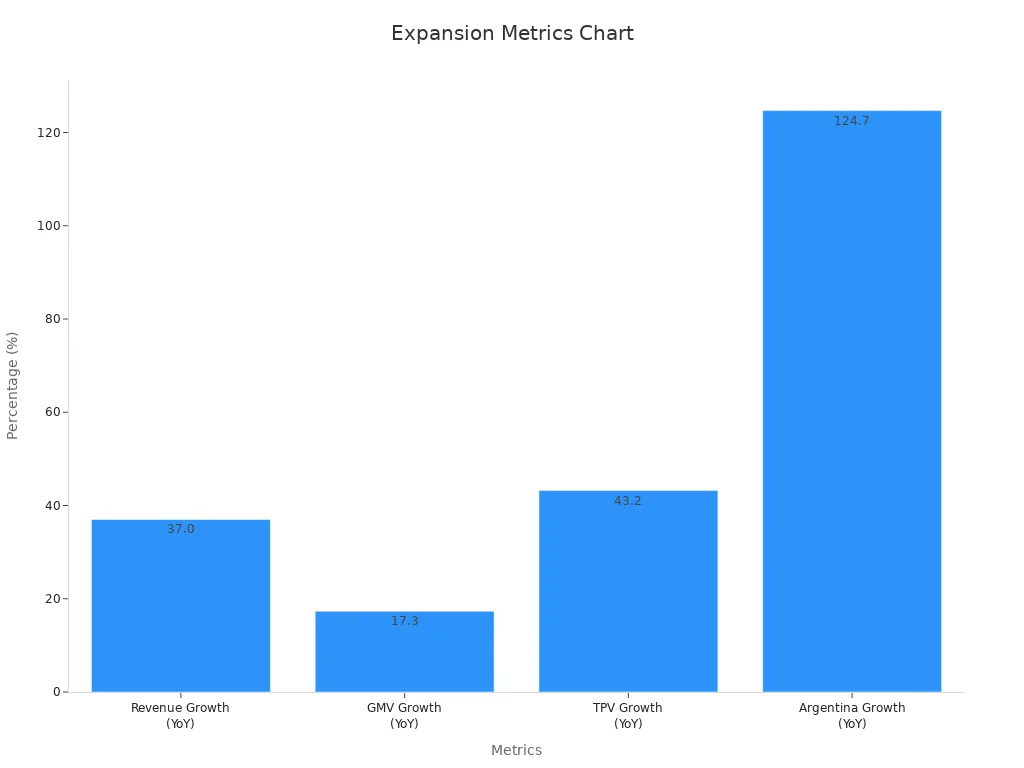
Mercado Libre's expansion strategy has been nothing short of remarkable. Over the past three years, the company achieved a compounded annual growth rate of 41.3% in sales. This growth reflects its ability to adapt to the diverse needs of Latin American markets.
The platform has also seen significant year-on-year growth in key metrics:
-
Revenue growth: 37.0%
-
Gross merchandise volume (GMV) growth: 17.3%
-
Total payment volume (TPV) growth: 43.2%
In Argentina alone, Mercado Libre generated $1.4 billion in revenue, marking a 124.7% year-on-year increase. The company also added 13.5 million unique active users, representing a 25.2% growth. These achievements underscore its position as the largest company in Latin America’s e-commerce sector.
Mercado Libre’s ability to scale its operations while addressing regional challenges has cemented its reputation as a leading marketplace in the region.
Strategies That Made Mercado Libre a Leader

Addressing Regional Consumer Needs
Understanding the unique needs of consumers has been a cornerstone of Mercado Libre's strategy. You can see this in how the platform has tailored its services to meet the demands of different regions. For instance, in cities like São Paulo and Rio de Janeiro, delivery times are nearly three times faster than those of competitors. In Mexico City, delivery speeds are 30% faster, while in Guadalajara, they are almost double. These improvements reflect a deep commitment to enhancing the customer experience.
Mercado Libre has also focused on building trust, a critical factor in e-commerce marketplaces. By introducing features like buyer and seller feedback systems, the platform has created a transparent environment. This approach has encouraged more users to engage confidently. Additionally, the company’s advertising revenue grew by 37% year-over-year, outpacing the overall gross merchandise volume growth of 14%. This growth highlights the platform's ability to attract and retain a loyal customer base.
Leveraging Innovation and Technology
Mercado Libre's success is closely tied to its use of technology and innovation. The platform has consistently invested in digital transformation to stay ahead in the competitive e-commerce landscape. For example, its digital payment system, Mercado Pago, has evolved into a comprehensive ecosystem. This system now generates over $2 billion in annual revenue, making it a vital part of the marketplace's growth.
The company has also embraced cutting-edge tools to improve user experiences. By using WhatsApp to send relational Net Promoter Score (NPS) surveys, Mercado Libre increased response rates from 2% to 25%. This strategy provided valuable insights into seller experiences, enabling the platform to refine its services. Furthermore, the focus on customer experience has led to a 10-15 point improvement in NPS, showcasing the effectiveness of its technology-driven approach.
Adapting to Latin America's Diversity
Latin America is a region of immense cultural and economic diversity. Mercado Libre has succeeded by adapting its strategy to address this complexity. The platform recognizes that what works in one country may not work in another. For example, the company has tailored its logistics network to suit the unique challenges of each market. This adaptability has allowed it to maintain its market leadership across the region.
The platform’s ability to cater to diverse consumer preferences has also played a significant role in its marketplace growth. By offering localized solutions, Mercado Libre has strengthened its position as a trusted e-commerce platform. Its efforts have not only boosted consumer confidence but also contributed to the digital transformation of the region.
Mercado Libre’s strategies—addressing consumer needs, leveraging technology, and adapting to diversity—have solidified its reputation as a leader in e-commerce marketplaces. These approaches continue to drive its success and set it apart in the competitive landscape.
Building Trust Through Mercado Pago
Mercado Pago has revolutionized how you approach digital payments in Latin America. As Mercado Libre's financial arm, it has become a cornerstone of the platform's success by fostering trust and security in online transactions. You rely on it not just for convenience but for peace of mind when making payments.
One of the key reasons Mercado Pago stands out is its ability to handle massive transaction volumes. The platform has seen remarkable growth in payment volume, reflecting its widespread adoption. Millions of users now actively engage with Mercado Pago, making it one of the most trusted fintech solutions in the region.
Security measures implemented by Mercado Pago go beyond basic protections. The platform employs cutting-edge fraud detection systems that continuously monitor transactions. These systems identify risks and prevent fraudulent activities before they occur. By prioritizing your safety, Mercado Pago has earned its reputation as a reliable payment solution.
The trust you place in Mercado Pago stems from its commitment to transparency and innovation. Its data-driven approach not only enhances security but also builds confidence among users. Whether you're buying products on Mercado Libre or using the platform for other digital payments, you can count on Mercado Pago to safeguard your financial information.
Mercado Pago's success is a testament to how fintech can transform the way you interact with money. By combining technology with a focus on user trust, it has set a benchmark for digital payments in Latin America. As you continue to embrace e-commerce, Mercado Pago ensures that your transactions remain secure and seamless.
Mercado Libre as the Digital Backbone of Latin America

Empowering Small and Medium Enterprises (SMEs)
Mercado Libre has become a lifeline for small and medium enterprises (SMEs) across Latin America. By providing a robust marketplace, it enables you to reach millions of potential customers without the need for a physical storefront. This accessibility has leveled the playing field, allowing smaller businesses to compete with larger corporations.
The platform offers tools that simplify your business operations. For example, you can use its analytics dashboard to track sales performance and identify trends in the market. These insights help you make informed decisions, ensuring your business stays competitive. Additionally, Mercado Libre’s advertising solutions allow you to promote your products effectively, driving more traffic to your listings.
Through its logistics network, Mercado Libre ensures that your products reach customers quickly and reliably. This efficiency not only enhances customer satisfaction but also boosts your revenue. SMEs that partner with Mercado Libre often experience significant growth, as the platform provides the infrastructure needed to scale operations.
Enhancing Logistics and Infrastructure
Mercado Libre’s logistics network is the backbone of its success. The company has invested heavily in infrastructure to ensure fast and reliable deliveries. With 22 logistics centers spread across Latin America, it can handle an annual shipping volume of 350 million packages. This scale allows you to enjoy delivery speeds of just 1-2 days in major cities.
|
Logistics Metric |
Performance |
|
Delivery Speed (Major Cities) |
1-2 days |
|
Logistics Centers |
22 |
|
Annual Shipping Volume |
350 million packages |
|
Average Delivery Time |
2.1 days |
|
Fulfillment Coverage |
85% of target markets |
|
Logistics Efficiency Improvement |
42% |
The logistics network is designed to adapt to the unique challenges of each market. For instance, in remote areas, Mercado Libre partners with local delivery services to ensure coverage. This adaptability has improved logistics efficiency by 42%, making it one of the most reliable systems in the region.
By focusing on infrastructure, Mercado Libre has not only enhanced its own operations but also set a benchmark for the e-commerce industry. Its logistics network ensures that you, as a customer or seller, can rely on timely and efficient deliveries.
Boosting Economic Growth in the Region
Mercado Libre’s impact on Latin America’s economy is profound. By creating opportunities for businesses and individuals, it has become a key driver of economic growth. In Q2 2024 alone, the platform generated $12.6 billion in gross merchandise volume, marking a 20% year-over-year growth.
|
Metric |
Q2 2024 Value |
YoY Growth |
|
Gross Merchandise Volume |
$12.6 billion |
20% (83% FX-neutral) |
|
Total Payment Volume |
$46.3 billion |
36% (86% FX-neutral) |
|
Unique Active Buyers |
56.6 million |
19% |
|
Fintech Monthly Active Users |
50+ million |
37% |

The platform’s fintech arm, Mercado Pago, has also contributed significantly to the region’s financial inclusion. With over 50 million monthly active users, it has made digital payments accessible to a broader audience. This accessibility has empowered more people to participate in the digital economy, further driving growth.
Mercado Libre’s role as the digital backbone of Latin America extends beyond commerce. By fostering innovation and creating jobs, it has become a catalyst for economic development. Its contributions to the region’s growth are a testament to the transformative power of e-commerce.
The Future of E-Commerce in Latin America
AI Integration in E-Commerce
Artificial intelligence is reshaping how you interact with e-commerce platforms. Mercado Libre and other marketplaces are leveraging AI to enhance your shopping experience. AI tools analyze your preferences and recommend products tailored to your needs. This personalization increases convenience and boosts sales.
Generative AI is also transforming the marketplace. Over 54% of companies now use this technology to create product descriptions, chatbots, and marketing campaigns. These innovations save time and improve accuracy. By 2025, the global e-commerce sector impacted by AI is projected to reach $8.65 billion, growing at a compound annual growth rate (CAGR) of 14.60%.
|
Statistic |
Value |
|
Percentage of e-commerce businesses working on AI solutions |
84% |
|
Expected global e-commerce sector value impacted by Generative AI |
$5.920 trillion |
AI doesn’t just enhance your shopping experience; it also improves logistics. Algorithms optimize delivery routes, reducing costs and environmental impact. As AI adoption grows, you can expect faster deliveries and more efficient operations across Latin America’s marketplaces.
Expanding Social Commerce
Social commerce is becoming a vital part of the future of e-commerce. Platforms like Mercado Libre are integrating social media features to help you shop directly from your favorite apps. This trend is driven by the time you spend on social media and the convenience of buying products without leaving the platform.
The social commerce market in Latin America is growing rapidly. From 2021 to 2024, it achieved a CAGR of 27.0%. By 2030, its value is expected to rise from USD 12.17 billion to approximately USD 27.92 billion. Fintech solutions like Brazil’s Pix payment system are making transactions faster and more secure, further boosting this sector.
-
The competitive landscape in e-commerce is driving innovation in social commerce.
-
Services like "buy-now-pay-later" are increasing accessibility for larger purchases.
-
The integration of digital wallets is reducing reliance on cash.
Social commerce is not just about convenience; it’s about creating a community. You can interact with sellers, read reviews, and share your experiences, making the marketplace more engaging and trustworthy.
Sustainability and Green Logistics
Sustainability is shaping the future of e-commerce logistics. Mercado Libre and other platforms are adopting green practices to reduce their environmental impact. Carbon footprint measurements help optimize transport and minimize emissions. Packaging waste is being reduced through recyclable materials, ensuring eco-friendly deliveries.
|
Metric |
Indicator |
|
Carbon Emissions |
CO₂ per delivery or ton-mile |
|
Energy Efficiency |
Fuel and electricity consumption |
|
Packaging Waste |
Use of recyclable materials |
|
Route Optimization |
Reducing miles per delivery |
|
Sustainable Transportation |
Electric vehicles and alternative fuels |
Green logistics also include reverse logistics, which manage returns efficiently to reduce waste. By incorporating electric vehicles and optimizing delivery routes, marketplaces are balancing sustainability with profitability. These efforts ensure that your purchases contribute to a greener future.
As e-commerce grows, sustainability will remain a priority. Platforms like Mercado Libre are setting benchmarks for ethical and eco-friendly logistics, ensuring that the future of e-commerce aligns with environmental goals.
Navigating Challenges and Opportunities
E-commerce in Latin America faces both challenges and opportunities as it continues to grow. You may notice that cross-border e-commerce (CBEC) is becoming more common, but it brings unique hurdles. Regulatory compliance and customs controls often slow down transactions. These factors can create delays and increase costs for businesses and consumers alike. Addressing these issues requires innovative solutions.
Technological advancements are reshaping the e-commerce landscape. Digitalization and platform-based business models are reducing transaction costs. Digital payment solutions are also becoming more widespread, making it easier for you to shop online. These innovations improve logistics efficiency, which is essential for overcoming the challenges of CBEC. Faster and more reliable deliveries benefit both buyers and sellers.
Opportunities in e-commerce are vast. The adoption of scalable technologies allows businesses to expand their reach. For example, companies can now use advanced tools to analyze customer behavior and tailor their offerings. This personalization enhances your shopping experience and builds customer loyalty. Additionally, the mass adoption of digital payments has opened doors for millions of unbanked individuals to participate in the digital economy.
To navigate these challenges, businesses must focus on improving logistics. Efficient delivery systems reduce costs and ensure customer satisfaction. Companies that invest in infrastructure and technology will likely lead the market. As a consumer, you benefit from these advancements through faster deliveries and better service.
The future of e-commerce in Latin America depends on balancing these challenges with opportunities. By addressing regulatory hurdles and embracing innovation, the industry can continue to thrive.
Mercado Libre has revolutionized how you shop and sell in Latin America. Its journey from a small startup to the region’s largest e-commerce platform showcases its ability to adapt and innovate. By addressing consumer needs and investing in technology, it has become the digital backbone of the region.
You can see its impact in the way it empowers businesses, enhances logistics, and drives economic growth. As e-commerce evolves, Mercado Libre is well-positioned to lead the way. Its focus on AI, social commerce, and sustainability ensures that it will continue shaping the future of online shopping in Latin America.
FAQ
What makes Mercado Libre’s logistics network so efficient?
The logistics network uses advanced technology to optimize delivery routes. With 22 logistics centers, it ensures fast shipping for over 350 million packages annually. You benefit from delivery speeds of 1-2 days in major cities, making it one of the most reliable systems in Latin America.
How does Mercado Libre contribute to the digital economy?
Mercado Libre empowers businesses and individuals by providing tools for online transactions and e-commerce. Its integrated ecosystem, including Mercado Pago, enables you to participate in the digital economy, fostering financial inclusion and driving economic growth across the region.
Can small businesses thrive on Mercado Libre?
Yes, Mercado Libre offers tools like analytics dashboards and advertising solutions to help you grow your business. Its logistics network ensures reliable deliveries, while its marketplace connects you with millions of potential customers, leveling the playing field for small businesses.
How does Mercado Libre ensure secure transactions?
Mercado Pago uses advanced fraud detection systems to monitor transactions. It analyzes data to identify risks and prevent fraud. This proactive approach ensures that your payments remain secure, building trust among users.
What role does Mercado Libre play in sustainability?
The platform adopts green logistics practices, such as route optimization and recyclable packaging. By using electric vehicles and reducing emissions, it aligns with environmental goals while ensuring efficient deliveries for you.
Related content