
Why the Tajikistani Somoni (TJS) Remains One of the Least Known Currencies in the World
Author:XTransfer2025.08.20TJS
The Tajikistani somoni is one of the least known currencies in the world. Most people do not see the tjs currency outside of Tajikistan. The tajikistani somoni is not well known for a few reasons. Tajikistan has a small economy and low average income. Many people in Tajikistan depend on money sent from other countries. The country sells goods worth about 1.6 billion USD but buys even more from other places. Not much trade or tourism happens with other countries, so the tjs currency does not spread around the world. Only a few people outside Tajikistan use the tajikistan somoni, so the tjs stays mostly unknown.
Highlights
-
The Tajikistani Somoni is mostly used in Tajikistan. People outside the country do not know or use it much. Tajikistan has a small economy and does not trade a lot. Not many tourists visit, so the Somoni is not popular in other places. The Somoni shows special cultural symbols. These symbols make people in Tajikistan feel proud and together. There are strict banking rules in the country. Economic problems also make it hard to exchange Somoni in other countries. It is also hard to use it for big business deals. Not many people know about the Somoni around the world. But Tajikistan wants to grow its economy. This could help more people learn about the Somoni later.
History of the Tajikistan Somoni
Origins and Introduction
The story of the tajikistan somoni started when Tajikistan was changing a lot. After the civil war ended in 1997, the country wanted a fresh start. In October 2000, the government brought in the somoni. It took the place of the Russian rouble as the main currency. This helped Tajikistan try to fix its economy after hard times. Banks had many problems, like high interest rates and people not trusting them. Some banks got help from groups like the IMF and World Bank. Money sent home by workers in other countries was very important for the country. During the war, the government stopped selling state property, but this started again after peace. Bringing in the tajikistani somoni was a big step for the country. It helped people feel more stable and proud of their nation.
The somoni became the main currency when Tajikistan was very poor compared to other former Soviet countries. The economy relied on selling cotton and aluminum. The country had a hard time with outside problems and slow growth. The somoni’s value has stayed weak because of issues like corruption and needing money from workers abroad.
Naming and Symbolism
The word "somoni" comes from Ismail Samani, who started the Samanid dynasty. He is a symbol of pride and culture for Tajik people. The tajikistan somoni shows important people and symbols on its coins and bills. These pictures show the country’s long history and culture.
|
Denomination |
Type |
Depicted Figure(s) / Design Elements |
|
1 Somoni |
Coin |
Mirzo Tursunzoda and National Bank of Tajikistan |
|
5 Somoni |
Coin |
Sadriddin Ayni and Shrine of Abuabdullo Rudaki |
|
100 Somoni |
Banknote |
Ismoil Somoni |
|
500 Somoni |
Banknote |
Abu Abdullo Roudaki |
The official currency has images of poets, scientists, and famous places. For example, the 100 somoni note has Ismoil Somoni on it. Other notes show Mirzo Tursunzoda and Rudaki. These choices show how much culture and history matter in the tajikistan somoni’s design. The pictures and symbols on the money help people feel proud and united. The tajikistani somoni is still the country’s main currency. It stands for Tajikistan’s path to being strong and independent.
TJS Currency in Use
Domestic Circulation
People in Tajikistan use the tajikistan somoni every day. They pay for food, bus rides, and bills with it. Most stores and markets only take the somoni. The tjs currency is made of coins and banknotes. There are coins for 1, 3, and 5 somoni. Smaller coins are called diram coins. Banknotes go from 1 to 500 somoni. Most people use cash to pay for things. This is even more true in small towns and villages. In big cities like Dushanbe, some people use digital payments. Still, cash is used the most. People cannot use US dollars or Russian roubles to buy things. The tajikistan somoni keeps the country’s economy working well. People trust the tjs currency for their daily needs.
International Recognition
The tjs currency does not go far outside Tajikistan. Only Tajikistan uses the tajikistan somoni as its official currency. No other country takes the somoni for trade or exchange. When people send money to or from Tajikistan, they use the US dollar or euro. The tjs currency can be used for some international money transfers through SWIFT, but this is rare. Most banks outside Tajikistan do not exchange the tajikistani somoni. The National Bank of Tajikistan controls all currency exchanges. Only a few banks can exchange the tjs currency, and they must follow strict rules. Tajikistan’s banks do not have direct links with US banks. This makes it even harder to exchange somoni. People who travel outside Tajikistan need to change their money before leaving. The tjs currency mostly stays inside the country. This is why it is one of the least known currencies in the world.
Tajikistan’s Global Role
Economic Isolation
Tajikistan is cut off from the world economy in many ways. The country has tough rules about foreign money. People have trouble getting foreign currency. Banks let people take out only small amounts. In 2015, the government shut down private exchange offices. Now, only banks can change money, and people must show ID each time. State-owned enterprises are very important in the economy. These companies control half of all loans and much of what the country makes. They do not follow world business rules and are not open about what they do. Investors worry because the law helps people with government ties. The banking system has many bad loans and people do not trust banks. Many use informal ways to manage money, so the official system stays weak. The Central Asian Stock Exchange does not have clear rules or good checks. This makes both local and foreign investors feel uneasy.
|
Factor |
Description |
|
Limited foreign currency |
Hard to get and withdraw foreign money from banks |
|
Centralized exchange controls |
Only banks can exchange money; strict rules and ID checks |
|
Dominance of SOEs |
SOEs control much of the economy; lack transparency and global standards |
|
Weak legal enforcement |
Courts favor the government; unclear rules; investors lack confidence |
|
Banking sector challenges |
Many bad loans; some banks are insolvent; people do not trust banks |
|
Poor market transparency |
Stock exchange lacks clear rules and oversight |
|
Taxation and financial policies |
All money coming in is taxed; no policies to help free flow of money |
|
Lack of international standards |
Weak rules for accounting and business; political influence over SOEs |
Trade and Tourism
Tajikistan does not trade much with other countries. In early 2025, it sold goods worth about $452.6 million. But it bought goods worth about $1.64 billion. This means it buys more than it sells. Its trade numbers are lower than its neighbors. Most trade is in raw materials like cotton and aluminum. Finished goods and technology come from other countries.
|
Period |
Exports of Goods (USD) |
Imports of Goods (USD) |
|
2025 Q1 |
~$452.6 million |
~$1.64 billion |
Tourism is still new in Tajikistan. In 2018, just over 1 million tourists came to visit. Most visitors are skilled travelers who want to see the mountains and nature. Tourism made about $102.4 million in 2020, but this dropped during Covid-19. The country is still a secret spot, and not many tourists come. Because of this, the somoni is not well known outside Tajikistan. Most tourists bring their own money and only change a little for local use.
-
In 2018, just over 1 million tourists visited.
-
Tourism made about $102.4 million in 2020.
-
Most visitors are experienced travelers.
-
The tourism industry is growing but still small.
-
The somoni is still not well known outside Tajikistan.
Why the Tajikistani Somoni Is Little Known
Comparison with Major Currencies
Most people know about the US dollar, euro, or Japanese yen. These currencies show up in movies and news. People use them for travel and trade. The tjs does not get this kind of attention. The tjs is only used in Tajikistan. No other country lets you shop with it. You cannot use tjs when you travel. Banks in other countries do not keep tjs.
Tajikistan’s economy is small. This helps explain why the tjs is not well known. Even other small countries have more known money. The table below shows how Tajikistan and Kyrgyzstan compare:
|
Indicator |
Tajikistan (2019 est.) |
Kyrgyzstan (2019 est.) |
|
GDP (Purchasing Power Parity) |
Approx. $33.9 billion (2010 $) |
Approx. $31.5 billion (2017 $) |
|
GDP (Official Exchange Rate) |
$2.522 billion |
$8.442 billion |
|
GDP per capita (PPP) |
About $3,380 (2017 $) |
About $5,253 (2010 $) |
|
GDP Growth Rate (Real) |
Around 7% |
Around 4.6% |
|
Public Debt (% of GDP) |
About 50% |
About 56% |
|
Economic Reliance |
Heavy on remittances, agriculture, natural resources |
Similar economic structure |
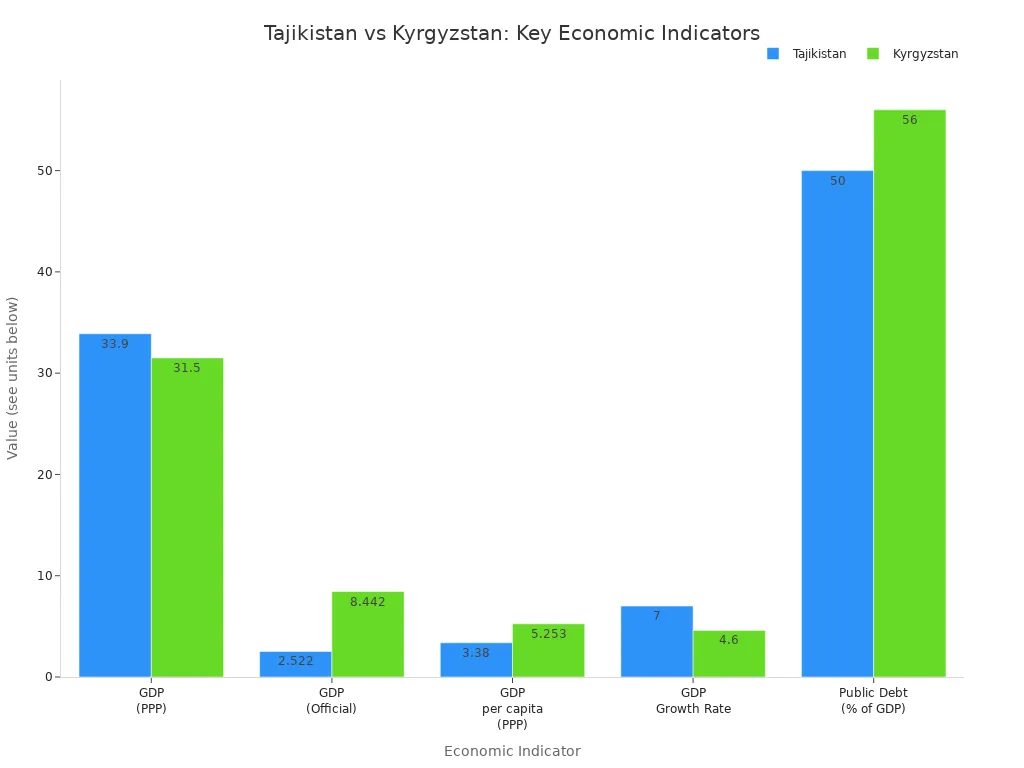
Tajikistan’s GDP is much lower than Kyrgyzstan’s. Both countries depend on money from workers abroad. They also sell raw materials. This makes their money less important worldwide. The tjs is not as strong as big currencies.
Foreign exchange traders and banks think the tjs is risky. They do not trust it much. Here are some reasons why:
-
They say the official exchange rate is too low. Banks often run out of foreign money, so people use the black market.
-
The black market rate is worse than the bank rate. For example, you might get 7 somoni per dollar on the street, but only 6.23 at the bank.
-
Traders face risks but keep trading because people need foreign money.
-
The government closed private exchange offices and checks for rule breakers.
-
Economists say the black market hurts the tjs and scares investors.
-
Tajikistan has a low rank for corruption, which worries investors.
-
The National Bank spends a lot to keep the tjs stable, but experts are unsure if this will work.
-
Most traders and banks think the tjs is unstable and not good for big deals.
The tjs does not have the trust or use that big currencies have. Its small economy and weak rules keep it out of the spotlight.
Media and Cultural Impact
The tjs almost never shows up in movies or books. People outside Tajikistan do not see the tjs in daily life. News stories about money rarely talk about the tjs. Most people learn about money from the media. The tjs does not get this kind of attention.
Tourists bring dollars or euros when they visit. They use tjs only for small things. When they leave, they cannot use tjs anywhere else. This keeps the tjs hidden from the world. Even global finance news does not talk about the tjs much.
Social media and pop culture matter too. People post pictures of dollars, euros, or yen online. The tjs is not in these posts. Young people in Tajikistan may think other currencies are cooler. The tjs stays local and does not become famous.
The tjs is one of the least known currencies because it does not appear in global media or culture. People outside Tajikistan almost never see it.
The Tajikistani Somoni is not well known. This is because Tajikistan has a small economy. The country does not trade much with others. Not many tourists visit Tajikistan. Problems in politics and banks also keep the currency alone. Some new changes give hope for the future:
|
Factor |
Description |
|
GDP Growth Projection |
8.4% growth in 2025 from trade, investment, and higher gold export prices |
|
Economic Outlook |
Positive growth drivers may strengthen the Somoni’s recognition |
-
The government wants more investment and teamwork with neighbors.
-
Big projects like the Roghun Dam hope to help energy and bring stability.
Even with these plans, the TJS will likely stay unknown outside Tajikistan.
FAQ
What is the symbol for the Tajikistani Somoni?
The symbol for the Tajikistani Somoni is ЅМ. People also see the code TJS at banks and exchanges. The National Bank of Tajikistan uses both the symbol and the code.
Can travelers exchange Somoni outside Tajikistan?
Most banks outside Tajikistan will not exchange Somoni. Travelers should change their money before they leave. Only a few exchange offices in nearby countries take Somoni.
What are the main denominations of the Somoni?
|
Coins (Somoni) |
Banknotes (Somoni) |
|
1, 3, 5 |
1, 5, 10, 20, 50, 100, 200, 500 |
People use coins and banknotes to buy things every day.
Why do most people outside Tajikistan not know about the Somoni?
Related content