
What is TRY Currency and How Does It Work
Author:XTransfer2025.07.25TRY
The Turkish lira, abbreviated as TRY currency, is the official currency of Turkey and Northern Cyprus, symbolized by ₺. It plays a vital role in Turkey's economy, influencing trade, daily transactions, and financial stability. While euros or dollars might be accepted in tourist areas, using TRY currency ensures smoother transactions. Recent economic measures, such as the Central Bank's interest rate increase to 50% in June 2023, reflect the importance of the TRY currency in managing inflation and promoting growth. As the backbone of Turkey’s financial system, the Turkish lira remains essential for both locals and visitors.
What is the Turkish Lira (TRY)?
Overview of the Turkish lira as Turkey's official currency
The Turkish lira serves as the official currency of Turkey and Northern Cyprus. It is symbolized by ₺ and abbreviated as TRY. This currency is central to Turkey's financial system, facilitating trade, investments, and daily transactions. As the backbone of the economy, the Turkish lira plays a crucial role in maintaining financial stability.
You will find the Turkish lira in various denominations, making it versatile for both small and large transactions. Coins and banknotes are widely used across the country. While foreign currencies like the euro or dollar may be accepted in tourist areas, the Turkish lira ensures smoother and more reliable transactions. This makes it essential for anyone engaging with Turkey's economy.
The Turkish lira also holds significance in international markets. The Turkish Lira Overnight Reference Interest Rate (TLREF) has gained recognition as a reliable benchmark. Unlike LIBOR, which relies on quotations, TLREF reflects actual transaction volumes. This reliability strengthens the lira's position in global financial systems.
Importance of the Turkish lira in Turkey's economy and trade
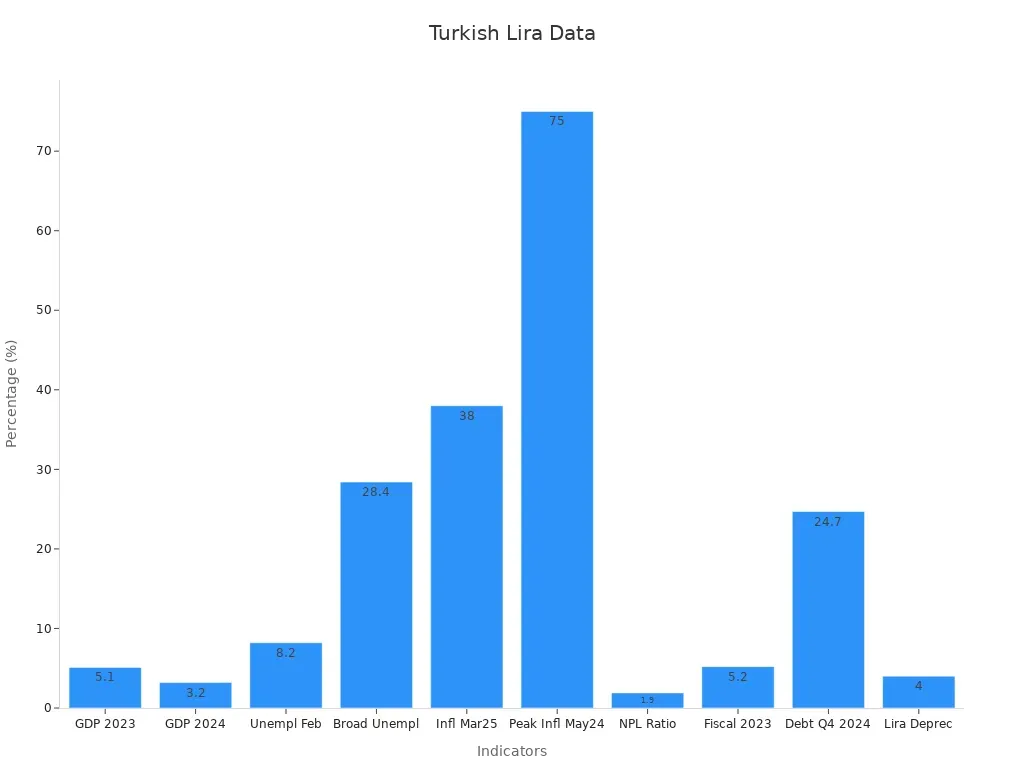
The Turkish lira directly impacts Turkey's economy and trade. It influences inflation, purchasing power, and consumer behavior. High inflation rates, which peaked at 75% in May 2024, have challenged the lira's value. However, recent measures aim to stabilize the currency and restore confidence.
Turkey's trade balance also highlights the lira's importance. A persistent current account deficit, such as $39.9 billion in 2023, underscores the need for foreign investment. This reliance on external funding affects the demand for the lira in global markets. Political factors and economic policies further shape the currency's performance.
Here is a table summarizing key economic metrics related to the Turkish lira:
|
Metric |
Value |
|
GDP Growth (2023) |
5.1% |
|
GDP Growth (2024) |
3.2% |
|
Unemployment Rate (February) |
8.2% |
|
Broad Unemployment Rate |
28.4% |
|
Current Account Deficit (2024) |
$10 billion (0.8% of GDP) |
|
Current Account Deficit (2023) |
$39.9 billion (3.6% of GDP) |
|
Inflation Rate (March 2025) |
38% |
|
Peak Inflation Rate (May 2024) |
75% |
|
Non-Performing Loan Ratio |
1.9% |
|
Fiscal Deficit (2023) |
5.2% of GDP |
|
Public Debt-to-GDP (Q4-2024) |
24.7% |
|
Net Reserves (February 2024) |
$65 billion |
|
Lira Depreciation (April 2025) |
4% |
The Turkish lira's role in commerce is undeniable. It facilitates exports and imports, ensuring the smooth flow of goods and services. Despite challenges, the currency remains a cornerstone of Turkey's economic activities.
A Brief History of the Turkish Lira
Origins of the Turkish lira and its introduction in 1844
The Turkish lira first appeared in 1844, marking a pivotal moment in Turkey's financial history. It replaced the Ottoman kuruş as the primary currency, simplifying trade and commerce. This change reflected the country's efforts to modernize its economy during the Ottoman Empire's Tanzimat reform era.
The lira also became a symbol of Turkey's cultural identity. Banknotes featured images of historical figures and landmarks, showcasing the nation's rich heritage. Over time, the currency underwent several revaluations to adapt to economic shifts and maintain its value against foreign currencies. These adjustments highlight the lira's resilience in the face of changing financial landscapes.
Key milestones, including the redenomination in 2005
The Turkish lira has experienced significant milestones throughout its history. One of the most notable events occurred in 2005 when the government introduced the "New Turkish Lira" (YTL). This redenomination removed six zeros from the currency, addressing the hyperinflation that had plagued Turkey for decades. For example, 1,000,000 old lira became 1 new lira. This change simplified transactions and restored confidence in the currency.
In 2009, the "New" prefix was dropped, and the currency returned to being called the Turkish lira. This transition marked a fresh start for Turkey's economy. The redesigned banknotes and coins introduced during this period included advanced security features, ensuring their authenticity and reducing counterfeiting risks. These updates reinforced the lira's role as a stable and reliable currency.
The Turkish lira's journey reflects Turkey's economic evolution. From its introduction in 1844 to the redenomination in 2005, the currency has adapted to meet the country's changing needs. Understanding this history helps you appreciate the lira's significance in Turkey's financial system.
How Does TRY Currency Work?
Denominations of TRY: Banknotes and coins
The Turkish lira comes in a variety of denominations, making it convenient for different types of transactions. You’ll find six banknotes in circulation: 5 lira, 10 lira, 20 lira, 50 lira, 100 lira, and 200 lira. These banknotes are used for larger purchases and payments. Coins, on the other hand, are available in smaller denominations: 1 kuruş, 5 kuruş, 10 kuruş, 25 kuruş, 50 kuruş, and 1 lira. Coins are ideal for small transactions, such as buying snacks or paying for public transportation.
When using TRY currency, you’ll notice that the denominations are designed to meet the needs of everyday life. Banknotes are commonly used for shopping, dining, and other expenses, while coins are perfect for quick, low-value payments. This range of denominations ensures that you can handle both minor and major transactions with ease.
Security features of TRY banknotes
Turkish lira banknotes include advanced security features to protect against counterfeiting. When you examine a banknote, you’ll see a watermark that becomes visible when held up to the light. This watermark often displays an image of Mustafa Kemal Atatürk, the founder of modern Turkey. Another feature is the security thread embedded within the paper. It appears as a shiny strip running vertically through the note.
You’ll also notice color-shifting ink on certain parts of the banknote. This ink changes color when viewed from different angles, making it harder to replicate. Additionally, microtext and holographic elements add extra layers of security. These features ensure that TRY currency remains trustworthy and reliable for daily use.
By understanding these security measures, you can confidently use Turkish lira without worrying about counterfeit notes. Always check for these features when handling cash to ensure its authenticity.
Practical Tips for Using TRY Currency
Understanding exchange rates and fluctuations
Exchange rates determine how much one currency is worth compared to another. When you buy Turkish lira, the exchange rate for Turkish lira tells you how much of your home currency you need to exchange. These rates fluctuate daily due to factors like economic policies, inflation, and global market trends.
To get the best value, monitor exchange rates before your trip. Currency exchange platforms or apps can help you track these fluctuations in real time. Avoid exchanging money at airports or tourist hotspots, as they often charge higher fees. Instead, look for banks or reputable exchange offices offering competitive rates.
If you're traveling to Turkey, understanding exchange rates ensures you know how much cash you'll need for your expenses. This knowledge helps you plan your budget and avoid overspending.
Where to obtain TRY: Banks, ATMs, and currency exchange offices
You can buy Turkish lira from several reliable sources. Banks are a safe option for obtaining TRY currency, offering fair rates and secure transactions. ATMs are widely available across Turkey, allowing you to withdraw cash directly in Turkish lira. Most ATMs accept international cards, making them convenient for travelers.
Currency exchange offices are another popular choice. These offices are located in major cities, airports, and tourist areas. They often provide competitive rates, but always check for hidden fees before exchanging money.
When withdrawing or exchanging money, opt for smaller denominations. Coins and lower-value banknotes are useful for everyday transactions, such as buying snacks or paying for public transportation. Carrying a mix of denominations ensures you’re prepared for any situation.
Payment methods in Turkey: Cash vs. card
In Turkey, both cash and card payments are widely accepted. Cash is essential for small transactions, especially in local markets, street vendors, and rural areas. Approximately 30% of transactions in Turkey are made using cash, highlighting its importance for everyday purchases.
Payment cards, including credit and debit cards, account for over 50% of transactions. Urban areas and larger establishments, such as restaurants and shopping malls, often prefer card payments. Cards are convenient for larger expenses and provide added security compared to carrying large amounts of cash.
When deciding how much cash to carry, consider your itinerary. If you plan to visit rural areas or shop at local markets, keep enough cash on hand. For urban areas, cards are a practical choice. Balancing cash and card usage ensures you’re prepared for any payment scenario.
Using XTransfer Exchange Rate Platform for real-time currency queries.
When managing currency exchanges, having access to accurate and real-time data is essential. The XTransfer Exchange Rate Platform offers a reliable solution for monitoring currency fluctuations. Whether you're a traveler, a business owner, or someone managing personal finances, this platform simplifies the process of staying updated on exchange rates.
Why Choose XTransfer?
XTransfer stands out for its user-friendly interface and precise currency data. It provides real-time updates, ensuring you always know the current value of the Turkish lira (TRY) against other currencies. This feature helps you make informed decisions, whether you're exchanging money, planning a budget, or analyzing financial trends.
Here are some key benefits of using XTransfer:
-
Real-Time Accuracy: The platform updates rates instantly, reflecting the latest market conditions.
-
Ease of Use: Its intuitive design makes it accessible, even for first-time users.
-
Global Reach: XTransfer supports multiple currencies, making it ideal for international transactions.
How XTransfer Enhances Financial Management
The platform's real-time currency data can significantly improve your financial planning. For example, businesses can use XTransfer to manage cash flow more effectively. By separating operating factors from currency fluctuations, you can create more accurate cash flow forecasts. This clarity helps you allocate resources wisely and avoid unexpected financial shortfalls.
Additionally, XTransfer supports constant currency reporting. This feature ensures that revenue and operating income reflect actual performance without distortions caused by exchange rate changes. Whether you're analyzing profits or preparing financial reports, XTransfer provides the tools you need for precise calculations.
The table below highlights how XTransfer impacts key financial metrics:
|
Performance Metric |
Impact of Real-Time Currency Conversion |
|
Revenue Growth |
Enables accurate reporting of operational performance without currency distortions. |
|
Operating Income |
Reflects actual performance through constant currency reporting. |
|
Cash Flow Management |
Improves accuracy in cash flow forecasts by separating operating factors from currency fluctuations. |
Practical Applications for Travelers
If you're visiting Turkey, XTransfer can help you determine the best time to exchange your money. By monitoring fluctuations in the Turkish lira, you can maximize the value of your home currency. The platform also allows you to compare rates across different currencies, ensuring you get the best deal.
For added convenience, use XTransfer alongside mobile banking apps. This combination lets you track your spending, manage your budget, and avoid unnecessary fees. With XTransfer, you gain the confidence to handle currency exchanges like a pro.
By incorporating XTransfer into your financial toolkit, you can navigate currency exchanges with ease. Whether you're managing a business or planning a trip, this platform ensures you stay informed and prepared.
The Turkish lira plays a vital role in Turkey's economy and daily life. Its rich history, from its introduction in 1844 to the 2005 redenomination, reflects its resilience. Understanding exchange rates is crucial for managing your finances effectively. Factors like inflation, interest rates, and government policies influence these rates.
|
Factor |
Explanation |
|
Balance of payments |
A deficit leads to a rise in foreign exchange rates, causing currency depreciation. |
|
Interest rate level |
Higher domestic interest rates attract capital inflow, increasing demand for domestic currency. |
|
Inflation factor |
Higher inflation reduces purchasing power, leading to currency depreciation against lower inflation. |
When traveling, carry small denominations for convenience and avoid high conversion fees by using tools like XTransfer for real-time rates.
FAQ
1. What is the best way to exchange money for Turkish lira?
You should exchange money at banks or reputable currency exchange offices. These places offer fair rates and secure transactions. Avoid exchanging money at airports or tourist hotspots, as they often charge higher fees.
2. Can you use foreign currencies in Turkey?
Yes, euros and dollars are accepted in tourist areas. However, using Turkish lira ensures smoother transactions, especially in local markets and rural areas. Carrying lira helps you avoid confusion and unnecessary fees.
3. Are credit cards widely accepted in Turkey?
Credit cards are accepted in urban areas, restaurants, and shopping malls. Cash is preferred for small transactions and rural areas. Carry both cash and cards to handle different payment situations.
4. How can you check the authenticity of TRY banknotes?
Examine the watermark, security thread, and color-shifting ink on the banknotes. These features protect against counterfeiting. Always check these elements when handling cash.🛡️ Note: If unsure, ask a local bank to verify the note's authenticity.
5. How do exchange rates affect your travel budget?
Exchange rates determine how much foreign currency you receive for your money. Fluctuations can impact your expenses. Monitor rates before your trip to plan your budget effectively.💡 Tip: Use platforms like XTransfer for real-time updates on exchange rates.
Related content