
“More Expensive Than the US Dollar? Unveiling the Hidden Secrets of the Jordanian Dinar (JOD)”
Author:XTransfer2025.08.20JPY
Yes, the Jordanian Dinar costs more than the US Dollar. The current rate shows 1 JOD equals about 1.41 USD, with the exchange rate remaining steady through 2024. People notice a similar pattern when looking at the usd to kes values. The current rate for usd to kes often changes, but the kes currency has shown small fluctuations. For example, the current rate for 1 JOD to KES averages around 182.29. The table below highlights recent usd to kes and kes currency rates in Kenya, showing a stable trend in the exchange rate.
|
Period |
Exchange Rate (1 JOD to KES) |
Notes |
|
Last 6 months |
~182.2953 KES |
Average rate |
|
Highest |
183.4800 KES |
Peak value in last 6 months |
|
Lowest |
181.3270 KES |
Lowest in last 6 months |
Highlights
-
The Jordanian Dinar is strong because it is tied to the US Dollar. This makes its value steady and easy to guess. Jordan has low inflation and strict money rules. The country also has a lot of foreign reserves. These things help keep the Dinar safe and the economy stable. Travelers like the steady exchange rate. They can plan their budgets easily. They save money by using banks or exchange offices. Hotels and airports often cost more. Businesses trust the Dinar because it does not change quickly. They can plan investments and trade without worry. The Dinar is strong because of smart economic choices and peace in Jordan. It is not strong because of oil or natural resources.
JOD vs. USD
Exchange Rate Overview
The Jordanian Dinar is special in the world of money. Its value compared to the US Dollar has stayed the same for a long time. In 2025, 1 JOD is worth about 1.41 USD. This number does not change much. The Central Bank of Jordan keeps the JOD tied to the USD. This means the bank buys and sells US dollars to keep the value steady.
The Central Bank of Jordan has kept the JOD tied to the USD since 1950. This helps make the exchange rate steady and easy to guess for travelers and businesses.
The table below shows how much the Jordanian Dinar can buy compared to the US Dollar in the world market:
|
Currency |
Country |
Code |
Exchange Rate (2025) |
Rank |
|
Jordanian Dinar |
Jordan |
JOD |
1 JOD = 1.41 USD |
1 |
The JOD is one of the strongest currencies in the world. Its value almost never changes, even when other currencies do. This helps Jordan keep its economy safe and lets people plan their money better.
What Makes JOD Expensive
There are many reasons why the Jordanian Dinar is worth more than the US Dollar. The value stays high because the Central Bank of Jordan uses smart money rules. Jordan also keeps a lot of foreign money to pay debts and keep the JOD strong.
-
The Jordanian Dinar is tied to the US Dollar, so its value does not change in the forex market.
-
Jordan’s economy is mixed. The country sells things like calcium phosphates and jewelry, not just oil.
-
The government uses good money plans to keep the economy safe.
-
Jordan is a peaceful country. This makes investors feel safe and keeps the value steady.
-
Prices in Jordan do not rise fast. In June 2025, inflation is about 2.02%. This low inflation helps the JOD keep its value against the USD.
-
Jordan sometimes has higher interest rates. This brings in money from other countries and helps the JOD stay strong.
-
The Central Bank of Jordan buys and sells US dollars to keep the value close to the set number.
Jordan’s money stays strong even though the country does not have a lot of oil. The tie to the US Dollar, low inflation, and peace all help keep the value high.
The value between the JOD and the USD shows why good planning is important. The current value shows that Jordan’s economy is strong and that people trust its money system. This also helps protect Jordan from big changes in the world money market.
KES Currency vs. USD
USD to KES Trends in 2025
The usd to kes exchange rate has shown a clear trend in recent years. In January 2024, the rate peaked at about 159.72 KES per USD. After this high point, the kes currency began to strengthen. By July 2025, the average usd to kes rate settled around 129.33 KES per USD. This marks a period of stability for the kes currency, with only minor changes each month.
The table below shows the usd to kes trend from early 2024 to mid-2025:
|
Month/Year |
Exchange Rate (KES per USD) |
|
Jan 2024 |
159.7159 |
|
Nov 2024 |
129.3335 |
|
Dec 2024 |
129.2907 |
|
Jan 2025 |
129.4328 |
|
Feb 2025 |
129.2369 |
|
Mar 2025 |
129.2561 |
|
Apr 2025 |
129.4759 |
|
May 2025 |
129.2903 |
|
Jun 2025 |
129.323 |
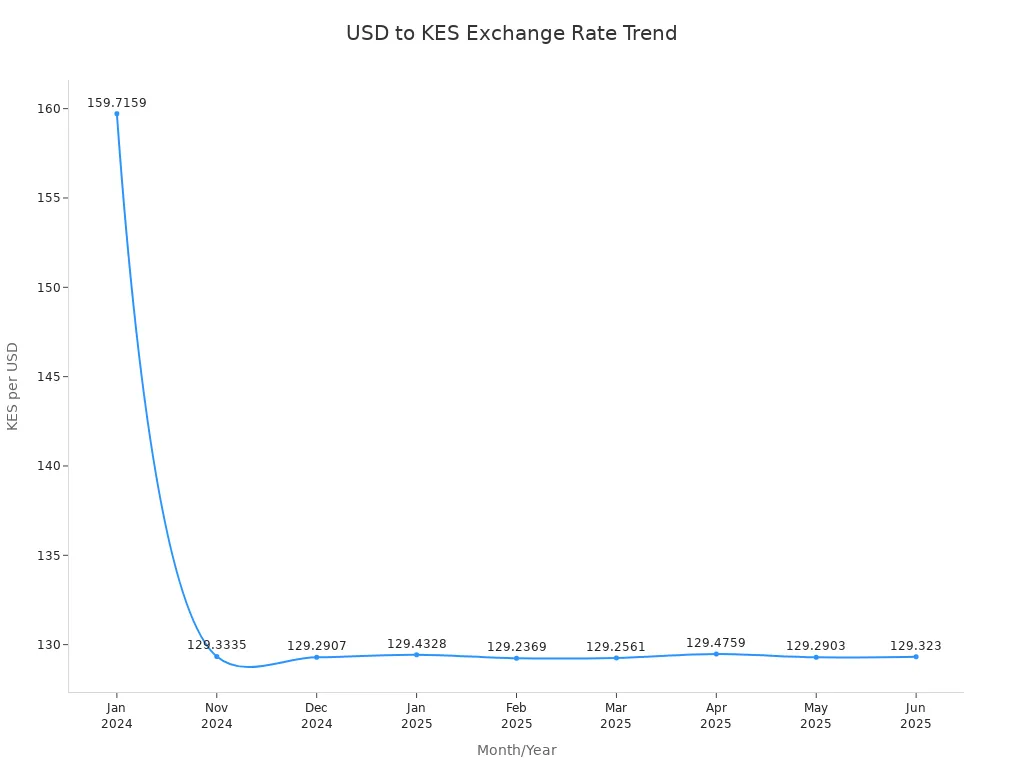
This chart highlights the sharp depreciation of the kes currency in early 2024, followed by a steady appreciation and stabilization. The usd to kes trend now shows limited volatility, which helps businesses and travelers plan better. The usd/kes forecast for the rest of 2025 points to continued shilling stability.
Factors Behind KES Strength
Several factors have helped the kes currency remain strong against the US Dollar. The Central Bank of Kenya (CBK) plays a key role in this process. In early 2025, the CBK lowered the Central Bank Rate to 10.75%. This move increased market liquidity and made Kenyan assets more attractive. The CBK also intervenes in the forex market by selling dollars to keep the usd to kes exchange rate stable.
Kenya’s foreign reserves reached a record $10.3 billion in May 2025. These reserves cover more than 4.5 months of imports. Strong reserves help the CBK manage the usd to kes rate and prevent sharp shilling depreciation. Remittances, export earnings, and loans from global partners have all boosted reserves.
Kenya’s current account deficit narrowed in 2024, thanks to higher exports and support from the IMF and World Bank. This improved investor confidence and reduced the risk of further depreciation.
The kes currency has benefited from careful monetary policy, strong reserves, and steady forex inflows. These actions have led to appreciation and shilling stability, making the kenyan shilling one of the more stable currencies in Africa. The trend suggests that Kenya will continue to see a stable usd to kes exchange rate, with less risk of sudden shilling depreciation.
Why JOD Stands Out
Monetary Policy Impact
The Jordanian Dinar is different from many other currencies. The Central Bank of Jordan uses careful rules to manage money. The bank watches interest rates and foreign reserves closely. It also checks the health of the financial system often. In September 2024, the Central Bank lowered interest rates by 0.5%. This helped lower inflation and kept the dinar steady. The bank grew its foreign exchange reserves from $18 billion in March 2022 to $20 billion in August 2024. These reserves act like a safety net for the country.
The central bank works hard to keep inflation low. In August 2024, inflation dropped to 1.9%. This helps protect the dinar’s value. It also helps people in Jordan buy what they need. The bank manages the interest rate margin, which fell to 2.24%. This is the lowest in 30 years. It shows that banks in Jordan are strong and stable.
Jordan’s economy does not depend on oil like some neighbors. Instead, it gets money from tourism, remittances, and foreign aid. The government uses smart spending and money rules to keep the dinar strong. The Central Bank of Jordan keeps the dinar tied to the US Dollar. This makes the dinar good for trade and investment.
|
Indicator/Action |
Description |
Impact on Jordanian Dinar |
|
Interest Rate Cut |
CBJ lowered rates by 50 basis points in Sept 2024 |
Helped stabilize the dinar and reduce inflationary pressures |
|
Foreign Exchange Reserves |
Increased from $18B (Mar 2022) to $20B (Aug 2024) |
Provides a strong buffer for stability |
|
Inflation Rate |
Fell from 5.4% (Sept 2022) to 1.9% (Aug 2024) |
Lower inflation supports currency strength and purchasing power |
|
Dollarisation |
Declined from 19.4% (Mar 2022) to 18.5% (July 2024) |
Strengthens confidence in the dinar |
|
Banking Sector Efficiency |
Interest rate margin narrowed to 2.24% |
Reflects improved financial sector stability |
|
Economic Growth |
2% growth in Q1 2024, expected 2.4% annual growth |
Economic growth underpins currency stability |
|
Trade Deficit |
Narrowed by 2.3% due to falling imports |
Improves balance of payments, supporting the dinar |
The Central Bank of Jordan sometimes raises interest rates to fight inflation. This makes the dinar more attractive to investors. By doing this, the bank takes extra money out of the market. This helps keep prices steady. Even when rates go up, the bank gives low-interest loans to local businesses. This helps businesses grow and keeps the economy active.
Jordan’s strong money rules, low inflation, and careful use of reserves make the dinar one of the most stable currencies in the area.
Currency Peg and Stability
The Jordanian Dinar has been tied to the US Dollar since 1995. The fixed rate is 1 USD equals 0.709 JOD. This peg keeps the currency steady. It helps people and businesses plan for the future. The fixed rate stops sudden changes in value. This attracts foreign investment and bank deposits.
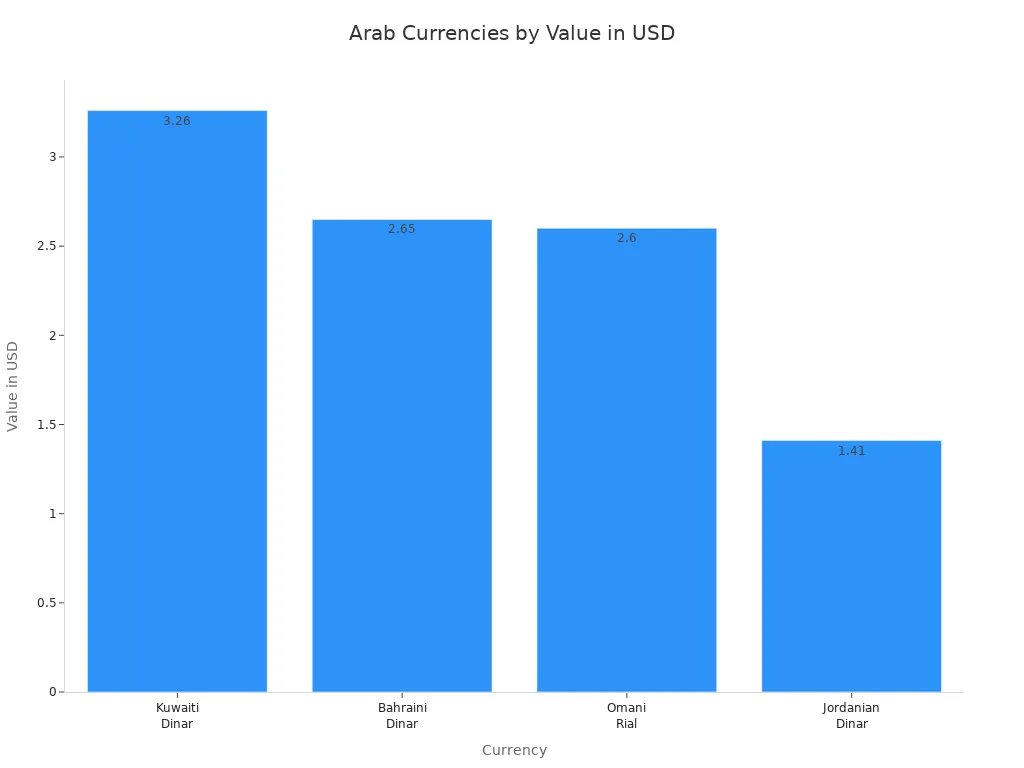
Here is how the Jordanian Dinar compares to other strong Middle Eastern currencies:
|
Currency |
Approximate Value in USD |
Rank Among Arab Currencies |
|
Kuwaiti Dinar |
$3.26 |
1 |
|
Bahraini Dinar |
$2.65 |
2 |
|
Omani Rial |
$2.60 |
3 |
|
Jordanian Dinar |
$1.41 |
4 |
The chart below shows the value of these currencies in US Dollars:
Jordan’s currency peg works in a few ways:
-
The Central Bank of Jordan ties the dinar to the US Dollar. This keeps the exchange rate steady.
-
The peg stops big swings in the currency’s value.
-
Investors feel safe because the dinar’s value does not change quickly.
-
The peg helps with trade, since the US is Jordan’s biggest supplier.
-
The fixed rate keeps banks stable, but it also means the bank cannot change policy easily during hard times.
Jordan’s fixed exchange rate has helped the country face tough times. These include regional problems and money crises. The peg made the currency more stable and brought in investment. But it also means the country cannot react quickly to things like inflation or recession. The government must use smart spending to keep the system working.
The Jordanian Dinar stays strong because of good central bank rules, a fixed peg to the US Dollar, and careful control of inflation and reserves. This keeps the currency steady, even when the country faces hard times.
Practical Implications
For Travelers
People who visit Jordan have some things to think about when they change money. The Jordanian Dinar has a set exchange rate of about 0.71 JOD for 1 USD. This means the value does not change quickly. Travelers do not have to worry about big changes in price. This makes it easier to plan and stick to a budget.
-
Banks and exchange offices give the best rates. You can find them at airports and borders. Hotels usually charge more money for exchanges.
-
Exchange offices are open longer than banks. Many do not ask for extra fees, especially in downtown Amman.
-
ATMs are easy to find and work with most credit cards. But using an ATM can cost extra, sometimes 3-4 JOD each time.
-
Paying in JOD is cheaper than using other money or cards. Many places take credit cards, but paying in USD or other money can cost more.
-
Airport and hotel exchanges often have bad rates and high fees. For example, if you change $100 at the airport, you might pay a $9 fee.
-
Travelers should use apps to check rates and try not to make many small exchanges. This helps save on extra fees.
Travelers can use these ideas to spend less and avoid problems. The set exchange rate also helps people guess prices when planning a trip.
For Businesses
Businesses in Jordan get help from the strong and steady JOD. The fixed link to the US Dollar makes trade and investment easier to plan. This steady value brings in investors from other countries because they see less risk.
-
The Central Bank of Jordan keeps enough foreign money to pay for over seven months of imports. This helps keep the JOD steady.
-
Many companies from other countries put money into Jordan’s roads and energy projects. Big projects like the $2.3 billion railway and solar plants show this.
-
The smaller current account gap and help from other countries make investors feel safer.
-
Businesses can plan ahead with more trust. They do not have to worry about the JOD losing value fast. This helps with setting prices and making long deals.
A steady currency lets businesses grow without worrying about exchange rate problems. This helps both local and foreign companies do well.
Hidden Secrets of JOD
Lesser-Known Factors
Most people do not know why the Jordanian Dinar is strong. There are some hidden reasons that help keep the JOD steady and valuable:
-
The Central Bank keeps the Jordanian Dinar tied to the US dollar. This peg is the main reason the currency does not change much.
-
Jordan’s leaders make careful choices about the economy. These choices help protect the currency from losing value fast.
-
The Central Bank works hard to keep money stable. This builds trust in the JOD and stops prices from rising too quickly.
-
Jordan has tough problems in its area and not many natural resources. The Dinar’s strength is special because of these limits.
-
Many investors believe in Jordan’s economy. Their trust helps the currency stay valuable and keeps its exchange rate high.
-
Jordan is in the Middle East and is a trade center. This good location helps the Dinar stay strong.
-
Money sent home by Jordanians and foreign aid are important. These inflows help the Dinar’s real value go up. They also help the economy and put pressure on the currency to rise, even though the exchange rate is fixed.
Myths and Misconceptions
Some people think the Jordanian Dinar is strong because Jordan has a lot of oil or resources. This is not true. Jordan does not have big oil reserves like some neighbors. The Dinar’s high value comes from good money management, steady rules, and the peg to the US dollar.
Another myth is that a high exchange rate means a country is rich or its money is always strong. In fact, the Dinar’s value is set by the Central Bank. The peg keeps the exchange rate steady and helps stop prices from rising too fast. The Dinar’s strength is not from market demand or resources, but from careful planning and trust in the money system.
Some people think the Dinar’s value will always go up or that it is easy to guess prices. But the fixed exchange rate means the Dinar does not change much against the US dollar. The Central Bank, not the market, decides its value.
The Jordanian Dinar is special for a few reasons.
-
It is always worth 1.41 US Dollars for each JOD.
-
Jordan is a peaceful country with safe banks. This helps keep the Dinar strong.
-
Jordan gets money from selling goods, people sending money home, and from other countries investing.
|
Country |
Inflation 2023 |
Inflation 2024 |
Inflation 2025 |
Trend |
|
Jordan |
4.2% |
3.6% |
3.3% |
Going down |
People who visit Jordan like that the JOD does not change much. Investors feel safe putting money in Jordan. The value of a currency is not just about numbers. You need to look closer to see what really makes a country’s money strong.
FAQ
What makes the Jordanian Dinar stronger than the US Dollar?
The Central Bank of Jordan keeps the dinar tied to the US Dollar. This peg, along with low inflation and strong reserves, helps the dinar stay valuable. Investors trust the system, which keeps the currency strong.
Can travelers use US Dollars in Jordan?
Most shops and restaurants in Jordan accept only the Jordanian Dinar. Some hotels and tourist spots may take US Dollars, but the exchange rate is not always good. Travelers should exchange money for better value.
Why does a high exchange rate not mean a country is richer?
A high exchange rate shows how much one currency is worth compared to another. It does not show a country’s wealth. The value depends on central bank policies, inflation, and trust in the currency.
How does the currency peg help Jordan’s economy?
Is the Jordanian Dinar likely to lose value soon?
Jordan’s central bank uses strong policies to protect the dinar. The peg to the US Dollar and high reserves make sudden drops unlikely. The dinar has stayed stable for many years.
Related content