
Key Insights on Transfer in Global Payment
Author:XTransfer2025.12.04Received
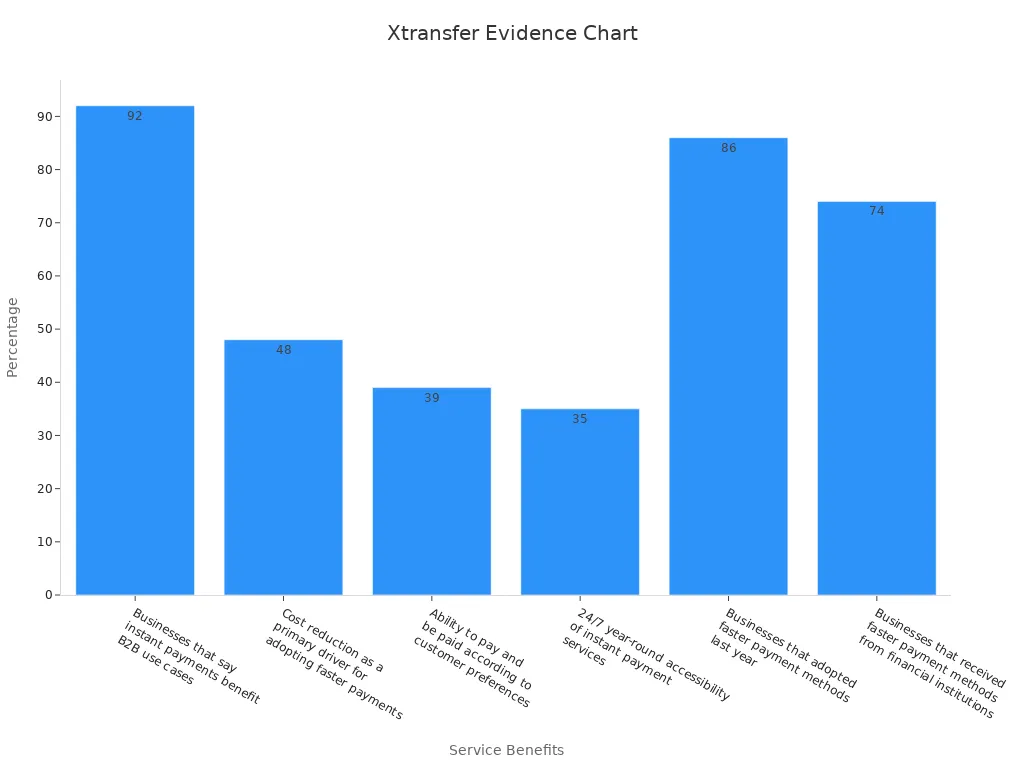
Efficient global payment transfers are vital for your business's success in today's interconnected world. Speed and accuracy in payments can enhance cash flow, improve supplier relationships, and boost customer trust. For instance, 73% of international companies rank payment speed as a top concern, while 92% report that faster payments positively impact their operations. Additionally, understanding global payment processes can help you navigate challenges like rising compliance costs, which over 98% of financial institutions face. By mastering these processes, you can optimize operations and stay ahead in a competitive market.
Understanding Global Payment Transfers

Definition and significance for businesses
Global payment transfers refer to the process of moving money across borders to facilitate transactions between businesses or individuals in different countries. These transfers are essential for businesses operating internationally, as they enable seamless trade and financial exchanges. According to the University of Minnesota, payment systems act as a medium of exchange, forming the backbone of global commerce. Martin (2015) further explains that these systems allow third-party acceptance of payments, which is crucial for international trade.
Understanding global payment transfers benefits your business in several ways. It helps you expand your market reach by accepting multiple currencies, ensures compliance with international regulations, and enhances fraud protection through advanced security measures. The table below highlights these benefits:
|
Benefit |
Description |
|---|---|
|
Facilitating International Trade |
Enables businesses to engage in cross-border transactions efficiently. |
|
Expanding Market Reach |
Allows businesses to offer products and services in various countries, accepting multiple currencies. |
|
Enhancing Fraud Protection |
Incorporates advanced security measures to reduce fraud risk and enhance transaction security. |
|
Ensuring Compliance |
Helps businesses adhere to international regulations, preventing illegal activities and ensuring transparency. |
Key players in global payment processing
The global payment processing ecosystem involves several key players, each contributing to the smooth flow of transactions. These include customers, merchants, issuers, acquirers, and card networks. Companies like PayPal, Square, Visa, and Mastercard dominate this space, driving innovation and efficiency. Analysts predict global payment revenues will reach $2.5 trillion by 2025, underscoring the importance of these players. Digital wallets and cards account for over 70% of e-commerce transactions, making them indispensable in global payment processing.
The role of currency exchange in international transactions
Currency exchange plays a pivotal role in international payments. Fluctuations in exchange rates can impact the cost of imports and exports, influencing trade dynamics. For example:
-
In 2022, inflation and interest rates significantly affected the pricing of goods and services in international markets.
-
Actions by the Federal Open Market Committee to stabilize domestic prices had global repercussions, altering trade balances.
By understanding currency exchange, you can better manage costs and mitigate risks in global payment transfers.
How Global Payment Processing Works
Steps involved in transferring money globally
Transferring money across borders involves several key steps to ensure accuracy and security. Here’s a simplified breakdown:
-
Gather Necessary Information: Collect the recipient's full name, address, bank account number, and SWIFT/BIC code.
-
Enter Recipient Details: Input this information into your global payment processor’s platform. Accuracy is critical to avoid delays.
-
Verify Transfer Details: Double-check the amount, currency, and recipient details.
-
Confirm and Send: Follow security prompts to finalize the transfer. Save the confirmation receipt for your records.
-
Track Your Transfer: Use the global payment processor’s tracking tools to monitor the status of your transaction.
|
Bank |
International Transfer Fee — Outgoing |
|---|---|
|
Bank of America |
Variable depending on account |
|
Chase |
Up to $50 |
|
Wells Fargo |
$35 — $45 |
The role of SWIFT and payment gateways
SWIFT and payment gateways play vital roles in global payment processing. SWIFT, a messaging network, connects banks worldwide to facilitate secure and standardized communication. It processes nearly 50 million messages daily, underscoring its importance in global payments.
Payment gateways, on the other hand, act as intermediaries between merchants and customers. They securely transmit payment data, ensuring smooth transactions. These gateways support various payment methods, including credit cards, digital wallets, and bank transfers. Their integration into global payment systems enhances efficiency and security.
Compliance and regulatory considerations
Compliance is a cornerstone of global payment processing. Businesses must adhere to both global and region-specific regulations to ensure legal and secure transactions. Key compliance standards include:
-
PCI DSS: A global standard for payment card security.
-
PSD2: A regulation in the EU aimed at creating a unified payments market.
-
FATF Recommendations: Guidelines to combat money laundering and terrorist financing.
|
Compliance Level |
Description |
|---|---|
|
Level 1 |
Merchants processing over 6 million card transactions annually. |
|
Level 2 |
Merchants processing between 1 and 6 million transactions per year. |
|
Level 3 |
Merchants handling transactions ranging from 20 thousand to 1 million per year. |
|
Level 4 |
Merchants processing up to 20 thousand transactions annually. |
Payments compliance requires navigating intricate rules. Understanding these standards helps you avoid penalties and ensures smooth global payment operations.
Challenges in Global Payment Transfers
Transaction fees and hidden costs
Transaction fees and hidden costs can significantly impact your business's bottom line. These costs often go unnoticed until they accumulate, eroding profit margins. For example:
-
A multinational electronics corporation discovered that hidden transaction costs accounted for nearly 12% of its total transaction expenses.
-
Factors like extended negotiation cycles, customs delays, and currency hedging expenses contributed to these hidden costs.
-
By centralizing negotiations and automating processes, the company reduced hidden costs by 3%, improving its financial performance.
To avoid such pitfalls, you should carefully evaluate your payment provider's fee structure. Look for transparency in pricing and consider solutions that minimize unnecessary expenses. This approach ensures that your global payment operations remain cost-effective.
Currency conversion and exchange rate fluctuations
Currency conversion and exchange rate fluctuations pose another challenge in international payments. These fluctuations can affect the cost of goods, services, and overall trade dynamics. The table below highlights the economic impact of currency fluctuations:
|
Economic Factor |
Impact of Currency Fluctuations |
|---|---|
|
Merchandise Trade |
A weaker currency makes imports more expensive and stimulates exports, affecting trade balance. |
|
Economic Growth |
Higher net exports contribute positively to GDP, which is inversely correlated with the strength of the domestic currency. |
|
Capital Flows |
Stable currencies attract foreign investment; instability can deter investors due to potential exchange-rate losses. |
|
Inflation |
A devalued currency can lead to increased costs for imports, resulting in imported inflation. |
|
Interest Rates |
Exchange rates influence central bank policies; a strong currency can lead to tighter monetary conditions. |
To manage these challenges, you can use tools like forward contracts or multi-currency accounts. These tools help you lock in favorable exchange rates and reduce the risks associated with currency volatility.
Compliance with AML and international regulations
Compliance with anti-money laundering (AML) and international regulations is essential but often complex. Different countries have varying regulatory frameworks, making it challenging to ensure compliance across borders. Key challenges include:
-
Lack of uniformity in regulations complicates compliance efforts.
-
High costs of implementing AML checks, especially for small businesses.
-
Data privacy concerns when handling personal information during cross-border payments.
In 2020, global banks faced $10.4 billion in fines for AML violations. Additionally, the financial industry reported an average data breach cost of $5.97 million in 2022. Real-time B2B payments add another layer of complexity, requiring collaboration among stakeholders to manage large data volumes while adhering to regulations.
To navigate these challenges, you should partner with payment providers that offer robust compliance solutions. Providers like XTransfer use AI-driven AML monitoring to simplify compliance and reduce associated costs, ensuring secure and legal cross-border payments.
Delays in processing and settlement.
Delays in processing and settlement can disrupt your business operations and strain relationships with suppliers and customers. These delays often arise from inefficiencies in global payment systems, regulatory bottlenecks, or outdated infrastructure. Understanding the causes and solutions can help you minimize disruptions and maintain smooth financial workflows.
Common Causes of Delays
Several factors contribute to delays in global payment processing. These include:
-
Bank Processing Times: Banks often operate on different schedules across countries, leading to mismatched timelines.
-
Time Zone Differences: Transactions between countries in vastly different time zones can extend processing times.
-
Manual Verification: Some payment systems rely on manual checks for compliance, which slows down the process.
-
Intermediary Banks: Payments routed through multiple banks can face delays due to additional verification steps.
For example, a payment initiated in the United States may pass through intermediary banks before reaching its destination in Europe. Each intermediary adds processing time, increasing the likelihood of delays.
Impact on Businesses
Delays in global payment settlement can have far-reaching consequences for your business. These include:
-
Cash Flow Disruptions: Late payments can hinder your ability to pay suppliers or invest in growth opportunities.
-
Damaged Relationships: Suppliers and partners may lose trust if payments consistently arrive late.
-
Missed Opportunities: Slow settlements can prevent you from capitalizing on time-sensitive deals or favorable exchange rates.
Solutions to Reduce Delays
You can take proactive steps to minimize delays in global payment processing. Consider the following strategies:
-
Use Advanced Payment Platforms: Modern platforms like XTransfer offer faster processing times and instant transfers.
-
Leverage Technology: Automation and AI-driven systems reduce manual intervention, speeding up compliance checks.
-
Optimize Payment Routes: Direct payment routes eliminate intermediary banks, reducing settlement times.
-
Partner with Reliable Providers: Choose providers with a proven track record in global payment efficiency.
For instance, XTransfer’s AI-driven compliance system ensures faster processing while adhering to international regulations. Its partnerships with major banks streamline payment routes, reducing delays significantly.
Why Speed Matters in Global Payment Transfers
Speed is a critical factor in global payment systems. Faster settlements improve cash flow, enhance trust, and allow you to seize market opportunities. A study by McKinsey found that businesses using efficient payment systems experienced a 15% improvement in operational efficiency. By prioritizing speed, you can gain a competitive edge in the global marketplace.
Optimizing Global Payment Transfers
Choosing the right payment partner: Xtransfer’s role
Selecting the right global payment partner is crucial for optimizing cross-border transactions. XTransfer stands out as a reliable choice for businesses, especially small and medium enterprises (SMEs). Its services are tailored to reduce costs and improve efficiency, making it an ideal partner for global payment needs.
XTransfer offers several benefits that help businesses save money and streamline operations. For example:
|
Feature |
Benefit |
|---|---|
|
Competitive Foreign Exchange |
Ensures businesses get the best value for their money, saving on every transaction. |
|
Low Transfer Fees |
Reduces costs associated with cross-border transfers compared to traditional banks. |
|
Better Exchange Rates |
Allows businesses to operate at optimal exchange times, saving on transaction costs. |
By leveraging XTransfer’s multi-currency accounts and competitive foreign exchange rates, you can minimize transaction fees and hidden costs. Its partnerships with major banks ensure secure and efficient payment processing, giving you peace of mind when handling international transactions.
Leveraging technology for secure and efficient transactions
Technology plays a pivotal role in enhancing the security and efficiency of global payment systems. Advanced tools like artificial intelligence (AI), blockchain, and real-time payment platforms have revolutionized the way businesses manage cross-border transactions.
Here are some key technological advancements driving improvements in global payment processes:
-
Real-time payments enable instant fund transfers, improving cash flow management and reducing transaction costs.
-
Blockchain technology offers secure and transparent transaction processing, appealing to those prioritizing privacy and speed.
-
Artificial intelligence is utilized for fraud detection and improving customer service, enhancing overall efficiency.
-
Voice payment technology enhances user experience but requires advanced security measures to prevent fraud.
By adopting these technologies, you can ensure secure transactions while reducing delays and operational inefficiencies. XTransfer integrates AI-driven compliance systems and automation tools to simplify processes, making it easier for you to focus on growing your business.
Localized payment methods for cost savings
Localized payment methods can significantly reduce costs and improve customer satisfaction. Offering payment options that align with local preferences minimizes friction during transactions and enhances the overall experience for your customers.
For instance, a global streaming service entering India saw a 30% boost in subscriptions after integrating mobile wallet payments and local bank transfer options. This example highlights the importance of understanding regional payment preferences to tap into emerging markets.
Benefits of localized payment methods include:
-
Providing preferred payment options reduces friction at checkout, minimizing cart abandonment.
-
Aligning with local payment preferences allows businesses to access untapped revenue potential in emerging markets.
By incorporating localized payment methods, you can lower transaction costs and expand your market reach. XTransfer supports various payment options tailored to local needs, helping you optimize your global payment strategy and achieve significant cost savings.
Managing exchange rates effectively.
Managing exchange rates is crucial for businesses engaged in global transactions. Exchange rate fluctuations can significantly impact your costs, revenues, and overall profitability. By adopting effective strategies, you can minimize risks and maintain financial stability.
Why Exchange Rate Management Matters
Exchange rates influence the price of goods and services in international trade. A sudden currency depreciation or appreciation can disrupt your financial plans. For example, when Switzerland removed its franc cap in 2015, the franc surged, causing exporters and banks to suffer heavy losses. This highlights the importance of proactive exchange rate management to avoid such financial shocks.
Strategies for Managing Exchange Rates
You can adopt several strategies to manage exchange rates effectively. These strategies help you mitigate risks and maintain control over your financial outcomes.
-
Use Hedging Tools: Instruments like forward contracts and options allow you to lock in exchange rates for future transactions. This protects you from unfavorable currency movements.
-
Diversify Currency Exposure: Conduct transactions in multiple currencies to reduce reliance on a single currency. This approach spreads the risk across different markets.
-
Monitor Market Trends: Stay updated on global economic trends and central bank policies. Real-time data helps you make informed decisions about currency conversions.
-
Collaborate with Experts: Work with financial advisors or payment providers like XTransfer. Their expertise ensures you implement the best strategies for your business.
Lessons from Global Case Studies
Countries have successfully managed exchange rates using innovative approaches. These examples provide valuable insights:
-
Chile (2009–2011) stabilized its peso and inflation through sterilized interventions and reserve accumulation targets.
-
Malaysia (1998) preserved its reserves and limited financial contagion by adopting a managed-floating system with capital controls.
-
Japan (2011) faced challenges when large-scale foreign exchange operations lacked coordination, weakening their credibility.
These cases emphasize the importance of aligning monetary policies with market conditions and maintaining transparency.
Practical Steps for Your Business
To manage exchange rates effectively, you should follow these steps:
-
Align your financial planning with central bank signals. This ensures your strategies complement broader economic policies.
-
Engage in regular discussions with stakeholders. Transparency builds trust and improves decision-making.
-
Use real-time data to monitor currency trends. Adaptive strategies based on accurate information help you respond quickly to market changes.
By implementing these strategies, you can protect your business from exchange rate volatility and ensure smoother global transactions.
Xtransfer’s Role in Simplifying Global Payments

Overview of Xtransfer’s services and benefits
XTransfer offers a comprehensive suite of services designed to simplify global payments for businesses. Its platform provides multi-currency accounts, enabling you to hold and transact in over 20 currencies. This feature minimizes the need for frequent currency conversions, saving you time and money. Additionally, XTransfer leverages AI and automation to enhance efficiency, ensuring faster and more secure transactions.
The platform also excels in cash flow management. By reducing payment processing times, it allows you to make timely payments in local currencies. Furthermore, XTransfer helps you manage currency risks by enabling you to hold various currencies, ensuring financial stability in volatile markets.
|
Performance Metric |
Impact |
|---|---|
|
Revenue Growth |
Enables accurate reporting of operational performance without currency distortions. |
|
Operating Income |
Reflects actual performance through constant currency reporting. |
|
Cash Flow Management |
Improves accuracy in cash flow forecasts by separating operating factors from currency effects. |
How Xtransfer supports SMEs in reducing costs and improving efficiency
XTransfer is particularly beneficial for small and medium enterprises (SMEs). Its cost-effective currency exchange services allow you to transact at favorable rates, reducing unnecessary expenses. The platform’s low transfer fees further enhance affordability, making it a practical choice for businesses with tight budgets.
Efficiency is another area where XTransfer shines. Digital payment solutions accelerate payment cycles, improving your cash flow management. Enhanced security measures, powered by AI, reduce fraud risks and ensure data integrity. These features enable you to focus on growing your business without worrying about payment complexities.
Real-world examples of businesses using Xtransfer successfully
Businesses worldwide have experienced significant benefits by using XTransfer. For instance, Ms. Trịnh Thị Minh Kiều from Vietnam praised the platform for simplifying her international transactions. Similarly, Mr. Ryan Lee from Hong Kong SAR highlighted how XTransfer resolved cash flow issues by enabling secure and compliant payments to suppliers in mainland China.
|
Customer Name |
Country |
Testimonial |
|---|---|---|
|
Ms. Trịnh Thị Minh Kiều |
Vietnam |
It has truly simplified my international business transactions! |
|
Mr. Ryan Lee |
Hong Kong SAR |
Cash flow has always been a big issue when dealing with exports. XTransfer allows me to pay suppliers in mainland China in a secure and compliant manner, and the money arrives in no time. |
|
Mr. Ahmad John |
Uzbekistan |
As a foreigner doing business in China, I face challenges in opening accounts and collecting payments through banks. XTransfer effectively solves this problem. |
These testimonials demonstrate how XTransfer supports businesses across diverse markets, helping them overcome challenges and achieve operational efficiency.
Optimizing global payment transfers is essential for your business to thrive in today’s competitive market. Strategic solutions and reliable partners can help you overcome challenges like high fees, currency fluctuations, and compliance complexities.
-
Businesses that optimize payment processes often achieve:
-
A 20% boost in operational efficiency.
-
A 5-10% increase in profit margins.
-
Significant cost savings, as seen in Curve’s case, where reducing processing costs saved £720,000 annually.
-
FAQ
What is the difference between SWIFT and payment gateways?
SWIFT connects banks globally for secure communication, while payment gateways act as intermediaries between merchants and customers. SWIFT handles bank-to-bank transfers, whereas gateways process payments like credit cards or digital wallets for e-commerce transactions.
How can you reduce transaction fees in global payments?
You can reduce fees by choosing providers like XTransfer, which offers low transfer costs and competitive exchange rates. Avoid unnecessary intermediaries and use multi-currency accounts to minimize conversion charges.
Why is compliance important in global payment transfers?
Compliance ensures your transactions follow international laws, preventing fraud and penalties. It protects your business from risks like money laundering and enhances trust with partners and regulators.
What tools help manage exchange rate fluctuations?
Forward contracts, multi-currency accounts, and real-time market monitoring tools help you lock in favorable rates. These strategies reduce risks and stabilize costs in international transactions.
How does XTransfer ensure secure payments?
XTransfer uses AI-driven compliance systems and partners with major banks to provide secure, fast, and compliant transactions. Its advanced technology minimizes fraud risks and ensures data protection.
Related content