
Best Practices for Managing Currency Exchange Risks
Author:XTransfer2025.12.15Hedge Foreign Exchange Risks
Currency exchange risk is the potential for financial loss due to changes in exchange rates. You might face this risk if your business operates in multiple countries or if your investment portfolio includes foreign assets. Companies that operate in other countries often experience both financial and operational challenges when foreign currency risk goes unmanaged. For example:
-
In Q4 2022, North American and European companies reported a combined loss of $30.26 billion due to unmanaged currency risks.
Proactive strategies to Hedge Foreign Exchange, such as forward contracts or diversified hedging, can help protect your business. These approaches ensure stability and reduce the impact of market fluctuations on your finances.
Understanding Currency Risk
What is currency risk?
Currency risk refers to the potential financial loss caused by changes in exchange rates. If your business operates internationally or invests in foreign markets, you are likely exposed to this risk. For example, when the value of a foreign currency drops, the revenue you earn in that currency may decrease when converted to your home currency. This can significantly impact your profitability.
Many businesses fail to address currency risk effectively. Studies show that 90% of corporate clients do not use multi-dealer platforms for trading. This oversight can lead to missed opportunities for cost savings, which are estimated at €158 million annually in the US dollar/euro market alone. The savings could be even higher in less liquid markets. By understanding and managing currency risk, you can protect your financial interests and improve your bottom line.
Why is it important to minimize foreign currency risk?
Minimizing foreign currency risk is crucial for maintaining financial stability and competitiveness. Currency fluctuations can reduce the value of your earnings or investments, especially if you operate in multiple countries. For instance, companies with significant foreign operations may experience lower sales in domestic terms when exchange rates shift unfavorably. This can make it harder to compete in global markets.
To counter these challenges, many businesses adopt strategies like using futures or options contracts. Others establish local production facilities to reduce their exposure to foreign currency risk. These approaches not only safeguard your finances but also help you maintain a competitive edge in volatile markets.
Key factors influencing exchange rate fluctuations
Several factors drive exchange rate fluctuations, and understanding them can help you anticipate changes and manage risks effectively. Here are the key factors:
-
Differentials in Inflation: Countries with lower inflation rates often see their currencies appreciate because their purchasing power remains stable.
-
Differentials in Interest Rates: Higher interest rates attract foreign capital, increasing demand for the currency and boosting its value.
-
Current Account Deficits: A country spending more on imports than it earns from exports may see its currency weaken over time.
-
Public Debt: High levels of public debt can deter foreign investment, leading to depreciation of the currency.
-
Terms of Trade: When a country’s export prices rise relative to its import prices, its currency tends to strengthen due to increased demand.
By monitoring these factors, you can better predict currency fluctuations and take proactive steps to mitigate their impact. For example, investing in currency-hedged funds can help protect your portfolio from sudden changes in exchange rates.
Types of Foreign Currency Risk
Transaction risk and its implications
Transaction risk arises when your business engages in cross-border transactions. It occurs due to exchange rate fluctuations between the time a deal is agreed upon and when it is settled. For example, if you agree to pay a supplier in euros but the euro strengthens against your home currency before payment, your costs increase. This can directly impact your profit margins.
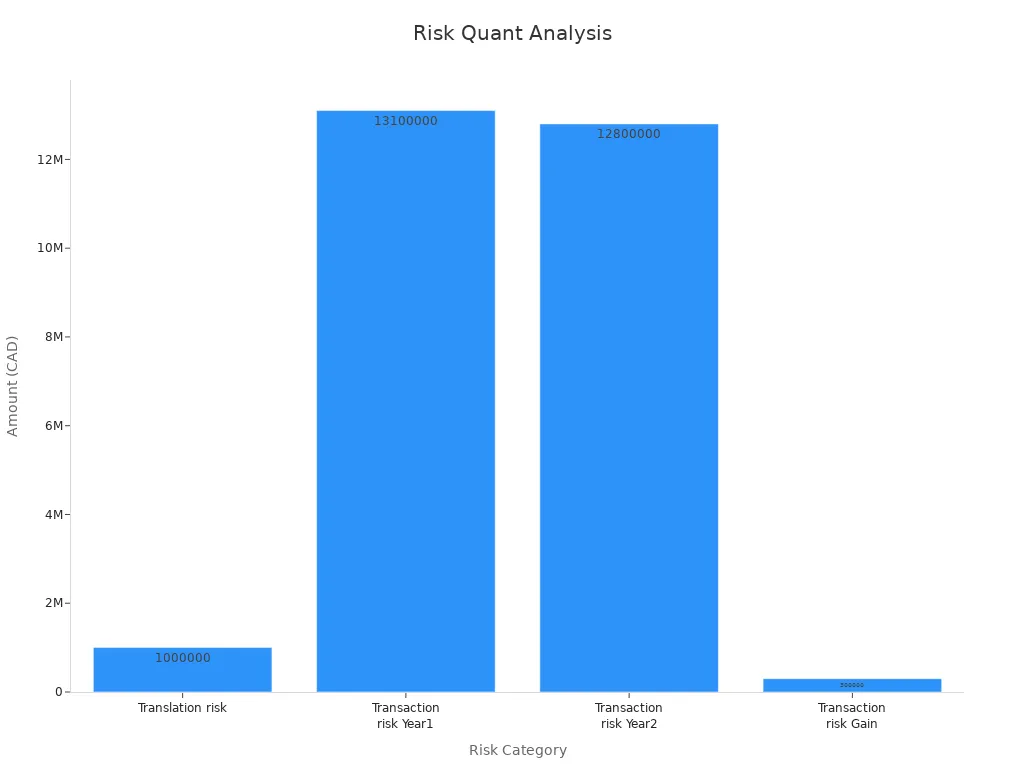
A real-world example highlights this risk. A company borrowed CAD 10 million at an exchange rate of 1.3100. By the end of the first year, the loan's value increased to CAD 13.1 million. However, in the second year, the exchange rate dropped to 1.2800, reducing the loan's value to CAD 12.8 million. This fluctuation resulted in a CAD 300,000 foreign gain.
|
Type of Risk |
Description |
|---|---|
|
Foreign Exchange Risk |
Unforeseen fluctuations in foreign exchange rates affecting transaction value, especially in cross-border deals. |
|
Commodity Risk |
Unexpected fluctuations in commodity prices impacting sectors like Oil & Gas and Mining. |
|
Interest Rate Risk |
Changes in interest rates affecting capital raising and debt obligations, impacting transaction viability. |
|
Time Risk |
Prolonged negotiations increasing the likelihood of unfavorable conditions leading to deal failure. |
|
Counterparty Risk |
Risk of the counterparty failing to meet contractual obligations, often due to other transaction risks. |
Translation risk in financial reporting
Translation risk impacts your financial statements when you convert foreign assets and liabilities into your home currency. This risk becomes significant for multinational companies with subsidiaries in different countries. Exchange rate fluctuations can alter the reported value of these assets, affecting your financial performance.
For instance, a group reporting in CHF with US subsidiaries holding CHF 500 million in assets would face a CHF 50 million loss if the Swiss franc strengthens by 10%. Additionally, only about half of companies hedge their translation risks, leaving many exposed to these challenges.
|
Risk Type |
Example Calculation |
Result (CAD) |
|---|---|---|
|
Translation Risk |
Loss due to currency fluctuation: (1.3200 - 1.2700) × 20,000,000 |
CAD 1,000,000 |
Economic risk and long-term business impact
Economic risk refers to the long-term effects of exchange rate fluctuations on your business's future cash flows and market value. Unlike transaction or translation risks, economic risk affects your competitive position in the market. Even if your company does not engage in international sales, you may still face this risk.
For example, a U.S. furniture manufacturer might lose market share to cheaper imports if the dollar strengthens. Similarly, a large U.S. pharmaceutical company generating 40% of its revenue from Europe and Japan could see significant impacts if the dollar weakens against the euro and yen. These scenarios highlight how foreign currency risk can influence your business's long-term performance.
Best Practices to Hedge Foreign Exchange

Use forward contracts to lock in exchange rates
Forward contracts are one of the most effective tools to hedge foreign exchange. These contracts allow you to lock in an exchange rate for a future transaction, providing financial certainty and protecting your business from unfavorable currency fluctuations. By using forward contracts, you can stabilize costs and revenues, even in volatile markets.
-
For example, a U.S. importer purchasing machine parts from a French supplier can agree on an exchange rate of 1.30 for 1 euro. This ensures that the price remains fixed, regardless of future currency movements.
-
A European exporter used forward contracts to shield profits from a depreciating euro, maintaining stable margins.
-
Similarly, a U.S. importer secured raw material costs through forward contracts, avoiding unexpected price hikes caused by currency fluctuations.
The effectiveness of forward contracts can be measured using various metrics:
|
Metric Type |
Description |
|---|---|
|
Performance against benchmarks |
Evaluates how well the hedging strategy performs compared to established benchmarks. |
|
Variance analysis |
Analyzes the variability in revenue and earnings due to currency fluctuations. |
|
Value at risk |
Measures the potential loss in value of the hedged position under normal market conditions. |
|
Scenario analysis |
Assesses the impact of different market scenarios on the effectiveness of the hedge. |
|
Reducing net revenue variance |
Aims to minimize fluctuations in revenue caused by foreign exchange changes. |
|
Earnings per share (EPS) impact |
Evaluates how FX fluctuations affect the company's earnings per share. |
|
Cost metrics |
Includes total volume of hedge contracts and premiums paid as a percentage of hedge notionals. |
By incorporating forward contracts into your strategy, you can hedge against foreign currency risk and reduce your risk of financial instability.
Leverage currency options for flexibility and protection
Currency options provide a flexible way to hedge foreign exchange. Unlike forward contracts, options give you the right—but not the obligation—to exchange currency at a predetermined rate. This flexibility allows you to benefit from favorable market movements while still protecting against adverse changes.
For instance, if you expect the value of a foreign currency to rise, purchasing a call option can lock in a favorable rate. On the other hand, a put option can protect you if the currency's value falls. This dual advantage makes currency options an excellent choice for businesses and investors seeking both protection and opportunity.
Currency options are particularly useful for companies with uncertain cash flows or fluctuating payment schedules. They allow you to adapt to changing market conditions without committing to a fixed rate. By leveraging this tool, you can hedge foreign exchange effectively while maintaining operational flexibility.
Diversify currency exposure across multiple markets
Diversifying your currency exposure is another powerful way to reduce your risk. By spreading your investments or operations across multiple currencies, you can minimize the impact of fluctuations in any single currency. This strategy is especially beneficial for businesses operating in global markets or investors managing multi-asset portfolios.
-
Market reports highlight the importance of managing currency exposure in multi-asset portfolios. Approaches include fully unhedged, fully hedged, asset-class-based, optimal hedge ratio, risk-premia harvesting, and active management.
-
Each method has unique trade-offs, balancing operational complexity with investment performance. For example, active management may offer higher returns but requires more resources and expertise.
Investing in multiple currencies can also enhance your portfolio's resilience. Currency-hedged ETFs, for instance, allow you to gain exposure to international markets while protecting against currency risk. This approach ensures that your investments remain stable, even during periods of high volatility.
By diversifying your currency exposure, you can hedge foreign exchange risks more effectively and safeguard your financial interests in a dynamic global economy.
Implement natural hedging strategies through operational adjustments.
Natural hedging involves aligning your business operations to reduce currency risk without relying on financial instruments. This strategy focuses on balancing your foreign currency inflows and outflows. For example, if you generate revenue in euros, you can match this by sourcing materials or paying suppliers in euros. This way, you minimize the impact of exchange rate fluctuations on your cash flow.
You can also adjust your supply chain to achieve natural hedging. Establishing production facilities in the same region where you sell your products reduces your reliance on currency conversions. For instance, a U.S. company selling goods in Japan could set up a local manufacturing plant. This approach not only reduces currency exposure but also lowers transportation costs and improves delivery times.
Another effective method is diversifying your supplier base. By working with suppliers in different countries, you spread your currency exposure across multiple markets. This diversification helps you hedge foreign exchange risks more effectively, especially during periods of high volatility.
Natural hedging requires careful planning and coordination. Regularly reviewing your operational structure ensures that your strategy remains aligned with market conditions. By implementing these adjustments, you can reduce your reliance on financial hedging tools and achieve greater stability in your international operations.
Regularly monitor and forecast exchange rate trends.
Monitoring and forecasting exchange rate trends is essential for managing currency risk. Exchange rates fluctuate due to various factors, including economic conditions, interest rates, and geopolitical events. By staying informed, you can anticipate changes and take proactive steps to protect your finances.
Several methods can help you track exchange rate trends effectively:
-
Purchasing power parity compares the relative value of currencies based on the cost of goods and services.
-
Relative economic strength evaluates the economic performance of different countries.
-
Econometric models use statistical techniques to predict future exchange rate movements.
You can also rely on insights from brokers, businesses, traders, government agencies, and investment banks. These entities provide valuable data and analysis to help you make informed decisions.
Forecasting exchange rates allows you to plan your transactions strategically. For instance, if you expect a foreign currency to weaken, you can delay payments or accelerate collections to maximize your gains. Conversely, if you anticipate a currency to strengthen, locking in rates through forward contracts or options can protect your margins.
Regular monitoring ensures that you stay ahead of market trends. By incorporating this practice into your currency risk management strategy, you can hedge foreign exchange risks more effectively and safeguard your financial interests.
Establish a formal currency risk management policy.
A formal currency risk management policy provides a structured approach to managing foreign exchange risks. This policy outlines your objectives, strategies, and procedures for mitigating currency exposure. It serves as a roadmap for your organization, ensuring consistency and accountability in your risk management efforts.
Developing a robust policy begins with identifying your risk tolerance and exposure. Assess the currencies you deal with, the volume of transactions, and the potential impact of exchange rate fluctuations on your finances. Once you have a clear understanding of your risk profile, you can define specific targets and strategies to address these challenges.
Research highlights the importance of sound practices in managing foreign currency risk. For example, public debt management strategies emphasize the need for clear objectives and the use of derivatives to hedge risks. These principles apply to businesses as well, helping you navigate the complexities of currency risk management.
Your policy should also include guidelines for using financial instruments like forward contracts, options, and swaps. Additionally, it should specify the roles and responsibilities of team members involved in risk management. Regular reviews and updates ensure that your policy remains relevant in a dynamic market environment.
By establishing a formal currency risk management policy, you create a strong foundation for protecting your business from exchange rate volatility. This proactive approach helps you hedge foreign exchange risks effectively and maintain financial stability.
Work with financial experts or consultants for tailored solutions.
Managing currency exchange risks can be complex, especially if your business operates in multiple countries. Financial experts or consultants can help you create a customized strategy to address your unique challenges. These professionals analyze your exposure to foreign currency risks and recommend the best tools and techniques to protect your finances.
Working with experts ensures that you stay informed about the latest market trends and hedging options. They can guide you in selecting the right financial instruments, such as forward contracts or currency options, based on your business needs. For example, if your company frequently deals with volatile currencies, a consultant might suggest using options to provide flexibility and protection.
Additionally, consultants can help you establish a robust risk management framework. This includes setting clear objectives, defining risk tolerance levels, and implementing monitoring systems. By partnering with financial experts, you gain access to specialized knowledge and resources that can enhance your ability to hedge foreign exchange effectively.
Incorporate contractual clauses to adjust for exchange rate fluctuations.
Including exchange rate adjustment clauses in your contracts is a proactive way to manage currency risks. These clauses allow you to renegotiate prices or payment terms if exchange rates move beyond a specified range. This approach protects both parties from unexpected financial losses due to currency fluctuations.
For instance, if you are an exporter, you can include a clause that adjusts the payment amount if the buyer's currency weakens significantly. Similarly, as an importer, you can negotiate terms that protect you from a strengthening foreign currency. These clauses provide a safety net, ensuring that neither party bears the full burden of unfavorable exchange rate movements.
Here’s an example of how such a clause might work:
Incorporating these clauses requires clear communication and mutual agreement. Ensure that the terms are well-documented and legally enforceable. By doing so, you can reduce your exposure to currency risks and maintain stable business relationships.
Invoice in local currency to reduce exposure.
Invoicing in the local currency of your customers or suppliers is another effective way to minimize currency risk. When you invoice in their currency, you transfer the exchange rate risk to the other party. This approach simplifies your financial planning and protects your profit margins from unfavorable currency movements.
For example, if your business sells products to customers in Japan, invoicing in Japanese yen eliminates the need to convert payments into your home currency. This reduces the impact of exchange rate fluctuations on your revenue. Similarly, paying suppliers in their local currency can help you avoid unexpected cost increases due to currency changes.
However, this strategy works best when combined with other risk management practices. For instance, you can use forward contracts to lock in exchange rates for future transactions. This ensures that you still benefit from financial certainty while reducing your exposure to currency risks.
Practical Examples of Managing Foreign Currency Risk
Case study: A multinational company using forward contracts
Forward contracts are a popular tool for multinational companies to manage currency risk. These contracts allow you to lock in an exchange rate for a future transaction, ensuring financial stability. For example, a global electronics manufacturer based in the United States sources components from Europe. The company agrees to pay its supplier in euros six months later. To avoid the risk of the euro strengthening against the dollar, the company uses a forward contract to secure the current exchange rate. This strategy protects its profit margins and ensures predictable costs.
By using forward contracts, you can eliminate uncertainty in cross-border transactions. This approach is especially useful for businesses with fixed payment schedules or long-term agreements. It allows you to focus on operations without worrying about fluctuating exchange rates.
Example: Small businesses leveraging natural hedging strategies
Small businesses often rely on natural hedging to manage currency risk. This strategy involves aligning your revenue and expenses in the same currency. For instance, a boutique coffee exporter in Brazil sells its products to European customers. To reduce exposure to currency fluctuations, the business sources packaging materials from European suppliers. This creates a balance between euros earned and euros spent, minimizing the need for financial hedging tools.
Natural hedging is cost-effective and straightforward. It works best when your business has consistent cash flows in foreign currencies. By adjusting your operations, you can reduce your reliance on complex financial instruments.
Scenario: Investors mitigating risk with currency options
Currency options offer investors flexibility and protection against unfavorable exchange rate movements. These financial instruments allow you to exchange currency at a predetermined rate, but only if it benefits you. For example:
-
If the USD/JPY exchange rate is 120.00, you can exercise an option at a strike rate of 112.00, converting 10 million yen to $89,286.00.
-
If the exchange rate drops to 108.00, you can let the option expire and convert at the market rate, receiving $92,593.00. This results in a $3,307 gain compared to a forward contract.
While options provide significant advantages, you must account for the cost of the premium. This expense impacts the overall profitability of your hedge. By carefully evaluating market conditions, you can use currency options to protect your investments and maximize returns.
Real-world application: Using foreign currency bank accounts.
Foreign currency bank accounts offer a practical way to manage exchange rate risks. These accounts allow you to hold, receive, and pay in foreign currencies without converting them into your home currency. By using these accounts, you can reduce the impact of exchange rate fluctuations on your cash flow and financial planning.
For example, if your business earns revenue in euros but operates in the United States, a euro-denominated account lets you keep the funds in euros. This eliminates the need for immediate conversion, protecting you from unfavorable exchange rates. You can then choose to convert the funds when the rates are more favorable.
Companies often use FX budget rates to analyze how currency fluctuations affect their financial performance. These rates help you evaluate key metrics like operating expenses, revenues, and profit margins. By isolating the impact of exchange rates, you can make better financial decisions and communicate performance more accurately. FX budget rates also serve as benchmarks for assessing the performance of your overseas operations, helping you refine your risk management strategies.
Foreign currency accounts also simplify international transactions. Paying suppliers or receiving payments in their local currency reduces transaction costs and avoids delays caused by currency conversions. This approach enhances your operational efficiency and strengthens relationships with global partners.
By incorporating foreign currency bank accounts into your strategy, you can protect your business from exchange rate volatility and improve your financial stability.
Understanding and managing currency risk is essential for protecting your financial stability. By adopting strategies like forward contracts, natural hedging, and currency options, you can minimize the impact of exchange rate fluctuations. These practices not only safeguard your profits but also enhance your competitive edge in global markets.
Evaluate your current approach to currency risk management. Identify areas for improvement and implement proactive measures to secure your financial interests. Taking these steps today ensures a more stable and predictable financial future.
FAQ
What is the best way to start managing currency exchange risks?
Begin by identifying your exposure to foreign currencies. Analyze your transactions, revenues, and expenses in different currencies. Then, create a risk management plan that includes tools like forward contracts or natural hedging. Regularly review your strategy to adapt to market changes.
How do forward contracts differ from currency options?
Forward contracts lock in an exchange rate for a future date, ensuring cost predictability. Currency options, however, give you the right—but not the obligation—to exchange at a set rate. Options provide flexibility, while forward contracts offer certainty.
Can small businesses manage currency risks effectively?
Yes, small businesses can use simple strategies like natural hedging. Align your revenue and expenses in the same currency. For example, source materials from the same region where you sell products. This reduces exposure without needing complex financial instruments.
How often should you monitor exchange rate trends?
You should monitor exchange rates regularly, especially if your business involves frequent international transactions. Weekly or monthly reviews help you stay informed about market trends. Use tools like economic reports or consult financial experts for accurate forecasts.
Are currency hedging tools expensive?
The cost depends on the tool you choose. Forward contracts usually have no upfront cost, while currency options require a premium. Evaluate your budget and risk tolerance to select the most cost-effective solution for your needs.
Related content