
Why NAFTA’s Impact Has Sparked Decades of Debate
Author:XTransfer2025.12.29NAFTA
NAFTA has sparked strong reactions for decades because of its wide-ranging economic, social, and political effects. People often point to job losses, wage pressures, and big changes in industries as reasons for concern. Political disputes add to the tension, while the agreement’s role in debates about globalization keeps it in the spotlight. Polling from 2017-2018 shows that even as many Mexicans felt uncertain about the United States, most continued to support NAFTA, believing it helped their economy. These mixed feelings highlight why the agreement remains a source of debate.
NAFTA and Economic Impacts

Jobs and Wages
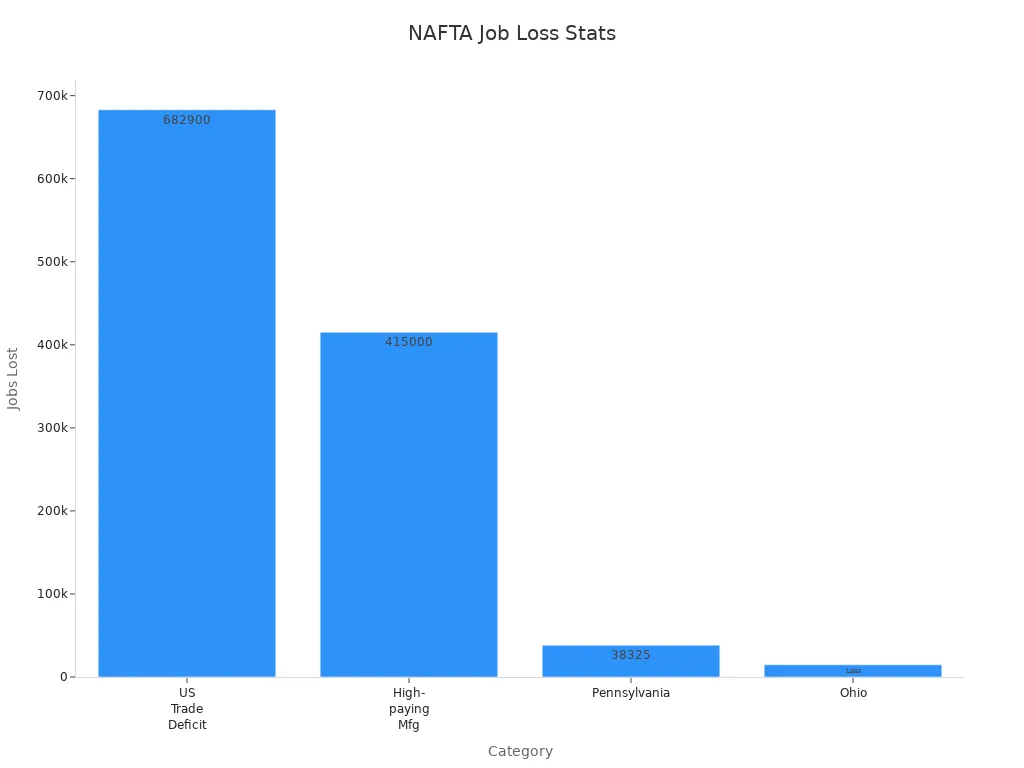
Many people link NAFTA to job losses in U.S. manufacturing and wage pressures for workers. Studies show that by 2010, about 682,900 U.S. jobs were displaced due to the trade deficit with Mexico. High-paying manufacturing jobs made up 61% of these losses, which means over 415,000 workers lost positions that paid more than average. States like Pennsylvania and Ohio saw thousands of jobs disappear. At the same time, export-oriented industries paid workers 13-16% more than the national average. Service sector jobs, which often replaced manufacturing roles, paid about 80% of what manufacturing jobs did.
Empirical studies use econometric models to measure these shifts. Researchers look at trade openness, tariff changes, and how close a region is to the U.S.-Mexico border. They find that wage and employment growth patterns differ between border and interior regions. Migration patterns also change, with more people moving to areas that benefit from trade.
Industry Shifts
NAFTA changed the way many industries operate. Sectors that lost tariff protection, like textiles and apparel, saw a sharp drop in wage growth. The most protected industries experienced a 17 percentage point decline compared to those that kept protections. The automobile industry stands out as a major example. Companies extended their supply chains into Mexico, which helped them lower costs and become more competitive. Over time, once a company moved part of its supply chain to Mexico, other parts often followed.
Comparative case studies show how different sectors responded:
-
Mexican tariffs dropped from 16% (1992) to 5.3% (1996)
-
U.S.-Mexico trade increased by 218% post-NAFTA
-
Trade deficit increased by 439%
-
34% of NAFTA-TAA certified workers (139,298) | Significant tariff reductions and removal of quotas led to large increases in trade volume and deficits; high worker adjustment costs indicated by TAA certifications. | | Automotive | - 6% of NAFTA-TAA certified workers (26,840)
-
Removal of Mexican import tariffs up to 25%
-
Increased bilateral trade due to elimination of restrictive policies | NAFTA eliminated Mexican automotive trade barriers, increasing trade flows and causing some job dislocations. | | Other Industries | - Microelectronics: 4% of NAFTA-TAA certifications
-
Electrical Equipment: 3%
-
Chemicals & Allied Products: 1%
-
Computer Equipment: 1% | Smaller but measurable impacts in other manufacturing sectors, reflected in worker certifications and trade changes.
Regional Effects
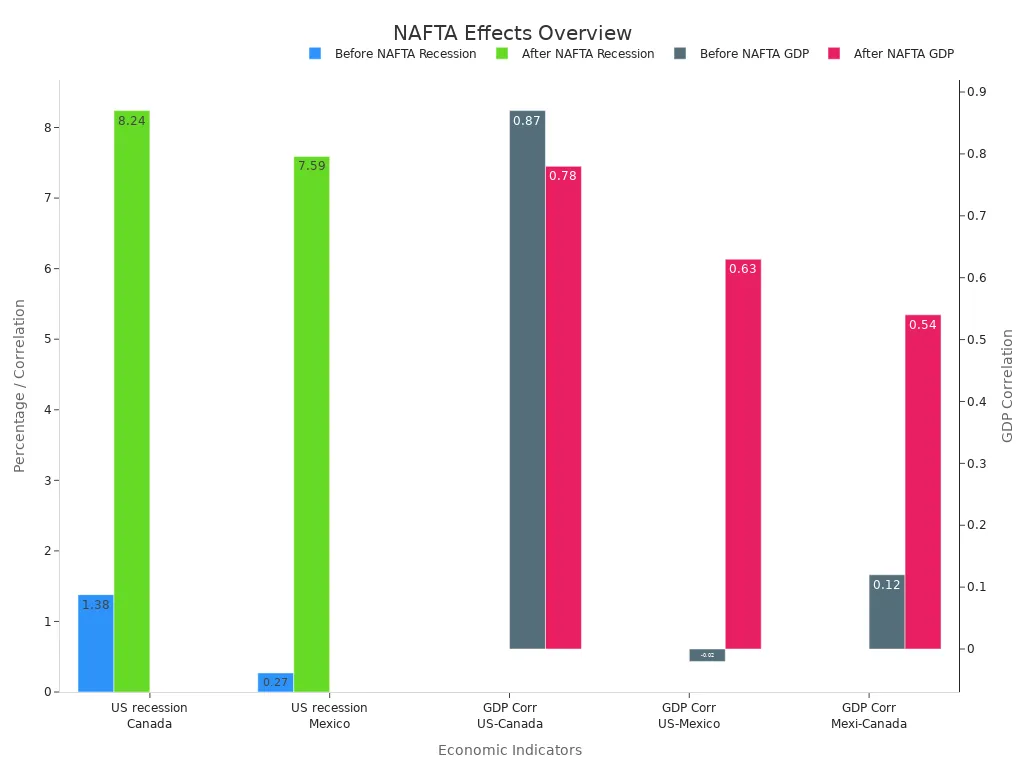
NAFTA’s impact varies across regions. In Mexico, local labor market data show a net gain of about 870,000 jobs, a 13.7% rise in domestic employment. Production workers saw even bigger gains, with employment up by 32.8%. These benefits appeared mostly in regions with high trade exposure, such as the northeast, northwest, and central east states.Data comparing periods before and after the implementation of the North American Free Trade Agreement (NAFTA) indicate changes in economic linkages among the United States, Canada, and Mexico.
Researchers use municipal-level data and spatial econometric methods to study these effects. They find that economic growth and job gains concentrate near the U.S.-Mexico border. Less populated regions with lower-skilled labor also see higher growth after NAFTA. Traded sectors like manufacturing and wholesale benefit more near the border, while non-traded sectors such as services grow further away, especially in areas with lower literacy rates.
Political and Legal Disputes
Renegotiation and USMCA
Political backlash against NAFTA grew as many communities faced job losses and wage declines. Counties most exposed to Mexican import competition saw employment drop by about 5 to 7 log points by 2000. These economic shocks did not cause people to move away, but they did change voting patterns. Many workers in manufacturing areas shifted their support to the Republican party. Union leaders and workers felt betrayed by the Democratic party, which had supported NAFTA. This sense of betrayal fueled political anger and shaped elections, especially in the Rust Belt.
Leaders responded to these concerns by renegotiating NAFTA into the United States-Mexico-Canada Agreement (USMCA). The new agreement introduced stricter rules for the auto industry, higher labor standards, and new wage requirements. For example, the regional value content for cars increased from 62.5% under NAFTA to 75% under USMCA. Labor value content rules now require 40% of a car’s value to come from workers earning at least $16 per hour. These changes aimed to protect jobs and raise wages, but they also increased production costs and reduced output, especially in Mexico.
Dispute Mechanisms
Legal debates about NAFTA often focused on how disputes were handled. The agreement set up panels to resolve trade conflicts, but these panels faced problems. Sometimes, countries blocked the formation of panels by refusing to appoint members. For example, the U.S. blocked a panel in a sugar dispute, making it hard to settle the issue. Investor-State Dispute Settlement (ISDS) allowed companies to sue governments, but critics said this limited policy choices and lacked transparency. USMCA restricted ISDS, limiting who could use it and for what reasons. Binational panels also faced criticism for slow decisions and limited success, especially in cases like softwood lumber.
Unaddressed Sectors
Some sectors did not receive enough attention under NAFTA. Public sector labor, such as teachers, remained outside labor protections. The steel industry lacked rules to prevent foreign steel from entering through Mexico, risking U.S. jobs. Aerospace manufacturing also saw jobs move to Mexico without clear protections. The auto sector faced growing trade deficits and falling wages, while dairy protections in Canada stayed mostly unchanged. USMCA made some improvements, like new quotas for U.S. dairy exports, but many gaps remain.
NAFTA in Public Perception

Globalization Symbol
NAFTA became a symbol in debates about globalization. People saw it as more than just a trade deal. It represented big changes in how countries connect and share goods, jobs, and culture. Many films and news stories used NAFTA to talk about these changes. For example, movies like The Mask of Zorro showed worries about American culture spreading into Mexico. The media often described NAFTA as a natural step toward economic integration, but some voices said it was unfair and ignored workers’ and environmental concerns. This made NAFTA a key topic in arguments about who wins and loses when countries open their borders.
-
Media often framed NAFTA as a symbol of progress, but critics said it hid real problems.
-
Cultural media, like movies, reflected fears about losing national identity.
-
News stories sometimes ignored alternative ideas about trade and focused on the benefits of free markets.
National Identity
NAFTA also changed how people thought about their own countries. In the United States, leaders used familiar stories and symbols to make NAFTA seem positive. At the same time, some Americans worried about losing jobs and what it meant for their country’s future. Studies show that people who supported NAFTA were less likely to have strong nationalistic feelings. In both the U.S. and Mexico, people’s sense of identity affected how they felt about working together as neighbors. Political changes, like shifts in voting patterns, also showed how NAFTA influenced ideas about what it means to be American or Mexican.
-
Sociological studies found that job losses in certain areas led to more protectionist attitudes and changes in voting.
-
People with less nationalistic views were more likely to support NAFTA and North American cooperation.
Public Opinion
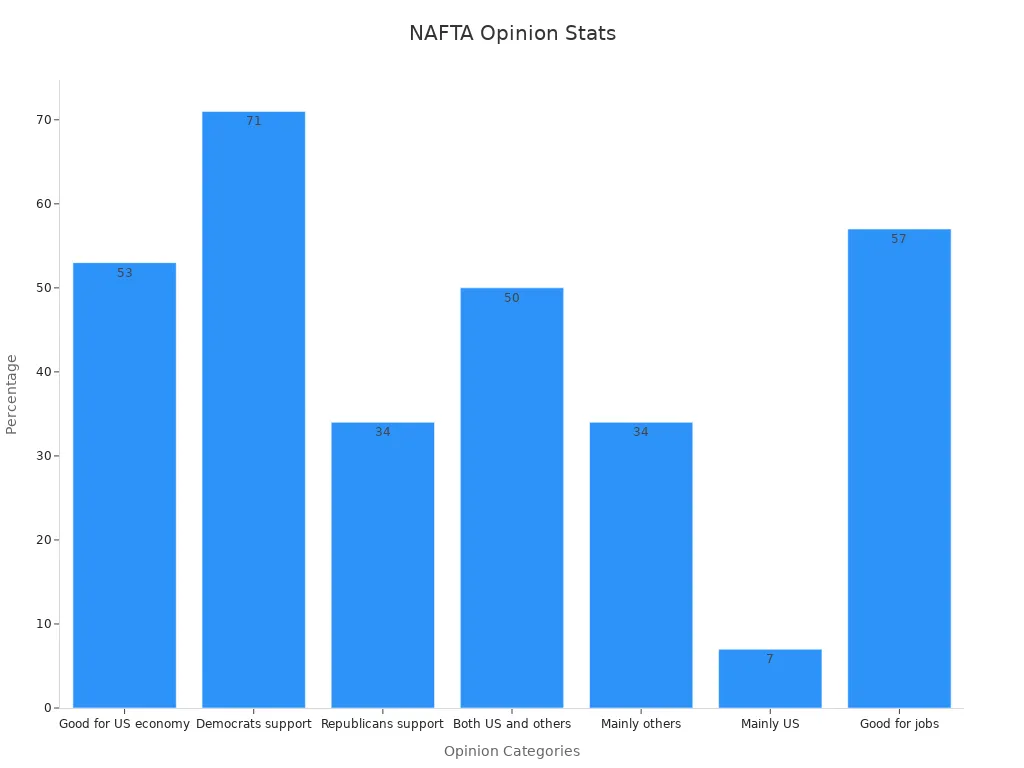
Public opinion about NAFTA has always been divided. Polls show that many people in the U.S., Canada, and Mexico support the agreement, but they do not always agree on who benefits most. In a 2017 poll, 58% of Americans, 74% of Canadians, and 79% of Mexicans supported NAFTA. However, 35% of Americans thought Mexico gained the most, while most Mexicans and many Canadians believed the U.S. benefited more. Education and age also played a role. Young adults and people with higher education levels were more likely to support NAFTA. Over time, Democrats became more supportive, while Republican support dropped.
-
In 2017, 53% of Americans said NAFTA was good for the U.S. economy, up from 42% in 2008.
-
67% of Democrats supported NAFTA, compared to only 22% of Republicans.
-
Young adults (18-29) showed the highest support at 73%.
Many experts find the legacy of this trade agreement complex. Studies show that job growth stayed steady or improved in the United States, Canada, and Mexico.
-
Unemployment rates dropped in all three countries after the agreement began.
-
Some jobs moved to lower-wage areas, but new high-skill jobs grew at home.
-
Trade intensity and productivity increased, especially in the auto industry.
Debate continues because the effects reach beyond economics, touching politics and national identity. Understanding both sides helps explain why the topic still matters.
FAQ
What is NAFTA?
NAFTA stands for the North American Free Trade Agreement. The United States, Canada, and Mexico signed it in 1994. The agreement removed most trade barriers between these countries. It aimed to increase trade and economic growth.
Did NAFTA cause job losses in the United States?
Many people believe NAFTA led to job losses in some industries, especially manufacturing. Some workers lost jobs when companies moved factories to Mexico. Other sectors, like agriculture and services, gained new jobs from increased exports.
How did NAFTA affect Mexico’s economy?
Mexico saw job growth in manufacturing and export industries. Many factories, called maquiladoras, opened near the U.S. border. Some regions benefited more than others. Wages and working conditions improved in some areas but stayed low in others.
What replaced NAFTA?
The United States-Mexico-Canada Agreement (USMCA) replaced NAFTA in 2020. USMCA added new rules for labor, the environment, and digital trade. It also changed requirements for the auto industry.
Why do people still debate NAFTA?
People debate NAFTA because its effects are mixed. Some gained jobs and higher wages, while others lost work. The agreement changed industries and communities. It also became a symbol in arguments about globalization and national identity.
Related content