
What is Marseilles? Definition, Role, and Application in International Trade
Author:XTransfer2026.01.14Marseilles
Marseille Definition: Europe's Historic Port Connecting Three Continents
Marseille (sometimes spelled Marseilles in English) is France's largest seaport and a major international trade hub on the Mediterranean, serving as a critical gateway for global shipping, logistics, and cross-border business connecting Europe with North Africa, the Middle East, and Asia. Located on France's southern coast, the Port of Marseille-Fos handles approximately 79-80 million tons of cargo annually, making it France's busiest port and the Mediterranean's third-largest commercial harbor.
Strategic importance for global trade: Marseille's 2,600-year history as a trading port positions it at the intersection of major maritime routes. Goods flowing between Asia and Europe, Africa and Europe, or within the Mediterranean basin frequently pass through Marseille's facilities, making this port essential infrastructure for international supply chains serving European markets.
Geographic and Strategic Position
Mediterranean Location Advantages
Marseille sits at the Mediterranean's northern edge where European markets meet sea routes from the Suez Canal carrying Asian goods, North African trade lanes, and intra-Mediterranean commerce. This positioning reduces sailing distances and transit times compared to northern European ports for cargo originating from Asia, the Middle East, or Africa.
Time savings matter significantly in competitive international trade. Container ships from Asia reach Marseille days before arriving at Rotterdam or Hamburg, allowing faster inventory replenishment for Southern European markets. Perishable goods, time-sensitive manufacturing components, and seasonal products particularly benefit from reduced Mediterranean transit times.
Hinterland access connects Marseille to major European consumer markets through road, rail, and river networks. The Rhône River corridor provides natural logistics route northward into France and toward Germany, Switzerland, and Northern Europe, making Marseille a viable alternative to congested northern ports.
Port Infrastructure and Capabilities
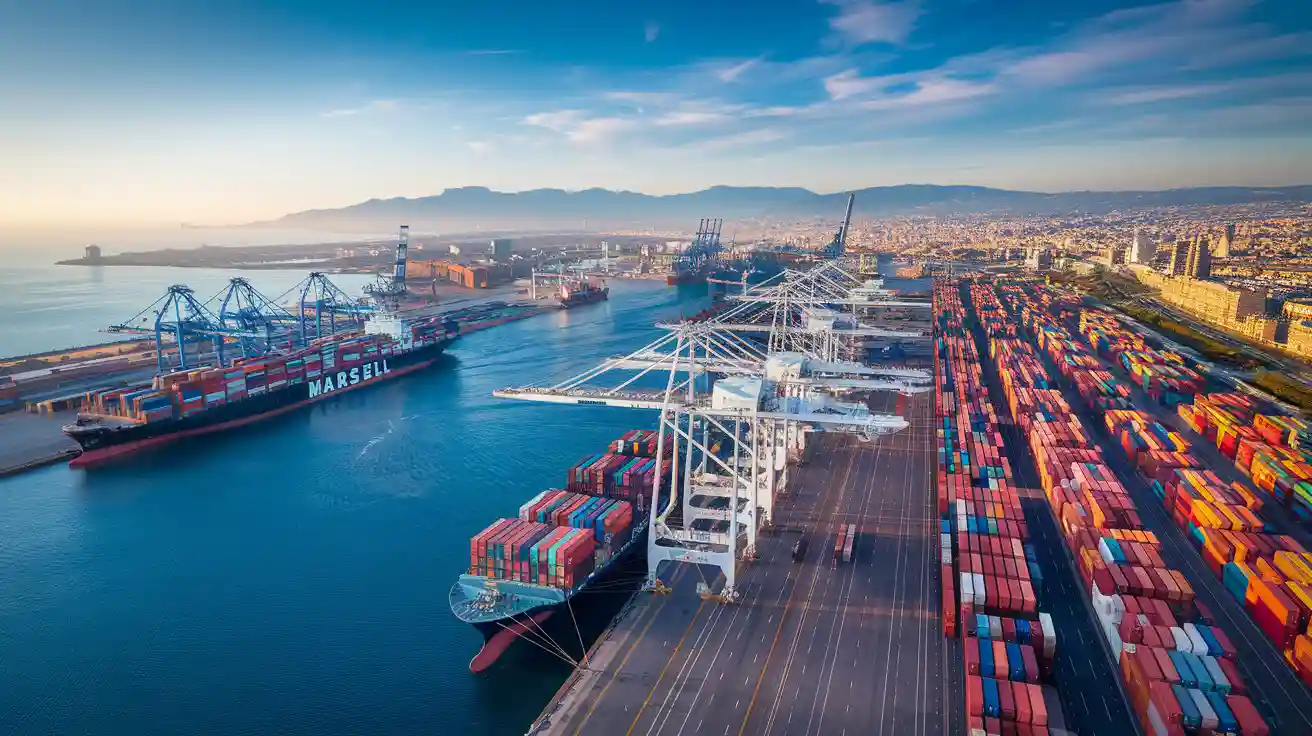
The Port of Marseille-Fos complex extends across two distinct areas: the older Marseille harbor handling containers, passengers, and specialized cargo, and the industrial Fos zone focusing on bulk commodities, oil, and heavy industry. This geographic separation allows specialized operations optimized for different cargo types.
Container terminals feature modern gantry cranes capable of handling the largest container vessels in service, automated stacking systems improving cargo throughput, and direct rail connections moving containers inland without road congestion. Annual container handling exceeds 1.3 million TEU with capacity for continued growth.
Bulk cargo facilities handle grain, coal, minerals, and liquid bulk including crude oil and refined petroleum products. Roll-on/roll-off terminals accommodate automobile shipments and truck-trailer traffic moving between North Africa and Europe. Specialized berths serve project cargo, breakbulk, and other non-containerized freight.
Digital Infrastructure and Tracking
Modern port management systems provide real-time cargo tracking, digital customs integration, and automated documentation processing. Shippers and consignees monitor container locations, vessel arrivals, and clearance status through online portals, improving supply chain visibility and reducing administrative delays.
Blockchain pilot programs test distributed ledger technology for shipping documentation, potentially eliminating paper bills of lading and streamlining cross-border trade documentation. These innovations position Marseille as a technology-forward port competing on efficiency rather than solely on geography.
Cargo Types and Trade Lanes
Container Shipping and General Cargo
Containerized goods represent substantial port volume, with consumer products, manufactured components, machinery, and packaged goods moving through Marseille's container terminals. Major shipping lines including MSC, CMA CGM (headquartered in Marseille), and Maersk maintain regular services connecting Marseille to global markets.
Asia-Europe trade flows heavily through Marseille as an alternative to northern range ports. Chinese manufacturers exporting electronics, textiles, furniture, and consumer goods to European markets can route through Marseille for faster Southern European delivery, though some shippers prefer Rotterdam or Hamburg despite longer sailing for better onward European connectivity.
Intra-Mediterranean trade moves agricultural products, manufactured goods, and consumer items between European Union members and North African countries. French exports to Algeria, Tunisia, Morocco, and Egypt frequently ship through Marseille, while return flows bring African agricultural products and raw materials to European markets.
Bulk Commodities and Energy
Marseille-Fos serves as France's primary energy import hub with oil refineries and storage facilities receiving crude petroleum from Middle Eastern and African sources. Natural gas terminals handle LNG imports supporting French and European energy needs, particularly as Europe diversifies away from pipeline gas dependence.
Grain exports from France's productive agricultural regions ship through Marseille to North African and Middle Eastern buyers. Wheat, corn, and other agricultural commodities load at specialized bulk terminals equipped for rapid vessel loading minimizing port time.
Industrial raw materials including iron ore, coal, bauxite, and other minerals arrive at Marseille-Fos serving French manufacturing and industrial facilities. The port's heavy industry zone hosts steel production, aluminum smelting, and chemical manufacturing leveraging raw material imports.
Passenger and Cruise Operations
Marseille ranks among Europe's busiest cruise ports, hosting Mediterranean cruise ships calling at the historic Vieux-Port and modern cruise terminals. Passenger ferries connect Marseille to Corsica, Sardinia, Algeria, and Tunisia, maintaining regular services for both tourists and commercial travelers.
Cruise tourism generates substantial economic activity beyond port operations—passengers spend in local shops, restaurants, and attractions during port calls. However, cruise operations must balance economic benefits against environmental concerns including air quality and congestion in historic city areas.
Customs and Regulatory Environment
European Union Customs Procedures
As a European Union port, Marseille follows EU customs regulations for goods entering or leaving the customs territory. Imports from non-EU countries require customs declarations, duty payments where applicable, and compliance with EU product standards and regulations.
Import customs clearance typically processes electronically through the EU's customs systems, with physical inspections applied selectively based on risk assessment. Authorized Economic Operator (AEO) status provides importers with expedited clearance and reduced inspection rates, rewarding compliant businesses with faster processing.
Export procedures verify goods leaving the EU, collect any export duties or taxes, and ensure compliance with export control regulations restricting certain strategic goods. France's customs authority (Direction Générale des Douanes et Droits Indirects) operates facilities throughout the port complex.
Documentation Requirements
International shipments through Marseille require standard documentation including commercial invoices, packing lists, bills of lading or airway bills, certificates of origin, and product-specific documents like health certificates for food products or safety certificates for regulated goods.
Electronic documentation increasingly replaces paper, with digital bills of lading, electronic customs declarations, and scanned supporting documents reducing processing time and eliminating physical document handling delays. However, some trading partners still require original paper documents creating dual documentation burdens.
Compliance with International Maritime Organization regulations, European safety standards, and bilateral trade agreements adds documentation complexity. Freight forwarders and customs brokers provide specialized expertise navigating these requirements for businesses unfamiliar with international trade procedures.
Marseille in International Supply Chains
Import Supply Chains to Europe
Asian manufacturers shipping to European customers increasingly consider Marseille as a competitive entry point, particularly for Southern European destinations. Container loads arriving at Marseille can reach distribution centers in Southern France, Spain, or Italy faster than routing through Northern European ports.
Cost-benefit analysis compares lower shipping costs to Northern ports against potentially higher inland transport costs distributing from Northern Europe southward. For goods destined for Mediterranean markets, Marseille often provides net savings despite sometimes higher port handling fees compared to ultra-high-volume Northern ports.
Just-in-time manufacturing relies on predictable supply chains with minimal inventory buffers. Marseille's shorter sailing times from Asia and less congestion than Rotterdam or Hamburg can provide reliability advantages valuable for time-sensitive manufacturing components.
Export Supply Chains from Europe
French and Southern European exporters shipping to Asian, Middle Eastern, or African markets benefit from Marseille's proximity and frequent vessel services. Agricultural products, manufactured goods, machinery, and luxury items flow outbound through the port destined for global markets.
Wine exports from France's renowned wine regions often ship through Marseille to Asian markets where French wine commands premium prices. Specialized temperature-controlled containers protect wine quality during ocean transit, with Marseille's facilities equipped for proper reefer handling.
Automotive exports from French and Italian manufacturers use Marseille's roll-on/roll-off terminals, with vehicles driven directly onto specialized car carrier vessels. This efficient loading method reduces handling costs and damage risk compared to container shipping.
Cross-Border E-commerce Logistics
E-commerce growth drives demand for efficient international logistics supporting cross-border online sales. European e-commerce platforms selling to North African or Middle Eastern customers, or Asian platforms selling to European consumers, utilize Marseille for last-mile distribution proximity.
Fulfillment centers near Marseille can service both local French markets and export shipments through the port, providing operational efficiency through consolidated operations. Inventory positioned near major ports reduces overall supply chain costs by minimizing inland transport distances.
Cross-Border Payment Considerations
Currency and Payment Methods
International trade through Marseille typically involves euro-denominated transactions for European parties, with currency conversion required for non-European trading partners. Asian exporters shipping to European importers through Marseille commonly invoice in euros, U.S. dollars, or occasionally yuan depending on negotiated payment terms.
Payment platforms like XTransfer facilitate efficient cross-border payments by providing multi-currency accounts, competitive foreign exchange rates, and compliance support. A Chinese exporter receiving euro payment for goods delivered through Marseille can convert euros to renminbi at favorable rates through specialized B2B payment platforms rather than traditional banks.
Letter of credit transactions remain common for international trade through major ports, with banks issuing credits payable upon presentation of shipping documents proving goods were loaded aboard vessels at Marseille. Documentary collections provide middle-ground payment security between advance payment and open account terms.
Payment Timing and Terms
Payment terms in international trade affect both cash flow and currency risk. Common structures include advance payment before shipment, payment against documents (sight or time drafts), or open account terms with net 30-90 day payment after delivery.
FOB Marseille terms mean the seller delivers goods to the vessel at Marseille port and risk transfers to the buyer at that point. Payment typically occurs upon presentation of shipping documents proving goods were loaded. CIF terms include cost, insurance, and freight to destination port, with payment at various agreed stages.
Environmental and Sustainability Initiatives
Green Port Initiatives
Marseille invests in environmental technologies reducing maritime shipping's ecological footprint. Shore power facilities allow docked vessels to shut down auxiliary engines and connect to land-based electrical power, eliminating diesel generator emissions while in port.
LNG bunkering infrastructure enables vessels using liquefied natural gas fuel to refuel at Marseille, supporting the transition from heavy fuel oil to cleaner-burning alternatives. As more shipping lines adopt LNG propulsion for environmental compliance, LNG fueling capability becomes a competitive port advantage.
Emission monitoring systems track air quality throughout the port complex, with data informing strategies to reduce pollution affecting nearby residential areas. Tension between port operations and urban populations requires careful environmental management maintaining port competitiveness while protecting public health.
Sustainable Logistics Practices
Rail transport expansion aims to shift cargo from trucks to more environmentally efficient rail, reducing road congestion and emissions. Dedicated rail connections to major European markets allow containers to move inland by rail rather than contributing to highway traffic.
Circular economy initiatives promote recycling port waste, reusing materials, and minimizing resource consumption. Container terminals increasingly use electric cargo handling equipment rather than diesel-powered machinery, reducing local emissions and noise pollution.
Competitive Position Among Mediterranean Ports
Comparison with Other Major Mediterranean Ports
Marseille competes primarily with Algeciras in Spain, Valencia in Spain, Piraeus in Greece, and Genoa in Italy for Mediterranean container volumes. Each port offers different advantages—Algeciras benefits from Gibraltar Strait positioning for transshipment, Valencia offers modern facilities and Spanish market access, Piraeus provides Chinese investment and Asian connections, and Genoa serves Northern Italian manufacturing.
Market differentiation positions Marseille as the gateway to France and the Rhône corridor northward into Europe. Ports cannot compete purely on price; instead they emphasize service quality, connectivity, and value-added services attracting shippers beyond lowest-cost options.
Port productivity measurements including vessel turnaround time, container dwell time, and documentation processing speed directly affect shipper costs. Delays at congested ports increase supply chain costs even if base port charges are lower, making efficiency a competitive differentiator.
Challenges and Opportunities
Labor relations occasionally create service disruptions affecting port reliability. Strikes by dock workers, customs officials, or transport workers can delay cargo movements, frustrating shippers requiring predictable supply chains. Maintaining labor harmony while modernizing operations presents ongoing management challenges.
Capacity expansion projects add berths, deepen channels for larger vessels, and improve inland connections. Investment in infrastructure maintains competitiveness against ports making similar improvements. The challenge is financing major infrastructure while remaining cost-competitive in global shipping markets.
Digital transformation offers opportunities to differentiate through superior information systems, documentation processing, and supply chain visibility. Ports leading in digital services can attract technology-forward shippers even if physical infrastructure matches competitors.
Marseille's Economic Impact
Employment and Economic Activity
The port complex directly employs thousands in cargo handling, logistics, maritime services, and port administration. Indirect employment in trucking, warehousing, freight forwarding, customs brokerage, and maritime support services multiplies the direct employment impact substantially.
Regional economic development benefits from port activity through tax revenues, business opportunities for local companies, and attracting logistics-dependent industries. Manufacturing facilities, distribution centers, and value-added processing operations locate near major ports accessing global supply chains.
Trade Facilitation for French Economy
Marseille's import capacity supports French manufacturing, energy security, and consumer markets. Raw material imports supply industrial production, energy imports power the economy, and consumer goods imports satisfy market demand for global products.
Export facilitation helps French agricultural producers, manufacturers, and luxury goods makers reach global markets efficiently. Wine, cheese, machinery, aerospace components, pharmaceuticals, and other French specialties ship through Marseille to Asian, African, and global buyers.
Frequently Asked Questions About Marseille Port
What is Marseille's port code for shipping documents?
Marseille uses UN/LOCODE "FRMRS" in international shipping documentation. This five-character code combines the ISO country code for France (FR) with the location code (MRS) designating Marseille specifically. Shippers should use FRMRS in bills of lading, customs documents, and shipping instructions to ensure proper routing.
How long does customs clearance take at Marseille?
Import customs clearance at Marseille typically completes within 24-48 hours for routine shipments with proper documentation and no inspection requirements. Shipments selected for physical inspection may require 2-5 additional days depending on inspection scheduling and complexity. Authorized Economic Operators with AEO status often experience faster clearance.
Can I ship from Asia to Marseille instead of Rotterdam or Hamburg?
Yes, many shipping lines offer regular services from Asian ports to Marseille. Transit time is typically 2-3 days shorter than to Northern European ports. Whether Marseille makes sense depends on your final destination—goods destined for Southern European markets often find Marseille more efficient, while Northern European destinations might still favor Rotterdam or Hamburg despite longer sailing times due to better regional connectivity.
What types of cargo does Marseille handle?
Marseille handles containers, bulk liquids (petroleum, chemicals), dry bulk (grain, minerals), roll-on/roll-off (vehicles, trailers), breakbulk, project cargo, and passengers. The diversified cargo mix serves different sectors from consumer goods importers to industrial manufacturers to energy companies.
How do I track cargo through Marseille port?
Most shipping lines provide online tracking through their websites using bill of lading numbers or container numbers. The Port of Marseille also offers tracking services through their digital systems. Freight forwarders managing your shipment typically provide tracking updates and notifications about vessel arrivals, container availability, and customs status.
Is Marseille more expensive than other Mediterranean ports?
Port charges vary based on cargo type, vessel size, and services required. Marseille's costs are generally competitive with other major Mediterranean ports, though not always the absolute lowest. Total landed cost should consider not just port fees but also sailing time, inland transport to final destination, and service reliability when comparing ports.
What payment methods are accepted for goods shipped through Marseille?
Payment methods depend on agreements between buyer and seller rather than the port itself. Common methods include wire transfers, letters of credit, documentary collections, and platform-based payments. International B2B payment platforms like XTransfer facilitate euro payments for Asian exporters shipping through Marseille, offering competitive currency conversion and efficient settlement.
How environmentally friendly is Marseille port?
Marseille has implemented shore power for vessels, supports LNG fueling, promotes rail over truck transport, and monitors emissions. While shipping inherently has environmental impacts, Marseille's sustainability initiatives position it among Mediterranean ports actively working to reduce ecological footprint. Continued improvement remains ongoing as technologies advance and regulations tighten.
Related content