
Comparing Leading Logistics Enterprise Providers for Business Success
Author:XTransfer2025.12.16Logistics enterprise
Choosing the right logistics enterprise provider can transform your business. Effective logistics solutions streamline supply chains, enhance productivity, and drive financial growth. Companies leveraging advanced logistics tools often witness a 10% reduction in operational costs annually. Research highlights the role of big data in optimizing inventory management and route planning, resulting in higher efficiency. With the right provider, you can navigate demand fluctuations and maintain seamless operations.
Understanding Logistics Enterprise Providers
Definition and Scope of Logistics Enterprise Providers
Logistics enterprise providers are companies that specialize in managing the movement, storage, and flow of goods, information, and resources across supply chains. These providers act as the backbone of global trade, ensuring that products reach their destinations efficiently and on time. Their scope extends beyond transportation to include warehousing, inventory management, and even technology-driven solutions like real-time tracking and data analytics. By partnering with a logistics service provider, you can focus on your core business while leaving the complexities of supply chain management to the experts.
Role in Supply Chain Management and Business Operations
Logistics providers play a pivotal role in supply chain management by optimizing each step of the process. They ensure that raw materials, components, and finished goods move seamlessly from suppliers to manufacturers and finally to customers. This efficiency reduces delays, minimizes costs, and enhances customer satisfaction. For your business, this means improved operational efficiency and a competitive edge in the market. Metrics such as inventory accuracy, stockout rates, and inventory carrying costs are often used to measure the performance and reliability of these providers.
|
Metric |
Description |
|---|---|
|
Inventory Accuracy |
Measures the alignment between recorded and actual inventory, expressed as a percentage. |
|
Days of Inventory on Hand (DOH) |
Indicates the average number of days inventory is held before sale or use. |
|
Stockout Rate |
Frequency of items being unavailable when demanded, expressed as a percentage. |
|
Inventory Carrying Cost % |
Proportion of total inventory costs relative to total inventory value, expressed as a percentage. |
Key Logistics Services Offered by Providers
Leading logistics providers offer a wide range of services tailored to meet diverse business needs. These include transportation, warehousing, freight forwarding, and customs brokerage. Many providers also invest in advanced logistics solutions, such as automation and artificial intelligence, to enhance efficiency. For example, in 2024, A.P. Moller-Maersk launched a new air freight gateway in Miami to improve connectivity. Similarly, UPS recently acquired MNX Global Logistics to strengthen time-critical logistics capabilities. These developments highlight the industry's focus on innovation and adaptability.
The logistics sector is growing rapidly, with a projected market size of USD 3,931.8 billion in 2024 and a revenue forecast of USD 5,951.0 billion by 2030. This growth underscores the increasing demand for reliable logistics services, driven by international trade and e-commerce expansion. By leveraging these services, you can streamline operations and position your business for long-term success.
Key Criteria for Comparing Logistics Service Providers
Technology and Innovation in Logistics Solutions
Technology plays a transformative role in logistics, enabling you to achieve operational efficiency and meet customer expectations. Advanced logistics technology, such as real-time tracking and automation, allows you to monitor shipments, optimize routes, and reduce delays. For instance, comparing process performance through statistical tools like T-tests can help identify bottlenecks and improve quality control. These innovations not only enhance service quality but also minimize risks by enabling proactive risk management.
Logistics providers that invest in cutting-edge solutions, such as transportation management systems and integrated supply chain solutions, stand out in the industry. These tools streamline transportation, inventory management, and warehouse operations, ensuring seamless supply chain efficiency. By leveraging these technologies, you can reduce costs, improve delivery times, and gain a competitive edge in the market.
|
Application |
Description |
|---|---|
|
Comparing Process Performance |
T-tests are used to compare performance metrics before and after changes to assess statistical significance. |
|
Quality Control |
Continuous comparisons help identify bottlenecks and monitor quality, leading to early detection of issues. |
|
Risk Management and Optimization |
Evaluating risk factors through T-tests aids in designing countermeasures to minimize disruptions. |
Scalability for Business Growth and Demand Fluctuations
Scalability is a critical factor when evaluating a logistics service provider. As your business grows, your logistics needs will evolve. A scalable provider can adapt to these changes, ensuring uninterrupted operations during peak seasons or unexpected demand surges. The rise of global trade and e-commerce has amplified the importance of scalability. For example, the logistics market is projected to grow from USD 5.65 trillion in 2024 to USD 8.07 trillion by 2033, driven by increasing complexities in shipping and delivery.
QuickCommerce trends further highlight the need for scalable logistics solutions. With revenues expected to reach USD 30.8 billion in 2024, logistics providers must invest in faster delivery systems to meet customer expectations. By choosing a provider with scalable capabilities, you can handle demand fluctuations efficiently and maintain high service standards.
-
Key growth statistics supporting scalability:
-
E-commerce order volume in India surged by 26.2% in fiscal year 2023.
-
The logistics market is growing at a rate of 4.02% from 2025 to 2033.
-
QuickCommerce is driving investments in faster delivery systems.
-
Cost-Effectiveness and Pricing Strategies
Cost-effectiveness is a cornerstone of logistics and supply chain management. A reliable logistics provider should offer transparent pricing strategies that align with your budget while maintaining service quality. To evaluate cost-effectiveness, you can analyze metrics such as spend versus service quality and identify improvement opportunities. Establishing clear objectives and relevant KPIs will help you assess whether a provider delivers value for money.
Third-party logistics providers often offer economies of scale, reducing costs associated with transportation, warehousing, and inventory management. However, it’s essential to balance cost savings with operational efficiency. A provider that prioritizes efficiency can help you minimize waste, optimize resources, and enhance customer satisfaction.
-
Factors to consider when evaluating cost-effectiveness:
-
Quality of service versus cost.
-
Opportunities for cost reduction through innovation.
-
Transparency in pricing and billing practices.
-
Industry expertise and specialization
Industry expertise and specialization are critical factors when selecting a logistics service provider. A provider with deep knowledge of your industry can offer tailored solutions that address specific challenges and opportunities. For example, a logistics enterprise specializing in healthcare understands the importance of temperature-controlled transportation for pharmaceuticals. Similarly, providers focused on e-commerce excel in managing high-volume, time-sensitive deliveries.
Specialization enables providers to leverage economies of scale, vertical integration, and learning effects, resulting in cost reductions and improved operational efficiency. Providers with industry expertise also reduce competitive risks by fostering trust and collaboration among stakeholders. This trust translates into better service quality and pricing strategies, giving your business a competitive edge.
|
Benefit |
Description |
|---|---|
|
Cost Reduction |
Achieved through economies of scale, vertical integration, and learning effects. |
|
Lowering Competitive Risk |
Increased trust among participants reduces competitive risks. |
|
Increased Price and Quality |
Differentiation and discrimination effects enhance service quality and pricing strategies. |
|
Increased Market Volume |
Diversification of products and markets leads to higher market volumes. |
|
Access to New Markets |
Logistics clusters provide opportunities for LSPs to diversify their services and markets. |
|
Professionalization of Services |
Clusters facilitate the professional development of LSPs through shared learning experiences. |
By choosing a specialized logistics provider, you gain access to innovative solutions and industry-specific expertise. This partnership ensures that your logistics and supply chain operations align with your business goals, driving long-term success.
Reliability and customer support
Reliability and customer support are the cornerstones of an effective logistics service provider. Reliability ensures that your goods reach their destination on time and in perfect condition. Providers with high on-time delivery rates demonstrate their commitment to operational efficiency and customer satisfaction. Metrics such as the Partner Reliability Index further assess a provider's ability to maintain high service standards across the supply chain.
|
Metric |
Description |
|---|---|
|
On-Time Delivery Rate |
Indicates the percentage of deliveries made on time, crucial for reliability. |
|
Customer Satisfaction Score |
Measures how satisfied customers are with the service provided. |
|
Partner Reliability Index |
Assesses the performance of logistics partners to ensure high service standards. |
Customer support plays an equally vital role in maintaining strong relationships with your customers. A provider offering 24/7 support and real-time tracking capabilities ensures transparency and responsiveness. These features allow you to address issues proactively, minimizing disruptions and enhancing customer trust. For instance, integrated supply chain solutions enable seamless communication between stakeholders, improving supply chain efficiency.
When evaluating a provider, consider their track record in reliability and customer support. A dependable partner not only meets your logistics needs but also strengthens your reputation with your customers.
Outsourcing Logistics vs. In-House Management
Benefits of Outsourcing Logistics Enterprise Services
Outsourcing logistics offers numerous advantages for your business. By partnering with a logistics service provider, you can reduce labor costs and eliminate the need for in-house staffing. Specialized providers bring established processes and expertise, delivering services more cost-effectively. This allows you to allocate resources toward strategic growth initiatives, such as product development or market expansion.
Flexibility is another key benefit. Outsourcing enables you to scale operations up or down based on demand fluctuations. For instance, third-party logistics providers leverage global networks to manage seasonal peaks without requiring significant upfront investments. Additionally, outsourcing converts fixed costs into variable costs, helping you optimize your budget. Providers also enhance operational efficiency by using advanced logistics technology, such as real-time tracking and transportation management systems, to streamline processes and reduce errors.
Risks and Challenges of Outsourcing
While outsourcing offers many benefits, it also comes with challenges. One major risk is the loss of control over critical processes. Reduced visibility can lead to delays or quality issues, which may impact customer satisfaction. Dependency on external suppliers increases vulnerability to risks like delivery disruptions or subpar service quality. Coordination gaps among stakeholders can further complicate operations, creating communication breakdowns.
Hidden costs also pose a challenge. Studies reveal that 22% of companies in the petroleum sector experienced unexpected expenses when outsourcing logistics. These costs can erode the financial advantages of outsourcing if not carefully managed. To mitigate these risks, you should establish clear contracts and maintain open communication with your provider.
Advantages of Managing Logistics In-House
Managing logistics in-house offers greater control over your operations. You can oversee every aspect of the supply chain, ensuring alignment with your business goals. This approach allows you to customize logistics solutions to meet specific needs, such as integrating sustainability initiatives or enhancing supply chain efficiency.
However, in-house logistics requires significant investments in infrastructure, staffing, and technology. While this may increase operational costs, it provides long-term benefits like improved service quality and customer satisfaction. For example, companies like Amazon have successfully built in-house logistics networks to maintain control over delivery timelines and customer experience.
Factors to consider when choosing between outsourcing and in-house management
Choosing between outsourcing logistics and managing it in-house requires careful evaluation of several factors. Each approach offers unique advantages, but the right decision depends on your business needs, goals, and resources. Here are the key considerations to guide your decision-making process:
-
Cost-Benefit Analysis
Conduct a detailed cost-benefit analysis to compare the financial implications of outsourcing versus in-house management. Outsourcing often reduces fixed costs by converting them into variable expenses, while in-house management may require significant upfront investments in infrastructure, staffing, and technology. -
Expertise and Reliability
Evaluate potential third-party logistics service providers based on their expertise, reliability, and service offerings. A provider with a proven track record in supply chain management can enhance operational efficiency and ensure seamless logistics solutions for your business. -
Technology Integration
Whether you outsource or manage logistics in-house, investing in technology is essential. Real-time tracking, transportation management systems, and integrated supply chain solutions improve supply chain efficiency and enhance customer satisfaction. These tools also enable you to monitor performance and address issues proactively. -
Focus on Core Competencies
Outsourcing non-core logistics functions allows you to concentrate on strategic business areas, such as product development or market expansion. This approach ensures that your resources are allocated to activities that drive growth and innovation. -
Relationship Management
Building strong relationships is crucial, whether you work with a logistics provider or manage operations internally. Collaborative partnerships with third-party logistics providers foster trust and ensure high service standards. For in-house management, maintaining good relationships with your team and stakeholders is equally important. -
Performance Monitoring
Regularly track key performance indicators (KPIs) to assess the effectiveness of your logistics operations. Metrics such as on-time delivery rates, cost efficiency, and customer satisfaction scores provide valuable insights for continuous improvement.
|
Key Performance Factor |
Description |
|---|---|
|
Cost-Benefit Analysis |
A thorough analysis comparing financial implications of outsourcing vs in-house management. |
|
Evaluate Providers |
Assess potential 3PL providers based on expertise, reliability, and service offerings. |
|
Leverage Technology |
Invest in technology solutions to enhance logistics efficiency, applicable to both outsourcing and in-house. |
|
Focus on Core Competencies |
Outsource non-core functions to concentrate on business growth areas. |
|
Build Strong Relationships |
Foster collaborative partnerships with 3PL providers or maintain good relationships in-house. |
|
Monitor and Review Performance |
Regularly track KPIs and assess logistics operations for continuous improvement. |
Comparing Leading Logistics Enterprise Providers
Overview of Top Logistics Service Providers
The global logistics market continues to grow, driven by the increasing demands of e-commerce and international trade. In 2023, the market was valued at USD 12.21 billion and is projected to reach USD 23.02 billion by 2032, with a compound annual growth rate (CAGR) of 7.3%. This growth highlights the critical role of leading logistics service providers in meeting the evolving needs of businesses.
Several key players dominate the logistics landscape, offering a wide range of services to enhance operational efficiency. These include:
-
C.H. Robinson Worldwide Inc. (U.S.)
-
United Parcel Service, Inc. (UPS) (U.S.)
-
FedEx Corp. (U.S.)
-
Deutsche Post AG (Germany)
-
Kuehne+Nagel International AG (Switzerland)
-
A.P. Moller – Maersk (Denmark)
-
Schenker AG (Germany)
-
DSV Solutions (Denmark)
-
Nippon Express Holdings, Inc. (Japan)
-
Landstar System Holdings, Inc. (U.S.)
These providers have established themselves as leaders by leveraging advanced technology, global networks, and specialized solutions. Their ability to adapt to market trends and deliver reliable services makes them indispensable partners for businesses seeking to optimize logistics and supply chain operations.
Recent industry surveys, such as the Global Express Parcels 2011 & International Express Parcels Survey, compare the performance of major carriers like UPS, FedEx, DHL, and TNT. These surveys evaluate key service attributes valued by shippers, providing insights into the strengths and weaknesses of each provider. Additionally, the Global Contract Logistics 2011 + Market Survey offers intelligence from senior executives in the logistics sector, helping businesses make informed decisions when selecting a provider.
Unique Offerings and Competitive Strengths
Leading logistics providers differentiate themselves through unique capabilities and competitive strengths. These strengths enable them to deliver tailored solutions that meet the specific needs of their customers. Key differentiators include:
-
Demand Management Capabilities: Providers focus on meeting customer expectations by offering value-added services, such as customized transportation solutions and flexible delivery options.
-
Information Exchange Capabilities: Advanced technology allows providers to analyze, store, and distribute strategic information effectively. Real-time tracking systems enhance visibility and improve decision-making.
-
Supply Management Capabilities: Efficient resource management minimizes costs and ensures timely delivery, contributing to overall operational efficiency.
Strategic partnerships and strong customer relationships further enhance the competitive edge of these providers. Collaboration with suppliers and stakeholders fosters resource sharing and improves service delivery. For example, postponement strategies allow providers to delay final production or delivery until customer demand is confirmed, ensuring flexibility and reducing waste.
The ability to integrate technology into logistics operations is another critical strength. Providers like FedEx and UPS invest heavily in automation, artificial intelligence, and transportation management systems to streamline processes and enhance efficiency. These innovations not only improve service quality but also support sustainability initiatives by reducing carbon emissions and optimizing resource utilization.
Limitations and Areas for Improvement
Despite their strengths, logistics service providers face challenges that can impact their performance. Studies emphasize the importance of operational quality (OQ) and information quality (IQ) in enhancing customer satisfaction (CS). Providers must address the following areas to improve their services:
-
Timely Delivery: Delays in transportation can lead to customer dissatisfaction and disrupt supply chain operations.
-
Problem-Solving: Effective resolution of issues, such as shipment errors or damaged goods, is essential for maintaining trust.
-
Clear Communication: Transparent communication with customers and stakeholders ensures smooth operations and minimizes misunderstandings.
|
Key Findings |
Description |
|---|---|
|
Service Quality Dimensions |
Operational and information quality significantly influence customer satisfaction. |
|
Customer Satisfaction |
High satisfaction levels increase the likelihood of service re-use. |
|
Areas for Improvement |
Providers should focus on timely delivery, problem-solving, and communication. |
Financial and strategic reports also highlight areas where providers can enhance their performance. For instance, shipment reports reveal patterns of delivery delays, offering opportunities for improvement. Providers can use these insights to optimize transportation routes, improve tracking systems, and enhance customer support.
By addressing these limitations, logistics providers can strengthen their market position and deliver greater value to their customers. Continuous improvement in service quality and operational efficiency will ensure long-term success in the competitive logistics industry.
Case studies of successful logistics partnerships
Successful logistics partnerships demonstrate how collaboration and innovation can transform supply chain operations. By analyzing real-world examples, you can uncover actionable insights to optimize your own logistics strategies. Below are case studies that highlight the impact of tailored solutions on operational efficiency and business growth.
Warehouse Processing Optimization
A leading logistics provider partnered with a global retailer to address inefficiencies in warehouse order processing. By implementing advanced automation solutions, the partnership reduced average order processing times by 15%. This improvement also decreased variability, as shown by a significant reduction in the standard deviation of processing times. The streamlined operations allowed the retailer to meet customer demands more effectively, enhancing overall satisfaction.
Fleet Fuel Consumption Analysis
Fuel costs often represent a significant portion of logistics expenses. A partnership between a logistics enterprise and a transportation company focused on evaluating fuel consumption across different vehicle types. By adopting fuel-efficient vehicles and optimizing routes, the collaboration achieved annual fuel cost savings of 10%. This initiative not only reduced expenses but also supported sustainability goals by lowering carbon emissions.
Route Efficiency and Delivery Times
A regional logistics provider worked with an e-commerce company to improve delivery efficiency. The partnership analyzed delivery routes and implemented route optimization software. As a result, delivery times decreased by 12%, enabling faster order fulfillment. This improvement strengthened the e-commerce company's competitive position in a market where speed is critical.
Inventory Turnover and Stock Management
Effective inventory management is crucial for minimizing costs and avoiding stockouts. A logistics provider collaborated with a manufacturing firm to enhance inventory turnover rates. By leveraging real-time tracking and predictive analytics, the partnership improved inventory accuracy and reduced excess stock. Enhanced F-statistic results confirmed the statistical significance of these improvements, showcasing the value of data-driven solutions.
Packaging and Material Handling Efficiency
Packaging protocols can significantly impact handling times and overall efficiency. A logistics enterprise partnered with a consumer goods company to evaluate and refine packaging processes. The collaboration trimmed handling time by 8%, enabling faster order processing and reducing labor costs. This case study highlights how small adjustments in logistics solutions can yield substantial benefits.
Cross-Docking Operations Improvement
Cross-docking operations are critical for reducing storage costs and speeding up delivery. A logistics provider worked with a retail chain to analyze turnaround times at cross-docking facilities. By optimizing loading and unloading processes, the partnership minimized delays and improved overall efficiency. Variance analysis revealed significant improvements in operational performance.
Distribution Center Staffing Optimization
Staffing levels directly influence the efficiency of distribution centers. A logistics enterprise partnered with a global distributor to optimize staffing schedules. By analyzing shift-specific performance data, the collaboration reduced overtime expenses and improved productivity. This case study underscores the importance of aligning human resources with operational demands.
Quality Control in Logistics Processes
Shipment errors can disrupt supply chains and damage customer trust. A logistics provider collaborated with a pharmaceutical company to enhance quality control measures. By implementing rigorous checks and leveraging automation, the partnership reduced error rates in shipment handling. Statistically significant differences in error percentages demonstrated the effectiveness of these solutions.
Temperature-Controlled Supply Chain Performance
Maintaining precise temperature control is essential for industries like healthcare and food. A logistics enterprise partnered with a biotech firm to improve temperature monitoring in the supply chain. Advanced sensors and analytics enhanced accuracy, ensuring product integrity. High F-statistic values validated the improvements, showcasing the critical role of technology in specialized logistics solutions.
Impact of Technological Integration on Logistics
Technology integration can revolutionize logistics operations. A partnership between a logistics provider and a retail giant focused on implementing tracking technology. The collaboration enhanced shipment visibility and reduced delays, leading to improved customer satisfaction. Significant differences in performance metrics before and after the upgrades highlighted the transformative impact of these solutions.
|
Case Study |
Overview |
Key Outcomes |
Performance Metrics |
|---|---|---|---|
|
Warehouse Processing Optimization |
Investigated variability in order processing times |
Reduced average order processing time by 15% |
Standard deviation reduction in processing times |
|
Fleet Fuel Consumption Analysis |
Evaluated fuel consumption across vehicle types |
Fuel cost savings of 10% annually |
Statistically significant differences in fuel consumption |
|
Route Efficiency and Delivery Times |
Compared delivery efficiency across routes |
Reduced delivery times by 12% |
Significant variance between regional routes |
|
Inventory Turnover and Stock Management |
Studied impact of inventory turnover |
Improved inventory accuracy |
Enhanced F-statistic results |
|
Packaging and Material Handling Efficiency |
Examined packaging protocols |
Trimmed handling time by 8% |
Statistical significance between packaging types |
|
Cross-Docking Operations Improvement |
Analyzed turnaround times |
Minimized loading/unloading times |
Variance analysis of cross-dock facilities |
|
Distribution Center Staffing Optimization |
Analyzed staffing levels |
Reduced overtime expenses |
Shift-specific impact on performance |
|
Quality Control in Logistics Processes |
Assessed quality control measures |
Reduced error rates in shipment handling |
Statistically significant differences in error percentages |
|
Temperature-Controlled Supply Chain Performance |
Analyzed temperature measurement variances |
Improved accuracy in temperature control |
High F-statistic values |
|
Impact of Technological Integration on Logistics |
Assessed impact of tracking technology |
Enhanced visibility and fewer delays |
Significant differences before and after upgrades |
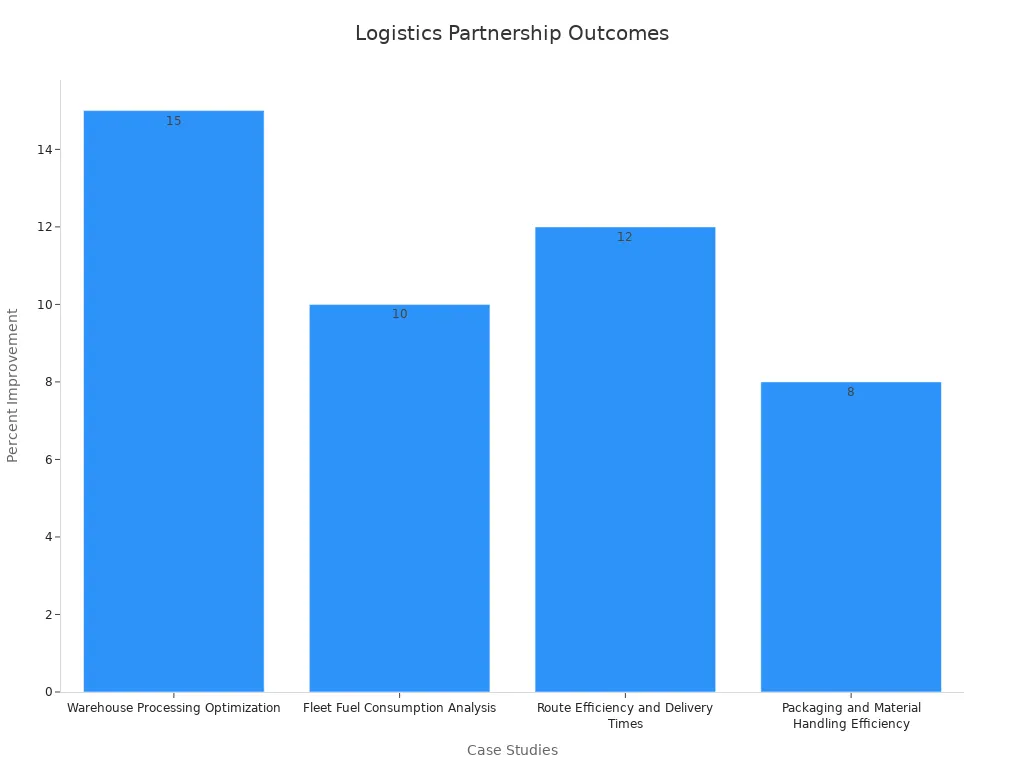
These case studies illustrate how strategic partnerships and innovative solutions can drive measurable improvements in logistics operations. By learning from these examples, you can identify opportunities to enhance your own supply chain performance and achieve long-term business success.
Future Trends in Logistics and Supply Chain Management

Automation and AI in logistics enterprise solutions
Automation and artificial intelligence are revolutionizing logistics by streamlining operations and enhancing decision-making. Companies increasingly rely on AI for demand forecasting, enabling precise inventory planning and reducing waste. Automation in warehousing improves efficiency by minimizing manual errors and accelerating order fulfillment. For example, predictive maintenance alerts help prevent equipment downtime, ensuring smooth operations.
AI-powered solutions also optimize transportation by analyzing routes and reducing empty miles. This not only cuts costs but also supports sustainability goals. Machine learning identifies patterns in supply chain data, allowing businesses to refine daily operations. Tools like natural language processing interpret large datasets, providing actionable insights that improve service quality. By adopting these technologies, you can enhance efficiency and remain competitive in a rapidly evolving market.
|
Application |
Benefit |
|---|---|
|
Route Optimization |
Efficient vehicle routing expedites delivery and reduces costs. |
|
Warehouse Automation |
Streamlines operations and reduces manual errors. |
|
Predictive Maintenance |
Alerts for maintenance needs, preventing downtime and improving efficiency. |
|
Data Quality Improvement |
High-quality data enhances AI performance and decision-making. |
Sustainability and green logistics initiatives
Sustainability is becoming a cornerstone of logistics strategies as businesses respond to consumer expectations and regulatory demands. Green logistics focuses on reducing carbon footprints through eco-friendly practices. For instance, companies are investing in low-carbon transportation technologies and optimizing supply chain processes to achieve net-zero emissions.
Corporate social responsibility initiatives also play a vital role in promoting sustainability. These efforts improve resource efficiency and align with global environmental goals. Green finance supports these initiatives by directing investments into sustainable solutions. By prioritizing sustainability, you not only meet regulatory requirements but also enhance your brand reputation and customer loyalty.
Impact of e-commerce on logistics service providers
The rise of e-commerce has transformed logistics, creating new challenges and opportunities. Consumers now expect faster delivery times and real-time tracking, pushing providers to adopt advanced technology. QuickCommerce trends, for example, demand innovative solutions like automated sorting systems and last-mile delivery optimization.
E-commerce growth has also increased the need for scalable logistics services. Providers must handle fluctuating demand while maintaining high service standards. This requires investments in transportation infrastructure and technology-driven solutions. By adapting to these changes, you can meet customer expectations and capitalize on the booming e-commerce market.
Strategies for adapting to evolving business needs
Adapting to evolving business needs requires a proactive approach to logistics management. As market demands shift, you must implement strategies that ensure your logistics solutions remain efficient and responsive. Below are key strategies to help you stay ahead:
-
Leverage Data Analytics
Data-driven insights are essential for identifying trends and predicting future needs. By analyzing customer behavior and supply chain performance, you can make informed decisions. For example, predictive analytics can help you optimize inventory levels, reducing the risk of overstocking or stockouts. -
Invest in Scalable Solutions
Scalability is critical for handling fluctuations in demand. Flexible logistics solutions, such as cloud-based transportation management systems, allow you to adjust operations quickly. This ensures you can meet customer expectations during peak seasons or unexpected surges. -
Enhance Supply Chain Resilience
Building a resilient supply chain minimizes disruptions caused by external factors. Diversifying suppliers and adopting multi-modal transportation options can reduce dependency on a single source. This approach ensures continuity even during unforeseen challenges. -
Embrace Technological Innovation
Automation and artificial intelligence streamline logistics processes, improving efficiency and accuracy. Tools like real-time tracking systems enhance visibility, enabling you to monitor shipments and address issues promptly. These innovations also support sustainability by optimizing resource usage. -
Monitor Market Trends
Staying informed about industry developments helps you anticipate changes and adapt your logistics strategies. For instance, the global logistics market grew by 17.6% from 2020 to 2021, reflecting increased demand for innovative solutions. Monitoring such trends allows you to align your operations with market needs.
By implementing these strategies, you can create a logistics framework that adapts to changing demands, supports growth, and enhances customer satisfaction.
Selecting the right logistics enterprise provider is crucial for achieving operational efficiency and long-term success. These providers enhance service reliability, align organizational processes, and offer specialized knowledge tailored to your industry. Their ability to scale operations and provide access to advanced technology ensures your business remains competitive in a dynamic market.
When evaluating providers, focus on their expertise, cost-effectiveness, scalability, and customer support. Use the table below to understand the comprehensive benefits they bring:
|
Benefit |
Description |
|---|---|
|
Improved Service |
Enhances order pickup and delivery reliability, reducing chargebacks and disruptions. |
|
Organizational Alignment |
Aligns production, transportation, and warehousing for better delivery performance. |
|
Industry Expertise |
Provides insights into freight trends and regulations, ensuring optimal freight outcomes. |
|
Specialized Knowledge |
Offers specialized logistics services tailored to specific industries, giving a competitive edge. |
|
Cost Savings |
Helps reduce costs through consolidation programs and efficiency improvements. |
|
Scalability |
Facilitates management of demand fluctuations and rapid response to market changes. |
|
Network Strength |
Access to a wide network of carriers to meet diverse order requirements efficiently. |
|
Access to Technology |
Saves on technological investments by providing access to advanced transportation management systems. |
|
Labor Cost Savings |
Frees up personnel from logistics tasks, allowing them to focus on core business activities. |
|
Performance Exception Management |
Provides solutions for unexpected delivery issues, ensuring effective problem resolution. |
To choose the best logistics solutions, start by defining your operational needs. Evaluate potential providers based on their track record, technological capabilities, and ability to scale with your growth. Prioritize those who align with your goals and offer tailored solutions for your industry.
FAQ
What is the primary role of a logistics enterprise provider?
A logistics enterprise provider manages the movement, storage, and flow of goods across supply chains. Their role includes transportation, warehousing, inventory management, and technology integration to ensure efficient and timely delivery of products.
How do I evaluate the reliability of a logistics provider?
Check their on-time delivery rates, customer satisfaction scores, and Partner Reliability Index. Reliable providers also offer 24/7 customer support and real-time tracking to address issues proactively and maintain high service standards.
Is outsourcing logistics more cost-effective than managing it in-house?
Outsourcing often reduces fixed costs by converting them into variable expenses. Third-party providers leverage economies of scale and advanced technology to lower costs. However, conduct a cost-benefit analysis to determine the best option for your business.
What technologies should a logistics provider offer?
Look for providers offering real-time tracking, transportation management systems, and automation tools. These technologies improve efficiency, reduce errors, and enhance visibility across the supply chain, ensuring seamless operations.
How can logistics providers support sustainability goals?
Providers can adopt eco-friendly practices like route optimization, fuel-efficient vehicles, and green warehousing. These initiatives reduce carbon footprints and align with global environmental standards, enhancing your brand's reputation.
Related content