
What Is the Current Dollar to PKR Rate and Why Does It Change
Author:XTransfer2025.07.31PKR
The dollar to pkr rate stands near 280 PKR per USD, showing steady movement in the past month. You need the latest usd to pkr exchange rate for travel, money transfer, remittance, or business. Even small changes in exchange rates can affect your remittance options or currency conversion. The average rate in 2025 is 279.49 PKR, with a peak of 293.342 PKR. Use trusted sources like the State Bank of Pakistan, XE.com, Wise, or your bank to compare exchange rate trends and select the best money transfer.
|
Aspect |
Details |
|---|---|
|
Average USD to PKR in 2025 |
Approximately 279.49 PKR |
|
Peak Exchange Rate (Mar 10, 2025) |
293.342 PKR |
|
Recent Stability Range (30 days) |
Between 279.650 and 280.250 PKR |
|
Importance |
Real-time tracking and comparison of remittance providers to maximize transfer value |
Dollar to PKR Rate
Latest USD to PKR Exchange Rate
You may notice that the dollar to pkr rate changes almost every day. As of June 30, 2025, the usd to pkr exchange rate stands at 283.7 PKR for 1 USD. This rate shows only a small change from last week. Over the past seven days, the highest rate reached 284.95 PKR, while the lowest dropped to 283.60 PKR. The largest single-day movement was a decrease of 0.465% on June 25, 2025. In the last 90 days, the rate ranged from a high of 284.95 PKR to a low of 280.05 PKR. The average exchange rate during this period was about 282.07 PKR. You can see that the volatility over 90 days was 1.74%, which means the rate did not swing wildly.
|
Period |
High (PKR) |
Low (PKR) |
Average (PKR) |
Volatility |
|
Last 7 Days |
284.95 |
283.60 |
284.03 |
0.48% |
|
Last 30 Days |
284.95 |
281.88 |
283.00 |
1.09% |
|
Last 90 Days |
284.95 |
280.05 |
282.07 |
1.74% |
|
Last Year |
284.95 |
277.43 |
279.48 |
2.69% |
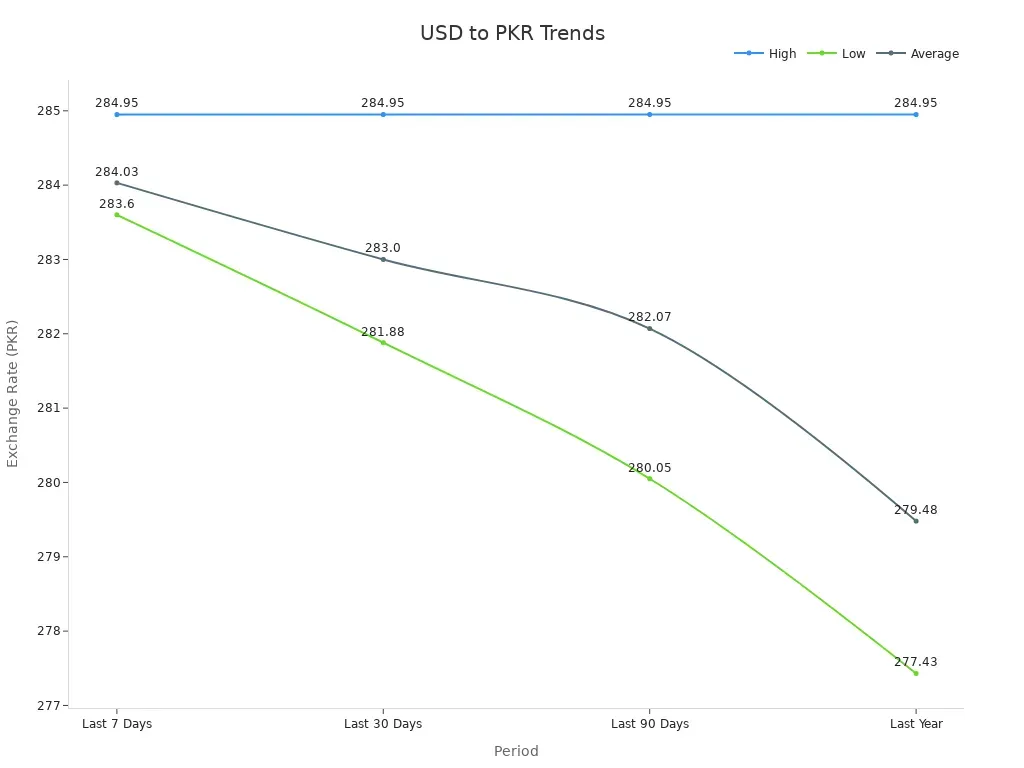
You might wonder why the usd to pkr exchange rate moves up and down. Many factors play a role. For example, during the COVID-19 pandemic, researchers found that the number of daily cases and tests had a strong effect on the volatility of the usd to pkr exchange rate. When the number of cases increased, the rate became more uncertain. This happened even after considering other things like oil and gold prices. These findings show that global events can quickly change the value of the pakistani rupee.
If you plan a money transfer or need to compare remittance options, you should watch these trends closely. Even a small change in the dollar to pkr rate can affect how much you receive or pay. Keeping an eye on exchange rate trends helps you make better decisions for remittance, travel, or business.
Where to Find Reliable Exchange Rates
You need accurate information before you send a money transfer or make a currency conversion. Many sources offer exchange rates, but not all give the same numbers. Some show the interbank rate, while others display the open market rate. To get the most reliable and competitive exchange rates, you should check trusted sources.
-
State Bank of Pakistan (SBP): The SBP website gives you the official usd to pkr exchange rate. This rate is often used by banks and large businesses.
-
XE.com: XE provides real-time exchange rates and historical data. You can use it to track the dollar to pkr rate and see how it changes over time.
-
Wise (formerly TransferWise): Wise shows the mid-market rate, which is the average between the buy and sell prices. This helps you find the best rate for your money transfer.
-
Major Banks: Many banks in Pakistan and abroad display their own usd to pkr exchange rate. These rates may include fees, so always compare before you choose.
-
Remittance Service Providers: Companies like Western Union and MoneyGram also list their rates. You can compare these to find the most competitive exchange rates for your remittance.
You should also look for tools that send alerts when the dollar to pkr rate reaches your target. This way, you can act fast and get the best value for your remittance or currency conversion. By staying informed, you protect your money and make smarter choices.
Why Exchange Rates Change
Floating vs. Fixed Systems
You might wonder why the value of the usd against the pakistani rupee changes so often. The answer starts with the type of exchange rate system a country uses. Pakistan uses a floating exchange rate system. This means the value of the currency moves up or down based on what buyers and sellers decide in the foreign exchange market. No one sets the price directly. Instead, the market finds the rate where supply meets demand.
In a fixed exchange rate system, the central bank tries to keep the currency at a set value. For example, China has pegged its currency to the usd in the past. The central bank must use its reserves to buy or sell currency to keep the rate steady. This can make the rate stable, but it may not show the real value of the currency.
You can see the difference in the table below:
|
Concept/Calculation |
Description |
Numerical Example/Formula |
Interpretation |
|
Purchasing Power Parity (PPP) |
Compares cost of a basket of goods in Pakistan and US to find theoretical exchange rate |
Basket cost: 3000 PKR (Pakistan), $20 (US) |
PPP rate = 3000 / 20 = 150 PKR/USD. Actual market rate = 300 PKR/USD. PKR is undervalued relative to USD |
|
Real Effective Exchange Rate (REER) |
Adjusts nominal exchange rate for inflation differences between Pakistan and US |
NEER = 17,650; Inflation Pakistan = 8%, US = 3% |
REER = 17,650 × (1.03 / 1.08) = 16,826.15. Lower REER suggests Pakistani goods are less competitive internationally |
|
Real Exchange Rate (RER) |
Adjusts nominal exchange rate for relative price levels between countries |
Nominal rate = 300 PKR/USD; Price level PKR = 110, US = 100 |
RER = (300 × 100) / 110 = 272.73 PKR/USD. Shows Pakistani goods are relatively more expensive in real terms |
|
Fixed Exchange Rate Regime |
Currency pegged to another currency; central bank intervenes to maintain rate |
Example: China pegging Yuan to USD |
Maintains stable but potentially artificial exchange rates requiring large reserves |
|
Floating Exchange Rate Regime |
Currency value determined by market supply and demand without direct intervention |
Example: USD and Eurozone currencies |
Reflects true market value but can be volatile |
Market Supply and Demand
You see the usd to pkr rate move because of supply and demand in the forex market. When more people want to buy usd, the price goes up. When more people want to sell usd, the price goes down. Many factors influence these changes. For example, if Pakistan imports more goods from the United States, it needs more usd to pay for them. This increases demand for usd and can make the pakistani rupee weaker.
The State Bank of Pakistan plays a key role in this process. It watches the market and sometimes steps in to keep things from getting out of control. The bank can use its reserves to buy or sell currency if the rate moves too fast. However, in a floating system, the bank does not set the rate every day.
You may also notice two types of rates: the interbank rate and the open market rate. The interbank rate is what banks use when they trade large amounts of currency with each other. The open market rate is what you see when you exchange money at a bank or money changer. The open market rate can be a little higher because it includes extra costs.
Many factors influencing exchange rates include inflation, interest rates, trade balances, and political events. These factors can change quickly and make the usd to pkr rate move up or down. You need to watch these factors if you want to understand why the rate changes.
Factors Affecting USD to PKR
Economic Indicators
You see the usd to pakistani rupee rate move because of many economic indicators. These indicators show the health of Pakistan’s economy and help you understand why the exchange rate changes. The table below explains how each one affects the value of the pakistani rupee:
|
Economic Indicator |
Impact on USD to PKR Exchange Rate |
Economic Effect / Relationship |
|---|---|---|
|
GDP Growth |
Exchange rate fluctuations inversely related to GDP growth |
Increase in exchange rate (devaluation) reduces GDP, which in turn increases inflation |
|
Inflation |
Negative effect on economic growth |
Higher inflation linked with exchange rate instability, harming growth |
|
Foreign Direct Investment (FDI) |
Positive relationship with exchange rate |
Exchange rate appreciation can increase FDI inflows; instability negatively affects FDI |
|
Exports and Imports |
Devaluation leads to increased exports |
Cheaper goods boost export demand, but devaluation can worsen trade balance |
|
Interest Rates |
Negative impact on economic growth |
High interest rates linked to exchange rate instability reduce investment and growth |
|
Foreign Debt |
Included as a macroeconomic variable affecting exchange rate regimes |
No direct quantified effect stated but considered in overall macroeconomic analysis |
|
Foreign Reserves |
Considered in exchange rate regime analysis |
Helps stabilize exchange rate but specific numerical impact not detailed |
When inflation rises, the pakistani rupee often loses value. High interest rates can also make the currency unstable. If exports grow, the rupee may strengthen. If imports rise faster, the rupee can weaken. You should watch these numbers when you compare remittance options.
Government and Central Bank Actions
You notice that government and central bank decisions can change the usd to pakistani rupee rate quickly. Here are some important actions:
-
The State Bank of Pakistan sometimes raises or lowers interest rates to control inflation.
-
The government may borrow money from other countries or the IMF to support the economy.
-
Special credit schemes can increase import demand, which affects the current account and the pakistani rupee.
-
When foreign reserves fall, the rupee often loses value.
-
Policies like import restrictions or fiscal discipline can help stabilize the currency.
Geopolitical Events
You see the usd to pakistani rupee rate react to world events. Some examples include:
-
Wars or conflicts, like the Russia-Ukraine war, can raise oil prices and increase import costs.
-
Global economic shocks may cause foreign investors to pull money out of Pakistan.
-
Changes in international aid or loans can affect reserves and the exchange rate.
-
Political instability at home can make the rupee weaker.
These events can make remittance more expensive or less predictable.
Impact on Pakistani Rupee
All these factors work together to shape the value of the pakistani rupee. When the economy faces high inflation, low reserves, or political trouble, the rupee often loses value against the usd. If the government and central bank take strong action, the rupee can recover. You should track these factors to choose the best time for remittance and protect your money. Even small changes in the usd to pakistani rupee rate can affect your remittance and savings.
Monitoring Exchange Rates
How to Track USD to PKR
You can track the USD to PKR exchange rate using several practical methods. Many people use online tools and mobile apps to get real-time updates. You can set up alerts on financial websites or banking apps. These alerts notify you when the rate reaches your preferred level for remittance or travel. Some platforms let you compare rates from different providers, helping you choose the best time for your remittance.
Advanced forecasting models, like fuzzy time series (FTS), now help experts predict currency movements more accurately than older methods. These models use special techniques to handle the ups and downs of the market. They give better short-term forecasts and help businesses, policymakers, and people who send remittance make smarter decisions. You do not need to use these models yourself, but knowing that experts rely on them can give you confidence in the forecasts you see on trusted sites.
You should watch for certain news and data points that signal changes in the USD to PKR exchange rate. These trends often affect the value of your remittance.
-
The current USD to PKR rate and its recent highs or lows
-
Changes in inflation rates in Pakistan
-
News about trade balance between the US and Pakistan
-
Reports on GDP growth and unemployment in Pakistan
-
Announcements from the State Bank of Pakistan or the US Federal Reserve about interest rates
-
Updates on Pakistan’s foreign exchange reserves
-
Political events or signs of instability in Pakistan
These news items can help you decide when to send a remittance or exchange currency. If you see reports about rising inflation or falling reserves, you might expect the rupee to weaken. Watching these trends helps you plan your remittance for the best value.
You have seen that the USD to PKR exchange rate changes because of supply and demand, economic news, and government actions. Reliable sources help you track these changes.
-
Check trusted sites like the State Bank of Pakistan or XE.com for updates.
-
Set alerts for your target rate.
-
Watch news about inflation, trade, and policy changes.
FAQ
What causes the dollar to pkr rate to change so often?
You see the dollar to pkr rate move because of supply and demand, inflation, interest rates, and political events. These factors influence the value of the pakistani rupee. Watching exchange rate trends helps you understand these changes.
How can you find the most competitive exchange rates for remittance?
You can compare rates from trusted sources like the State Bank of Pakistan, XE.com, and Wise. Always check several providers before a money transfer. This helps you find competitive exchange rates and get the best value for your remittance options.
Why does the usd to pkr exchange rate matter for currency conversion?
The usd to pkr exchange rate affects how much you get when you convert money. Even small changes in the average exchange rate can impact your currency conversion. You should track trends to make smart decisions for travel, remittance, or business.
What news or trends should you watch before sending a money transfer?
You should watch news about inflation, interest rates, and foreign reserves. These trends and factors influencing exchange rates can change the value of the pakistani rupee. Staying updated helps you choose the best time for your money transfer.
Related content