
What Is the Australian Dollar Currency?
Author:XTransfer2025.07.09AUD
The Australian Dollar (AUD) serves as the official currency of Australia and its external territories. It ranks among the top five most traded currencies globally, despite Australia being the 12th largest economy by GDP. This highlights its importance in global trade. Key industries like mining, which contributes over 8.5% to GDP, and agriculture, accounting for more than 2%, bolster the AUD’s stability. These sectors drive exports, making the currency a vital player in international markets. When you introduce AUD currency into your financial dealings, you engage with one of the world’s most reliable and influential monetary systems.
Overview of the Australian Dollar

What is the AUD?
The Australian Dollar, abbreviated as AUD, is the official currency of Australia and its external territories. It is symbolized by "$" and often referred to as the "Aussie" in financial markets. Introduced in 1966, the AUD replaced the Australian pound, marking a significant shift in the country’s monetary system. Today, it ranks as the sixth most traded currency globally, reflecting its importance in international finance.
One of the defining characteristics of the AUD is its strong connection to Australia’s resource-rich economy. The currency is heavily influenced by the prices of commodities like iron ore and coal, which are among the country’s top exports. This makes the AUD particularly sensitive to global commodity market trends. Additionally, the Reserve Bank of Australia (RBA) plays a crucial role in determining the currency’s value through its monetary policies, including interest rate adjustments.
|
Feature |
Description |
|
Trading Volume |
Ranks 6th in the world |
|
Commodity Sensitivity |
Easily influenced by the commodity market due to resource-rich exports |
|
Exposure to China |
Strong correlation with the Chinese economy as a major trading partner |
|
Interest Rate Influence |
Determined by the Reserve Bank of Australia, impacting investment decisions |
|
Bond Yield Correlation |
Correlates with Australian and US bond yield spreads |
|
Credit Rating |
Rated AAA by major agencies, indicating low credit risk |
Why is the Australian Dollar important in global trade?
The Australian Dollar plays a vital role in global trade due to its stability and high trading volume. It accounts for 19.46% of the average daily market share, with a daily trading volume of $5.98 billion. These figures highlight the AUD’s prominence in the foreign exchange market. Its popularity stems from Australia’s position as a leading exporter of natural resources, including iron ore, coal, and gold. These commodities are in high demand worldwide, making the AUD a preferred currency for trade in these sectors.
|
Metric |
Value |
|
Daily Trading Volume |
$5.98B |
|
Average Daily Market Share |
19.46% |
|
Australian ETF Market Share |
63.22% |
Another factor contributing to the AUD’s importance is its strong ties to the Chinese economy. China is Australia’s largest trading partner, and the health of its economy directly impacts the demand for Australian exports. This relationship makes the AUD a barometer for global economic trends, particularly in the Asia-Pacific region.
The significance of the AUD in Australia’s economy
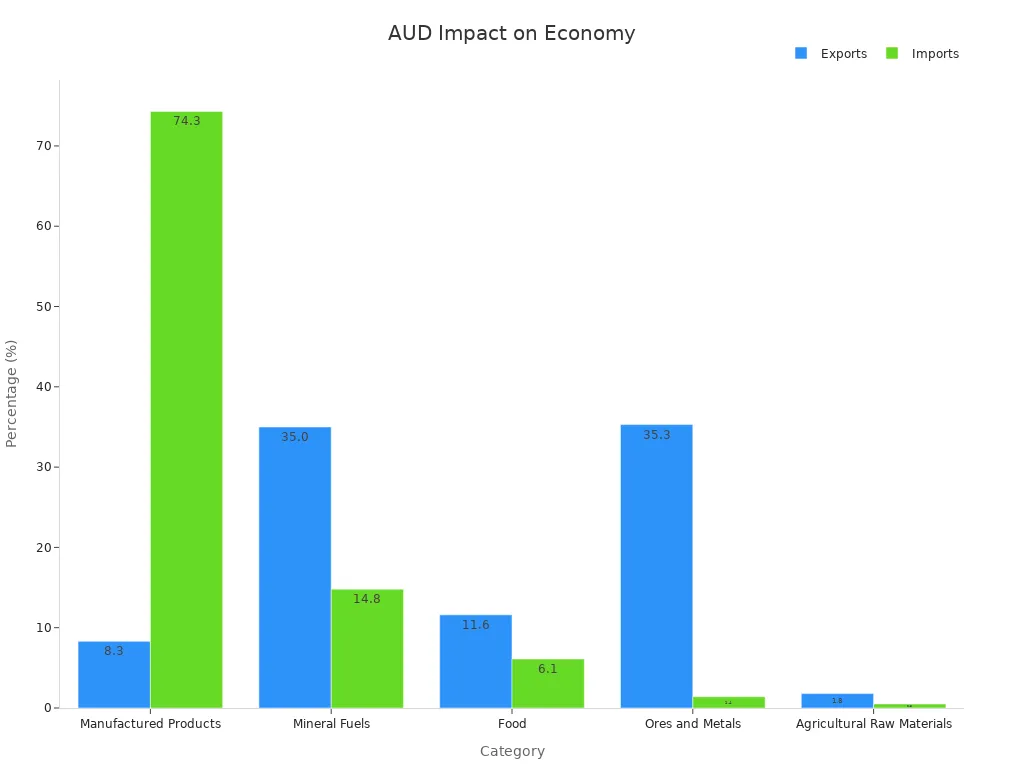
The Australian Dollar is more than just a medium of exchange; it is a cornerstone of Australia’s economic stability. A strong AUD reflects a healthy trade balance, driven by the country’s robust export sector. For instance, mineral fuels and ores account for over 70% of Australia’s exports, with iron ore being the largest contributor. Rising prices for these commodities increase demand for the AUD, strengthening its value.
|
Indicator |
Description |
|
Trade Balance |
A positive Trade Balance strengthens the AUD, as it indicates higher demand for Australian exports. |
|
Interest Rates |
Set by the RBA, higher interest rates compared to other countries support the AUD. |
|
Health of Chinese Economy |
As Australia's largest trading partner, a strong Chinese economy increases demand for Australian goods, boosting the AUD. |
|
Price of Iron Ore |
As Australia's largest export, rising prices of Iron Ore lead to increased demand for the AUD. |
The Reserve Bank of Australia also plays a pivotal role in maintaining the currency’s stability. By adjusting interest rates, the RBA influences investment flows and consumer spending, which in turn affect the AUD’s value. A stable Australian currency benefits businesses, investors, and consumers by reducing uncertainty in financial transactions.
History and Evolution of the AUD
Transition from the Australian pound to the Australian Dollar
The Australian Dollar replaced the Australian pound in 1966, marking a pivotal moment in the country’s monetary history. Before this transition, Australia used the Australian pound, which was tied to the British pound. The shift to the AUD introduced a decimal system, simplifying calculations and aligning the currency with modern standards. This change made financial transactions easier for businesses and individuals alike. The introduction of the AUD also reflected Australia’s growing economic independence from Britain.
Key milestones in the history of the Australian currency
The evolution of Australia’s currency spans centuries, with several key milestones shaping its development:
-
Indigenous Australians used shells and stone tools as trade items before European contact.
-
During the early colonial period (1788–1810), barter systems and foreign currencies like Spanish dollars were common.
-
In 1813, the New South Wales pound became the first official colonial currency.
-
The gold rush of the 1850s led to the establishment of the Sydney Mint, where gold coins were produced.
-
The Australian pound replaced colonial currencies in 1910, unifying the monetary system.
-
In 1966, the Australian Dollar was introduced, replacing the pound and adopting a decimal system.
-
Australia issued the world’s first polymer banknotes in 1988, enhancing security and durability.
-
Today, the AUD stands as a key global currency, reflecting Australia’s economic strength.
These milestones highlight the adaptability and innovation of Australia’s monetary system over time.
The AUD’s journey to becoming a major global currency
The Australian Dollar’s rise to global prominence began with its float on December 12, 1983. By allowing the currency’s value to be determined by market forces, the government opened Australia’s economy to international trade and investment. This decision, led by the Hawke and Keating administration, marked a shift from traditional economic policies. Deregulating the financial system and removing tariffs further strengthened the AUD’s position in global markets.
Today, the AUD is one of the most traded currencies worldwide. Its stability and ties to Australia’s resource-rich economy make it a preferred choice for investors and traders. The currency’s journey reflects Australia’s transformation into a modern, globally integrated economy.
Features of the Australian Dollar

Design and security features of Australian banknotes
Australian banknotes stand out for their innovative design and advanced security features. These notes are made from polymer, a durable material that resists wear and tear while making counterfeiting more challenging. You’ll notice transparent windows embedded in the notes, which serve as a key anti-counterfeiting measure. Raised printing adds texture to specific areas, allowing you to verify authenticity by touch.
Other security elements include diffraction grating, which creates a shimmering effect under light, and a coat of arms watermark visible on all polymer bills. These features ensure the Australian Dollar remains one of the most secure currencies globally, protecting its integrity in financial transactions.
Denominations of the AUD: coins and banknotes
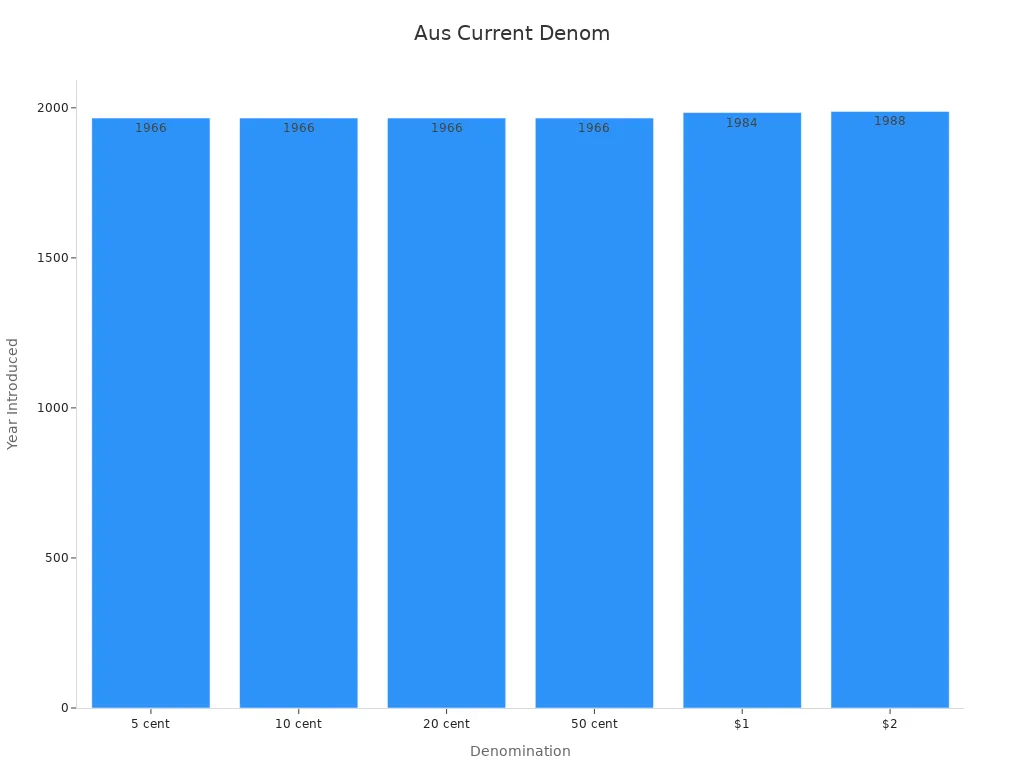
The Australian Dollar offers a range of denominations in both coins and banknotes, catering to various transaction needs. Coins include values of 5 cents, 10 cents, 20 cents, 50 cents, $1, and $2. Banknotes are available in denominations of $5, $10, $20, $50, and $100. While 1-cent and 2-cent coins were introduced in 1966, they were withdrawn from circulation in 1992.
|
Denomination |
Year Introduced |
Legal Tender Status |
|
1 cent |
1966 |
Withdrawn (1992) |
|
2 cent |
1966 |
Withdrawn (1992) |
|
5 cent |
1966 |
Legal tender |
|
10 cent |
1966 |
Legal tender |
|
20 cent |
1966 |
Legal tender |
|
50 cent |
1966 |
Legal tender |
|
$1 |
1984 |
Legal tender |
|
$2 |
1988 |
Legal tender |
This variety ensures you can easily manage transactions, whether small or large, using Australian currency.
The AUD’s role in the global foreign exchange market
The Australian Dollar plays a significant role in the global foreign exchange market. In 2024, the market was valued at USD 160.4 billion, and projections estimate it will reach USD 323.32 billion by 2033. This growth represents a compound annual growth rate (CAGR) of 7.40% from 2025 to 2033.
The AUD’s popularity stems from its stability and ties to Australia’s resource-driven economy. As a major exporter of commodities like iron ore and coal, Australia’s currency attracts traders and investors worldwide. When you engage with the AUD in the foreign exchange market, you’re participating in one of the fastest-growing sectors in global finance.
Practical Aspects of the AUD
Where is the Australian Dollar used?
The Australian Dollar serves as the official currency in Australia and several of its external territories. You will find it widely accepted in regions such as Christmas Island, Norfolk Island, and the Cocos (Keeling) Islands. Beyond these areas, the AUD is also used in Nauru, a small island nation in Micronesia, and the remote Heard Island and McDonald Islands.
|
Country |
Region |
|
Australia |
Australia/New Zealand |
|
Christmas Island |
Australia/New Zealand |
|
Cocos (Keeling) Islands |
Australia/New Zealand |
|
Nauru |
Micronesia |
|
Norfolk Island |
Australia/New Zealand |
|
Heard Island and McDonald Islands |
Australia/New Zealand |
If you plan to visit any of these locations, you can confidently use the AUD for your transactions. Its widespread use in these areas ensures convenience for travelers and residents alike.
How to exchange AUD for other currencies
Exchanging AUD for other currencies is straightforward. You can visit banks, currency exchange offices, or even use online platforms to complete the process. Many airports and tourist hubs also offer exchange services, though these may charge higher fees. To get the best value, compare rates from different providers before making a decision.
For example, the current exchange rate for AUD to USD is 1 AUD = 0.63905 USD. Over the past week, the rate has fluctuated between a high of 0.651 and a low of 0.639. This highlights the importance of timing your exchange to maximize value. Keep an eye on market trends and consider using real-time exchange rate platforms to monitor changes.
-
Current exchange rate for AUD to USD: 1 AUD = 0.63905 USD
-
Change since yesterday: -0.815%
-
Change over the past week: -0.265%
-
Fluctuation range in the past week: High of 0.651, Low of 0.639
When you introduce AUD currency into your financial dealings, understanding these fluctuations can help you make informed decisions. Whether you need to buy Australian dollars or exchange them for another currency, staying updated on rates ensures you get the most out of your money.
Tips for travelers using Australian currency
If you're traveling to Australia, managing your money effectively can enhance your experience. Start by familiarizing yourself with the denominations of Australian coins and banknotes. Carrying a mix of smaller denominations can be helpful for everyday purchases like public transport or snacks.
When deciding how much money to bring to Australia, consider your itinerary and daily expenses. For instance, urban areas like Sydney or Melbourne may require a higher budget compared to smaller towns. Using credit or debit cards is common, but having some cash on hand is always a good idea for emergencies or places that don't accept cards.
You can also save on exchange fees by using local ATMs to withdraw AUD directly. Many banks offer competitive rates, though you should check for any international transaction fees. Planning ahead and budgeting wisely will ensure you make the most of your trip without overspending.
Using the XTransfer Exchange Rate Platform for real-time currency queries
When dealing with currency exchanges, staying updated on real-time rates is crucial. The XTransfer Exchange Rate Platform simplifies this process by providing accurate and instant currency data. Whether you're a traveler, investor, or business owner, this tool ensures you make informed financial decisions.
Key Features of the XTransfer Platform
The XTransfer platform offers several features that make it a reliable choice for real-time currency queries:
-
Live Exchange Rates: Access up-to-the-minute exchange rates for the Australian Dollar (AUD) and other global currencies.
-
User-Friendly Interface: Navigate the platform easily, even if you're new to currency exchange.
-
Historical Data: Review past exchange rate trends to identify patterns and make better predictions.
-
Multi-Currency Support: Check rates for multiple currencies simultaneously, saving you time.
-
Mobile Accessibility: Use the platform on your smartphone, ensuring convenience wherever you are.
How to Use XTransfer for Real-Time Queries
Using the XTransfer platform is straightforward. Follow these steps to get started:
-
Visit the Website or Open the App: Go to the XTransfer website or launch the mobile app.
-
Select Your Currencies: Choose AUD and the currency you want to exchange it with.
-
View Real-Time Rates: Instantly see the current exchange rate and any recent fluctuations.
-
Set Alerts: Enable notifications to receive updates when rates reach your desired level.
-
Analyze Trends: Use the historical data feature to understand how rates have changed over time.
Why Choose XTransfer?
The XTransfer platform stands out for its accuracy and ease of use. It eliminates guesswork by providing reliable data, helping you avoid unfavorable exchange rates. Whether you're planning a trip or managing international transactions, XTransfer ensures you stay ahead in the currency market.
|
Feature |
Benefit |
|
Real-Time Updates |
Make decisions based on the latest exchange rates. |
|
Historical Insights |
Understand trends to predict future rate movements. |
|
Multi-Currency Support |
Compare rates for multiple currencies in one place. |
|
Mobile Compatibility |
Access the platform anytime, anywhere. |
By incorporating XTransfer into your financial toolkit, you gain a competitive edge in managing currency exchanges. Its real-time updates and user-friendly features make it an essential resource for anyone dealing with the Australian Dollar or other currencies.
Investment Opportunities and Risks
Investing in the AUD through forex trading
Investing in the Australian Dollar through forex trading offers unique opportunities. The AUD is closely tied to Australia’s resource-driven economy, making it a popular choice for traders. Its value often fluctuates based on commodity prices, such as gold and iron ore, and economic indicators like GDP growth and inflation. The AUD/USD pair is one of the most traded currency pairs globally, influenced by decisions from the Reserve Bank of Australia and the U.S. Federal Reserve.
You can also use the AUD as a diversification tool in portfolios focused on Asian economies. Australia’s strong trade relationship with China makes the AUD a reflection of economic trends in the Asia-Pacific region. By monitoring economic data like trade balances and employment rates, you can make informed decisions when trading the AUD in the forex market.
Factors influencing the value of the Australian Dollar
Several macroeconomic indicators and global events impact the value of the AUD. Understanding these factors can help you predict currency movements and make better investment decisions.
|
Indicator/Event |
Impact on AUD Value |
|
GDP Growth Rate |
Strong growth signals a healthy economy, attracting foreign investment and boosting AUD. |
|
Inflation Rates |
High inflation can erode confidence, leading to a weaker AUD. |
|
Employment Changes |
Increased employment boosts investor confidence, elevating AUD value. |
|
Trade Balance |
A positive trade balance supports AUD value as it indicates strong export performance. |
|
Commodity Prices |
Rising global demand for Australian exports increases AUD value; falling prices decrease it. |
|
Interest Rates |
Higher rates attract foreign capital, increasing AUD value; lower rates can weaken it. |
|
Geopolitical Events |
Political stability and trade relationships impact AUD; tensions can lead to volatility. |
By keeping an eye on these indicators, you can better understand the factors driving the AUD’s value.
Risks and considerations for AUD investments
Investing in the AUD comes with risks that you should carefully evaluate. Changes in U.S. trade policies can create market volatility, directly affecting the Australian Dollar. Additionally, the AUD’s reliance on commodity prices means that global demand fluctuations can lead to unpredictable movements.
To manage these risks, you need to stay informed about market conditions and adopt effective strategies. Diversifying your investments and setting clear financial goals can help you navigate the challenges of forex trading. Understanding the AUD’s sensitivity to global events ensures you make well-informed decisions.
The Australian Dollar plays a crucial role in global trade and finance. Its stability and ties to Australia’s resource-driven economy make it a reliable currency for international transactions. For example, iron ore, Australia’s largest export, contributes $118 billion annually, with China as the primary destination. A positive trade balance strengthens the AUD, while a negative balance weakens it.
|
Evidence Type |
Details |
|
Major Export |
Iron Ore is Australia's largest export, accounting for $118 billion a year (2021 data). |
|
Primary Destination |
China is the primary destination for Australian Iron Ore exports. |
|
Trade Balance Impact |
A positive trade balance strengthens the AUD, while a negative balance weakens it. |
The AUD’s recent decline to 61.44 US cents, down from 69 US cents, highlights its investment potential. A weaker currency benefits export-oriented industries, increasing revenues for sectors like mining. Tools like the XTransfer Exchange Rate Platform simplify currency management, offering real-time insights for travelers, businesses, and investors.
-
The Australian Dollar (AUD) has recently dropped to 61.44 US cents, down from over 69 US cents per barrel at the end of September.
-
A weaker AUD benefits export-oriented businesses, potentially increasing revenues for sectors like mining due to higher demand for Australian commodities.
The AUD’s rich history, unique features, and practical applications make it indispensable for global trade and investment.
FAQ
What is the symbol for the Australian Dollar?
The Australian Dollar uses the "$" symbol, but it is often written as "A$" or "AUD" to distinguish it from other dollar currencies like the US Dollar.
Can you use the Australian Dollar outside of Australia?
Yes, you can use the Australian Dollar in Australia’s external territories, such as Christmas Island and Norfolk Island. It is also accepted in Nauru and some Pacific regions.
How does the Reserve Bank of Australia influence the AUD?
The Reserve Bank of Australia (RBA) sets interest rates and implements monetary policies. These actions impact the AUD’s value by influencing inflation, investment, and economic growth.
Are Australian banknotes made of paper?
No, Australian banknotes are made of polymer. This material increases durability and includes advanced security features like transparent windows and raised printing to prevent counterfeiting.
Why is the AUD called the "Aussie"?
The nickname "Aussie" reflects Australia’s informal and friendly culture. It is widely used in financial markets to refer to the Australian Dollar.
Related content