
What is Euro to Dollar? Euro to Dollar Definition, Mechanism, and B2B Application
Author:XTransfer2026.01.13Euro to Dollar
EUR/USD Definition: The Exchange Rate Connecting Europe and America
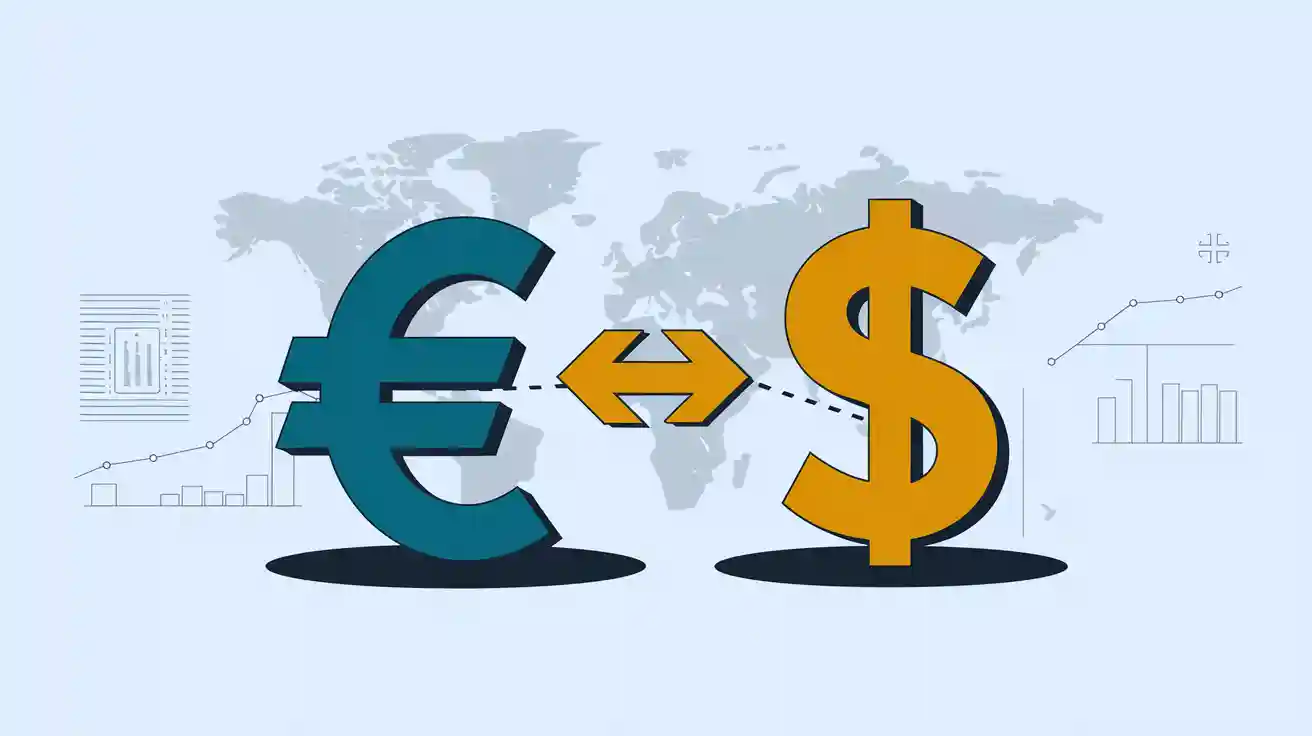
Euro to Dollar (EUR/USD) refers to the exchange rate that shows how many US dollars are required to purchase one euro, serving as a key benchmark in global trade and cross-border business transactions. As the most traded currency pair in the world, EUR/USD accounts for approximately 23% of all foreign exchange transactions, making it the primary indicator of relative economic strength between the Eurozone and the United States.
How to read the rate: When EUR/USD quotes at 1.10, this means one euro exchanges for 1.10 US dollars. If the rate rises to 1.15, the euro has strengthened—each euro now buys more dollars. If it falls to 1.05, the euro has weakened—each euro buys fewer dollars. This seemingly simple number affects billions of dollars in daily trade between Europe and America.
Understanding the EUR/USD Exchange Rate Mechanics
Base Currency and Quote Currency Structure
EUR/USD follows forex convention where the first currency (EUR) is the base currency and the second (USD) is the quote currency. The rate always expresses how much quote currency (dollars) one unit of base currency (euro) purchases. This standardization allows instant comparison across time periods and between different currency pairs.
Reciprocal relationship means USD/EUR shows the inverse—how many euros one dollar buys. If EUR/USD is 1.10, then USD/EUR is approximately 0.909 (calculated as 1 ÷ 1.10). Markets primarily quote EUR/USD rather than USD/EUR because the euro serves as base currency in this major pair.
How the Rate is Determined
EUR/USD floats freely based on supply and demand in the global foreign exchange market, which operates 24 hours daily across global financial centers. When demand for euros exceeds supply—perhaps because European exports are strong or investors want European assets—the euro strengthens and EUR/USD rises.
Market participants include commercial banks executing client transactions, corporations hedging international business exposure, investment funds allocating between dollar and euro assets, central banks managing reserves or intervening to influence rates, and speculators betting on rate movements. Their combined trading creates the observed exchange rate.
No single entity sets the EUR/USD rate, though the European Central Bank and US Federal Reserve significantly influence it through monetary policy. When the Fed raises interest rates while the ECB holds steady, dollars typically strengthen (EUR/USD falls) as investors seek higher dollar returns. When the ECB tightens policy more aggressively than the Fed, the opposite occurs.
Factors Influencing EUR/USD Movements
Interest Rate Differentials
Interest rate differences between the Eurozone and United States represent perhaps the single most important EUR/USD driver. Higher US interest rates attract capital flows toward dollar assets seeking better returns, strengthening the dollar. Higher European rates create the opposite effect, strengthening the euro.
Central bank policy divergence creates significant rate movements. When the Federal Reserve raised rates aggressively in 2022-2023 to combat inflation while the ECB moved more cautiously, EUR/USD fell from approximately 1.15 to near parity (1.00), representing a substantial euro weakening. Businesses with euro-dollar exposure saw major impacts on profitability.
Forward-looking expectations matter more than current rates. If markets anticipate Fed rate cuts or ECB rate increases, EUR/USD moves before policy changes actually occur, incorporating expected future rate differentials into present exchange rates.
Economic Growth and Data Releases
Stronger economic growth in the Eurozone relative to the US tends to strengthen the euro as investors perceive better growth prospects for European investments. GDP reports, employment data, manufacturing indices, and consumer confidence figures all influence EUR/USD when they diverge from expectations.
Economic surprises move markets. If Eurozone GDP grows 2.5% when forecasts predicted 2.0%, EUR/USD typically rises on the positive surprise. If US unemployment falls more than expected, indicating economic strength, the dollar often strengthens. Markets constantly evaluate relative economic performance between the two currency zones.
Trade balances affect EUR/USD over longer periods. The Eurozone typically runs trade surpluses (exports exceed imports), creating structural demand for euros as foreign buyers need euros to pay European exporters. US trade deficits create structural dollar selling. However, capital flows often overwhelm trade effects in determining exchange rates.
Inflation and Central Bank Response
Inflation differentials influence exchange rates both directly through purchasing power and indirectly through expected central bank responses. Higher inflation in the US than Europe should theoretically weaken the dollar, though if the Fed responds with aggressive rate increases, the dollar might strengthen from higher rates despite higher inflation.
Inflation expectations embedded in markets appear in various indicators including inflation-protected securities yields and consumer surveys. When markets expect rising European inflation requiring ECB tightening, EUR/USD often strengthens before actual policy changes occur.
Political Events and Risk Sentiment
European political instability—elections in major member states, conflicts over EU fiscal rules, concerns about Eurozone cohesion—typically weakens the euro as risk-averse investors flee toward dollar "safe haven" assets. US political uncertainty can have similar effects on the dollar, though the dollar's reserve currency status complicates these relationships.
Geopolitical crises usually strengthen the dollar regardless of where crises occur. During global uncertainty, investors worldwide typically buy US Treasury securities and dollar assets as safe stores of value, increasing dollar demand and strengthening it against most currencies including the euro.
EUR/USD in Business Transactions
Export and Import Pricing
European exporters to the United States face critical decisions about invoice currency. Invoicing in euros eliminates their exchange rate risk but pushes it onto American buyers who must acquire euros for payment. Invoicing in dollars shifts risk to European exporters who receive dollars requiring conversion to euros.
Competitive dynamics often determine currency choice. A German machinery manufacturer competing against American producers might invoice in dollars to match competitor pricing and eliminate currency concerns for customers. A specialized European producer with unique products might invoice in euros, requiring buyers to accept currency risk.
American importers from Europe prefer dollar invoicing to avoid euro exposure, while European exporters prefer euro invoicing for the same reason. Negotiating power and industry practices determine which party typically bears currency risk in specific markets.
Payment Timing and Rate Exposure
Time between contract signature and payment creates exchange rate exposure. A contract signed today for payment in 90 days locks the euro or dollar amount but leaves the converted value uncertain. If an American importer agrees to pay €100,000 in 90 days when EUR/USD is 1.10, they expect to pay $110,000. If EUR/USD rises to 1.15 by payment date, the cost increases to $115,000—a $5,000 loss purely from currency movement.
Extended payment terms amplify exposure. Net 30 day terms create 30 days of rate risk. Net 90 day terms create 90 days. Open account terms with quarterly settlement create three months of exposure per payment. Conservative businesses hedge these exposures through forward contracts or other instruments.
Progress payments and milestone billing reduce exposure by shortening the time between invoice date and payment date. A €1 million contract paid in five €200,000 installments over project completion creates less rate risk than a single €1 million payment at project end.
Multi-Currency Business Operations
Companies operating in both Eurozone and United States with revenues and expenses in both currencies create natural hedges. A business earning euros from European sales while paying dollars for American supplies offsets exposures—euro revenues naturally hedge euro payment obligations.
Treasury management for multi-currency operations requires sophisticated approaches. Centralizing foreign exchange through dedicated treasury functions or platforms allows netting exposures across business units, optimizing conversion timing, and accessing better rates through larger transaction sizes.
Managing EUR/USD Exchange Rate Risk
Forward Contracts for Rate Certainty
Forward contracts lock EUR/USD rates for future dates, eliminating uncertainty for planned transactions. A European exporter expecting to receive $500,000 in 60 days can sell a 60-day forward contract, guaranteeing the conversion rate today regardless of spot rate movements.
Forward rates differ from spot rates based on interest rate differentials between currencies. If US interest rates exceed Eurozone rates by 2% annually, 12-month EUR/USD forwards will trade at a discount to spot—fewer dollars per euro in the forward than spot—reflecting the interest rate difference.
Forward contract costs or benefits depend on whether the forward rate is better or worse than the spot rate at contract maturity. If you lock EUR/USD at 1.10 via forward and spot ultimately reaches 1.12, you've "lost" 0.02 per euro compared to converting at spot. However, if spot falls to 1.08, you've "gained" 0.02 per euro. Forwards provide certainty, not profit.
Options for Flexible Protection
Currency options provide rate protection while preserving ability to benefit from favorable movements. A put option on euros (call option on dollars) guarantees a minimum EUR/USD rate while allowing participation in higher rates if the euro strengthens. This flexibility costs option premiums.
Collar strategies combine buying protective options with selling options at favorable rates, using premium from sold options to offset cost of purchased protection. This creates a rate band within which the business accepts exposure while protecting against movement beyond the band.
Natural Hedging Through Business Structure
Matching currency of revenues and expenses provides the most cost-effective hedging. A European company with US operations can naturally hedge by using dollar revenues to pay dollar expenses—American subsidiary salaries, rent, and local suppliers get paid from American customer receipts without currency conversion.
Strategic sourcing decisions consider currency matching. A European manufacturer buying components might prefer US suppliers payable in dollars if their products sell in the US market for dollars. Dollar revenues naturally hedge dollar costs without requiring financial hedging instruments.
EUR/USD for Different Industries and Business Types
Technology and Software Services
European software companies selling to American enterprises typically invoice in dollars to align with customer expectations and standard software industry pricing in dollars. This creates euro-dollar exposure as euro costs (European employee salaries, offices) are paid with dollar revenues.
SaaS subscription models with monthly recurring revenue create ongoing currency exposure. A European company with $10 million annual recurring revenue from American customers has continuous dollar-to-euro conversion needs, typically handled through systematic hedging or multi-currency accounts optimizing conversion timing.
Manufacturing and Industrial Trade
European manufacturers exporting machinery, automobiles, or industrial equipment to the US face significant per-transaction exposure given high product values. A €500,000 machine order creates substantial currency risk during the manufacturing and payment period.
Customized manufacturing with long production cycles creates extended exposure periods. If a German manufacturer receives an order today for delivery in nine months with payment on delivery, they face nine months of EUR/USD exposure between agreeing to the euro price and receiving dollar payment.
Fashion and Consumer Goods
European luxury brands selling in the US market typically maintain dollar pricing but translate revenues to euros for European parent companies. Brand positioning requirements often override currency optimization—a luxury handbag maintaining stable dollar price points for market positioning requires the European manufacturer to absorb EUR/USD volatility.
Fast fashion retailers importing European products to US stores manage continuous currency exposure through inventory cycles. Purchase orders in euros for goods selling in the US for dollars create exposure from order placement through inventory sale, requiring active currency management.
Financial Services and Investment Management
European investment managers with American clients or dollar-denominated portfolios continuously manage EUR/USD exposure. A European hedge fund with dollar assets but euro expenses and euro-based investors faces complex currency considerations in performance measurement and fee calculations.
Cross-border M&A transactions denominating deal values in euros or dollars create massive one-time currency exposures. A $5 billion acquisition of a European company by an American firm involves converting dollars to euros at agreed rates, with rate movements potentially affecting final costs significantly.
Technology Platforms Supporting EUR/USD Transactions
Real-Time Rate Access and Transparency
Modern B2B payment platforms provide real-time EUR/USD rates updated continuously as market rates change. This transparency allows businesses to make informed decisions about conversion timing and understand exact costs before committing to transactions.
Rate alerts notify businesses when EUR/USD reaches target levels, enabling strategic conversion timing. A European exporter wanting to convert dollars to euros when EUR/USD falls below 1.08 (meaning each euro costs fewer dollars, so dollars convert to more euros) can automate conversion when rates hit that target.
Multi-Currency Account Management
Platforms like XTransfer allow businesses to hold both euros and dollars in the same account, converting between currencies only when needed or when rates are favorable. This eliminates forced conversion timing and reduces transaction costs by enabling accumulation and batch conversion.
Netting capabilities across multiple transactions reduce total conversion volumes. A business receiving €100,000 while owing $110,000 can net these obligations if EUR/USD is 1.10, eliminating the need for two separate conversions and associated costs.
Automated Compliance and Documentation
International EUR/USD payments require compliance with both European and US regulations including anti-money-laundering verification, sanctions screening, and transaction documentation. Automated platforms handle these requirements, reducing manual compliance work and errors.
Audit trails created by digital platforms document exchange rates applied, fees charged, and payment purposes for regulatory reporting, tax filing, and internal auditing. This documentation proves increasingly valuable as cross-border transaction regulations tighten globally.
EUR/USD Historical Trends and Patterns
Long-Term Historical Perspective
The euro launched in 1999 at approximately EUR/USD 1.17, fell below parity (1.00) to about 0.85 by 2001, climbed to 1.60 by 2008, fell back toward 1.20-1.40 through the 2010s, reached near-parity again in 2022, and has fluctuated in the 1.05-1.15 range through 2026.
Major historical drivers included the 2008 global financial crisis where dollars strengthened as a safe haven, the European sovereign debt crisis of 2010-2012 weakening the euro, massive quantitative easing by both central banks affecting interest rate differentials, and pandemic-related policy divergences.
Seasonal and Cyclical Patterns
Some currency analysts identify seasonal EUR/USD patterns, though their reliability is debated. The "September effect" sometimes shows euro weakness, attributed to European vacation season ending and corporate foreign exchange activities resuming. Year-end repatriation flows as multinational companies consolidate foreign earnings can create temporary rate movements.
Economic cycles in the Eurozone and US don't synchronize perfectly, creating multi-year EUR/USD trends. When European growth accelerates while US growth slows, the euro typically strengthens. The opposite pattern weakens the euro. These relative growth cycles can persist for years.
Costs and Fees in EUR/USD Conversion
Bank Charges and Markups
Traditional banks typically apply 1-3% markup to mid-market EUR/USD rates plus charge explicit wire transfer fees ($25-50 for international transfers). Total costs for small businesses can reach 3-4% of transaction value when combining rate markups and fees.
Opaque pricing where banks quote only final converted amounts without breaking down mid-market rate versus markup makes cost comparison difficult. Sophisticated businesses demand transparent pricing showing exact rate applied and all fees separately.
Payment Platform Advantages
Specialized B2B payment platforms offer EUR/USD conversion at significantly lower costs than traditional banks—often 0.3-0.8% total including rate margin and fees. Higher transaction volumes and technology-driven efficiency enable better pricing.
Volume-based pricing rewards businesses with regular EUR/USD transactions. A company converting €100,000 monthly might pay 0.5% while one converting €10,000 monthly pays 0.8%. Consolidating transactions to achieve better pricing makes sense when feasible.
Frequently Asked Questions About Euro to Dollar Exchange
What does it mean when EUR/USD rises or falls?
Rising EUR/USD means the euro is strengthening—each euro buys more dollars. For example, EUR/USD rising from 1.10 to 1.15 means the euro gained value. Falling EUR/USD means the euro is weakening—each euro buys fewer dollars. This affects businesses differently: European exporters to the US prefer a weaker euro (lower EUR/USD) making their products cheaper for American buyers.
How often does the EUR/USD rate change?
EUR/USD rates change continuously during market hours as the forex market operates 24 hours daily Monday through Friday. Rates update second-by-second based on supply and demand. For business purposes, banks and platforms typically quote rates that hold for brief periods (seconds to minutes) before updating.
What is a good EUR/USD rate for my business?
This depends entirely on your business position. European exporters receiving dollars prefer higher EUR/USD rates (stronger euro), maximizing euros received per dollar. American importers paying euros prefer lower EUR/USD rates (weaker euro), minimizing dollars spent per euro. There's no universally "good" rate—it depends on your currency exposure direction.
Should I convert euros to dollars immediately or wait?
This depends on your currency risk tolerance, cash flow needs, and market outlook. Immediate conversion provides certainty but eliminates potential gains from favorable rate movements. Waiting creates risk of unfavorable movements but opportunity for favorable ones. Conservative businesses prefer certainty through immediate conversion or hedging. Risk-tolerant businesses with strong cash positions might take selective conversion timing views.
How do I protect my business from EUR/USD volatility?
Forward contracts lock future rates, eliminating uncertainty. Options provide protection while preserving upside potential. Multi-currency accounts allow holding both euros and dollars, converting only when needed. Natural hedging matches euro revenues with euro expenses. The best approach depends on transaction size, frequency, and risk tolerance. Many businesses combine multiple strategies.
What causes major EUR/USD movements?
Central bank policy divergence (especially interest rate differences), unexpected economic data releases, political events affecting Europe or the US, geopolitical crises, and changes in market risk appetite all drive significant EUR/USD movements. Major policy announcements from the Federal Reserve or European Central Bank often trigger immediate substantial rate changes.
Is EUR/USD more volatile than other currency pairs?
EUR/USD shows moderate volatility compared to other major pairs. It's less volatile than emerging market currencies but can still move 1-2% daily during major events. Typical daily movement ranges 0.3-0.5% in normal conditions. The pair's deep liquidity actually reduces volatility compared to less-traded pairs with thinner markets.
Can I negotiate better EUR/USD rates with my bank?
Possibly, especially for larger transaction sizes or regular volume. Banks have discretion to adjust rate markups for valuable clients. However, specialized payment platforms often offer better baseline rates than even negotiated bank rates. Comparing multiple providers and consolidating volume with preferred partners generally achieves best pricing.
Related content