
THB Currency Basics for Everyday Use
Author:XTransfer2025.07.30THB
The Thai baht serves as the official currency of Thailand and plays a vital role in the country’s daily transactions. Whether you buy street food, pay for a taxi, or shop at local markets, you will need to use this currency. For travelers, understanding the Thai baht is essential to manage expenses efficiently. Globally, the THB currency ranks among the top 20 most traded currencies, reflecting its importance in international markets. As of November 2023, the exchange rate stood at 22.5 baht per AUD, with predictions suggesting slight fluctuations in the coming months. This stability makes the Thai baht a reliable currency for visitors.
Understanding the Thai Baht
A brief history of the Thai baht
The Thai baht has a rich history that reflects Thailand's economic and cultural evolution. As the official currency of Thailand, it has been in use for centuries. Historically, the baht originated as a unit of weight for silver and gold, which were used in trade. Over time, it transitioned into a standardized currency system. In 1902, the government introduced modern banknotes and coins, replacing the traditional use of silver and cowrie shells.
One of the most significant events in the baht's history occurred during the 1997 Asian financial crisis. At that time, Thailand unpegged the baht from the U.S. dollar, leading to a sharp devaluation. This decision caused widespread economic challenges but also prompted reforms in monetary policies. Today, the Thai baht remains a symbol of resilience and adaptability, reflecting the country's ability to overcome economic hardships.
The significance of the THB currency in Thailand’s economy
The Thai baht plays a crucial role in Thailand's economy. It facilitates daily transactions, supports international trade, and influences the country's financial stability. As a traveler, you will notice that the baht is essential for everything from buying food to paying for transportation. Its stability makes it a reliable currency for both locals and visitors.
Thailand's economic policies are closely tied to the baht's performance. For example, the 1997 financial crisis highlighted the importance of managing exchange rate volatility. Since then, the government has implemented strategies to stabilize the baht and boost export competitiveness. These policies include monitoring global economic conditions and adjusting interest rates to maintain balance.
Recent data shows how the baht impacts the economy. In May 2023, the exchange rate stood at 33.1280 THB per USD, reflecting a 0.39% increase. Additionally, Thailand's inflation rate in April 2025 was -0.22%, while the interest rate was 1.75%. These figures demonstrate the government's efforts to maintain economic stability and market confidence.
|
Date |
USD/THB |
Change (%) |
|
May 9, 2023 |
33.1280 |
+0.39% |
|
Historical High |
56.50 |
N/A |
The baht's recent appreciation signals recovery in the Thai economy. It also highlights the growing confidence of international markets in Thailand's financial system. As you use the baht during your travels, you are participating in an economy shaped by its history and ongoing efforts to ensure stability.
Thai Baht Denominations
Coins: Common values and how to identify them
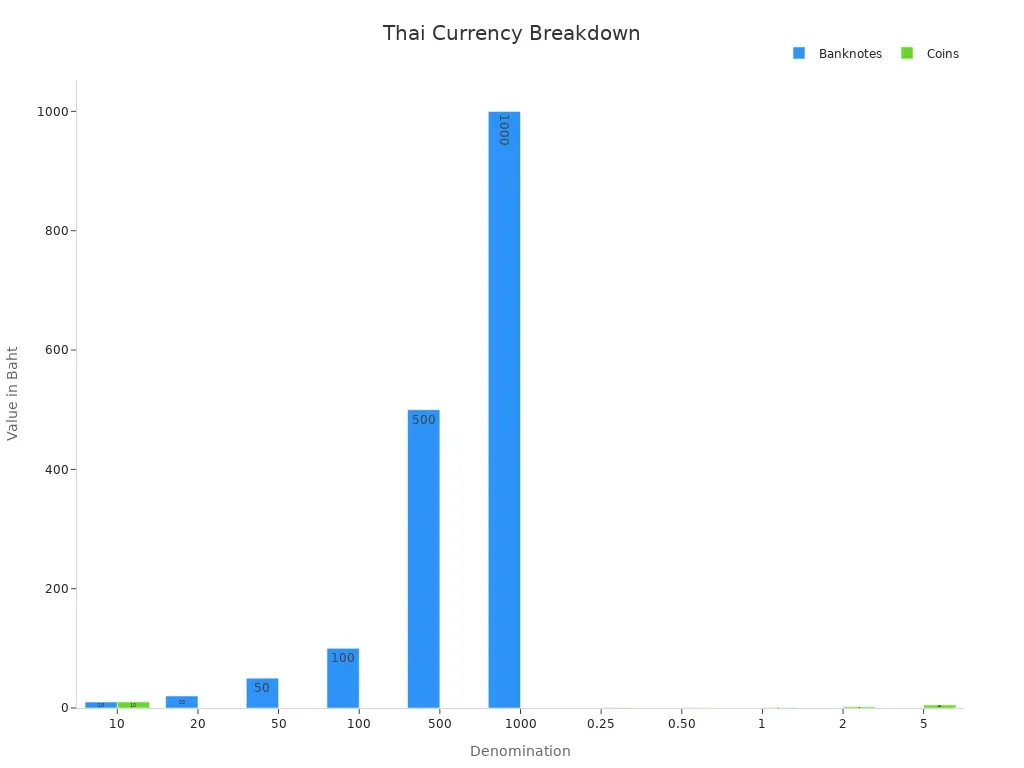
Thai baht coins are an essential part of daily transactions in Thailand. You will encounter coins in various denominations, ranging from small satang coins to larger baht coins. The most common coins include:
-
25 satang and 50 satang: These are the smallest denominations. They are rarely used but may appear in supermarkets or when receiving change.
-
1 baht, 2 baht, 5 baht, and 10 baht: These coins are widely used for everyday purchases, such as paying for street food or public transportation.
Each coin has unique features to help you identify it. For example, the 10-baht coin has a two-tone design, with a silver outer ring and a gold-colored center. The 5-baht coin is slightly larger than the 2-baht coin, making it easy to distinguish. Familiarizing yourself with these coins will make your transactions smoother.
Banknotes: Denominations and key features
Thai baht currency denominations for banknotes include 10, 20, 50, 100, 500, and 1,000 baht. These notes are color-coded for easy identification:
-
10 baht: Brown
-
20 baht: Green
-
50 baht: Blue
-
100 baht: Red
-
500 baht: Purple
-
1,000 baht: Gray
Each banknote features a portrait of King Maha Vajiralongkorn on the front and significant cultural or historical imagery on the back. Security features, such as watermarks, color-shifting ink, and raised printing, help prevent counterfeiting.
Recognizing and avoiding counterfeit currency
Counterfeit currency is rare in Thailand, but you should still remain cautious. To avoid accepting fake notes, always check for the following security features:
-
Watermarks: Hold the note up to the light to see the watermark image.
-
Raised printing: Feel the texture of the note, especially on the portrait and numerals.
-
Color-shifting ink: Tilt the note to observe changes in the ink color.
If you suspect a counterfeit note, refuse to accept it and notify the nearest bank or police station. Staying vigilant will ensure you handle only genuine Thai baht.
Exchanging THB Currency
Where to exchange Thai baht (banks, exchange counters, airports)
When exchanging Thai baht, choosing the right location can save you money. Banks, exchange counters, and airports are common options, but their rates and fees vary. Banks often provide reliable services, but their rates differ depending on the branch. For example:
|
Location |
Exchange Rate (THB) |
Difference from Mid-Market Rate (%) |
|
Kasikornthai (best branch) |
Same as best rates |
~1% lower |
|
Other Kasikornthai branches |
Much lower rates |
7-8% lower |
|
Super Rich and Happy Rich |
Lower for smaller notes |
6-8% lower |
|
General airport exchange booths |
6-8% lower |
6-8% lower |
Exchange counters like Super Rich and Happy Rich are popular for their competitive rates, but they may offer lower rates for smaller notes. Airport exchange booths are convenient but typically charge 6-8% more than mid-market rates. If you must exchange currency at the airport, head to the underground level near the Airport Rail Link for better rates.
Tips for getting the best exchange rates
To get the best currency exchange rate, plan your transactions wisely. Exchanging money in Thailand often yields better rates than doing so in your home country. Visit reputable exchange counters like Super Rich for competitive rates. Avoid exchanging large amounts at airports unless absolutely necessary. Always check the current rate before making a transaction to ensure you’re getting a fair deal.
Using the XTransfer Exchange Rate Platform for real-time rates
The XTransfer Exchange Rate Platform is a valuable tool for managing your currency exchanges. It provides real-time updates, allowing you to view live rates instantly. You can also access historical data to analyze trends and make informed decisions. The platform offers customizable alerts, so you can act quickly when the rate reaches your desired level. Using this platform ensures you stay updated and maximize the value of your currency exchanges.
Practical Tips for Using Thai Baht
Cash vs. cards: When to use each in Thailand
When deciding between cash and cards in Thailand, understanding the local payment landscape is essential. While cash remains widely accepted, especially in rural areas and small businesses, card payments are becoming increasingly popular. Since 2017, Thailand has been transitioning toward a cashless society. Digital payment methods, including credit and debit cards, e-wallets, and QR code payments, are now common in urban areas. In 2023, the total transaction value in the digital payment sector reached $33 billion, with projections to grow to $55 billion by 2027. This shift highlights the convenience of using cards for daily transactions, particularly in cities.
You should carry cash for small purchases like street food, market shopping, or transportation in tuk-tuks. However, cards are ideal for larger expenses, such as hotel bills or shopping at malls. Many establishments accept Visa and Mastercard, but American Express may not be as widely recognized. Always check for additional fees when using cards, as some merchants may impose a surcharge.
Using ATMs: Fees, safety, and best practices
ATMs in Thailand are a convenient way to access cash, but you should be aware of fees and safety measures. Most ATMs charge a withdrawal fee for foreign cards. Aeon Bank offers the lowest fee at 150 THB, while other banks charge up to 220 THB per transaction. Additionally, your home bank may impose foreign transaction fees. If the ATM offers currency conversion, decline it to avoid unfavorable exchange rates.
For safety, follow these best practices:
-
Use ATMs located inside bank branches or secure areas with security personnel.
-
Cover your PIN when entering it and never share it with anyone.
-
Avoid using ATMs in isolated or poorly lit areas, especially at night.
-
Carry emergency cash and a backup ATM card, storing them in separate locations.
Note: Confirm the fees displayed on the ATM screen before proceeding with a transaction. This helps you avoid unexpected charges.
General safety tips for handling cash in Thailand
Handling cash safely in Thailand requires careful planning. Maintain an optimal cash stock level to meet your needs without carrying excessive amounts. This minimizes the risk of loss or theft. For example, withdrawing smaller amounts more frequently can help you manage your travel money effectively.
A study on cash management in Thailand suggests using predictive models to estimate withdrawal needs. While this may not apply directly to travelers, it highlights the importance of planning. Strategies like reducing cash stock by 10% can lower risks and costs associated with carrying large sums.
|
Best Practices for Cash Management in Thailand |
Description |
|
Optimal Cash Stock Levels |
Maintain enough cash for daily needs while avoiding excess. |
|
Emergency Cash |
Keep a small reserve in a secure location for emergencies. |
|
Secure Storage |
Use a money belt or hotel safe to store cash securely. |
By following these tips, you can use the official currency of Thailand confidently and safely during your trip.
Understanding the THB currency is essential for managing your expenses in Thailand. Familiarizing yourself with Thai baht denominations, exchange options, and safety tips ensures smooth transactions during your trip. Staying informed about the best exchange rate options helps you maximize the value of your money.
Using tools like the XTransfer Exchange Rate Platform simplifies this process. Many users, including Mr. Ahmad John from Uzbekistan, praise its efficient financial services. Ms. Muskan Somaya from India highlights how it streamlines payments in local currency, while Mr. Michael Fabiyi from Nigeria appreciates the knowledgeable staff who reduce risks. These features make XTransfer a reliable choice for accurate and real-time currency rates.
FAQ
1. Can you use foreign currency in Thailand?
Thailand primarily uses the Thai baht for transactions. Foreign currencies are rarely accepted, except at major hotels or tourist shops. Always exchange your money into baht before making purchases.
2. Are credit cards widely accepted in Thailand?
Credit cards are accepted at hotels, malls, and restaurants in urban areas. However, cash is preferred for small businesses and street vendors. Visa and Mastercard are the most commonly accepted cards.
3. What is the best way to avoid ATM fees in Thailand?
Use ATMs from Aeon Bank for lower fees. Decline currency conversion offers to avoid unfavorable rates. Withdraw larger amounts less frequently to minimize transaction costs.
|
Bank Name |
Fee (THB) |
|
Aeon Bank |
150 |
|
Other Banks |
220 |
4. How can you check if a Thai banknote is genuine?
Inspect the watermark by holding the note to the light. Feel the raised printing on the portrait and numerals. Tilt the note to observe color-shifting ink.
5. Is it better to exchange money before arriving in Thailand?
Exchanging money in Thailand often provides better rates than in your home country. Visit reputable exchange counters like Super Rich for competitive rates. Avoid airport booths unless necessary.
Related content