
South Korean Won (KRW): More Than K-pop and Kimchi – The Hidden Story of Korea’s Currency
Author:XTransfer2025.08.20KRW
Few currencies show a country’s culture like the KRW Currency. South Korea’s banknotes have special holograms and moving taegeuk shapes. These features help stop people from making fake money. The KRW Currency is the only money you can use in South Korea. Its design shows famous artists and important national symbols. K-pop and kimchi are known around the world. But the story of Korea’s money is still not well known.
Highlights
-
The South Korean won (KRW) is the money used in South Korea. Coins and bills show important symbols and famous people from history.
-
KRW bills have special safety features like holograms and color-changing ink. They also have raised marks to stop fake money and help everyone use them.
-
People in South Korea pay with cash, credit cards, and mobile apps. They also use prepaid cards. This makes paying for things quick and easy.
-
The won has been around for a long time. It shows South Korea’s growth and hard times. Its value goes up and down with world markets. But it stays steady because the government has strong rules.
-
KRW money stands for national pride and culture. It helps South Koreans feel close to their history. It also changes to fit new digital ways to pay.
KRW Currency Basics
What Is KRW?
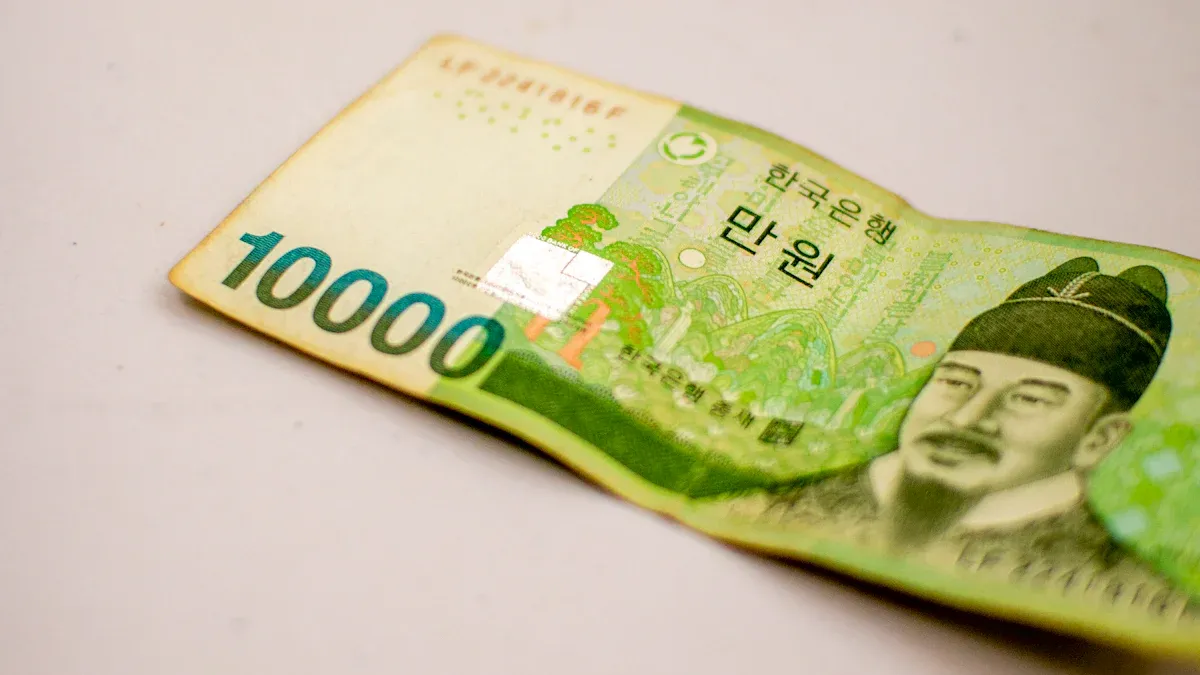
The South Korean Won is the main money in South Korea. The Bank of Korea controls and gives out this money. People know the won by its sign, ₩, and its code, KRW. The KRW Currency is used to buy things and pay for services. The won can be split into 100 jeon, but people do not use jeon anymore. The KRW Currency is a fiat currency. This means it has value because the government says so.
Denominations and Symbol
South Korea uses coins and banknotes every day. Coins you can use are ₩10, ₩50, ₩100, and ₩500. Coins like ₩1 and ₩5 are not used now because of inflation. Banknotes come in ₩1,000, ₩2,000, ₩5,000, ₩10,000, and ₩50,000. The ₩2,000 note is rare and is for special events. The ₩ sign is on all coins and notes, so you can spot the currency.
|
Denomination |
Type |
Common Usage |
|
₩10 |
Coin |
Small purchases |
|
₩50 |
Coin |
Vending machines |
|
₩100 |
Coin |
Public transport |
|
₩500 |
Coin |
Everyday change |
|
₩1,000 |
Note |
Daily transactions |
|
₩2,000 |
Note |
Special occasions |
|
₩5,000 |
Note |
Groceries, shopping |
|
₩10,000 |
Note |
Larger purchases |
|
₩50,000 |
Note |
High-value payments |
Everyday Use
People use the KRW Currency in many ways. Cash is still used for small buys at markets and street shops. In cities, people use credit and debit cards in stores and hotels. Mobile payment apps like KakaoPay, Samsung Pay, and Naver Pay are popular with young people. These apps need a Korean bank account. Prepaid cards like T-Money help people pay for buses, subways, and taxis.
-
KRW Currency can be cash or electronic.
-
Coins and notes are used for most things.
-
Credit and debit cards are common in cities.
-
More people use mobile payment apps now.
-
Prepaid cards make travel easy on public transport.
-
ATMs for foreign cards are in stores, banks, and subways.
-
You can exchange money at airports, banks, and hotels.
The Bank of Korea helps manage the KRW Currency. It controls how much money is in use and sets money rules. The Bank of Korea also looks at digital money and works with the government on new types of money like stablecoins. This keeps the KRW Currency safe and trusted.
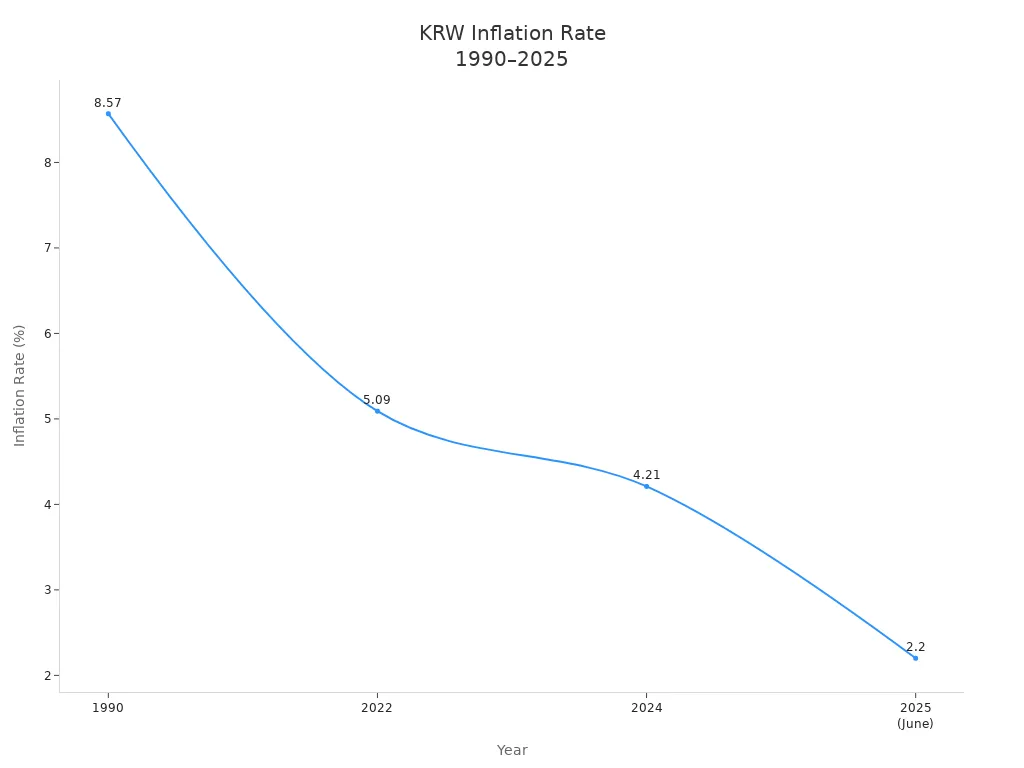
|
Year |
Inflation Rate (%) |
|
1990 |
8.57 |
|
2022 |
5.09 |
|
2024 |
4.21 |
|
2025 (June) |
2.20 |
The Bank of Korea watches inflation and changes rules to keep the KRW Currency strong. This helps the country grow and keeps prices steady for people.
Design and Security
Banknote Features
South Korean banknotes have detailed designs and smart technology. Each note is made with strong paper and special ink. The Bank of Korea adds features to help people spot real notes. Since 2006, every note has at least ten safety features. These make the KRW Currency very safe.
-
You see 3D images when you move the note.
-
The ink changes color if you tilt the note.
-
Watermarks show pictures when you hold the note to light.
-
Omron rings are tiny circles printed on every note.
-
Tactile marks help people with vision problems know the value.
-
Serial numbers use Western letters and numbers for tracking.
The Bank of Korea puts a special thing in the ink. This helps machines and people find fake notes fast. Many other countries use this idea now.
Security Measures
Security is very important for South Korean money. The Bank of Korea changes notes often to stop fake ones. New notes have micro text, holograms, and special patterns. The taegeuk pattern from the Korean flag is on many notes. This pattern moves and changes color in the light.
-
Micro text is tiny writing you need a magnifying glass to see.
-
Holograms show moving pictures when you tilt the note.
-
Special inks react to light and machines.
-
Tactile marks are under the watermark for people who cannot see well.
These things keep the KRW Currency safe and trusted by everyone.
Cultural Symbols
South Korean money shows the country’s history and culture. Each note and coin has a part of Korea’s story. The Bank of Korea picks famous people and symbols that show national pride.
|
Currency Denomination |
Depicted Figure or Symbol |
Description and Significance |
|
50,000 Won Note |
Shin Saimdang |
She was a poet, painter, and scholar from the 1500s. She is the only woman on modern money. She is also the mother of Yi I. |
|
10,000 Won Note |
King Sejong |
He was the fourth king of the Joseon Dynasty. He made Hangul and helped science and art grow. |
|
5,000 Won Note |
Yi I |
He was a famous Neo-Confucian scholar and the son of Shin Saimdang. He worked to change society and politics. |
|
1,000 Won Note |
Yi Hwang |
He was a top Neo-Confucian scholar, teacher, and thinker. |
|
500 Won Coin |
Crane (symbol) |
The crane stands for long life, wise scholars, and living forever. It shows hope for Korea’s economy. |
|
100 Won Coin |
Yi Sun-sin |
He was a famous navy general from Joseon. He is a hero for winning battles in the Imjin War. |
|
50 Won Coin |
Rice grains (symbol) |
Rice is Korea’s main crop. This coin is part of a UN program for World Food Day. |
|
10 Won Coin |
Dabotap Pagoda |
This pagoda is a national treasure at Bulguksa Temple. It is a symbol of Korean culture. |
Banknotes and coins show how Korea has changed over time. They have kings, scholars, and treasures. The ₩2,000 note was made for the Pyeongchang Winter Olympics. It marks a big event in Korean history. The designs show Korea’s strength and pride. When people use the KRW Currency, they hold a piece of Korea’s story.
History of KRW
Origins
The South Korean won has a long story. In 1902, the won took the place of the yang as Korea’s money. When Japan took over in 1910, the Japanese yen replaced the won. After World War II ended in 1945, Korea split into two countries. South Korea brought back the won and stopped using the Japanese yen. The Bank of Joseon gave out the first new won notes.
|
Event |
Date |
Details |
|
Introduction of South Korean won |
1945 |
After World War II, Korea was divided. The won replaced the Japanese yen. The Bank of Joseon made the first new notes. |
|
Temporary replacement by hwan |
February 15, 1953 |
The hwan took the place of the won. One hwan was worth 100 won. |
|
Reintroduction of won |
June 9, 1962 |
The won came back. One won was worth 10 hwan. |
|
Legal currency status |
March 22, 1975 |
The won became the only money you could use in South Korea. |
Major Changes
South Korea’s money has changed many times.
-
In 1902, the won replaced the yang.
-
In 1910, Japan made people use the yen.
-
In 1945, the won came back after Korea was free.
-
In 1953, the hwan replaced the won because of high prices.
-
In 1962, the won returned and brought more stability.
-
In 1997, a big financial crisis made the won lose value fast.
-
After 1997, strong rules helped the won get stronger again.
Key Events
Many things have changed the won’s value and form.
-
In 1902, the won took over from the yang.
-
After 1945, both Koreas used the won.
-
In 1953, high prices made the hwan replace the won.
-
In 1962, the won came back as South Korea grew richer.
-
In 1997, the won started to float after a deal with the International Monetary Fund.
-
In December 2024, political problems and failed martial law made the won fall to its lowest in 15 years against the US dollar.
-
Trade, inflation, government actions, and world events have also changed the won’s value.
KRW Currency in the Economy
Floating Exchange Rate
South Korea uses a floating exchange rate for its money. The value of the won goes up and down in the world market. This depends on how much people want to buy or sell it. The Bank of Korea and the Ministry of Economy and Finance sometimes help control big changes. In the last ten years, the won has moved a lot against the US dollar. On July 25, 2025, one US dollar was about 1,380 KRW, says the Federal Reserve Economic Data. The won also changes compared to the Japanese yen. In the past six months, the KRW to JPY rate was between 0.0981 and 0.1076 JPY per KRW. The average rate was 0.1040.
|
Metric |
KRW to JPY Exchange Rate |
|
Current rate (July 2025) |
~0.107 JPY per KRW |
|
Highest rate in last 6 months |
0.1076 JPY |
|
Lowest rate in last 6 months |
0.0981 JPY |
|
Average rate last 6 months |
0.1040 JPY |
Global Comparison
The KRW Currency is one of the most stable in Asia. It is second in stability, just after the Japanese yen. The Bank of Korea uses strong rules and steps in to keep the won steady. South Korea sells many goods to other countries. Its banks and money system are well managed. These things help keep the won stable. In 2025, big banks think the won might get weaker against the US dollar. It could go to the mid-1,400s per dollar. This is because of new leaders and money problems. Still, South Korea’s economy is strong. The government acts fast to help the won when needed.
|
Currency |
Stability Ranking |
Key Stability Factors |
Monetary Authority & Policies |
|
South Korean Won (KRW) |
2nd most stable |
Strong export-oriented economy, well-regulated financial sector |
Bank of Korea's sound monetary policies and market interventions |
|
Japanese Yen (JPY) |
Most stable |
Strong economy, large foreign exchange reserves |
Bank of Japan's careful exchange rate management |
|
Singapore Dollar (SGD) |
Highly stable |
Robust financial infrastructure, prudent monetary policies |
Managed floating exchange rate by MAS |
Convertibility
The South Korean won can be traded for other big world currencies. You can change it for US dollars, Japanese yen, or euros. The Bank of Korea works hard to keep the won steady. Since the late 1990s, the won changed from a fixed system to a floating one. South Korea lets people trade the won in other countries. But the government still checks banks to stop problems.
"We are not fully allowing the won to be freely traded outside the country but just make it more convertible," said Vice Minister Bang Ki-sun. "The government would still maintain its oversight over the financial institutions trading the won."
The KRW Currency is important in the world money market. South Korea is a top 10 world economy. This helps the won stay important in global trade.
Cultural Impact
National Identity
The South Korean won is a sign of national pride. Every coin and banknote shows important people and symbols. When people use money, they see their history and achievements. The Bank of Korea picks designs that show the country’s values. King Sejong and Shin Saimdang are on notes. This helps people remember Korea’s smart leaders and thinkers. The look of the money helps everyone feel united and proud.
Daily Life
The won is very important in South Koreans’ lives. People use it to shop, pay bills, and save money. There are many types of coins and notes. This makes it easy to buy small or big things. The Bank of Korea works to keep the won steady and safe. This makes people trust their money and economy.
-
People use the won to buy food and pay for services.
-
Coins and bills come in many amounts for all needs.
-
A steady currency helps people plan and feel safe.
-
The Bank of Korea sets rules to keep the won strong.
-
The won’s value changes prices and helps Korean goods sell.
-
Exports grew from 2.4% of GNP in 1962 to 31% in 1979. This shows how the won helps the economy.
The won does more than just pay for things. It affects jobs, family debt, and living costs.
Pop Culture
Korean pop culture shows the won in music, movies, and TV. In dramas, people count money or buy fancy things. K-pop stars sing about money and dreams. The won is seen in art and ads, mixing old and new styles. Young people use apps to pay, but the won’s image is still strong. The currency links older people who like cash with youth who use new tech.
User Experience
Payment Methods
South Korea has many ways to pay for things. Most people use credit cards for shopping and online buys. Visa and Mastercard are used the most. Local cards like BC Card and Lotte Card are also popular. You can pay with contactless cards for up to 50,000 KRW. You do not need a PIN or signature for these small payments. Digital wallets are now very important. KakaoPay, Naver Pay, Toss, and PayCo have many users. People use these wallets in stores and online. Prepaid cards like T-Money and Cashbee work on buses, trains, and in shops. Virtual accounts and bank transfers are common for paying bills and shopping online. People still use cash, but not as much as before.
Digital Trends
Most people in South Korea use digital payments now. By 2025, almost everyone has a digital wallet. The top payment apps have more users than the country’s population. Stores use NFC and QR codes for fast payments. Samsung Pay is on many phones and handled over KRW 73 trillion in 2023. More than three out of four online buys use digital payments. The government helps by adding digital IDs and more QR codes. Only about 14% of payments use cash now. Many banks do not give out cash anymore.
For Foreigners
Visitors find it easy to pay in South Korea. Most foreign cards work in shops, hotels, and ATMs. Mobile payment apps need a Korean bank account, so tourists use cards or cash. T-Money cards are simple for buses, trains, and small buys. You can change money at airports, banks, and hotels. Digital payments are used most, but cash is good for topping up cards or shopping in markets. Travelers like how safe and easy it is to pay in South Korea.
South Korea’s currency stands out with its advanced security, rich cultural symbols, and modern payment systems. Each note and coin tells a story about the nation’s past and present. The world knows K-pop and kimchi, but the currency also deserves attention. How does your country’s money reflect its culture? Readers can share their thoughts below.
FAQ
What does the ₩ symbol mean?
The ₩ symbol shows the South Korean won. People use it to write prices and amounts in South Korea. This symbol helps everyone know it is Korean money.
Can foreigners use credit cards in South Korea?
Most stores, hotels, and places to eat take foreign credit cards. Visa and Mastercard work the best. Some small shops only take cash. ATMs in cities let travelers get won with their international cards.
Why do South Korean banknotes have famous people on them?
The Bank of Korea picks leaders, scholars, and artists for banknotes. These people show Korea’s history and values. Their pictures help people learn about the country’s culture and what it has done.
Is it easy to exchange foreign money for won?
Travelers can change money at airports, banks, and hotels. Most places take US dollars, Japanese yen, and euros. Exchange rates can change every day. People should look at the rates before changing a lot of money.
Related content