
NGN Currency Overview for 2025
Author:XTransfer2025.07.31NGN
The Nigerian Naira (NGN) stands as the official currency of Nigeria, playing a vital role in the nation’s financial ecosystem. In 2025, the naira’s significance grows as it navigates economic challenges and opportunities. You’ll notice its exchange rate against the US Dollar at ₦1,610.13, reflecting a 13.43% rise over the past year. Despite this improvement, Nigeria’s inflation rate of 24.23% highlights ongoing pressures that impact purchasing power. The NGN currency also influences global trade, with Foreign Portfolio Investment reaching $14 billion, showcasing investor confidence. Tools like the XTransfer Exchange Rate Platform provide real-time insights, helping you monitor these shifts effectively.
History of the Nigerian Naira
Origins of the NGN currency
The Nigerian Naira emerged as the official currency of Nigeria in 1973, replacing the Nigerian Pound. This transition marked a significant shift in the country’s monetary system, with the exchange rate set at 2 Naira for 1 Pound. The Central Bank of Nigeria, established in 1958, has overseen the management of the currency since its inception. Before the Naira, Nigeria relied on a cash-based economy, but the introduction of the Naira paved the way for a gradual shift toward modern financial systems. Over the years, the currency has evolved to reflect the nation’s economic growth and challenges.
Key milestones in the evolution of the Naira
The Naira has undergone several transformations since its introduction.
-
1973: The Naira replaced the Nigerian Pound, symbolizing Nigeria’s independence from colonial monetary systems.
-
1986: The Structural Adjustment Program (SAP) led to significant fluctuations in the Naira’s value against the US Dollar.
-
1993: The exchange rate deteriorated to 17 Naira per US Dollar, a sharp decline from 90 kobo in the early 1980s.
-
2016: The Naira was allowed to float, ending its peg at ₦197 to US$1.
-
2021: Nigeria launched the eNaira, a digital version of the currency, to embrace cashless transactions.
-
2023: A currency crisis caused the Naira to lose 23% of its value, highlighting the challenges of government policy changes.
These milestones reflect the dynamic nature of the Naira and its response to economic policies and global trends.
Historical significance of the Naira in Nigeria's economy
The Naira has played a pivotal role in shaping Nigeria’s economic landscape. From managing foreign exchange to influencing inflation rates, the currency has been central to the nation’s financial stability. For instance, the enactment of the Exchange Control Act in 1962 aimed to regulate currency flows but faced challenges during the Civil War. Similarly, the oil boom of 1974 boosted foreign reserves, positively impacting the Naira’s value.
|
Year |
Event/Policy |
Impact on Naira and Economy |
|
1962 |
Enactment of the Exchange Control Act |
Aimed to manage currency but undermined by Civil War. |
|
1973 |
Introduction of the Naira |
Stabilized the economy amidst global shifts. |
|
1974 |
Surplus in balance of payment |
Increased foreign reserves due to oil boom. |
|
1978 |
Shift to weighted basket of currencies |
Revealed overvaluation of the Naira. |
These events underscore the Naira’s influence on Nigeria’s economic trends and its ability to adapt to changing circumstances.
Features and Design of the NGN Currency
Overview of Naira denominations
The Nigerian Naira offers a range of denominations to meet diverse financial needs. You’ll find banknotes in values of ₦5, ₦10, ₦20, ₦50, ₦100, ₦200, ₦500, and ₦1,000. Coins include 50 kobo, ₦1, and ₦2.
Older versions of ₦1,000, ₦500, and ₦200 notes remain valid legal tender. A Supreme Court ruling on November 29, 2023, confirmed their indefinite circulation. This decision ensures that you can use all versions of these notes without concern.
Security features of the Nigerian Naira
The Nigerian Naira incorporates advanced security features to prevent counterfeiting. You’ll notice watermarks, color-shifting ink, and embedded security threads on the banknotes. These features make it easier to verify authenticity. For example, the ₦1,000 note includes a holographic patch that reflects light differently when tilted.
Additionally, tactile marks on higher denominations help visually impaired individuals identify the notes. These features demonstrate Nigeria’s commitment to safeguarding its currency and ensuring accessibility for all users.
Recent updates to the NGN currency
Recent changes to the Naira reflect efforts to modernize its design and address economic challenges. The redesign of the ₦200, ₦500, and ₦1,000 notes introduced new colors and patterns, enhancing their visual appeal and security. However, the cash scarcity caused by this redesign impacted many Nigerians. A survey revealed that 80% of mobile money agents had to shut down operations during this period. In some areas, the number of Point of Sales (POS) operators dropped from ten to two.
These updates highlight the importance of balancing currency reforms with economic stability. As Nigeria continues to adapt its monetary policies, you can expect further improvements to the Naira’s design and functionality.
Naira and the Nigerian Economy
The role of the NGN in trade and commerce
The NGN currency plays a vital role in Nigeria's trade and commerce. As the official currency of Nigeria, it facilitates transactions across various sectors, from agriculture to technology. You’ll notice its widespread use in local markets, where it supports small businesses and daily trade activities. The naira also serves as a medium of exchange in regional trade within West Africa, strengthening Nigeria's economic ties with neighboring countries.
In international trade, the naira's value influences the cost of imports and exports. A stronger naira reduces the cost of imported goods, benefiting consumers and businesses. Conversely, a weaker naira increases export competitiveness, as Nigerian goods become more affordable in global markets. This dynamic highlights the significance of the naira in shaping Nigeria's trade balance and economic growth.
Impact of the Naira on inflation and purchasing power
The naira directly affects inflation and purchasing power in Nigeria. Inflation, currently around 20%, creates significant challenges for households and businesses. Rising prices reduce the naira's purchasing power, making it harder for you to afford basic goods and services. Imported goods, in particular, become more expensive due to the declining value of the naira.
Different regions in Nigeria experience varying inflation rates. Northern areas face higher inflation due to agricultural challenges, while southwestern states benefit from better infrastructure and lower costs. Government policies, such as subsidies and price controls, also play a crucial role in managing inflation and stabilizing the naira.
-
Key economic metrics demonstrating the naira's impact:
-
Inflation Rate: Around 20%, reflecting significant inflationary pressures.
-
Currency Value: Declining purchasing power affects the cost of imported goods.
-
Regional Variations: Higher inflation in northern areas, lower in southwestern states.
-
Government Policies: Spending, subsidies, and price controls influence inflation and purchasing power.
-
Understanding these dynamics helps you appreciate the role of the naira in Nigeria's economy and its impact on your daily life.
NGN in foreign exchange and global trade
The NGN currency plays a critical role in Nigeria's participation in global trade. Its performance in foreign exchange markets determines the cost of international transactions and influences investor confidence. For example, the exchange rate of ₦1.000 to $0.0006185 on May 9, 2025, reflects a slight improvement of 0.461% compared to the previous day. However, fluctuations in the naira's value can create challenges for businesses and individuals engaged in global trade.
|
Date |
Exchange Rate (₦ to $) |
Change (%) |
|---|---|---|
|
May 9, 2025 |
₦1.000 = $0.0006185 |
0.461% (1 day) |
|
May 2, 2025 |
₦1.000 = $0.001 |
N/A |
|
May 7, 2025 |
₦1.000 = $0.001 |
N/A |
|
Last Week |
N/A |
-1.543% |
The role of the Central Bank of Nigeria in managing foreign exchange policies is crucial. By implementing measures to stabilize the naira, the central bank aims to enhance Nigeria's competitiveness in global markets. You can see how these efforts impact the country's trade balance and economic stability.
The naira and the Nigerian economy are deeply interconnected. From local trade to global markets, the naira's value and stability influence every aspect of Nigeria's economic landscape.
Real-time exchange rate tools like XTransfer Exchange Rate Platform
Understanding the current exchange rate dynamics is essential for navigating Nigeria's evolving financial landscape. Tools like the XTransfer Exchange Rate Platform provide you with real-time insights into currency fluctuations, empowering you to make informed decisions. Whether you're a business owner managing international transactions or an individual tracking the value of the Nigerian Naira (NGN), these platforms offer valuable data to guide your financial strategies.
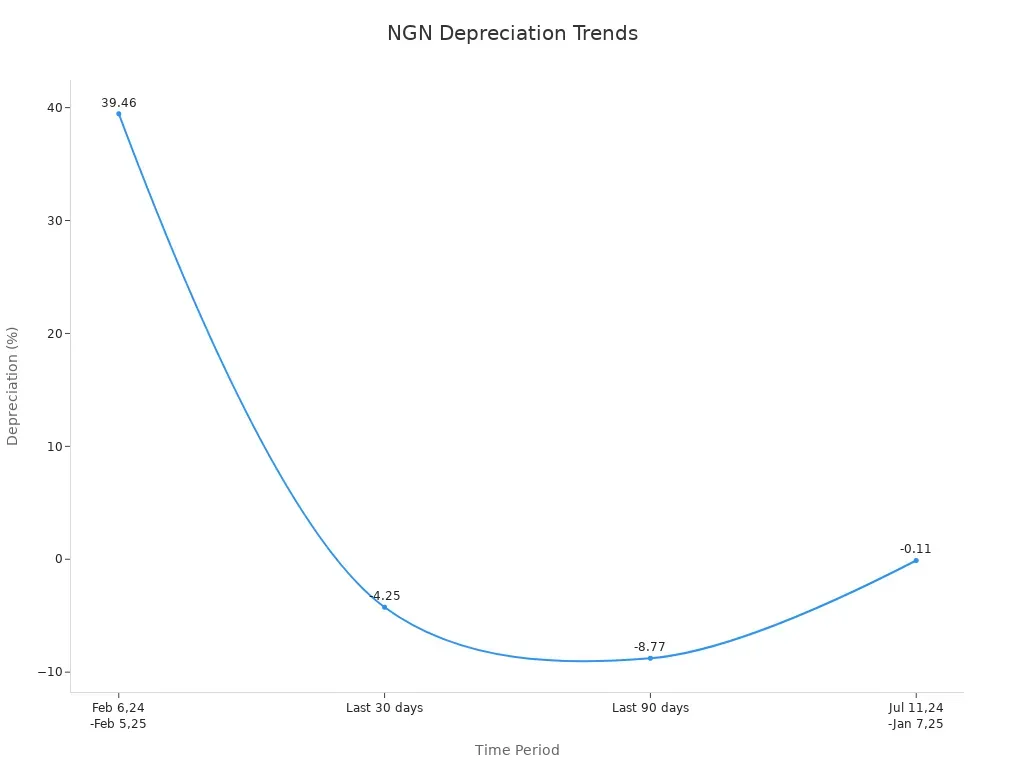
One of the key features of XTransfer is its ability to display historical trends and patterns in exchange rates. For example, between February 6, 2024, and February 5, 2025, the NGN experienced a depreciation of 39.46%. This decline highlights the challenges faced by the currency in maintaining stability. Below is a detailed table showcasing exchange rate trends over various periods:
|
Period |
Average Exchange Rate (USD/NGN) |
Highest Rate (USD/NGN) |
Lowest Rate (USD/NGN) |
Depreciation (%) |
|
February 6, 2024 - February 5, 2025 |
0.0006607 |
N/A |
N/A |
39.46 |
|
November 27, 2024 |
N/A |
1,685.62 |
N/A |
N/A |
|
December 10, 2024 |
N/A |
N/A |
1,529.14 |
N/A |
|
Last 30 days |
1,632.0640 |
N/A |
N/A |
-4.25 |
|
Last 90 days |
1,652.8690 |
N/A |
N/A |
-8.77 |
|
July 11, 2024 - January 7, 2025 |
N/A |
N/A |
N/A |
-0.11 |
This data allows you to identify periods of significant depreciation and plan accordingly. For instance, businesses importing goods can use this information to anticipate higher costs during periods of currency weakness.
Visual tools like charts further enhance your understanding of exchange rate trends. The following chart illustrates the depreciation of the NGN over various timeframes, providing a clear picture of its performance:
Platforms like XTransfer also offer features such as alerts for rate changes, historical data analysis, and predictive modeling. These tools help you stay ahead of market trends and make proactive financial decisions. For example, if you notice a consistent decline in the NGN's value, you can adjust your investment or trading strategies to mitigate potential losses.
By leveraging real-time exchange rate tools, you gain a competitive edge in managing your finances. These platforms not only provide accurate data but also simplify complex financial concepts, making them accessible to everyone. Whether you're monitoring the NGN for personal or professional reasons, tools like XTransfer ensure that you stay informed and prepared for any economic shifts.
Challenges Facing the NGN in 2025
Inflation and its effects on the Naira
Inflation remains one of the most pressing challenges facing the naira in 2025. Rising prices erode the purchasing power of the currency, making it harder for you to afford basic goods and services. Nigeria’s inflation rate averaged 14.05% from 1996 to 2025, peaking at 47.56% in January 1996. Although recent efforts have reduced inflation, the rate still climbed to 24.23% in March 2025, up from 23.18% in February. Food inflation also dropped to 23.51% in February, marking its lowest point since September 2022. These fluctuations highlight the ongoing struggle to stabilize prices.
Several factors contribute to inflation in Nigeria. Currency devaluation, such as the naira’s fall from ₦450 to ₦1,600 per dollar between June 2023 and January 2024, exacerbates the issue. Higher import costs drive up prices for essential goods, while subsidy removals further strain household budgets. Without a stabilized exchange rate, inflation is likely to persist, impacting your daily expenses and the broader economy.
Exchange rate volatility and policy issues
Exchange rate volatility poses another significant challenge for the naira. Frequent fluctuations in the currency’s value create uncertainty for businesses and investors. For example, the naira’s exchange rate against the US Dollar showed persistent volatility between 2007 and 2010, as revealed by studies using ARCH and GARCH models. These analyses found that changes in money supply and past exchange rate movements significantly influence the naira’s stability.
Government policies also play a crucial role in shaping exchange rate dynamics. Monetary policy shifts, such as adjustments to interest rates or foreign exchange reserves, can either stabilize or destabilize the naira. Between 1987 and 2023, annual data revealed conditional volatility in exchange rates, emphasizing the need for consistent and effective policy measures. When policies fail to address underlying economic issues, the naira becomes more vulnerable to external shocks, affecting your ability to plan for the future.
External factors influencing the NGN
External economic indicators heavily influence the naira’s performance. Global market trends, such as oil production and trade balances, directly impact the currency’s value. Increased oil production attracts foreign investors, raising demand for the naira and stabilizing its value. Conversely, high inflation diminishes purchasing power, leading to currency depreciation and increased volatility.
Interest rates also play a pivotal role. Higher rates attract foreign investment, strengthening the naira and reducing volatility. A positive trade balance boosts foreign exchange reserves, further stabilizing the currency. However, political stability remains a critical factor. A stable environment encourages investment, while instability can lead to decreased investor confidence and heightened volatility. These external factors shape the challenges facing the naira and highlight the importance of proactive measures to mitigate their impact.
Oil dependency and economic diversification
Nigeria's economy heavily depends on oil revenues, which account for a significant portion of government finances. This reliance creates challenges for the Nigerian Naira (NGN) and the broader economy. When oil prices fluctuate, government budgets face instability. This instability often weakens the Naira, making it harder for you to afford goods and services. The over-reliance on oil also slows down efforts to diversify the economy, leaving other sectors underdeveloped.
Economic diversification is essential for reducing Nigeria's vulnerability to oil price shocks. By investing in non-oil sectors like agriculture, technology, and manufacturing, Nigeria can create a more balanced economy. For example, agriculture employs a large portion of the population. Expanding this sector could boost food production and reduce the need for costly imports. Similarly, supporting the technology industry can open up new opportunities for innovation and job creation.
Did you know? Nigeria's oil dependency has made the economy highly sensitive to global oil market trends. A sudden drop in oil prices can lead to a budget deficit, affecting public services and infrastructure development.
To achieve diversification, the government must implement policies that encourage investment in non-oil industries. Tax incentives, infrastructure development, and access to credit can help businesses grow. You might notice that countries with diversified economies often experience more stable currencies. For Nigeria, reducing oil dependency could strengthen the Naira and improve its purchasing power.
The journey toward economic diversification requires collaboration between the government, private sector, and international partners. By reducing reliance on oil, Nigeria can build a resilient economy that supports long-term growth and stability. This shift will not only benefit the Naira but also improve the quality of life for millions of Nigerians.
Future Prospects for the NGN
Economic diversification and its impact on the Naira
Economic diversification holds the key to reshaping the dynamics of the Nigerian economy and strengthening the NGN currency. By reducing reliance on oil revenues, Nigeria can create a more balanced economic structure that supports long-term growth. Diversification strategies emphasize external investments to mitigate local risks and advocate for reinvesting wealth back into Nigeria as conditions improve. These approaches safeguard the naira from external shocks and enhance its stability.
Recent forecasts highlight the positive impact of diversification on the naira’s market performance. For instance, during Q2 2024, the naira’s value stood at ₦1,415.78 per dollar, reflecting a 39.42% decline. However, by Q3 2024, the currency showed signs of recovery, with a positive change in its value at ₦1,316.60 per dollar.
|
Forecast Period |
Naira Value (₦/$) |
Change (%) |
|---|---|---|
|
Q2 2024 |
1,415.78 |
-39.42 |
|
Q3 2024 |
1,316.60 |
Positive |
These projections underscore the importance of diversification in stabilizing the naira and improving its prospects for the future.
Digital currency adoption in Nigeria
Digital currency adoption is rapidly transforming Nigeria’s financial landscape. Many Nigerians, especially the youth, are turning to cryptocurrencies to navigate economic challenges such as high inflation and currency depreciation. Platforms like Nairex, the largest crypto exchange in Nigeria, have gained popularity, with businesses increasingly accepting cryptocurrencies as payment. Weekly trading volumes on Local Bitcoins have reached $1.65 million, showcasing significant market activity.
This growing interest in digital currencies reflects a shift in how Nigerians manage their finances. Cryptocurrencies offer an alternative to traditional banking systems, providing access to financial services for those excluded from conventional methods. As adoption rates rise, digital currencies could play a pivotal role in shaping the future of the NGN currency.
Policy reforms shaping the NGN's future
Policy reforms are essential for securing the future prospects for the naira. Effective measures can stabilize the currency and foster economic growth. Recent reforms focus on improving monetary policies, enhancing foreign exchange reserves, and promoting transparency in government spending. These initiatives aim to reduce inflation and strengthen the NGN currency against external pressures.
For example, policies encouraging investment in non-oil sectors align with diversification goals, creating a more resilient economy. By addressing structural challenges and implementing forward-thinking strategies, Nigeria can pave the way for a stronger naira and a more stable financial environment.
Leveraging tools like XTransfer for currency management
Managing currency in a volatile economic environment can feel overwhelming. Tools like the XTransfer Exchange Rate Platform simplify this process by providing real-time data and actionable insights. You can use these tools to monitor exchange rates, track trends, and make informed financial decisions.
One of the key benefits of XTransfer is its ability to display historical exchange rate data. This feature allows you to analyze patterns and predict future movements. For example, if you notice a consistent depreciation of the Naira over several months, you can adjust your financial strategies to minimize losses. Businesses importing goods can plan purchases during periods of favorable exchange rates, saving money and improving profitability.
Another advantage of XTransfer is its user-friendly interface. The platform simplifies complex financial data, making it accessible even if you’re not an expert in economics. You can view charts, tables, and summaries that break down the information into easy-to-understand visuals. This clarity empowers you to make confident decisions, whether you’re managing personal finances or running a business.
For businesses involved in international trade, XTransfer’s predictive modeling tools are invaluable. These features help you anticipate market trends and prepare for potential challenges. By leveraging these insights, you can optimize your operations and reduce risks associated with currency fluctuations.
Using tools like XTransfer gives you a competitive edge in today’s fast-changing financial landscape. Whether you’re a business owner or an individual, these platforms provide the resources you need to navigate currency management with confidence.
The naira, as Nigeria's official currency, remains central to the nation's economic identity in 2025. It drives trade, commerce, and financial stability, even as it faces challenges like inflation and exchange rate volatility. Despite these hurdles, opportunities for growth abound. Economic diversification and digital innovation promise to reshape the naira's trajectory, fostering resilience and adaptability.
Digital currencies and blockchain technology offer solutions to longstanding issues, such as high transaction costs and limited banking access. For instance, NGN-backed stablecoins simplify international remittances and e-commerce payments, reducing fees and enhancing convenience. The chart below illustrates how these innovations address key challenges:
Tools like XTransfer Exchange Rate Platform empower you to navigate currency fluctuations effectively. By leveraging real-time data and predictive insights, you can make informed decisions in a rapidly changing financial landscape. These advancements ensure the naira remains a vital asset for Nigeria's future.
FAQ
1. What is the current exchange rate of the Nigerian Naira (NGN) in 2025?
The exchange rate of the Naira against the US Dollar in 2025 is ₦1,610.13. This reflects a 13.43% rise compared to the previous year. You can track real-time rates using platforms like the XTransfer Exchange Rate Platform.
2. Why does the Naira experience frequent fluctuations?
The Naira fluctuates due to factors like inflation, oil price changes, and government policies. External influences, such as global market trends, also play a role. These factors collectively impact the currency's stability and value.
3. How does inflation affect the Naira's purchasing power?
Inflation reduces the Naira's purchasing power, making goods and services more expensive. For example, a high inflation rate of 24.23% in 2025 means you need more Naira to buy the same items compared to previous years.
4. What are the security features of the Nigerian Naira?
The Naira includes watermarks, color-shifting ink, and embedded security threads. Higher denominations also have tactile marks for visually impaired users. These features help prevent counterfeiting and ensure authenticity.
5. How can I monitor exchange rate trends effectively?
You can use tools like the XTransfer Exchange Rate Platform. It provides real-time data, historical trends, and alerts for rate changes. These features help you make informed financial decisions and plan ahead.
Related content