
MAD Currency Explained: Everything You Need to Know About the Moroccan Dirham
Author:XTransfer2025.08.19MAD
When you go to Morocco, you will use the Moroccan dirham. It is the official currency of Morocco. The international code for the Moroccan dirham is MAD. The currency is split into smaller units called santim. You may see it written as MAD, د.م., or dh. You cannot bring Moroccan currency into or out of the country. Knowing about the mad currency helps you use money in Morocco. It also helps you avoid scams and travel easily. More than 13 million people visit Morocco each year. So, it is important to know how to use Moroccan money.
Highlights
-
The Moroccan dirham (MAD) is the main money in Morocco. You must exchange your money after you arrive. You cannot bring dirham into or out of Morocco.
-
Use cash for most things you buy each day. This is important in markets, taxis, and small shops. Carry small bills and coins to pay and tip easily.
-
Exchange money only at safe places like banks, Bureaux de Change, or ATMs. This helps you avoid scams and get good rates. Keep your exchange receipt. You need it to change leftover dirham before you leave.
-
Credit and debit cards work in hotels and big stores. But do not depend on them for everything. ATMs are easy to find in cities. They are hard to find in the countryside. Plan how much cash you will need.
-
Travel costs in Morocco depend on how you travel. Food, transport, and places to stay can be cheap. Bargaining and tipping are normal here. These customs help you enjoy your trip like a local.
Moroccan Dirham
The Moroccan dirham is the main money in Morocco. You need it to buy things, like food or hotel rooms. If you visit Morocco, you will use this money. When you know about the mad currency, you can spend your money wisely. This helps you not get mixed up when you travel. The dirham is also called MAD. That is its code for other countries. People in Morocco use the dirham every day. They use it to shop, eat, and pay for things. The moroccan dirham is very important for life and travel in Morocco.
Denominations
You can find the moroccan dirham as coins and paper bills. The money is split into smaller parts called centimes. But most people use whole dirham coins and bills. Here is a table that shows the main types you will see:
|
Currency Type |
Denominations |
|
Banknotes |
20, 50, 100, 200 dirhams |
|
Coins (centimes) |
5, 10, 20 centimes |
|
Coins (dirhams) |
0.5, 1, 2, 5, 10 dirhams |
You will use these types of money the most in Morocco:
-
20, 50, 100, and 200 dirham bills are for bigger buys.
-
1, 5, and 10 dirham coins are for small things and change.
-
Centimes are not used much every day.
-
People like cash in markets and small shops. Credit cards work in hotels and big stores.
When you travel in Morocco, you will see that cash is used a lot. This is true in small towns and markets. The moroccan dirham types help you pay for both big and small things.
Symbols and Codes
You will notice different signs and codes for the moroccan dirham. These help you know prices in stores, restaurants, and banks. Here is a table to help you learn the main signs and codes:
|
Representation Type |
Symbol/Code |
Description |
|
ISO Currency Code |
MAD |
Official international code for moroccan dirham |
|
Arabic Symbol |
د.م. |
Used in Arabic writing |
|
Latin Script Symbol |
DH |
Used in Latin letters |
|
Plural Form |
Dhs |
Plural form in Latin letters |
You might see prices like "50 DH", "50 د.م.", or "50 MAD". All of these mean 50 moroccan dirhams. The code MAD is used in banks and when you change money. The signs DH and د.م. are seen in stores and on receipts. When you swap money, look for MAD to get the right kind.
Issuing Authority
Bank Al-Maghrib is the main bank in Morocco. This bank makes all moroccan dirham coins and bills. It also controls the country’s money rules and watches over other banks. Bank Al-Maghrib started making the dirham in 1959. Before that, another bank made the money. Over time, Bank Al-Maghrib got more power to keep the money safe.
Bank Al-Maghrib checks that all money in Morocco is real. The bank also sets rules for banks and how money moves. If you see new looks on dirham coins or bills, Bank Al-Maghrib made those changes. The bank also controls the value of the mad currency and keeps extra money for Morocco.
The moroccan dirham is steady and trusted in Morocco. When you use the mad currency, you can trust your money is safe and used everywhere.
MAD Currency Exchange
Where to Exchange
When you get to Morocco, you need Moroccan dirham for spending. You cannot get dirham in the UK or most other countries. The dirham is a closed currency. You can only buy it after you arrive in Morocco. The best places to exchange money are called Bureaux de Change. These are official currency exchange offices. You can find them in city centers like Jemaa el-Fnaa in Marrakech. Banks and ATMs also give you dirham. Many ATMs take foreign cards and give you cash in MAD.
You can also get money at airports, hotels, and some big shops. But airport and hotel rates are usually not as good as city bureaus. Some places say "no commission," but their rates may be bad. Always check the rate before you exchange money. Do not use street vendors. They might scam you or give you fake bills.
ATMs in Morocco charge about 30-35 MAD each time you use them. BMCI bank ATMs let you take out up to 8000 MAD with a 35 MAD fee. Al Barid Bank ATMs do not charge a fee but only let you take out 2000 MAD. Your own bank at home might charge more fees. Always bring your passport when you exchange cash. Make sure your bills are clean and not old.
Exchange Rates
The value of the Moroccan dirham changes every day. The rate depends on where you exchange and on the market. Bureaux de Change in city centers usually have the best rates. Airports and hotels often have higher fees or worse rates. There is no set legal rate, so rates can be different at banks and exchange offices.
Here is a table that shows how much Moroccan dirham is worth in euros and US dollars:
|
Amount (MAD) |
Equivalent (EUR) |
Equivalent (USD) |
|
1 |
~0.095 |
~0.11 |
|
5 |
~0.47 |
~0.56 |
|
10 |
~0.95 |
~1.11 |
|
20 |
~1.90 |
~2.23 |
|
50 |
~4.74 |
~5.57 |
|
100 |
~9.49 |
~11.14 |
|
250 |
~23.72 |
~27.84 |
|
500 |
~47.43 |
~55.68 |
|
1000 |
~94.87 |
~111.36 |
|
2000 |
~189.74 |
~222.71 |
|
5000 |
~474.34 |
~556.78 |
|
10000 |
~948.68 |
~1113.56 |
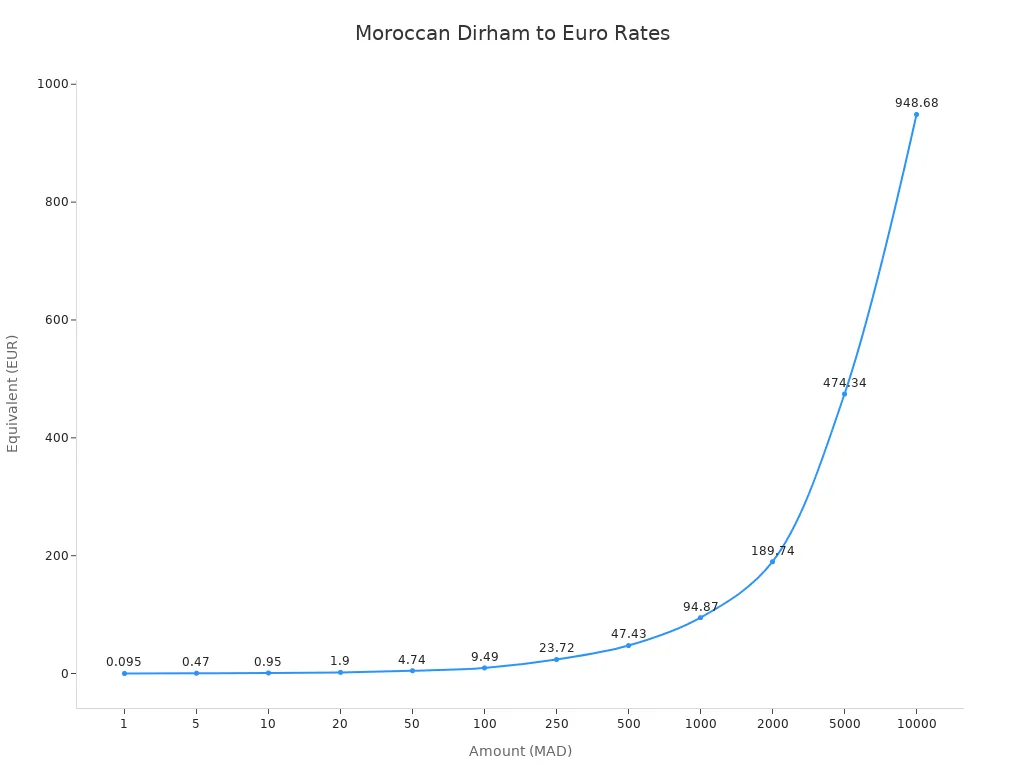
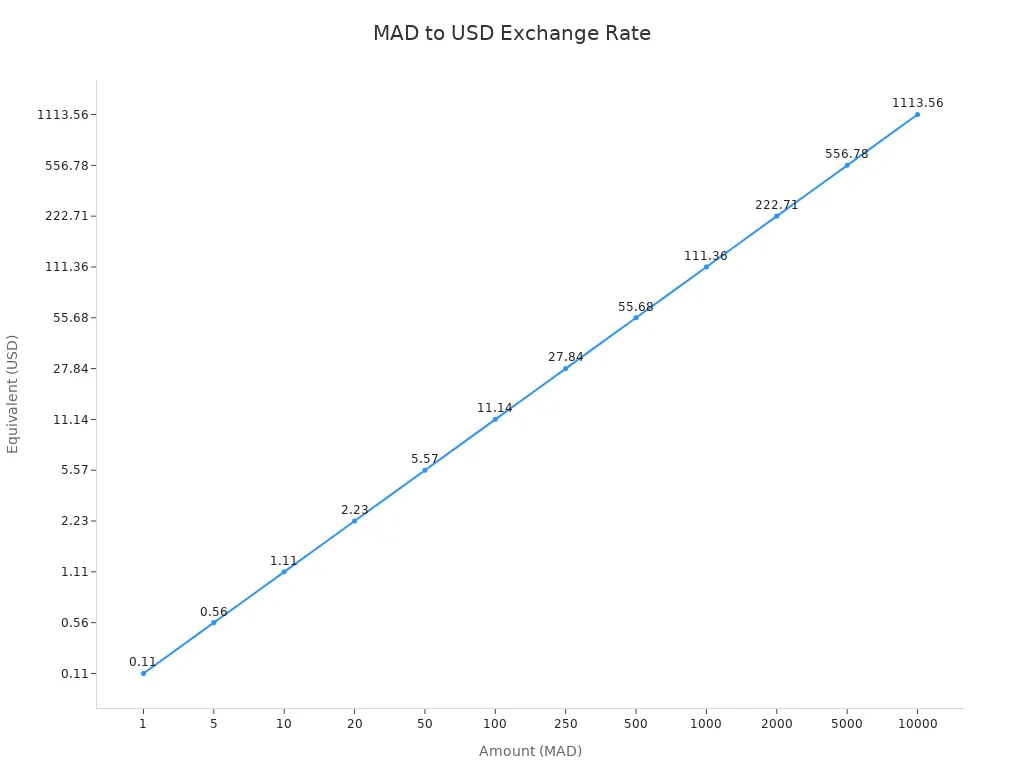
The exchange rate for the dirham can change for many reasons. These include supply and demand, government actions, inflation, and interest rates. Sometimes, the Moroccan government steps in to keep the dirham steady. In the last few months, the rate has not changed much.
-
Exchange rates go up and down because of market demand.
-
Government actions can change the value of the dirham.
-
Inflation and interest rates also change the rate.
-
Trade and investor trust matter too.
If you want to pay less in fees, use a credit card when you can. Fees are often no more than 1%. Some shops and riads may take euros, but you should use dirham for most things.
Currency Restrictions
Morocco has strict rules about its money. The Moroccan dirham is a non-convertible currency. You cannot bring dirham into or out of Morocco. You must get your dirham after you arrive in Morocco. If you try to get dirham in the UK or another country, you will not find it. You must exchange your foreign money at banks, ATMs, or official exchange offices in Morocco.
-
You cannot bring dirham into or out of Morocco.
-
You must exchange leftover dirham before you leave.
-
Keep your exchange slip if you want to change dirham back to your home money.
-
Most banks outside Morocco do not buy or sell dirham.
-
The government uses these rules to protect the economy.
If you plan your money exchange, you will not have problems when you travel. Always use official places to get your money. This keeps your money safe and helps you avoid scams. Getting your Moroccan dirham is easy if you follow these steps. Remember, you cannot buy Moroccan money before you arrive, so plan ahead.
Using Dirham in Morocco
Cash and Cards
When you visit Morocco, you will notice that cash is the main way people pay for things. Over 70% of transactions use cash, while credit and debit cards make up less than 30%. You will need cash for markets, taxis, and small shops. Larger hotels and restaurants often accept cards, but you should always ask first. Carry small bills and coins to make payments easier.
You can use many types of cards in Morocco. Most businesses accept these:
-
Visa and Mastercard (most widely accepted)
-
Union Pay, Discover, Diners, and JCB
-
Local CMI cards, which are common for online and in-person payments
Payment gateways like CMI, NOWPayments, and PayPal help businesses accept both local and international cards. Still, you should not rely only on cards when spending money in Morocco.
ATMs and Mobile Payments
ATMs are easy to find in big cities like Casablanca, Marrakech, and Rabat. You will see them in malls, airports, and tourist spots. Most ATMs accept international cards such as Visa, Mastercard, and Maestro. In rural areas, ATMs are rare, so plan ahead and carry enough cash.
|
City |
Number of ATMs |
|
Casablanca |
1,593 |
|
Marrakech |
695 |
|
Rabat |
617 |
|
Tangier |
478 |
|
Agadir |
449 |
|
Fez |
390 |
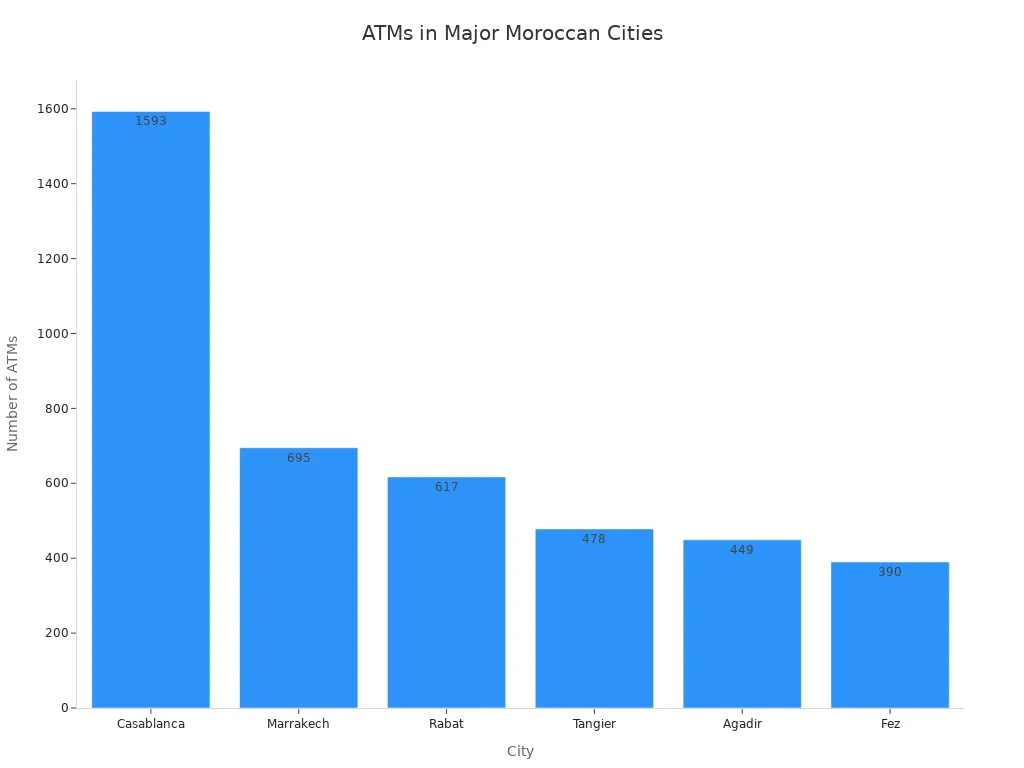
Mobile payments are growing in Morocco. E-wallets and card payments now make up over a third of online purchases. Many people use smartphones for shopping and paying bills. Mastercard and Bank of Africa are working together to make mobile payments safer and easier.
Local Customs
You will find that haggling is normal in Moroccan markets. Start with a low offer, usually less than half the asking price. Most deals end at about 70% of the first price. Stay polite and patient. Sellers may use emotional tactics, but you should keep calm and friendly. If you do not like the price, you can walk away.
Tipping, called 'baksheesh,' is common in Morocco. People tip in restaurants, hotels, taxis, and even for street performers. Carry small dirham coins for tips. Here is a quick guide:
|
Service Type |
Typical Tip Amount |
|
Restaurant |
5-10% of the bill |
|
Café |
1-5 dirhams |
|
Hotel Porter |
10-20 dirhams |
|
Taxi Drivers |
Round up or 5-10 dirhams |
|
Tour Guide |
50-300 dirhams |
Knowing how to pay in Morocco and handling money in Morocco will help you enjoy your trip and avoid problems with currency.
Morocco Travel Costs
Accommodation
You will find many types of places to stay in Morocco. You can choose from budget hostels, mid-range hotels, or luxury riads. The cost depends on your travel style. Here is a table to help you compare average daily prices:
|
Traveler Type |
Average Daily Accommodation Cost (USD) |
Average Daily Accommodation Cost (MAD) |
|
Budget |
$16 |
MAD 141 |
|
Mid-Range |
$42 |
MAD 382 |
|
Luxury |
$123 |
MAD 1,113 |
Most budget travelers pick hostels or simple guesthouses. Mid-range hotels offer more comfort and private bathrooms. Luxury riads give you beautiful rooms and extra services. You can save money by booking early or staying outside tourist areas.
Food and Drink
Moroccan food is tasty and affordable. You can eat well without spending much. The price of a meal changes based on where you eat. Local restaurants and food stalls cost less than tourist spots. Here is a table with common meal prices:
|
Item |
Average Cost (Moroccan Dirhams) |
|
Tagine |
50 – 100 DH |
|
Couscous |
40 – 80 DH |
|
Pastilla (Meat Pie) |
60 – 120 DH |
|
Harira (Lentil Soup) |
30 – 60 DH |
|
Mint Tea |
10 – 20 DH |
You may wonder how much is a meal for two in morocco. In a local restaurant, you can expect to pay about 60 to 200 dirhams for two people. Meals at food stalls in Jemaa el-Fnaa start at 20 to 50 dirhams. Mid-range restaurants charge 100 to 250 dirhams per person. Fine dining can cost up to 1,000 dirhams for two. Local cafés and snack stands offer meals for as little as 30 dirhams.
-
Local restaurants: 30–100 dirhams per meal
-
Mid-range: 100–250 dirhams per meal
-
Fine dining: up to 1,000 dirhams for two
-
Drinks like coffee, Moroccan tea, or fresh juice: 10–20 dirhams
You may ask how much do drinks cost in morocco. Most non-alcoholic drinks are cheap, but alcohol costs more, especially in tourist cities. Food and drink prices are higher in tourist areas. Local neighborhoods offer better value and bigger portions.
Transport and Attractions
Getting around Morocco is easy and not expensive. You can use trains, buses, or taxis. Here is a table with average transport costs:
|
Transportation Mode |
Average Cost (MAD) |
Notes |
|
First-class Train Ticket |
~150 |
Reserved seat, more comfort, air-conditioning |
|
Second-class Train Ticket |
Cheaper |
No reserved seat, may stand during busy times |
|
Bus (Marrakech to Essaouira) |
~80 |
Air-conditioned, Wi-Fi on some routes |
|
Bus (Marrakech to Agadir) |
~110 |
Luggage fees 5–10 MAD |
|
Petit Taxis (in cities) |
Metered fares |
Short trips, max 3 passengers + driver |
|
Grand Taxis (long distance) |
Variable |
Fares negotiated or fixed |
You can travel between cities by train or bus. First-class train tickets cost about 150 dirhams. Buses are cheaper and connect most towns. Petit taxis work inside cities and use meters. Grand taxis take you longer distances and you can share the ride.
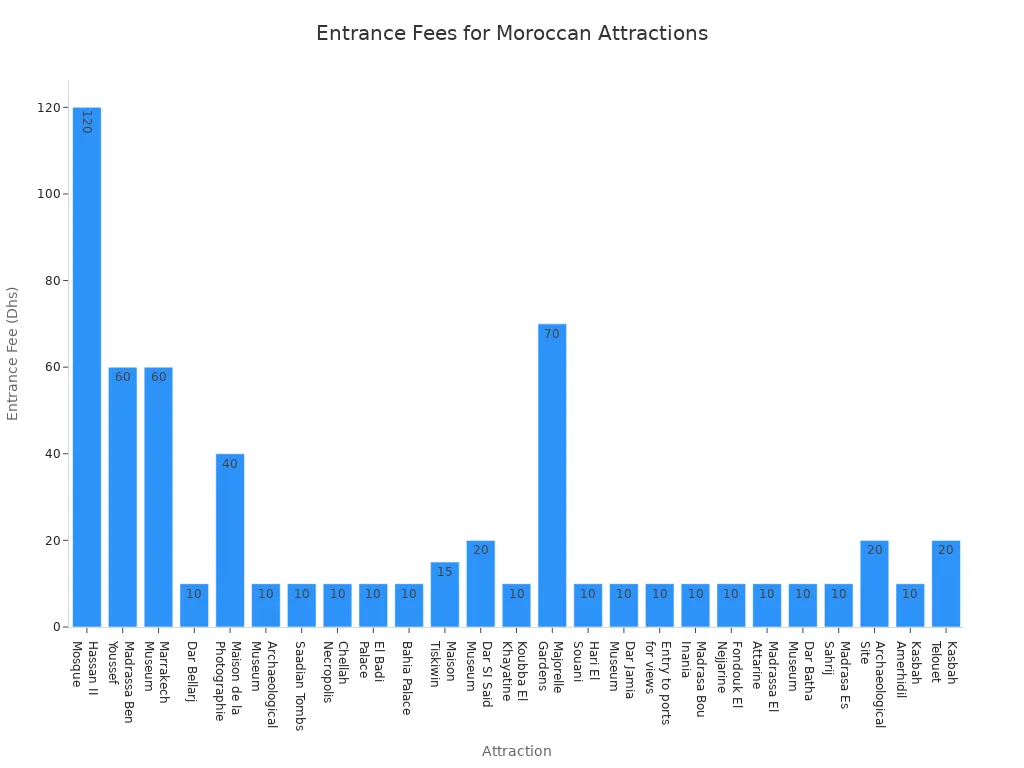
When you visit museums or historical sites, you may ask how much do tourist attractions cost in morocco. Entrance fees usually range from 10 to 100 dirhams. Some famous places, like the Hassan II Mosque in Casablanca, charge up to 120 dirhams. Here is a chart showing entrance fees for popular attractions:
You have learned how to use the moroccan dirham and mad in Morocco. Exchange your money only after you get there. Use ATMs or official exchange offices you trust. Bring small bills for buying things every day. Check online for the newest exchange rates. Most of the time, pay with cash instead of other money. Do not use foreign money in stores. Remember to tip and bargain like locals do. This will help you have a good trip. If you have more questions, look at the FAQ section.
FAQ
Can you use euros or US dollars in Morocco?
You need to use Moroccan dirham for most purchases. Some hotels or tourist shops may accept euros or dollars, but you will get a poor exchange rate. Always pay with dirham for the best value.
How much cash should you carry each day?
You should carry enough cash for small purchases, taxis, and tips. Most travelers find 200–400 MAD per day is enough. Use your card for hotels or big expenses. Keep small bills for markets and taxis.
Are credit cards safe to use in Morocco?
You can use credit cards safely at hotels, restaurants, and large stores. Always check for card machines before you order. Avoid using your card in small shops or markets. Watch your card during payment to prevent fraud.
What should you do with leftover dirham before leaving Morocco?
You cannot take dirham out of Morocco. Exchange leftover dirham at the airport or an official bureau before you leave. Keep your exchange receipt. You can also spend your last dirham on snacks or souvenirs.
Related content