
5 Quick Facts to Introduce ZAR Currency
Author:XTransfer2025.07.30ZAR
The South African Rand, widely known as ZAR, is the official currency of South Africa. Introduce ZAR currency into your daily life, whether through routine transactions like grocery shopping or more significant financial activities such as investments. The South African Reserve Bank oversees the ZAR, ensuring its stability and accessibility.
-
The ZAR was introduced in February 1961, replacing the South African pound at an exchange rate of 2 rand for every British pound.
-
By Q3 2023, consumer spending in South Africa had reached an impressive 3.07 trillion ZAR.
-
The current exchange rate of the ZAR is R18.83 per USD, highlighting its role in global trade.
Familiarizing yourself with the South African Rand, or ZAR, provides valuable insight into its impact on both local and international economies.
What Is the South African Rand (ZAR)?
The origin and meaning of "ZAR."
The abbreviation "ZAR" comes from the Dutch term "Zuid-Afrikaansche Republiek," which translates to "South African Republic." This name reflects the historical roots of the region during the 19th century. The Zuid-Afrikaansche Republiek was established in 1852 after the Sand River Convention, which granted independence to the Boer settlers north of the Vaal River. Over time, the name evolved, especially during British rule, when the term "Transvaal" became more common. Despite these changes, the abbreviation "ZAR" remains a nod to South Africa's rich history and cultural heritage.
Historical background of the rand and its introduction in 1961.
The South African Rand officially became the national currency on February 14, 1961. This change followed the Decimal Coinage Commission's recommendation in 1958 to adopt a decimal-based system. Before this, South Africa used the South African pound, which was linked to the British pound sterling. The transition to the rand marked a significant modernization of the country's monetary system. The rand replaced the pound at a rate of 2 rand to 1 pound.
The first series of rand banknotes included denominations of 1, 2, 10, and 20 rand. These notes featured designs that celebrated South Africa's natural and cultural heritage. The name "rand" itself originates from the Witwatersrand, a region known for its rich gold deposits and the location of Johannesburg. This connection highlights the importance of gold in South Africa's economy.
Over the years, the rand has evolved into a widely traded emerging market currency. During the apartheid era, South Africa introduced the Financial Rand as a parallel currency to control capital outflows. This system ended in 1995, reflecting the country's economic transformation after apartheid. Today, the South African Rand plays a vital role in both local and international trade.
Where Is the ZAR Currency Used?
Primary usage in South Africa.
The South African Rand serves as the backbone of South Africa's economy. You will find it used in every aspect of daily life, from buying groceries to paying for public transportation. It is also the standard currency for businesses, government transactions, and financial institutions. The rand's role in South Africa's economy is evident in the country's nominal GDP figures. For example, in the fourth quarter of 2024, South Africa's nominal GDP reached 7,452,735 million ZAR, slightly higher than the third quarter's 7,351,789 million ZAR.
|
Quarter |
Nominal GDP (Mil. ZAR, SAAR) |
|
2024 Q4 |
7,452,735 |
|
2024 Q3 |
7,351,789 |
This widespread use of the rand highlights its importance in maintaining economic stability and supporting growth within South Africa.
Acceptance in the Common Monetary Area (Lesotho, Namibia, Eswatini).
The South African Rand is not limited to South Africa. It is also accepted in the Common Monetary Area (CMA), which includes Lesotho, Namibia, and Eswatini. These countries rely on the rand due to their economic ties with South Africa.
-
The CMA framework prevents Lesotho, Namibia, and Eswatini from having independent monetary policies. This reliance on South Africa ensures the rand's acceptance in these nations.
-
Interest rates in these countries closely follow South Africa's rates, showing how interconnected their economies are.
-
South Africa's monetary policy significantly impacts the CMA countries. For instance, changes in South Africa's repo rate directly affect inflation and economic output in these nations.
The CMA agreement allows the rand to circulate freely alongside local currencies in these countries. This arrangement simplifies trade and travel within the region, making the rand a vital currency for economic integration.
Key Features of the ZAR Currency
Physical characteristics of ZAR coins and banknotes.
The South African Rand stands out with its vibrant and meaningful designs. You will notice that ZAR coins come in denominations ranging from 1 cent to 5 rand. Each coin features unique imagery, such as the springbok antelope on the 1 rand coin, symbolizing South Africa's natural heritage. The coins are made from various metals, including nickel, copper, and bronze, giving them a distinct look and feel.
ZAR banknotes are equally fascinating. They are available in denominations of 10, 20, 50, 100, and 200 rand. Each note showcases a portrait of Nelson Mandela on the front, honoring his legacy as a global icon. The back of the notes highlights South Africa's "Big Five" animals—lion, leopard, elephant, rhino, and buffalo. These designs not only celebrate the country's wildlife but also make the currency easily recognizable. The notes also include advanced security features like watermarks, color-shifting ink, and raised printing to prevent counterfeiting.
The role of the South African Reserve Bank in managing the currency.
The South African Reserve Bank (SARB) plays a crucial role in maintaining the stability of the rand. It ensures that the supply of ZAR coins and banknotes meets the needs of the economy. SARB also oversees monetary policy to control inflation and support economic growth. For example, it adjusts interest rates to influence borrowing and spending in the country.
You might find it interesting that SARB monitors the value of the rand in global markets. It takes steps to stabilize the currency during periods of volatility. By doing so, SARB helps maintain confidence in the South African Rand both locally and internationally. The bank also works to ensure that the ZAR remains a reliable medium of exchange in South Africa and the Common Monetary Area.
Why Is the ZAR Currency Important?
Its role in global trade and investment.
The South African Rand plays a significant role in global trade and investment. As South Africa's official currency, the rand facilitates international transactions, especially in sectors like mining and agriculture. South Africa is a major exporter of gold, platinum, and other commodities, and the rand serves as the medium of exchange for these trades. This makes the currency essential for businesses and investors worldwide.
The importance of the rand in international markets is evident in South Africa's trade and financial indicators. For example:
|
Indicator |
Latest Update (Date) |
Value (R) |
Previous Value (R) |
|
Current Account Deficit |
September 5, 2024 |
64.6 billion |
106.9 billion |
|
Trade Surplus |
September 30, 2024 |
5.63 billion |
17.07 billion |
These figures highlight the rand's role in balancing South Africa's trade and financial activities. A trade surplus, for instance, strengthens the rand's position in global markets, attracting foreign investment and boosting economic growth.
Additionally, studies have shown that South African firms face significant exposure to foreign exchange risks, with reliance on the rand exceeding 40% before adjustments. This underscores the currency's importance in both domestic and international economic activities.
Factors influencing the ZAR exchange rate, including economic and political trends.
The value of the rand fluctuates due to various economic and political factors. Historical events, such as the apartheid era, caused significant depreciation of the rand due to international sanctions. Post-apartheid, the currency stabilized but continues to face challenges like high unemployment and income inequality. These issues impact investor confidence and the rand's exchange rate.
Several key factors influence the USD/ZAR exchange rate:
-
Interest Rates: Higher interest rates in the United States often strengthen the USD against the rand.
-
Economic Indicators: Positive economic data from South Africa, such as GDP growth, can enhance the rand's value.
-
Commodity Prices: Changes in global commodity prices affect South Africa's export earnings, influencing the rand's exchange rate.
-
Political Stability: Political uncertainty can lead to rand depreciation as investors seek safer currencies.
-
Global Events: Events like trade tensions or financial crises can shift the USD/ZAR exchange rate.
Understanding these factors is crucial for policymakers and investors. For example, a weaker rand can lead to inflation, increasing the cost of imported goods and services. On the other hand, a stronger rand boosts purchasing power and attracts foreign investment.
The rand's volatility reflects the dynamic nature of South Africa's economy and its integration into global markets. By monitoring these trends, you can better navigate the complexities of the currency and make informed decisions.
How to Check ZAR Exchange Rates Easily
Using the XTransfer Exchange Rate Platform for real-time updates.
Staying updated on exchange rates is essential when dealing with the South African Rand. The XTransfer Exchange Rate Platform offers a reliable way to monitor real-time rates. This platform provides accurate and up-to-date information, helping you make informed decisions whether you're traveling or managing business transactions.
The platform's user-friendly interface allows you to check the latest currency exchange rates with ease. You can track the value of the rand against major global currencies like the US dollar or euro. This feature is particularly useful for businesses that rely on international trade or individuals planning trips to South Africa.
XTransfer also offers tools to analyze trends in exchange rates. For example, you can view historical data to understand how the rand has performed over time. This insight can help you predict future fluctuations and plan your financial activities accordingly. By using XTransfer, you gain a competitive edge in managing your finances effectively.
Practical tips for travelers and businesses dealing with ZAR.
When handling the South African Rand, understanding the local currency system is crucial. For travelers, carrying a mix of small and large denominations simplifies transactions, especially in smaller shops or markets. The Swazi Lilangeni, pegged to the rand at a 1:1 exchange rate, allows for seamless transactions in Eswatini.
Be cautious of financial scams. Protect your cash and cards by using secure payment methods whenever possible. Tipping is customary in South Africa, with 10% being the standard for services like dining or guided tours. If you visit local markets, bargaining is common. Start by offering 50-60% of the initial asking price to negotiate effectively.
For businesses, monitoring exchange rates is vital. Fluctuations in the rand's value can impact profit margins, especially for importers and exporters. Using platforms like XTransfer ensures you stay informed and prepared for any changes in the currency market.
By following these tips, you can navigate the complexities of the rand with confidence, whether you're a traveler or a business owner.
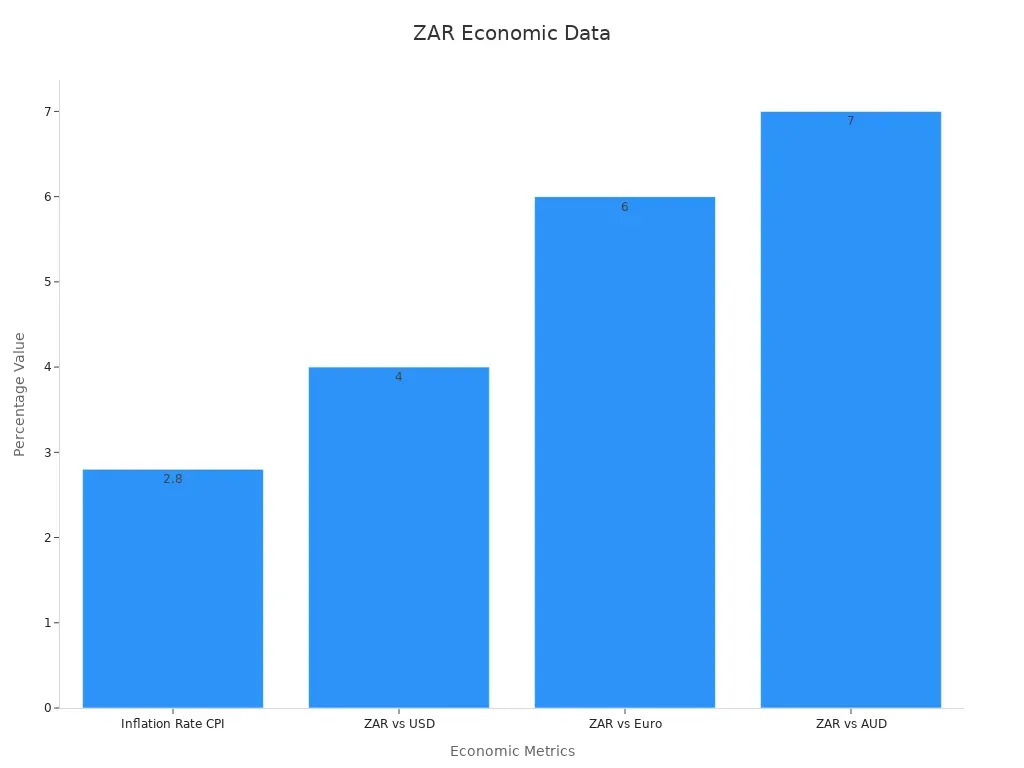
The South African Rand reflects South Africa's rich economic and historical journey. Its value has evolved significantly, with historical peaks like 1.32 USD per rand in 1980, compared to approximately 19.2 ZAR per USD today. This shift highlights the rand's reduced purchasing power, now about 50% undervalued relative to its Purchasing Power Parity.
|
Metric |
Value (2023) |
Value (2022) |
Change (%) |
|
Inflation Rate (CPI) |
2.8% |
5.1% |
-45.1% |
|
ZAR vs USD |
4% increase |
10% decrease |
N/A |
|
ZAR vs Euro |
6% increase |
N/A |
N/A |
|
ZAR vs AUD |
7% increase |
N/A |
N/A |
Understanding the rand helps you make informed decisions, whether you're traveling or investing. Tools like the XTransfer Exchange Rate Platform simplify tracking exchange rates, ensuring you stay ahead in the currency market.
FAQ
What does "ZAR" stand for?
The abbreviation "ZAR" stands for "Zuid-Afrikaansche Republiek," which means "South African Republic" in Dutch. It reflects South Africa's historical ties to Dutch settlers.
Can you use the South African Rand outside South Africa?
Yes, you can use the rand in Lesotho, Namibia, and Eswatini. These countries are part of the Common Monetary Area, where the rand circulates alongside their local currencies.
How can you identify counterfeit ZAR banknotes?
Look for security features like watermarks, raised printing, and color-shifting ink. Authentic notes also have a portrait of Nelson Mandela and images of South Africa's "Big Five" animals.
Why does the ZAR exchange rate fluctuate?
The exchange rate changes due to factors like interest rates, commodity prices, and political events. For example, higher gold prices often strengthen the rand since South Africa is a major gold exporter.
What is the best way to check ZAR exchange rates?
Use platforms like XTransfer for real-time updates. These tools provide accurate rates and historical data, helping you plan your financial transactions effectively.
Related content