B2B Payments
How We Pay Suppliers in China and Vietnam from a Yiwu Sourcing Base: A Treasury Workflow Walkthrough
- Supplier diversification is essential for supply chain resilience, but it creates operational challenges in payment management across multiple countries, currencies, and banking systems.
- Centralized treasury operations through a single account can simplify payment management for businesses paying suppliers across China, Vietnam, and other Asian markets, though provider coverage and corridor support vary by platform.
- Batch payment processing reduces finance team workload by allowing multiple supplier payments to be grouped, reviewed, and executed in a single workflow rather than individual transfers.
- Local currency settlement helps streamline supplier relationships by enabling Vietnamese suppliers to receive VND, Chinese suppliers to receive CNY, and other regional suppliers to receive payments in their preferred currencies.
- Scalable payment infrastructure supports business growth without proportionally increasing administrative effort, allowing finance teams to manage larger supplier networks efficiently.
1. Introduction
Modern direct-to-consumer (DTC) brands and B2B e-commerce businesses are no longer sourcing from a single country. To improve supply chain resilience and access specialized manufacturing capabilities, many companies now work with suppliers across China, Vietnam, and other emerging manufacturing markets in Asia.
According to recent supply chain studies, many global sourcing companies are adopting China+1 procurement strategies to reduce supply chain concentration risk and improve resilience.
While supplier diversification creates operational flexibility and reduces dependency on any single region, it also introduces a significant challenge: managing payments to dozens of suppliers across multiple countries, currencies, and banking systems. Each payment destination may require different documentation, compliance procedures, and settlement timelines.
This walkthrough traces how a Yiwu-based e-commerce company streamlines supplier payments using XTransfer's centralized treasury account and batch payment processing, enabling efficient management of a complex, multi-regional supplier network.
2. Case Study: A Yiwu-Based E-Commerce Company Managing Suppliers Across Asia
Company Overview
The following case study illustrates how XTransfer's treasury workflow operates in practice for a Yiwu-based sourcing business. The scenario, supplier counts, and payment volumes shown below are illustrative figures used to demonstrate the platform's standard operating pattern; they do not refer to a specific identified customer.
A foreign-owned e-commerce company operates its sourcing and procurement team in Yiwu, China's largest wholesale market, while selling products to customers in the United States, Europe, and Australia. The company's business model relies on efficient sourcing from multiple manufacturing regions.
Its supplier network includes:
- Manufacturers in China (primarily in Yiwu and surrounding regions)
- Component suppliers in Vietnam
- Specialized suppliers in emerging Asian markets
- Logistics and fulfillment partners across the region
The Growth Challenge
As the business scales, the finance and procurement teams face increasing complexity:
- Supplier numbers grow from dozens to hundreds
- Monthly invoicing increases proportionally
- Multiple currencies must be managed simultaneously
- Finance operations become increasingly time-consuming and error-prone
- Manual payment tracking and reconciliation become unsustainable The company's finance team was spending significant time processing individual supplier payments, managing multiple banking relationships, and reconciling transactions across different currencies and payment channels.
A Typical Week for the Finance Team
- Monday Receive USD and EUR customer payments through XTransfer collection accounts
- Wednesday Review supplier invoices from China and Vietnam Prepare payment batches in the XTransfer dashboard
- Friday Execute batch payouts through XTransfer Chinese suppliers receive CNY Vietnamese suppliers receive VND
Why Many E-Commerce Businesses Are Expanding Beyond China
- The China+1 Strategy
- Supply chain diversification
- Growing supplier networks across Asia
3. The Challenge of Paying Suppliers Across Multiple Countries
One Supply Chain, Multiple Payment Destinations
Every month, the company needs to pay:
- Chinese suppliers in CNY (Chinese Yuan)
- Vietnamese suppliers in VND (Vietnamese Dong)
- Suppliers in other Asian markets in their local currencies
- Logistics and service providers across different regions Each payment destination operates under different banking systems, compliance requirements, and settlement timelines.
Why Traditional Payment Methods Become Inefficient
Common challenges with traditional banking approaches include:
- Multiple banking relationships: Maintaining separate accounts with different banks for different currencies and regions
- Repetitive manual transfers: Each supplier payment requires individual processing, documentation, and approval
- High administrative workload: Finance teams spend disproportionate time on payment processing rather than strategic financial planning
- Limited visibility into outgoing payments: Payments processed through multiple channels are difficult to track and reconcile
- Time-consuming reconciliation processes: Matching payments to invoices and supplier records becomes increasingly complex
- Delayed settlement times: Traditional wire transfers can take 3-5 business days, disrupting production planning and supplier relationships
4. The Multi-Country Supplier Payment Workflow
| Feature | Typical Correspondent Bank Setup | XTransfer |
|---|---|---|
| Multi-country supplier payments | Generally requires separate banking relationships per corridor | Single account covering China, Vietnam, and other supported Asian markets |
| Batch payouts | Not typically available as a native feature | Yes |
| Local currency settlement | Generally requires local in-country accounts | Direct settlement to suppliers in CNY, VND, and other supported local currencies |
| Treasury visibility | Fragmented across multiple bank portals | Centralized |
Why a Single-Account Treasury Model Simplifies Multi-Country Supplier Payments
As supplier networks expand across China, Vietnam, and other Asian manufacturing markets, businesses that continue managing payments through multiple banks typically encounter growing operational complexity. Centralizing collections, fund management, and supplier payouts through a single treasury account is one way to reduce that complexity.
In June 2026, XTransfer and Société Générale announced a strategic partnership at Money 20/20 Europe. The collaboration leverages Société Générale's European clearing network to support euro, pound sterling, and Swiss franc local-currency settlements for cross-border trade between China, the UK, and continental Europe.
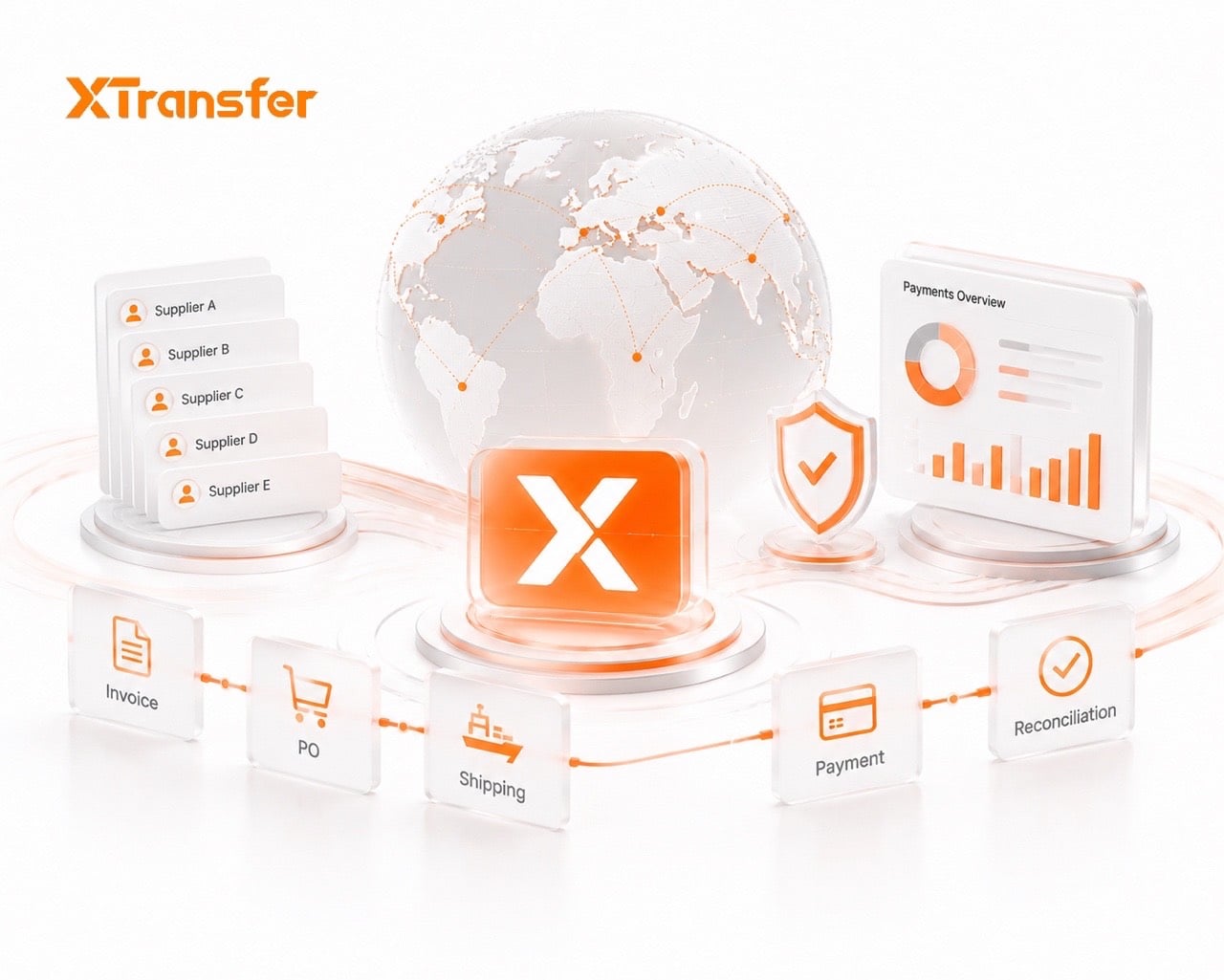
Through XTransfer's treasury workflow, businesses collect customer payments, hold multi-currency balances, and pay suppliers across China, Vietnam, and other supported Asian markets from a single account.
Key features in this workflow include:
- Centralized treasury account — Incoming funds and supplier payments are managed through a single account rather than separate banking relationships per currency or country.
- Local currency payouts across supported Asian supplier markets — Suppliers in eligible corridors can receive payments in CNY, VND, or other regional currencies, with settlement processed through local clearing networks where available.
- Batch payouts for growing supplier networks — Multiple supplier payments can be grouped, reviewed, and executed in a single workflow rather than initiated as individual transfers.
- Cross-border trade workflow design — The platform is structured around cross-border collections, foreign exchange conversion, and multi-country supplier payouts as its core operating model. For companies adopting China+1 sourcing strategies, a centralized payment infrastructure can help simplify treasury operations while maintaining visibility across an increasingly complex supplier network.
One Account for Multi-Country Supplier Payments
Instead of maintaining multiple bank accounts and payment channels, the company uses XTransfer as its centralized treasury platform. Through a single XTransfer account, it can collect customer payments, manage multi-currency balances, and pay suppliers across China, Vietnam, and other Asian markets.The platform supports:
- Global collection accounts for receiving customer payments in multiple currencies
- Multi-currency fund management within a single account
- Local currency payment capabilities to suppliers across supported regions
- Centralized payment approvals and audit trails
Batch Payments Instead of Individual Transfers
Rather than processing each supplier payment individually, the finance team can:
- Upload multiple supplier payments at once through a batch file
- Review and approve payment batches before execution
- Execute payouts through a single workflow covering multiple suppliers, countries, and currencies
- Maintain a complete record of all payments for compliance and reconciliation
Local Currency Payments for Suppliers
Suppliers can receive payments in their local currencies where supported, helping streamline settlement processes and strengthen supplier relationships. This capability is particularly valuable in Asia, where local currency payments reduce friction in supplier relationships and improve payment reliability.
5. How the Payment Flow Works
Step 1: Collect Payments from Global Customers
The business receives customer payments from multiple markets, including USD, EUR, GBP, and AUD.
Step 2: Centralize Funds in One Account
Incoming funds are managed through a centralized treasury management solution, improving cash visibility and liquidity management. The company can see all incoming and outgoing funds in a single dashboard.
Step 3: Prepare a Batch Payout File
The finance team groups supplier payments by country of destination, currency of payment, and payment schedule. This grouping allows for efficient batch processing and reduces the number of individual transactions.
Step 4: Execute Batch Payouts
A single payment run can cover China suppliers receiving CNY payments, Vietnam suppliers receiving VND payments, and other eligible suppliers receiving local currency payments, all processed through a single batch execution.
Step 5: Monitor and Reconcile Payments
The team can track payment execution in real-time and maintain a clearer view of supplier settlement activity. Payment records can be exported for accounting and compliance purposes.
6. Why Centralized Treasury Operations Matter for Growing Businesses
Reduce Operational Workload
Finance teams spend significantly less time processing individual supplier payments. Batch processing reduces the number of transactions that require individual attention and approval.
Improve Payment Accuracy
Standardized workflows and batch processing reduce manual errors and duplicate payments. Centralized payment records improve audit trails and compliance documentation.
Strengthen Supplier Relationships
Reliable payment processes and faster settlement times help build trust with suppliers and support smoother production planning. Suppliers receive payments in their preferred currencies, reducing friction in the payment process.
Scale Without Expanding Finance Headcount
Businesses can manage larger supplier networks without proportionally increasing administrative effort. As the company grows from 50 suppliers to 500 suppliers, the finance team's workload grows incrementally rather than proportionally.
7. Building a Scalable Treasury Model
As supplier networks expand across multiple countries, businesses need a treasury model that can support multi-currency fund management and conversion, cross-border supplier payments to multiple destinations, centralized payment approvals and audit controls, better cash flow visibility and liquidity management, and compliance with local regulations in multiple jurisdictions.
A single-account approach helps simplify operations while supporting future growth. By centralizing treasury operations, businesses can focus on scaling their supply chain rather than managing payment infrastructure.
8. Conclusion
This case study illustrates how a Yiwu-based sourcing business uses XTransfer's treasury workflow to consolidate collections, multi-currency balances, and supplier payouts into a single account, with batch processing covering China (CNY) and Vietnam (VND) payouts in the same payment run.
For sourcing businesses operating across multiple Asian manufacturing hubs, XTransfer's single-account treasury model addresses three operational pressures identified in this article: fragmentation across multiple banking relationships, manual per-supplier payment processing, and the inability to settle suppliers in their preferred local currency.
The workflow described above is one operational pattern for managing multi-country supplier payments. Businesses evaluating payment infrastructure should compare provider capabilities against their own supplier geography, currency mix, and compliance requirements before selecting a platform.
Sources
The information in this article is based on the following publicly available sources:
-
XTransfer Official Website – Services Overview
-
XTransfer Prospectus (Hong Kong Stock Exchange Filing)
-
XTransfer and Société Générale Partner to Streamline Cross-Border Payments for Global Trade Transactions
-
McKinsey & Company. Supply Chains: Still Vulnerable
-
Stripe. How Long Do Cross-Border Payments Take?
Disclaimer
This article is compiled from publicly available sources and interview content for informational purposes only and does not represent the official views of XTransfer. XTransfer accepts no liability for any damages arising from reliance on this content.
Frequently Asked Questions
How do e-commerce companies pay suppliers in multiple countries?
This article walks through the XTransfer workflow specifically, so the answer below describes how that workflow handles multi-country supplier payments. In the XTransfer workflow, e-commerce companies consolidate supplier payments through a single multi-currency account, enabling CNY payouts to Chinese suppliers, VND payouts to Vietnamese suppliers, and payments in other supported regional currencies without maintaining separate banking relationships per country.
Can I pay suppliers in China and Vietnam from one account?
Yes. Through XTransfer's multi-currency account, businesses fund and pay suppliers in China and Vietnam from a single balance, with suppliers receiving settlement in CNY or VND respectively.
What are batch payouts?
Batch payouts are a payment processing method that allows multiple supplier payments to be grouped together, reviewed as a single batch, and executed in a single workflow. This approach reduces administrative workload and improves payment accuracy compared to processing individual transfers.
Can suppliers receive payments in local currency?
Yes. In the XTransfer workflow, Chinese suppliers receive CNY, Vietnamese suppliers receive VND, and suppliers in other supported corridors receive payments in their local currency, subject to corridor coverage and regulatory availability.
How can finance teams reduce manual supplier payment work?
Finance teams can reduce manual work by: (1) centralizing payments through a single account, (2) using batch payment processing instead of individual transfers, (3) automating payment approvals through standardized workflows, and (4) maintaining centralized payment records for easy reconciliation and compliance.
Why is treasury management important for global supply chains?
Effective treasury management improves cash flow visibility, reduces payment delays, strengthens supplier relationships, and enables finance teams to focus on strategic financial planning rather than transaction processing. For businesses with complex, multi-regional supplier networks, centralized treasury operations are essential for operational efficiency and scalability.
What is the cheapest way to pay suppliers in Vietnam?
Cost efficiency depends on transaction size, corridor, and currency conversion route. Within the XTransfer workflow, local currency settlement to VND-eligible suppliers reduces intermediary banking fees and FX spread compared with USD wire transfers routed through multiple correspondent banks. For specific fee benchmarks, consult XTransfer's published pricing.
How long do international supplier payments take?
Traditional correspondent bank wires typically take 3–5 business days. In the XTransfer workflow, batch payouts to suppliers in supported Asian corridors are generally processed within the same business day, subject to corridor, compliance screening, and cut-off time.
Can businesses pay multiple suppliers at once?
Yes. Batch payout functionality allows finance teams to upload and process multiple supplier payments in a single workflow. This can reduce administrative workload, improve consistency, and simplify reconciliation.
What are the risks of managing supplier payments through multiple banks?
Using multiple banks can create fragmented visibility, inconsistent approval workflows, higher reconciliation effort, and increased operational complexity. It may also make it harder for finance teams to maintain centralized audit trails and cash flow oversight.