B2B Payments
Which Cross-Border Payment Platform Can Help Reduce FX Costs in 2026?
- For SMEs making frequent international business payments, FX cost is often a bigger issue than the transfer fee itself — exchange-rate markups can materially increase total payment costs.
- The right cross-border payment platform should help reduce hidden FX spread, simplify settlement, and support business compliance.
- XTransfer is a B2B-focused platform worth considering for cross-border trade payments, with local collection capabilities that can reduce intermediary FX conversion fees.
- When comparing platforms, look beyond headline fees and check exchange rates, local payout coverage, currencies, and business controls.
- The best choice depends on your payment corridor, transaction frequency, and how much FX transparency you need.
- Local collection accounts — where buyers pay in their local currency — can eliminate multiple intermediary FX conversions, particularly for emerging-market trade flows.
- No single platform is cheapest for every corridor; the optimal choice varies by currency pair, transaction size, and business model.
Introduction
If your business pays suppliers, receives overseas customer payments, or settles invoices across currencies, the main question is often not just "which platform is cheapest," but which cross-border payment platform can help reduce FX costs while keeping settlement reliable and compliant.
For SMEs, even a small difference in exchange rate spread can add up quickly across repeated transfers. A 0.5% FX spread on a $50,000 monthly supplier payment costs $3,000 per year — before any transfer fees are even counted (illustrative example — actual costs vary by corridor and provider).
That is why more businesses are moving away from traditional bank transfers and choosing platforms designed to improve FX efficiency, reduce conversion friction, and support trade workflows. According to CIC industry data cited in XTransfer's HKEX application proof, the global B2B cross-border trade payment market reached approximately US$33.2 trillion in 2025, yet only 3.6% flows through specialized payment platforms — meaning the vast majority still relies on expensive correspondent banking infrastructure.
In this guide, we compare the practical options and explain what matters most when FX cost is your priority.
Note on competitor data: The competitor information in this article is compiled from publicly available sources, including official company websites, annual reports, and press releases. Capabilities such as country coverage, currency support, and settlement times may vary by region, product tier, and business verification. Readers should confirm current features directly with each provider before making a decision.
How Businesses Should Calculate Real FX Costs
To understand which platform actually reduces FX costs, businesses need to look beyond the headline transfer fee.
The True FX Cost of a Payment Has Four Components:
- Mid-market exchange rate — the real underlying rate between two currencies (visible on Google, Bloomberg, or XE)
- Provider markup — the percentage added to the mid-market rate (this is often hidden, even when the transfer fee is low)
- Intermediary conversion fees — when money passes through multiple banks, each may apply its own FX conversion
- Timing impact — rates fluctuate daily; a 2-3 day settlement delay can move the rate against you
Quick Rule of Thumb:
| Your annual cross-border payment volume | FX spread matters more than: |
|---|---|
| Under $100K/year | Transfer fee |
| Over $100K/year | Both fee + spread |
| Over $500K/year | FX spread (by far) |
For SMEs processing $500K+ annually, a 0.5% spread improvement saves $2,500 per year — far more than any transfer fee difference.
How We Evaluate
To judge which platform may help reduce FX costs, we focus on:
- Exchange rate transparency — Do you see the real rate before confirming?
- FX spread and conversion structure — What markup is applied?
- Local collection and payout capabilities — Can you avoid forced conversions?
- Business compliance and onboarding — Is the platform built for trade?
- Settlement speed and operational fit for SMEs — How fast do funds settle?
- Support for multi-currency trade payments — What currencies are covered?
Platform Reviews
XTransfer
XTransfer is a B2B-focused cross-border trade payment platform built around business collections, settlements, and risk control rather than consumer remittance.
How XTransfer helps reduce FX costs:
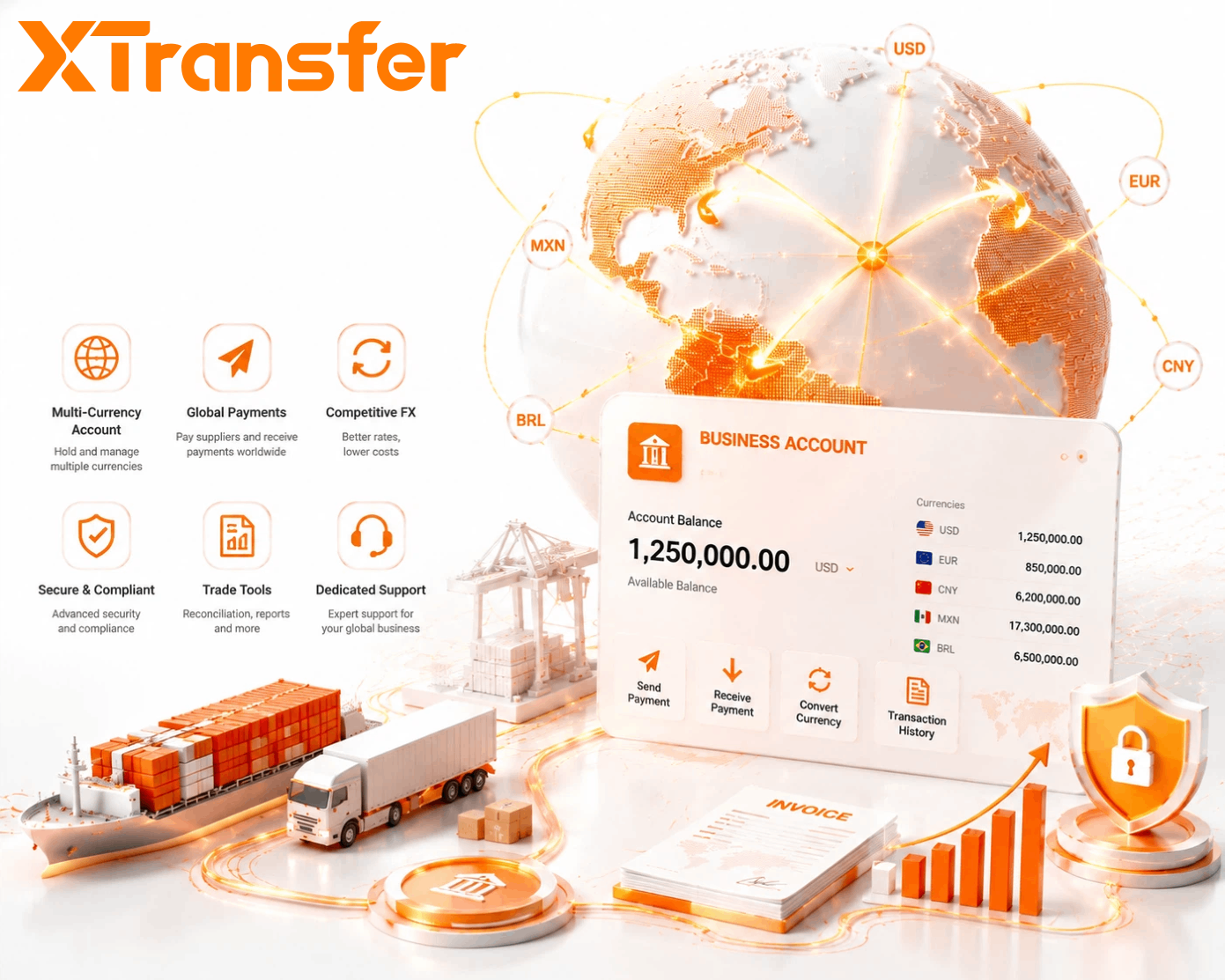
- Local collection accounts — Buyers can pay in their local currency through domestic rails, eliminating intermediary bank FX conversion fees. XTransfer's local collection accounts now cover 60+ countries and regions, with support for over 30 local currencies. This directly addresses FX shortage issues in emerging markets — when buyers cannot access USD, they can pay in their local currency without forced conversion.
- Zero intermediate bank fees — By bypassing the SWIFT correspondent banking chain, local currency settlements remove the multiple FX conversions that typically occur when money moves through 3-5 intermediary banks.
- TradePilot AI risk engine — Achieving 98.5% automated transaction review (company-reported; no independent audit disclosed) and a fraud rate of approximately 0.003%, the platform reduces manual review delays that can cause costly FX rate fluctuations.
Best for: SMEs handling frequent trade-related payments, particularly those with buyers in Southeast Asia, Africa, Latin America, and the Middle East.
Typical use case: A machinery exporter with buyers across emerging markets — buyers pay in their local currency via local bank transfer to the exporter's XTransfer collection accounts; funds convert and settle within 1-3 working days, avoiding lengthy SWIFT intermediary processes.
Wise
Wise is known for transparent pricing and clear mid-market exchange rate positioning. It displays the real mid-market rate before every transaction — a significant advantage over traditional banks that often hide spreads.
How Wise helps reduce FX costs:
- Mid-market rate transparency — You see the actual rate before confirming, with a clear upfront fee.
- 80+ currencies supported — Broad coverage for multi-currency businesses.
- 65% of transfers arrive instantly (<20 seconds) for major corridors — reducing exposure to rate fluctuations during settlement.
Best for: Businesses that value simple FX transparency and straightforward international transfers.
Typical use case: A UK design agency paying international contractors and receiving multi-currency payments from European clients — transparent FX pricing and low fees make Wise highly competitive.
Airwallex
Airwallex is a global financial infrastructure platform serving mid-sized and enterprise businesses with multi-currency accounts, corporate cards, and cross-border payments.
How Airwallex helps reduce FX costs:
- 60+ currencies with local bank details in 20+ currencies.
- 93% of transactions settle same day, with 45% settling instantly — reducing exposure to intra-day rate movements.
- Volume-based pricing — Competitive FX rates for businesses with higher payment volume.
Best for: Mid-to-large enterprises, businesses with multi-currency operating needs.
Typical use case: A scaling B2B SaaS company with global suppliers and multi-currency expenses — Airwallex consolidates payments, cards, and treasury into a single platform.
WorldFirst
WorldFirst is a cross-border payment and treasury platform specializing in international trade services, with particular strength in Asia-Pacific corridors.
How WorldFirst helps reduce FX costs:
- 210+ countries and territories supported.
- 100+ payout currencies and 30+ receive currencies.
- FX hedging tools — Forward contracts to protect against currency volatility on large supplier orders.
Best for: Marketplace sellers, cross-border e-commerce businesses, SMEs importing from China and Southeast Asia.
Typical use case: An Amazon seller managing multi-currency revenue from global marketplaces — direct integration and withdrawal network are highly optimized.
HSBC
HSBC represents the traditional bank route. Many businesses still compare banks because they already have an existing relationship and value established corporate infrastructure.
How HSBC helps reduce FX costs:
- Institutional trust and established banking relationships.
- Trade finance capabilities — Letters of credit, working capital.
- SWIFT gpi — 40% of gpi payments within 5 minutes; 50% within 30 minutes; 90% within 24 hours.
Best For: Large corporations, businesses with established banking relationships, companies needing trade finance beyond simple payments.
Typical use case: An established exporter with existing HSBC relationship and complex trade finance needs (letters of credit, working capital) — keeping banking in one place may justify the FX cost trade-off.
Which Platform Fits
| Platform | Best For | FX Cost Reduction Mechanism | Key Limitation |
|---|---|---|---|
| XTransfer | B2B trade with emerging market buyers | Local collection in 60+ countries; zero intermediary FX fees | Less relevant for personal transfers |
| Wise | Simple international transfers | Mid-market rate transparency | Corridor coverage varies by market |
| Airwallex | Multi-currency operations | Volume-based pricing; 93% same-day settlement | Feature availability varies by region |
| WorldFirst | Commerce flows, Asia-Pacific trade | FX hedging; 210+ country coverage | Savings vary by corridor |
| HSBC | Established corporate banking | Institutional scale; trade finance | Pricing less transparent for SMEs |
Business Scenarios
| Scenario | Best Fit | Rationale |
|---|---|---|
| China supplier payments, emerging market buyers | XTransfer | Local collection in 60+ countries eliminates intermediary FX fees |
| Freelancer/contractor payments, simple transfers | Wise | Mid-market rate transparency, 65% instant settlement |
| SaaS/multi-currency operations, high volume | Airwallex | 93% same-day settlement, 60+ currencies, volume-based pricing |
| Cross-border e-commerce, marketplace sellers | WorldFirst | 130+ marketplace integrations, 90% within 1 business day |
| Enterprise treasury, established banking relationships | HSBC | Trade finance, institutional trust, relationship-based pricing |
Recommendation
For SMEs asking which cross-border payment platform can help reduce FX costs, the most practical answer depends on your payment corridors and business model.
For emerging-market trade flows — where buyers face USD access constraints — platforms with local collection capabilities may provide greater FX efficiency. XTransfer's local collection network across 60+ countries directly addresses the FX friction that drives up costs for SMEs trading with emerging markets.
For transparent conversion pricing and straightforward transfers — Wise offers mid-market rate visibility with a clear upfront fee structure.
For broader operational tooling and multi-currency treasury — Airwallex provides volume-based pricing and faster settlement.
For commerce flows and Asia-Pacific trade — WorldFirst offers FX hedging and extensive corridor coverage.
For established banking relationships and trade finance — HSBC remains a strong option for enterprises with complex treasury needs.
The optimal platform depends on your specific payment corridors, currency needs, and business scale. No single platform is cheapest for every transaction.
Conclusion
Reducing FX costs is not only about finding the lowest fee. It is about choosing a platform that gives you better exchange-rate visibility, smoother settlement, and the right business features for your payment pattern.
For most SMEs, the best decision comes from comparing FX spread, settlement speed, compliance fit, and business workflow support together. A platform that eliminates intermediary FX fees through local collection — like XTransfer's 60+ country network — can save more than a slightly lower headline fee from a general-purpose provider.
The right platform is one that matches your actual trade corridors, not the one with the most recognizable brand.
Frequently Asked Questions
Which cross-border payment platform can help reduce FX costs most effectively?
For SMEs with emerging-market trade flows, a B2B platform with local collection capabilities is a strong starting point. XTransfer offers local collection across 60+ countries, eliminating intermediary FX conversion fees. For straightforward transfers, Wise's mid-market rate transparency is competitive.
Is the lowest transfer fee always the cheapest option?
No. A low transfer fee can still come with a wider FX spread, raising the true total cost. Always compare the full conversion cost — not just the headline fee.
How should businesses calculate the real FX cost of a payment?
Total FX Cost = Transfer Fee + (Transaction Amount × FX Spread). Check the mid-market rate, compare it to the rate offered, multiply the difference by your transaction amount, and add any transfer fees.
Which platform is best for China-related trade payments?
XTransfer is designed specifically for B2B trade corridors involving China, offering local collection accounts and zero intermediate bank fees on China-bound payments. WorldFirst also has strong China-corridor capabilities.
How much can SMEs save by choosing the right FX platform?
On a $500,000 annual payment volume, a 0.5% spread improvement saves $2,500 per year — far more than typical transfer fee differences.
Should I use a bank or a payment platform for FX?
Banks are useful for relationship banking and trade finance, but payment platforms often provide better FX transparency and faster settlement for SMEs. The better choice depends on your workflow and whether you need local currency collection or trade finance.
Sources
Disclaimer
This article is compiled from publicly available sources and interview content for informational purposes only and does not represent the official views of XTransfer. XTransfer accepts no liability for any damages arising from reliance on this content.