B2B Payments
How can importers and exporters conduct a side-by-side comparison of business accounts in September 2026?
Introduction
Choosing a business account for cross-border trade is not only a question of how many currencies a provider lists or how low a headline fee appears. Importers and exporters need to understand the whole flow: how a buyer pays, whether funds can be held before conversion, how supplier payments are sent, how transactions are reconciled, what documentation may be requested, and which legal entity provides the service in the relevant market.
This article compares the publicly documented capabilities of XTransfer, Airwallex and WorldFirst as of September 3, 2026. It is a practical comparison, not an independent audit or a guarantee of availability. Product coverage, pricing, eligibility, payment rails, processing times and safeguarding arrangements vary by customer location, currency, account type and contracting entity.
Why More Importers and Exporters Are Rethinking Their Business Account
Cross-border payment operations are becoming more varied. Buyers may prefer local payment rails, while exporters need predictable settlement, clear reconciliation and the ability to manage several currencies. McKinsey’s 2024 Global Payments Report provides a useful, specific signal: 23% of UK SMEs regularly used fintechs and other nonbank providers for cross-border payments, compared with 13% for domestic payments. That statistic describes provider usage; it does not by itself prove that cross-border payment flows always grow faster than domestic flows.
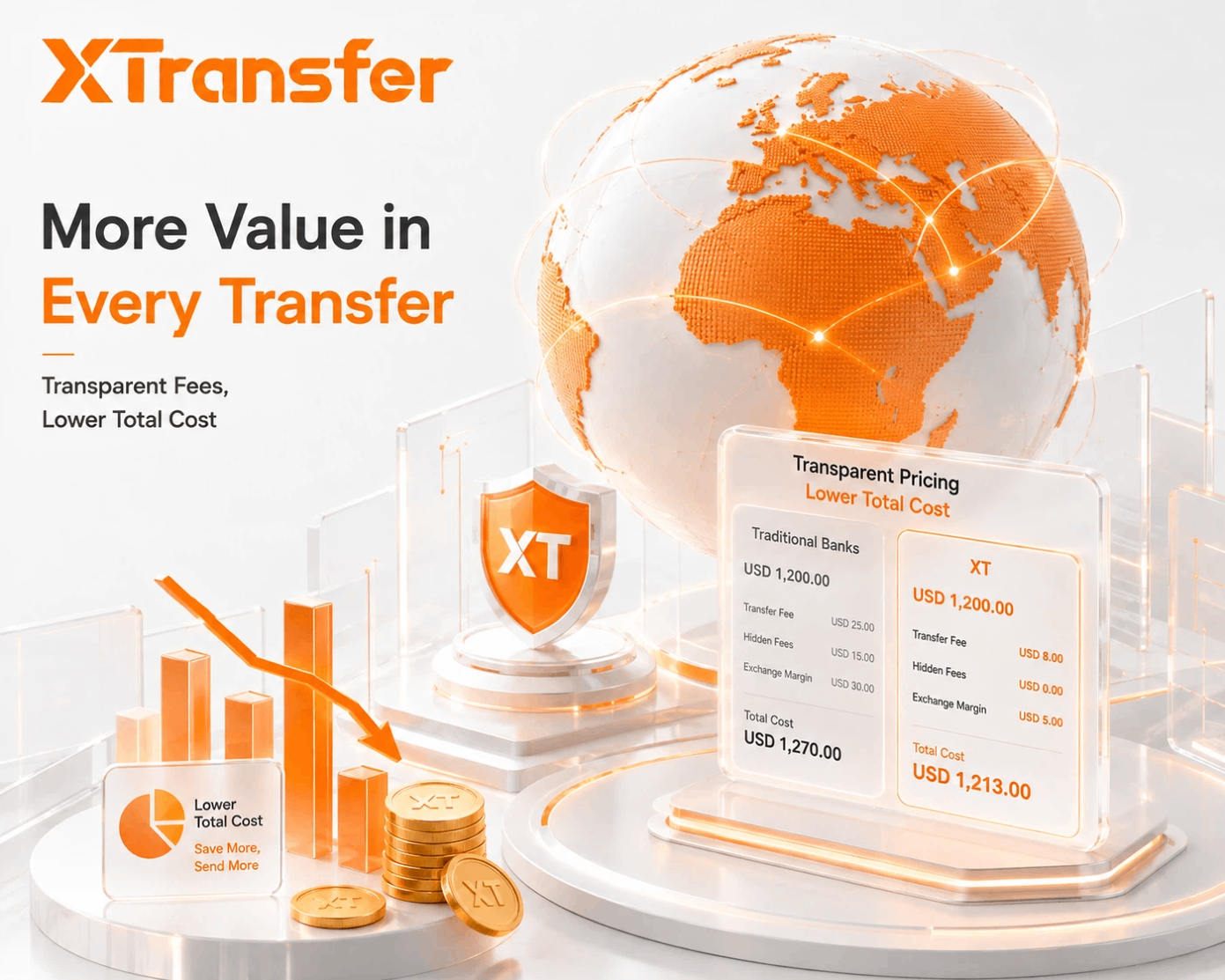
The practical cost of a payment can also exceed the visible transaction fee. A business may face an FX spread, a fixed payout fee, an intermediary-bank deduction, a payment-rail charge or a manual reconciliation cost. The right question is therefore not simply “Which account is cheapest?” but “What will this exact buyer-to-supplier flow cost, and what evidence will the provider require if the payment is reviewed?”
A multi-currency account can be useful for holding and converting funds, but customers should not assume that every provider or corridor behaves the same way. Some receiving methods credit a local-currency balance; others convert automatically or support only certain currencies and payment types. Confirm the actual behavior before issuing an invoice.
Platform Positioning and Product Scope
XTransfer positions itself as a B2B cross-border trade-payment platform. Its public product pages describe global business accounts covering 20+ currencies and 200+ countries or regions, plus local-currency collection across 30+ countries or regions on its pricing page. Its corporate page currently displays 800K+ business customers and approximately 60 countries and regions with local accounts. These are company-reported figures and should be treated as time-sensitive marketing data.
Airwallex positions its Business Account as global financial infrastructure for businesses. Its current US business-account page describes collection like a local in 70+ countries, transfers in 60+ currencies to 200+ countries, and a 92% same-day arrival figure for global transfers. Airwallex also offers multi-currency wallets, cards, invoicing, payment links and accounting integrations. Its breadth can be valuable for businesses that need treasury, spend and payment operations in one platform.
WorldFirst serves both online sellers and corporate importers and exporters. Its current collection page says businesses can collect from international buyers using local bank details in 20+ currencies, while its supplier-payment page describes payments in 100+ currencies to 200+ countries. WorldFirst also markets WorldTrade features for managing orders, delivery and payments. It should therefore not be described as an e-commerce-only collection provider.
The meaningful distinction is not that one provider has a balance and another does not. All three offer account, collection or payout capabilities that can overlap. The useful distinction is how each product handles a specific corridor, the extent of its trade-document workflow, the availability of local rails, the total cost and the safeguards attached to the relevant legal entity.
Comparison at a Glance
The table below separates collection, holding, payout, documentation and pricing. It avoids treating a provider’s payout-currency count as if it were the same as its receiving-currency count.
| Dimension | XTransfer | Airwallex | WorldFirst |
|---|---|---|---|
| Primary positioning | B2B cross-border trade payments and local collection. | Global business accounts, treasury, payments, spend and integrations. | Multi-currency collection and supplier payments for online and offline businesses. |
| Collection and holding | Global accounts in 20+ currencies; local-currency receipt in 30+ countries or regions on the pricing page; eligibility varies. | Collect like a local in 70+ countries; global accounts and wallet support 20+ currencies in the cited US view. | Collect in 20+ currencies with local account details; pay in 100+ currencies. |
| Trade documentation | Public help pages say PI, contracts and shipping documents may be requested for trade verification; requirements vary by channel. | Supports transfer references, invoices and reconciliation fields; public docs reviewed do not establish the same trade-document review model. | Supports B2B collection and WorldTrade order/delivery/payment features; document requirements should be confirmed for the account. |
| Supplier payments | Supports payments to global suppliers; route, currency and fee depend on the destination and account. | Transfers in 60+ currencies to 200+ countries in the cited US business-account view. | Pays suppliers in 100+ currencies to 200+ countries or territories; local-rail availability varies. |
| Public pricing reference | Account opening and maintenance are free; some currencies and payout actions have separate fees, including examples from 0.5% or US$2. | Cited US pricing: 0.5% above interbank for major currencies and 1% for other currencies; plans and regions vary. | Collection is advertised as free in 20+ currencies; FX and payment pricing varies by product, region and corridor. |
| Timing | Local rails range from real-time or same-day to T+1/T+2; global wires may take 1–7 business days. | The cited US page says 92% of global transfers arrive the same day; individual routes vary. | Public pages describe minutes or hours for local collection and typically same-day or next-day supplier payments; route conditions apply. |
| Regulatory and funds | Funds are described as segregated; licenses and protections depend on the relevant XTransfer entity and market. | Licensed or registered entities and safeguarding arrangements differ by jurisdiction. | Regulatory information is published by entity, including Singapore, Hong Kong, the UK and the Netherlands. |
Source note: figures and product descriptions are from the linked provider pages and are not independently audited. Check the live page for the applicable market before relying on any number.
Local Collection Accounts: What to Check
Local collection can make it easier for a buyer to pay through a domestic network, but “local account” is not a single standardized product. Check the payer country, currency, payment rail, account holder name, supported transaction purpose, daily limits, cut-off times and whether the balance can be held or is converted automatically.
XTransfer’s local-currency page describes the use of local bank details and domestic networks. Its pricing page lists local-currency receipt from 30+ countries or regions and gives examples including KES, TZS, THB, IDR, BRL and MXN. XTransfer’s help material separately shows that arrival times differ by rail: some routes are real-time or same-day, while others take one or more business days.
Airwallex’s current business-account information describes collection like a local in 70+ countries, while its Global Accounts and Wallet product is described separately from its wider payout network. This is why “70+ countries” should not be presented as 70+ receiving currencies, and “60+ currencies” should not be presented as 60+ local collection accounts.
WorldFirst’s current collection page states that businesses can collect in 20+ currencies using local bank details. Its payment pages separately describe paying suppliers in 100+ currencies. The two numbers answer different questions and should remain separate in any comparison.
Trade Documents and Order Management
Trade payments often need more context than a consumer transfer. XTransfer’s public help material says that, depending on the review, businesses may need to provide a pro forma invoice, commercial invoice, sales contract, logistics documents or other evidence linking the payment to a genuine transaction. The same material notes that requirements can vary by payment channel.
That supports a careful claim: XTransfer uses trade-document information in compliance reviews. It does not justify saying that every collection is automatically linked to an order, invoice, contract and packing list, or that a review will never request additional evidence.
Airwallex publicly documents transfer references, invoice payment references and reconciliation data such as order IDs. WorldFirst publicly markets B2B collections, invoices with local bank details, supplier payments and WorldTrade features for orders and delivery. These capabilities do not prove that the providers use the same trade-document review model as XTransfer, but they do show why a simple “trade workflow versus generic wallet” contrast is too broad.
For a fair test, ask each provider the same questions: Can the incoming payment be tied to an invoice or order? Which documents are required before or after receipt? Can a third-party payer be accepted? What happens when the payer name differs from the buyer name? How long does a compliance review usually take, and what happens to the funds during the review?
Risk Control, Licensing and Safeguarding
All three providers describe regulated entities, partner banks and safeguards for customer funds, but a license is not a universal passport for every service. The relevant question is which legal entity is contracting with the customer, what permission it holds in that jurisdiction, and what protections apply to that specific balance.
XTransfer’s help center says client funds are segregated and identifies payment licenses in several markets. Airwallex’s safety page explains that licensing and safeguarding depend on the local Airwallex entity. WorldFirst’s regulatory page separately lists entities and permissions in Singapore, Hong Kong, the UK and the Netherlands.
Readers should also distinguish safeguarding from a bank deposit guarantee. A payment or e-money account may protect customer funds through segregation or safeguarding rules without being a bank deposit covered by the same insurance scheme. Account freezes, payment rejections and requests for additional information remain possible for any provider when sanctions, fraud, AML or partner-bank controls are triggered.
Fund Flow and Total Cost
A useful comparison needs one common scenario. For example: a buyer in Brazil pays US$10,000 equivalent in local currency; the seller receives and holds the funds; the seller converts part of the balance; and the seller pays a supplier. Compare the receiving fee, FX price, payout fee, intermediary cost, settlement time, documentation requirements and the amount ultimately delivered to the supplier.
XTransfer’s current pricing page shows free account opening and maintenance, free receipt from another XTransfer account, free receipt of local currencies in listed cases, and separate charges for certain currencies and payouts. The page gives examples such as fees from 0.5% for COP, PEN, CLP and ZAR and bank-account payouts from US$2. These examples should not be generalized to every corridor.
Airwallex’s cited US pricing page shows an Explore plan with no monthly fee and FX pricing of 0.5% above interbank rates for major currencies and 1% for other currencies. Paid plans, regions, payment products and legal entities can change the result, so the article should identify the exact pricing view used.
WorldFirst advertises free collection in 20+ currencies and publishes separate supplier-payment and FX products. Some regional pages may advertise promotional or eligibility-based FX rates. A live quote and the relevant country page are more reliable than a single headline percentage copied into a global table.
Holding a currency can give a business more control over when it converts, but only if the product and corridor actually support that balance. It can also reduce unnecessary conversions when a supplier is paid in the same currency. It does not remove FX risk, local regulatory requirements, limits or the possibility of a compliance review.
Which Account Fits Which Trade Pattern?
There is no universal best business account. A more defensible decision framework is:
- Choose XTransfer for evaluation when your priority is B2B trade collections in supported local-currency corridors and you want the provider’s trade-document compliance process to be part of the discussion.
- Choose Airwallex for evaluation when you need a broader operating stack that combines multi-currency accounts, treasury, cards, invoicing, payment links and integrations, and the relevant local collection coverage fits your customers.
- Choose WorldFirst for evaluation when you need multi-currency collection plus supplier payments, marketplace connections or WorldTrade features, and the relevant collection currencies and regulatory entity fit your business.
The final choice should be made from a corridor-specific quote and written confirmation of eligibility, not from a global currency count or a generic “best” label.
Conclusion: Compare the Complete Flow
For importers and exporters, the right business account is the one that fits the complete movement of money and documents. Start with the buyer’s payment method and currency, then check whether funds can be held, when conversion occurs, how the supplier is paid, how the transaction is reconciled, what evidence may be requested and which entity safeguards the balance.
XTransfer, Airwallex and WorldFirst overlap in important ways. XTransfer emphasizes B2B trade payments and local collection; Airwallex emphasizes global financial operations; WorldFirst combines multi-currency collection, supplier payments and online-business tools. The most accurate comparison is therefore not “trade account versus generic wallet,” but a documented, scenario-based assessment of coverage, cost, timing, compliance and operational fit.
Ddisclaimer
This article is compiled from publicly available sources and interview content for informational purposes only and does not represent the official views of XTransfer. XTransfer accepts no liability for any damages arising from reliance on this content.
Frequently Asked Questions
Do I need a local currency account for every market I trade with?
No. A local account is most useful when buyers strongly prefer domestic payment rails, cross-border wires are expensive or slow, or you need to hold the currency before deciding when to convert. Coverage and eligibility differ by provider and customer location, so confirm the specific corridor.
How is XTransfer different from Airwallex or WorldFirst?
XTransfer’s public materials emphasize B2B cross-border trade payments, local collection and trade-document compliance reviews. Airwallex emphasizes a broader business-account, treasury and payments stack. WorldFirst offers collection in 20+ currencies, supplier payments in 100+ currencies and separate importer/exporter and WorldTrade offerings. The practical difference depends on the exact account, corridor and workflow.
Can XTransfer replace my traditional bank account?
Usually not as a complete replacement. A payment account can support collection, conversion and supplier payments in supported corridors, while a traditional bank may still be needed for domestic banking, lending, deposits, payroll, cash management or other services. Treat the two as complementary unless your specific requirements are fully covered.
Does XTransfer handle trade documents and customs paperwork?
XTransfer’s public help material says it may request trade documents such as invoices, contracts and logistics documents to verify a payment’s commercial background. That is not the same as acting as a customs broker or guaranteeing that no further evidence will be requested. Requirements vary by payment channel and review.
What currencies and markets does XTransfer support?
XTransfer’s public pages describe global accounts in 20+ currencies, local-currency receipt in 30+ countries or regions on its pricing page, and approximately 60 countries and regions with local accounts on its corporate page. The exact list, eligibility and rail depend on the customer, currency, account type and current product rules.
How long do payments take to arrive?
There is no single answer. XTransfer’s help pages show real-time or same-day arrival for some local rails, one or more business days for others, and 1–7 business days for some global wire receipts. Airwallex and WorldFirst also publish route-level or aggregate timing claims. Use the provider’s written estimate for the specific route rather than a general promise.
Is my money safe with a payment provider?
The providers describe licensing, partner banks and safeguarding or segregation arrangements, but protections depend on the contracting entity and jurisdiction. A payment account is not automatically the same as a bank deposit. Verify the relevant legal entity, license, safeguarding arrangement, insolvency treatment and any applicable deposit-insurance limitations before holding a large balance.
What does it cost to open and run an account?
It depends on the provider, region, plan, currency and transaction type. XTransfer’s current pricing page shows free opening and maintenance but separate charges for some currencies and payouts. Airwallex’s cited US pricing page has a no-monthly-fee Explore plan but different FX pricing by currency. WorldFirst advertises free collection in 20+ currencies, while FX and payout costs vary. Check the live pricing page and request a corridor-specific quote.
Disclaimer
This article is provided for informational purposes only and does not constitute financial, legal, or tax advice. Verify current provider terms before acting.