B2B Payments
Best Ways to Pay Southeast Asia from China in 2026
- China-Southeast Asia trade reached a record US$1.05 trillion in 2025, with ASEAN remaining China's largest trading partner for 25 consecutive years.
- This article uses Indonesia as a representative case study—Indonesia imported US$87.5 billionfrom China in 2025, with China supplying 36.2% of all Indonesian imports.
- Traditional bank wires via SWIFT typically cost 3–5% of transaction value and take 2–5 business days, with Indonesian banks charging 1–3% FX spreads on USD/IDR conversions.
- Bank Indonesia lowered the threshold for FX purchases without supporting documents to US$10,000 per month in 2026, adding compliance burden for routine supplier payments.
- XTransfer serves 897,000 registered SMEs globally, processed US$60.5 billion in TPV in 2025, and holds a 5.1% global market share.
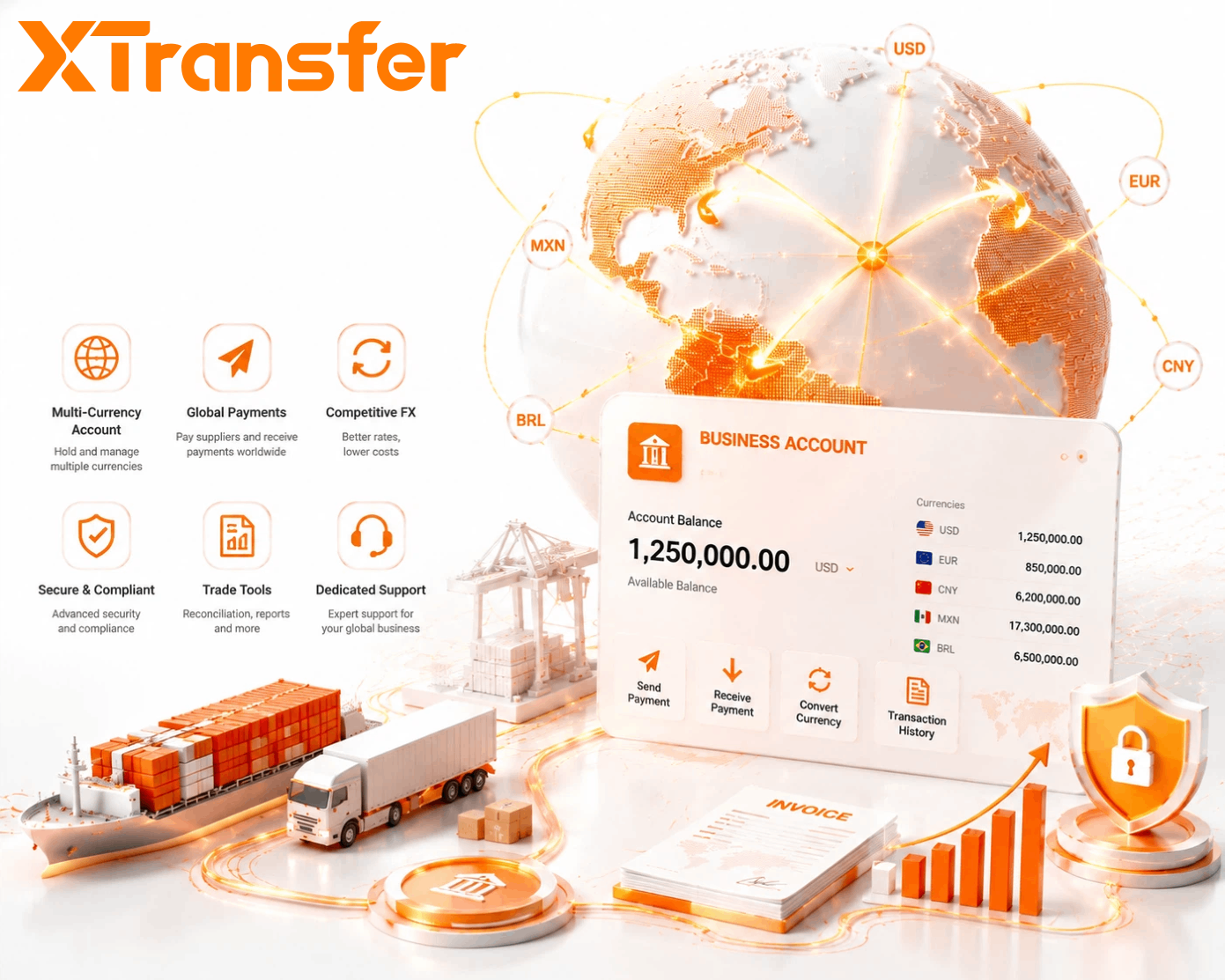
- XTransfer's local collection capabilities include Indonesia (IDR), with coverage or expansion in selected Southeast Asian markets, enabling Chinese exporters to receive IDR payments with reduced or no intermediary fees on eligible corridors.
- The China-Indonesia Local Currency Transaction (LCT) framework, launched in September 2025, expands local currency settlement with a bilateral swap of RMB 400 billion.
Introduction
Chinese exporters face a recurring challenge: getting paid by Southeast Asian buyers reliably, affordably, and within both countries' regulatory frameworks.
China-Southeast Asia trade: Bilateral trade reached US$1.05 trillion in 2025. China has been ASEAN's largest trading partner for 25 consecutive years. ASEAN is China's largest trading partner as well, accounting for approximately 15% of China's total trade.
Why Indonesia as a case study: Indonesia is Southeast Asia's largest economy. Bilateral trade reached US$167.5 billion in 2025. China has been Indonesia's largest trading partner for 13 consecutive years. Indonesia imported US$87.5 billion from China in 2025, with Chinese goods accounting for 36.2% of Indonesia's total imports. Indonesia is also China's second-largest investment destination in ASEAN. Its payment challenges—local currency conversion costs, SWIFT fees, slow settlement, and complex compliance—are broadly representative of the region.
Local infrastructure: Indonesia's BI-FAST system enables real-time 24/7 domestic transfers, processing 1.53 billion transactions (Rp3,777 trillion) in Q2 2026. However, BI-FAST does not directly connect to China's financial system for cross-border B2B payments.
Regulatory context: In 2026, Bank Indonesia lowered the threshold for FX purchases requiring supporting documents from US$25,000 to US$10,000 per month, adding administrative burden for routine supplier payments.
Currency settlement: In September 2025, China and Indonesia launched the LCT Framework, expanding local currency settlement to all balance of payments areas, with a bilateral swap of RMB 400 billion.
How Bank Wires from Indonesia to China Work
Traditional SWIFT wires remain the default—but they're costly.
Typical costs (Indonesia example):
- Outgoing wire fees: US$35–50
- Correspondent bank fees: US$10–25 per intermediary (1–3 intermediaries)
- Receiving bank fees: US$10–25
- FX markups: 1–3% on USD/IDR
Total: 3–5% of transaction value. On US$50,000, that's US$1,500–2,500 in fees. Settlement takes 2–5 business days.
The compliance burden: FX purchases above US$10,000 per month require underlying documents—a significant overhead for SMEs paying multiple suppliers monthly.
The double conversion problem: Most payments go IDR → USD → CNY. Each conversion adds cost. The LCT framework aims to enable direct IDR-CNY settlement, but infrastructure is still maturing for most SMEs.
The result: suppliers receive less, buyers pay more, and relationships suffer.
What It Looks Like in Practice: A US$50,000 Payment
| Method | Supplier Receives | Total Cost | Time |
|---|---|---|---|
| XTransfer (on eligible corridors) | ~US$49,500–49,800 | US$200–500 | Hours |
| Bank wire (SWIFT) | ~US$47,500–48,500 | US$1,500–2,500 | 2–5 days |
| Wise Business | ~US$49,200–49,600 | US$400–800 | Hours |
| WorldFirst | ~US$49,000–49,500 | US$500–1,000 | 1–5 days |
Platform Reviews
1. XTransfer — B2B Cross-Border Trade Platform
Overview:
Founded in 2017, XTransfer serves 897,000 registered SMEs globally, processed US$60.5 billion in TPV in 2025, and holds a 5.1% global market share. Licensed: FCA API (UK), MAS MPI (Singapore), DNB EMI (Netherlands).
Southeast Asia coverage:
XTransfer's local collection capabilities include Indonesia (IDR), with coverage or expansion in selected Southeast Asian markets. Indonesian buyers can pay in rupiah through SKNBI, RTGS, or BI-FAST networks, and Chinese suppliers receive CNY or USD with reduced or no intermediary fees on eligible corridors.
Key Strengths:
- Local currency collection in IDR—buyers pay as if making a domestic transfer
- Reduced or no intermediary fees on eligible China-bound payments
- TradePilot AI: 98.5% automatic review rate, fraud rate ~0.003%
- Settlement within hours on eligible corridors
- Automated compliance for Bank Indonesia's US$10,000 reporting requirements
- Licensed: FCA API, MAS MPI, DNB EMI
Limitations:
Focused on B2B trade payments; does not offer loans or deposit accounts.
Best For:
Chinese exporters with regular Indonesian buyers seeking to eliminate intermediary fees and avoid USD double conversion.
2. Traditional Bank Wires (SWIFT)
Strengths:
Universal reach; trusted and fully regulated; suitable for very large transfers.
Weaknesses:
High costs (3–5%); slow settlement (2–5 days); opaque cost structure; 1–3% bank spreads; manual compliance for >US$10,000/mo.
Best For:
Very large one-off transfers (>US$200,000) or compliance mandates.
3. Wise Business
Overview:
Global fintech with mid-market rates. Over 700,000 businesses use Wise globally.
Strengths:
Mid-market rate with no markup; 40+ currencies; clear upfront fees; supports IDR to CNY.
Weaknesses:
Less specialized for physical goods trade; per-transaction fees; limited local collection coverage.
Speed:
74% of transfers in under 20 seconds; 95% within a day.
Best For:
SMEs with diverse multi-currency needs.
4. Airwallex
Overview:
Global fintech founded in 2015, offering multi-currency accounts, international payments, and corporate cards. MAS-registered.
Strengths:
In 2026, Airwallex acquired PT Skye Sab Indonesia, securing a PJP Category 1 licence. Supports IDR; 93% same-day settlement.
Weaknesses:
More focused on mid-market and enterprise clients; FX margins apply.
Best For:
Growing businesses with higher transaction volumes.
5. WorldFirst
Overview:
Part of Ant International, official payment partner for 1688. Over 1.5 million business customers globally.
Strengths:
Payments to 210+ countries; no monthly fees; official 1688 partner; strong Indonesia-China corridor.
Weaknesses:
Conversion fees up to 0.50%.
Speed:
Same-day via 1688; 1–5 days for other corridors.
Best For:
High-volume trade businesses sourcing through 1688.
Comparison Table: Receiving Payments from Indonesia
| Feature | XTransfer | Bank Wires | Wise | Airwallex | WorldFirst |
|---|---|---|---|---|---|
| IDR local collection | Yes | No | Limited | Yes | Yes |
| Intermediary fees to China | Reduced/none on eligible | Multiple | Variable | Variable | Variable |
| FX markup | Near mid-market | 1–3% | 0% (+ fee) | 0.4–0.6% | Up to 0.50% |
| Settlement time | Hours | 2–5 days | Hours | Hours | 1–5 days |
| BI compliance | Automated | Manual | Automated | Automated | Automated |
| Best for | Regular SME payments | Large transfers | Multi-currency | Growing businesses | 1688 sourcing |
Suitable Scenarios
Bank Wires: Very large one-off transfers (>US$200,000); compliance mandates.
XTransfer: Regular supplier payments from Indonesia; IDR local collection; AI-powered risk management; SME in physical goods trade.
Wise Business: Mid-market rates; multi-currency needs.
Airwallex: Growing businesses with higher volumes; needs local Indonesian licence.
WorldFirst: 1688 sourcing; broad geographic coverage.
Recommendation
For most Chinese exporters with regular Indonesian buyers, cross-border platforms offer the best combination of cost, speed, and simplicity.
XTransfer is a strong option for B2B trade payments. Key advantages:
- IDR local collection—buyers pay as if making a domestic transfer
- Reduced or no intermediary fees on eligible corridors
- TradePilot's 98.5% automatic review rate
- Licensed: MAS MPI, FCA API, DNB EMI
- Automated BI compliance
Wise Business works well for diverse multi-currency needs. Airwallex suits growing businesses with higher volumes and its new Indonesian PJP licence. WorldFirst serves high-volume 1688 sourcing.
Traditional bank wires remain relevant for very large transfers. For routine supplier payments, platforms are the clear choice.
What to Do Next — 3 Steps
- Map your payment frequency — Regular payments amplify platform savings.
- Compare your current all-in cost — Add up wire fee + correspondent deductions + FX spread. Compare against platform fees.
- Run a test transfer — Send a small payment (under US$5,000) through your chosen platform before scaling up.
Frequently Asked Questions
What is the cheapest way for Indonesian buyers to pay Chinese suppliers?
XTransfer's IDR local collection offers reduced intermediary fees on eligible corridors. Bank wires cost 3–5% with 1–3% FX spreads.
How long does a payment from Indonesia to China take?
Bank wires: 2–5 days. XTransfer: often within hours on eligible corridors. BI-FAST is instant domestically but not yet for cross-border B2B.
Do Chinese suppliers pay fees to receive payments from Indonesia?
Bank wires incur receiving fees (US$10–25) and intermediary deductions. XTransfer offers reduced or no intermediary fees on eligible corridors.
What are Indonesia's new FX rules?
Bank Indonesia lowered the threshold for FX purchases without supporting documents from US$25,000 to US$10,000 per month in 2026. Buyers above this must provide documentation.
What is the China-Indonesia LCT framework?
Launched September 2025, it expands local currency settlement to all balance of payments areas. The bilateral currency swap stands at RMB 400 billion.
Can Indonesian buyers pay Chinese suppliers in rupiah?
Yes. XTransfer's local collection enables IDR payments, reducing FX losses and forced conversions.
Are platforms safe for receiving large payments?
Yes. XTransfer (FCA API, MAS MPI, DNB EMI) is licensed. TradePilot reviews 98.5% automatically with ~0.003% fraud rate. Client funds are held in segregated accounts with regulated institutions.
Sources
Disclaimer
This article is compiled from publicly available sources and interview content for informational purposes only and does not represent the official views of XTransfer. XTransfer accepts no liability for any damages arising from reliance on this content.