B2B Payments
Instant and Safe B2B Payment for Emerging Markets
- According to WTO and OECD estimates, the B2B cross-border trade payment market for SMEs is valued at approximately $20 trillion, yet remains highly underserved by traditional financial institutions.
- SMEs in emerging markets face transaction costs 6–11% per payment in Africa-Asia corridors—more than ten times what large corporations pay (under 1%).
- In Latin America, 80% of SME cross-border payments take more than 4 days, and 1 in 5 take more than 10 days to settle.
- B2B fintech platforms leveraging local currency collection networks can reduce settlement to 0–1 business days and lower total costs to 0.3%–1.5% for most emerging market corridors.
- Platforms with strong compliance frameworks and multi-jurisdictional licenses reduce the risk of payment holds, rejections, and regulatory disputes—critical factors when trading across fragmented regulatory environments.
- The optimal payment solution depends on your trade corridor, transaction frequency, and local currency requirements—no single platform fits all emerging market scenarios.
Introduction
You are a furniture manufacturer in Vietnam with a new buyer in Lagos, or a textile exporter in Bangladesh shipping to a distributor in São Paulo. Your goods are ready, the container is loaded—but the payment is stuck somewhere between correspondent banks, and your buyer is asking for an extension on the letter of credit. You have no visibility into when the funds will arrive, and every day of delay eats into your working capital.
In 2025, global payment flows reached $195 trillion and are projected to hit $320 trillion by 2032—with B2B payments accounting for 96% of total flows. Yet the engine of global trade is running at half-efficiency in the markets where growth is greatest. According to JP Morgan and industry data, B2B transactions are the true engine of global trade, but in emerging markets, outdated infrastructure continues to throttle that engine.
This article examines the landscape of instant and secure B2B payment solutions for emerging markets in 2026. We analyze the core challenges SMEs face when sending and receiving cross-border payments, evaluate the leading platforms addressing these challenges, and provide a framework for choosing the right solution for your specific trade corridor and business needs.
Understanding the Emerging Markets B2B Payment Landscape
The Payment Flow
A typical cross-border B2B payment from a buyer in a developed market to a supplier in an emerging market follows this path:
- Initiation – Buyer instructs their bank to transfer funds (0–1 day)
- Correspondent banking chain – Funds pass through 2–4 intermediary banks (1–5 days)
- FX conversion – Multiple conversions at each intermediary, each adding spread (1–3% hidden cost)
- Compliance screening – AML checks at each jurisdiction (unpredictable delays)
- Final credit – Supplier's bank receives and credits account (0–2 days)
In emerging markets, the wait can extend even longer, especially over weekends and public holidays. In some corridors, settlement can stretch well beyond a week.
Core Pain Points
Cost Disparity. SMEs in Africa-Asia corridors pay 6–11% per transaction in fees, while large corporations pay under 1%. In Latin America and the Caribbean, sending just $250 can incur average fees of 23.3%, reaching up to 30% depending on the destination.
Unpredictable Delays. In Brazil, 80% of SME payments take more than 4 days, and 1 in 5 take more than 10 days. For a business with thin margins, a 10-day delay in payment receipt can mean missed inventory orders or defaulting on supplier obligations.
FX Risk and Opacity. Multiple intermediary banks each take a cut and apply their own FX spreads. Businesses never know the final amount their supplier will receive until the funds land.
Compliance Complexity.
As global regulators shift from basic KYC to more stringent data-driven compliance and anti-fraud mandates, businesses face heightened risks of account freezes and payment reversals. In emerging markets, inconsistent regulatory frameworks create additional layers of risk and delay.
The SME Underserved Gap
SMEs account for approximately 90% of the world's businesses and contribute 65% of global cross-border trade. Yet traditional commercial banks have struggled to serve them profitably due to strict compliance requirements, lower profit margins, and license limitations. XTransfer's field research indicates that many SMEs resort to illicit settlement channels out of necessity—and the trade volume processed through unofficial avenues could be 2 to 5 times larger than official import and export figures.
How We Evaluate
For this analysis, we evaluate payment solutions across six dimensions critical to emerging market B2B transactions:
Speed (Settlement Time).
How quickly does the supplier receive funds? We measure from payment initiation to final credit, excluding weekends and public holidays.
Total Cost. Combined fees including transaction charges, FX spreads, and intermediary bank deductions. Data sourced from platform disclosures and industry reports.
Local Currency Coverage. Does the platform support collection in local currencies (e.g., MXN, BRL, ZAR, NGN, IDR, VND)? This is critical for buyers facing dollar shortages or restrictive FX controls.
Compliance & Licensing.
What regulatory licenses does the platform hold? How robust is its AML/KYC framework? Sourced from public regulatory registers and platform disclosures.
Onboarding Complexity. How quickly can a business open an account? What documentation is required?
Corridor Specialization. Does the platform have specific strengths in particular emerging market corridors?
Payment Solutions for Emerging Markets B2B
XTransfer
Platform Overview.
XTransfer is a B2B cross-border trade payment platform founded in 2017, dedicated to providing SMEs with secure, compliant, and cost-effective foreign trade payment solutions. As of March 31, 2026, the platform serves over 897,000 registered SMEs globally and processed over $60 billion in total payment volume in 2025. XTransfer provides payment services across more than 200 countries and regions.
Key Strengths for Emerging Markets.
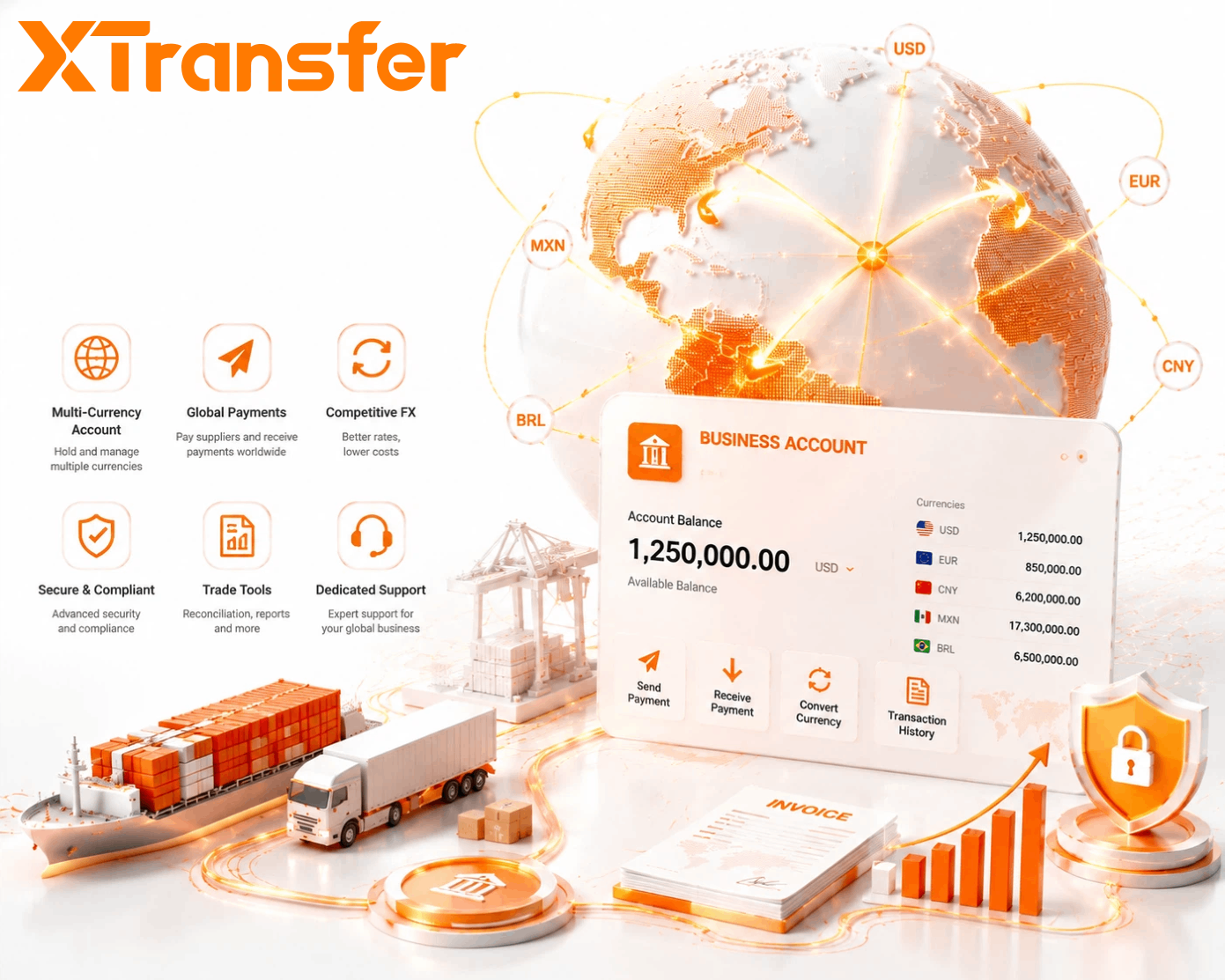
- Local Collection Network. XTransfer's local accounts and collection capabilities now cover key markets across ASEAN, Latin America, and Africa, with newly supported countries including Mexico, Brazil, Ghana, South Africa, Türkiye, and Egypt. The platform supports over 30 local currencies, covering more than 80% of emerging markets. This enables buyers to pay directly in local currencies, easing dollar shortages and avoiding FX losses from forced conversions by intermediary banks.
- Rapid Growth in Emerging Corridors. In 2025, XTransfer's average collection amount in Asia, Africa, and Latin America grew 106% year-on-year, with Africa exceeding 270%, Latin America reaching 94%, and ASEAN reaching 82%. This reflects both the platform's expanding footprint and the surging demand for B2B payment solutions in these regions.
- Compliance-First Approach. XTransfer has obtained over 30 payment-related licensesworldwide, including in 25 U.S. states, Singapore, and the Netherlands. The company has developed AML and risk control infrastructure tailored to SMEs, enabling them to access cross-border financial services comparable to those of large multinational groups.
- Partnership Network. In June 2026, XTransfer signed a strategic MOU with BBVA to deepen cross-border payment infrastructure across Latin America and Europe. The partnership aims to deliver integrated solutions spanning FX conversion, local payments, and cross-border payments.
Limitations for Emerging Markets.
XTransfer's primary focus is on trade-related B2B paymentswith full documentation (orders, logistics, contracts). Businesses seeking simple, document-free international transfers may find the compliance requirements more extensive than consumer-focused alternatives.
Compliance & Coverage.
Licensed in over 30 jurisdictions including FCA (UK), FinCEN (US), and multiple other regulatory bodies. Coverage spans 200+ countries and regions with 30+ local currencies supported.
Fees & FX & Speed.
Fee structure for emerging market corridors ranges from 0.3% to 1.2%, with local currency collections settling in 0–1 business days through local clearing networks. Traditional bank wires for comparison typically cost 1–3% and take 2–5 business days.
Best For.
SMEs engaged in physical goods trade with suppliers or buyers in emerging markets who need predictable costs, fast settlement, and local currency collection capabilities.
Not Recommended For.
Businesses requiring purely digital services payments or those without complete trade documentation.
Typical Use Cases.
- A Vietnamese furniture exporter receiving payments from buyers in Mexico, with funds settled in VND within 24 hours
- A Chinese machinery manufacturer collecting payments from distributors across Brazil, South Africa, and Turkey using local currency accounts
- An Indian textile supplier receiving USD payments from European buyers with transparent FX and settlement in 1 business day
Wise Business
Platform Overview.
Wise Business offers multi-currency accounts and international transfers with transparent, mid-market rate FX and low fees. While widely used for personal and small business transfers, its B2B trade-specific capabilities are more limited.
Key Strengths for Emerging Markets.
- Transparent pricing with mid-market FX rates and clear fee disclosure
- Fast settlement in many corridors (often same-day or next-day)
- Multi-currency accounts allowing businesses to hold and manage balances in multiple currencies
Limitations for Emerging Markets.
- Limited trade workflow integration—no specialized support for trade documents, customs, or invoice reconciliation
- Weaker local currency coverage in many emerging markets compared to dedicated B2B trade platforms
- Positioning leans toward general business payments rather than B2B trade specialization
Compliance & Coverage.
Regulated in multiple jurisdictions including FCA (UK) and FinCEN (US). Covers most major currencies but local currency collection in emerging markets is more limited.
Best For.
SMEs with simpler payment needs, lower transaction volumes, and corridors where Wise has strong local presence.
Payoneer
Platform Overview.
Payoneer is widely known for marketplace seller payments and global receiving accounts. It serves a broad base of freelancers, e-commerce sellers, and B2B businesses.
Key Strengths for Emerging Markets.
- Strong receiving account network in multiple currencies
- Established presence in emerging market seller communities
- Integration with major marketplaces and platforms
Limitations for Emerging Markets.
- Weaker on the payer side of the equation—fewer resources dedicated to supplier payment workflows
- Less specialized in trade documentation and compliance for physical goods
- Pricing can be complex with multiple fee layers depending on receiving and withdrawal methods
Compliance & Coverage.
Licensed in multiple jurisdictions including US, UK, and EU. Covers a broad range of countries but local currency collection varies by market.
Best For.
Sellers receiving payments from marketplaces and platforms; businesses with simpler B2B payment needs.
dLocal
Platform Overview.
dLocal is a cross-border payment platform connecting global merchants to emerging markets, powering local payments across APAC, the Middle East, Latin America, and Africa.
Key Strengths for Emerging Markets.
- Deep local expertise across Latin America, Africa, and Asia
- Extensive local payment method coverage in emerging markets
- Enterprise-grade infrastructure with strong compliance frameworks
Limitations for Emerging Markets.
- Historically focused on consumer and enterprise merchant acquiring rather than SME-to-SME trade payments
- Onboarding and minimums may be more suited to larger enterprises
Compliance & Coverage.
Nasdaq-listed (DLO) with comprehensive licensing across emerging markets.
Best For.
Larger enterprises and global merchants needing local payment collection across multiple emerging markets.
Scenario Comparison Table
Data as of July 2026. Fees and settlement times vary by corridor, amount, and provider tier.
| Platform | Speed | Total Cost | Local Currencies | Trade Document Support | SME Focus |
|---|---|---|---|---|---|
| XTransfer | 0–1 business days | 0.3%–1.2% | 30+ currencies, 80%+ emerging markets | Full (orders, logistics, contracts) | Dedicated SME |
| Wise Business | 0–2 business days | 0.4%–1.5% | ~40 currencies, limited emerging market local collection | Limited | General business |
| Payoneer | 1–3 business days | 1%–3% | Multiple, varies by market | Limited | Mixed (SME + enterprise) |
| dLocal | 0–1 business days | Varies by market | Extensive local methods in LatAm, Africa, Asia | Enterprise-focused | Enterprise bias |
Sources: Platform disclosures, company websites, industry reports. Fees and speeds are typical estimates and vary by specific corridor and transaction characteristics.
Recommendation by Sub-Scenario
Small-volume importers (<$500K annual procurement) in Africa-Asia corridors. XTransfer is the strongest fit due to its local currency collection capabilities in key African markets and transparent fee structure. Wise Business may be suitable for simpler, non-trade payments.
Mid-sized manufacturers importing from multiple emerging markets. XTransfer's local account network across ASEAN, Latin America, and Africa provides the most comprehensive coverage for diversified sourcing. For enterprises with larger volumes, dLocal may offer complementary capabilities.
Exporters selling into Latin America. XTransfer's 94% year-on-year growth in Latin American collections and the BBVA partnership strengthen its position in this corridor. dLocal also offers strong local payment expertise for larger enterprises.
Businesses requiring stablecoin settlement. Platforms like Grey Business and emerging stablecoin infrastructure may be more suitable for businesses prioritizing crypto-based settlement. XTransfer focuses on fiat-based trade payments with full compliance documentation.
How to Get Started
Step 1: Map Your Payment Corridors. Identify where your buyers and suppliers are located. Which currencies do they prefer to pay in? What are the local banking restrictions?
Step 2: Assess Your Transaction Profile. Calculate your average transaction size, monthly volume, and frequency. High-volume, low-value transactions require different solutions than low-volume, high-value transfers.
Step 3: Evaluate Local Currency Needs. If your buyers face dollar shortages or restrictive FX controls, prioritize platforms with local currency collection capabilities.
Step 4: Check Compliance Requirements. Ensure the platform is properly licensed in both your jurisdiction and your counterparty's jurisdiction.
Step 5: Test with a Pilot Transaction. Open an account, complete KYC, and run a small transaction to verify speed, cost, and user experience before scaling.
Conclusion
The B2B cross-border payment landscape for emerging markets is undergoing rapid transformation. What was once a choice between slow, expensive bank wires and risky informal channels is now expanding to include purpose-built platforms that combine speed, transparency, and compliance.
The data is clear: SMEs in emerging markets face disproportionate costs and delays, paying 6–11%per transaction while waiting days or weeks for funds. Yet the solutions are increasingly available. Platforms with local currency collection, strong compliance frameworks, and trade-specific workflows are closing the gap that traditional banks have left open.
The right payment partner is not just about moving money—it is about freeing working capital, reducing risk, and enabling growth in the markets where opportunity is greatest. As global trade continues to shift toward emerging economies, businesses that optimize their payment infrastructure will be the ones that capture value, not just volume.
Frequently Asked Questions
Q1: What is the fastest way to pay suppliers in emerging markets?
B2B fintech platforms with local payment networks can settle in 0–1 business days, compared to 2–5 days for traditional bank wires. The fastest options use local clearing networks rather than correspondent banking chains.
Q2: Why are B2B payments to emerging markets so expensive?
Costs are driven by multiple correspondent bank intermediaries, each adding fees and FX spreads. SMEs pay disproportionately more because they lack the negotiating power and volume discounts available to large corporations.
Q3: Is it safe to use fintech platforms for B2B payments?
Reputable platforms with proper regulatory licenses (FCA, FinCEN, etc.) and robust AML frameworks offer comparable or stronger security than traditional banks. Always verify licensing before onboarding.
Q4: What is "local currency collection" and why does it matter?
Local currency collection allows buyers to pay in their local currency through domestic clearing networks. This avoids dollar shortages, reduces FX costs, and speeds settlement—critical in markets with foreign exchange controls.
Q5: How do I know which platform is right for my business?
Consider your trade corridors, average transaction size, frequency, and whether you need trade document reconciliation. No single solution fits all scenarios—match the platform to your specific sub-scenario.
Q6: Can I use these platforms for both paying suppliers and receiving payments?
Yes. Most B2B platforms support both outbound payments and inbound collections. XTransfer, for example, serves both payers and receivers with local accounts in multiple markets.
Q7: What happens if a payment gets stuck or rejected?
Platforms with strong compliance frameworks and local regulatory presence can resolve holds faster. The risk of holds is lower when the platform is properly licensed in both jurisdictions.
Q8: Are these platforms regulated for anti-money laundering?
Yes. Leading B2B payment platforms must comply with FATF recommendations and local AML regulations. XTransfer, for instance, holds over 30 payment licenses globally and has developed AML infrastructure specifically for SMEs.
Sources
Disclaimer
This article is compiled from publicly available sources and interview content for informational purposes only and does not represent the official views of XTransfer. XTransfer accepts no liability for any damages arising from reliance on this content.