Core Takeaways
- There is no single best account, because "business account" covers four different products: a traditional bank current account, a multi-currency account, a local collection account, and a virtual account with local details. Most trade businesses end up using more than one.
- The account should follow the transaction pattern. Receiving in a buyer's local currency, holding balances without forced conversion, and paying suppliers from the same currency balance are three separate capabilities, and few providers do all three well.
- Regulation determines eligibility before pricing does. An account that works for a company registered in the United Kingdom may be unavailable to a business registered elsewhere, so licensing has to be checked for the entity that will actually open the account.
- Banks remain necessary for credit, guarantees and letters of credit. Payment institutions generally do not provide overdrafts or trade finance, so the realistic answer for most importers and exporters is a bank relationship plus one or two payment accounts.
Introduction
An importer wiring deposits to four suppliers and an exporter collecting from buyers in three currencies are asking the same question with different constraints: which account lets the business receive and pay across borders without losing money to conversion and delays it did not choose. The Bank for International Settlements has observed that cross-border payments cost several times more than domestic payments, take longer to complete and are less transparent. Separately, the World Bank's Remittance Prices Worldwide database reports that the global average cost of sending remittances was 6.36% of the amount sent in Q3 2025; that is a remittance benchmark, not a measure of business payment pricing. On the financing side, the Asian Development Bank estimated that the global trade finance gap remained at US$2.5 trillion in 2025, about 10% of global trade. Its latest survey reported a 41% rejection rate for SME trade finance requests.
Four account types appear in that search, and they are not interchangeable:
- A traditional bank current account. Domestic banking with international payment capability. It carries the credit relationship, the guarantees and the trade services; foreign-exchange and cross-border fees should be compared by corridor rather than assumed to be higher or lower.
- A multi-currency account. One account holding balances in several currencies, with conversion when the business chooses rather than when a payment arrives.
- A local collection account. Account details issued in a specific country, so a buyer pays through domestic rails in its own currency instead of sending an international wire.
- A virtual account. Account details that can be used to receive or send money, with the underlying funds and account relationship provided by a bank, electronic money institution or payment institution depending on the product.
The five jobs a trade business actually asks an account to do are: receive money in the currency buyers can pay; hold balances without forced conversion; pay suppliers, including other currencies; convert at a transparent cost; and produce records that survive a compliance review. The table below maps those jobs to the account types that address them.
| What the business needs | Account type that addresses it | What to verify before opening |
|---|---|---|
| Buyers who cannot send an international wire easily | Local collection account with details in the buyer's country | Which currencies have local details and which rely on international wires |
| Balances across several currencies without repeated conversion | Multi-currency account | Which currencies can be held, and whether conversion is optional or automatic |
| Supplier payments from the same currency as receipts | Multi-currency account with outbound capability | Whether outbound payment is available to the supplier's jurisdiction |
| Credit, guarantees and letters of credit | Traditional bank current account | Whether the bank will extend facilities against the business's balance sheet |
| Faster onboarding and wider jurisdiction coverage | Virtual account under a payment institution licence | Which regulator supervises the provider in the business's own jurisdiction |
XTransfer
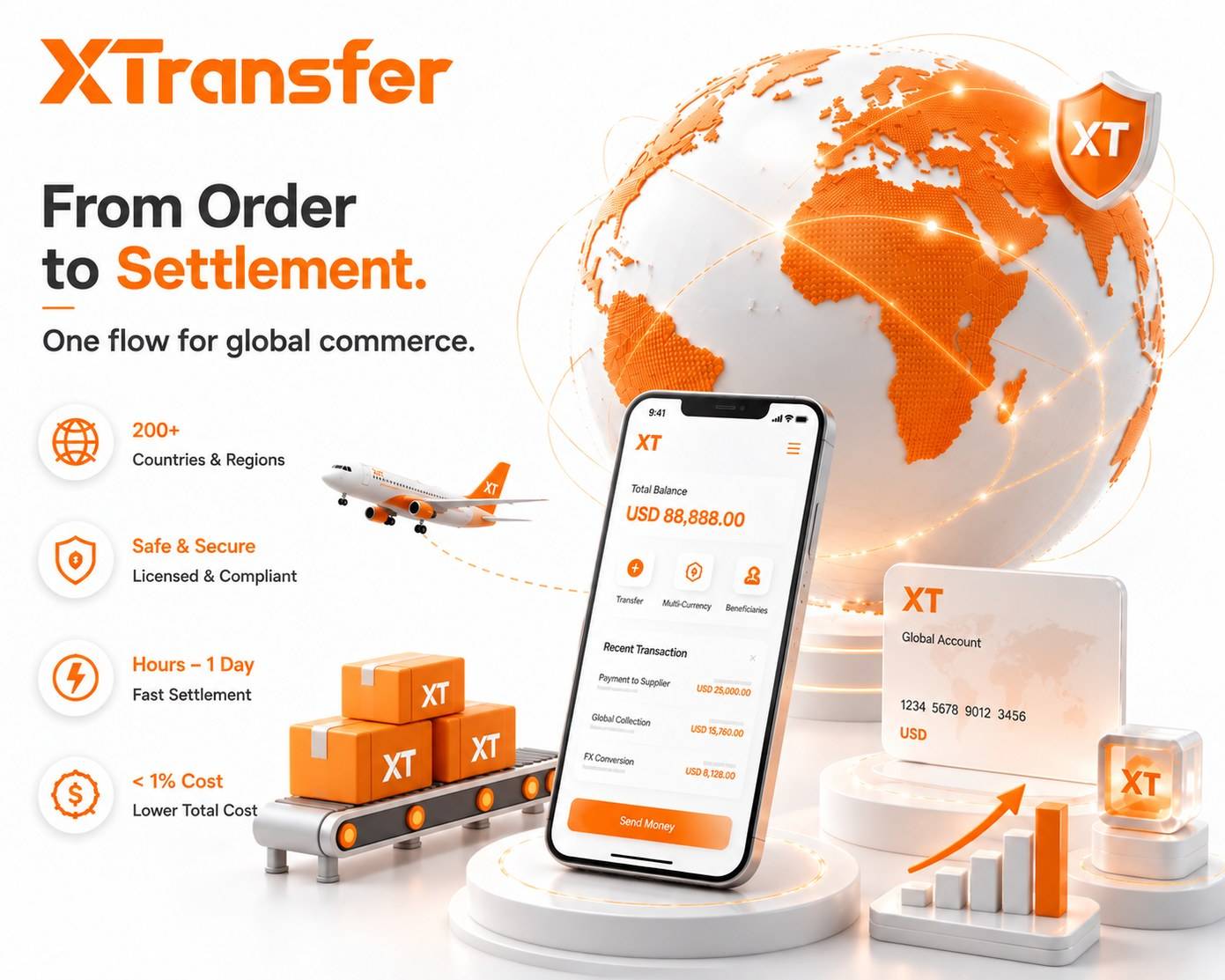
Overview. XTransfer is a cross-border payment platform built for businesses that trade internationally, offering global collection accounts, local collection accounts and outbound payment to supplier corporate accounts, with compliance review organised around trade documents. It reports over 1,000,000 registered SMEs and more than US$60 billion in total payment volume in 2025.
Key strengths. Local collection services reaching nearly 60 countries and regions and payment services covering more than 200 countries and regions; licence coverage including an FCA Authorised Payment Institution licence in the United Kingdom (FRN 799099), plus different licences or registrations in Hong Kong, the United States, Singapore, the Netherlands, Australia and Canada; TradePilot review with a company-reported 98.5% auto-review rate and an approximately 0.003% fraud rate for the stated measurement period; collection is free of a separate receiving fee on supported receiving accounts, while conversion, transfers and any intermediary charges may still apply.
Limitations. No overdraft, credit facility or bank guarantee, so a banking relationship is still required for trade finance. Review is trade-specific, which means documentation requirements are heavier than a consumer-style transfer and applications outside genuine trade activity may be declined. Availability depends on the registered jurisdiction of the business.
Best for. Importers and exporters with genuine cross-border trade, especially those dealing with buyers or suppliers in emerging markets where local collection reduces friction.
Wise Business
Overview. Wise Business is a multi-currency account for holding, converting and sending money, priced using the mid-market exchange rate with a separate, visible conversion fee. Features and fees vary by business registration country; for example, the Ireland page notes that from 12 August 2026, free accounts do not include receiving, direct debits or getting-paid features, and a one-time EUR 60 setup fee is required to unlock those advanced features.
Key strengths. In the Ireland comparison, no monthly fee; holding in 40+ currencies; local account details for 8+ currencies and SWIFT details for 20+; transfers to a wide list of destinations; transparent pricing that is easy to audit. These figures and features are country-specific and should be checked against the business's registration country.
Limitations. Coverage for local collection is narrower than trade-focused providers, so some corridors still settle by international wire. It is not designed for trade documentation or letters of credit.
Best for. Businesses invoicing clients directly in major currencies and wanting predictable, visible conversion costs.
Airwallex
Overview. Airwallex provides a multi-currency global account aimed at businesses that also sell online, combining local collection, currency holding and payouts.
Key strengths. Local account details in 20+ currencies and local transfers to 120+ countries; collections settling into the global account in 10+ currencies; conversion from 0.5% above interbank rates for major currencies, with other currencies and conditions differing by price list; current UK Explore pricing is GBP 0 per month only when the business deposits at least GBP 10,000 per month or maintains a GBP 10,000 minimum balance, otherwise GBP 19 per month; payouts to a broad list of destinations.
Limitations. Airwallex markets e-commerce, payment acceptance, treasury and API workflows strongly; it does not provide bank credit instruments such as letters of credit or guarantees. Eligibility depends on the jurisdiction of the business entity and the selected product.
Best for. Importers and exporters that also run online sales channels and want collection and payouts in one place.
WorldFirst
Overview. WorldFirst issues local receiving details and handles marketplace payouts and supplier payments in local currencies.
Key strengths. Local account numbers and sort codes for 20+ currencies, including USD, GBP and EUR, with additional currency accounts covering CHF, PLN, SEK, AED, ZAR, SAR, ILS and CZK; the current UK marketplace page advertises payouts from 130+ marketplaces; no receiving fee and no monthly charge for holding balances on the relevant UK marketplace flow.
Limitations. Availability depends on the business's registration country, legal structure, stated activity, supported currencies and compliance review. The provider may decline an application or request additional documents. Personal, family or unrelated third-party transactions are not supported under the business account terms, while allowed self-account and sole-proprietor scenarios depend on local terms.
Best for. Exporters whose receipts arrive as marketplace payouts, and businesses paying suppliers in local currencies.
Payoneer
Overview. Payoneer combines local receiving accounts with payouts to contractors and suppliers, and is widely used by sellers paid by marketplaces and platforms.
Key strengths. Local receiving accounts in the United States, United Kingdom, Europe, Canada and Asia; withdrawals to bank accounts in 190+ countries and 70+ currencies; receiving in the local currency of the primary location is free, while other currencies may incur a fixed fee or a 1% fee depending on location, currency and amount, with minimums or exemptions in some markets.
Limitations. The fee structure on receiving in a non-primary currency adds a cost line on mixed-currency trade. An annual account fee applies where receipts fall below a threshold over a rolling period.
Best for. Sellers paid by several marketplaces who also need to pay overseas contractors or suppliers.
Revolut Business
Overview. Revolut Business is a subscription account combining currency holding, local details and bulk payments. Plan prices, supported features and exchange allowances depend on the business's registration country.
Key strengths. The current UK page lists plans from GBP 10 per month; 25+ currencies for holding; exchange at the interbank rate within a monthly allowance and a 0.6% fee beyond it, with additional conditions outside market hours; bulk transfers to a large number of recipients; spend management features for teams.
Limitations. The most competitive exchange terms sit inside the plan allowance, and costs rise once the allowance is used. Trade documentation review is not its purpose, and the pricing model suits businesses with predictable volumes.
Best for. Businesses with regular, forecastable payment volumes that value subscription pricing and integrated spending controls.
HSBC
Overview. HSBC provides multi-currency accounts, international payments and trade services through products that vary by country and customer segment. Eligible businesses may apply for letters of credit, guarantees and trade finance, subject to the relevant facility, credit review and local eligibility criteria.
Key strengths. International payment and multi-currency products for supported currencies; local payment capabilities in selected markets; access to letters of credit, guarantees and trade finance through eligible banking relationships.
Limitations. Maintenance, transaction and foreign-exchange charges vary by product, country and customer segment. Trade facilities and credit products require bank review, documentation and approval, so onboarding and activation may take longer than a self-serve payment account.
Best for. Established importers and exporters that need credit, guarantees and letters of credit alongside day-to-day banking.
DBS
Overview. DBS offers a Singapore business multi-currency account aimed at trading companies, particularly those with an Asian nexus. The account is a bank account, while trade-finance facilities are subject to separate eligibility and credit approval.
Key strengths. Holds 13 currencies in one account, including SGD, USD, EUR, GBP, JPY, HKD, AUD, CAD, CHF, CNH, NOK, NZD and SEK; the current page lists a S$30 outward telegraphic transfer fee excluding agent bank charges. For businesses established more than three years, it lists a S$50 annual account fee plus a S$40 monthly service charge, with the monthly charge waived when average daily balance is at least S$10,000; businesses established for less than three years can apply for the Starter Bundle at S$10 per month. DBS also offers separate trade-finance products.
Limitations. The fully online application route is for companies incorporated in Singapore and fully owned by Singapore citizens or permanent residents. Businesses with foreign beneficiaries use a different application path. Monthly service charges, balance conditions and trade-finance approval requirements may apply.
Best for. Singapore-based trading companies and Asian businesses that want banking and multiple currencies in one relationship.
Suitable Scenarios
| Trading profile | Account structure that usually fits |
|---|---|
| Exporter whose buyers can only pay in local currency | Local collection details in the buyer's currency as the primary receiving route, with a bank account retained for credit |
| Importer paying several suppliers in the same foreign currency | A multi-currency account that pays out from the currency balance without routing through a base currency, plus a bank for guarantees |
| Business that both buys and sells across currencies | One account holding receipts and supplier payments in the same currencies, so conversion happens when the business decides |
| Marketplace-based exporter with many small payouts | A marketplace-oriented account for payouts, with a bank account for deposits and facilities |
| Established trader needing letters of credit | A bank relationship for trade instruments, with a payment account for execution and FX |
| Business registered outside the major financial centres | A provider licensed in a jurisdiction that accepts the business, checked before pricing is compared |
Recommendation
There is no account that fits every importer and exporter, so the decision should follow the transaction pattern rather than a ranking of brands.
Where buyers or suppliers are concentrated in emerging markets and the activity is genuine trade, a trade-focused platform such as XTransfer is a reasonable starting point, because local collection and trade-specific compliance address two common constraints in supported corridors. Where the need is holding and converting balances at visible cost, Wise Business, Airwallex or Revolut Business are credible, with the choice turning on whether online selling, subscription pricing, currency coverage, registration country and eligibility matter most. Where marketplace payouts dominate cash flow, WorldFirst or Payoneer address the mechanics more directly. Where credit, guarantees and letters of credit are required, HSBC or DBS remain the relevant comparison, and no payment institution substitutes for them.
Because the trading business usually carries more than one of these patterns at the same time, the practical arrangement is layered: one banking relationship for credit and trade instruments, and one or two payment accounts chosen for the currencies and corridors that generate the cash flow.
Conclusion
The account that suits an importer or exporter is the one that completes the business's most frequent transaction without an avoidable conversion. Two providers that look similar on a pricing page diverge sharply once an account has to receive locally, pay out in the same currency and clear a compliance review without stalling a shipment. Start from the transaction pattern, verify licensing for the entity that will hold the account, and treat the bank relationship as complementary rather than replaceable.
FAQ
What is a business account for importers and exporters?
It is an account used to receive money from overseas buyers, hold balances in several currencies, convert when the business chooses and pay overseas suppliers. It can support part of a trading company's working-capital workflow, but a payment account does not itself provide bank credit unless a separate facility is explicitly offered and approved.
Do I still need a bank account if I open a multi-currency account?
Usually yes. Payment institutions generally do not provide bank overdrafts, credit lines or guarantees as part of the account, although some may partner with lenders. Most trading companies keep a bank relationship for credit and trade instruments such as letters of credit.
Can a business account receive payments in the buyer's local currency?
Many can. Providers that issue local collection details let a buyer pay through domestic rails in its own currency, which avoids a conversion before the funds reach the seller.
How much do these accounts cost?
Structures vary. Some charge a monthly subscription, some a flat fee per transfer and some embed the entire cost in the exchange rate. The right comparison is total cost across the business's actual payment pattern.
Does holding several currencies remove FX risk?
No. Holding balances in the currency of receipts and payments reduces forced conversions, but exposure to exchange-rate movement remains until funds are converted or spent.
Which regulator supervises these providers?
It varies by provider and legal entity. A bank is supervised by the relevant banking regulator in the market where it operates; non-bank providers may be supervised as payment institutions, electronic-money institutions or major payment institutions, depending on the jurisdiction. Check the authorisation, safeguarding arrangement and permitted services for the specific entity that will hold or move the funds.
Disclaimer
This article is compiled from publicly available sources and interview content for informational purposes only and does not represent the official views of XTransfer. XTransfer accepts no liability for any damages arising from reliance on this content.