Key Takeaways
- USD is not automatically the cheapest currency route. Compare the amount the supplier must actually receive with the total cost of each available route.
- FX costs can accumulate across repeated payments. Deposits, production balances, samples, packaging, and rework payments can create multiple conversion events.
- Bank transfers remain useful for established suppliers and high-value transactions, while letters of credit can provide documentary controls when required.
- Cards and online payment services may suit small or urgent transactions, but their commercial fees and FX treatment can make them less suitable for recurring factory payments.
- Multi-currency accounts can reduce unnecessary conversions by allowing businesses to hold funds and choose when to convert.
- XTransfer may be worth evaluating for recurring B2B trade payments where CNY settlement, multi-supplier payment workflows, and FX visibility are relevant and the specific route is eligible.
Quick Answer
Apparel importers can reduce FX costs by comparing the total cost of each payment route, not just the advertised transfer fee. The main variables are the exchange-rate margin, payment fees, intermediary deductions, the supplier’s required currency, and how often the business converts the same funds.
For importers making regular payments to Chinese manufacturers, a multi-currency B2B payment workflow may also help separate receiving, holding, converting, and paying decisions. However, the right option depends on the supplier, currency, payment corridor, transaction size, and documentation requirements.
Why Apparel Importers Face Higher FX Costs
Apparel sourcing often involves several payments rather than one final invoice. A typical order may include:
- Sample or development fees
- A production deposit
- A balance before shipment
- Charges for labels, packaging, or rework
- Payments for repeat or seasonal orders
If each payment requires a separate currency conversion, the cost can accumulate even when the exchange-rate difference on an individual transaction looks small.
There is also a timing issue. A deposit may be converted weeks before the final balance is due, so the importer is exposed to changes in the exchange rate during the production cycle.
For this reason, the useful question is not simply:
“What is the transfer fee?”
It is:
“How much does it cost to deliver the required net amount to the Chinese manufacturer?”
A practical comparison should include the exchange-rate margin, transfer fees, intermediary or receiving-bank deductions, and any additional conversion or reconciliation costs.
The World Bank’s remittance methodology similarly separates transfer fees from the exchange-rate margin. That framework is useful for understanding FX costs, although remittance pricing is not a direct benchmark for B2B factory payments.
How to Compare FX Costs When Paying Chinese Manufacturers
Use the same assumptions for every payment route.
| Cost factor | What to check |
|---|---|
| Exchange rate | Customer rate versus reference/market rate |
| FX margin | Difference between the quoted rate and reference rate |
| Transfer fee | Fixed or percentage-based payment charge |
| Intermediary deductions | Whether correspondent banks may deduct fees |
| Receiving fee | Whether the Chinese supplier’s bank charges for receiving |
| Currency | USD, CNY, or another agreed settlement currency |
| Net amount received | What the manufacturer actually receives |
| Operational cost | Reconciliation, approvals, documentation, and manual work |
A simple comparison is:
Total payment cost = FX cost + transfer fees + intermediary/receiving charges + relevant operational costs
The supplier’s net received amount should be the common reference point.
For example, if a manufacturer requires a fixed CNY amount, compare how much the importer must spend in its own funding currency to deliver that same CNY amount through each available route.
This avoids the common mistake of comparing a bank’s transfer fee with a payment provider’s fee while ignoring the exchange-rate difference.
Payment Methods for Chinese Manufacturers
1. Bank Transfer or T/T
Bank transfers remain a standard option for established importer-manufacturer relationships.
Depending on the transaction, the payment may be sent in USD, CNY, or another agreed currency. The overall cost can include the sending bank’s fee, FX margin, intermediary-bank deductions, and receiving-bank charges.
When it can make sense
- The supplier is already verified.
- The payment amount is relatively large.
- The importer has an established banking relationship.
- The transaction requires conventional bank settlement.
What to check
Ask the bank for the customer exchange rate and total expected charges, rather than comparing the advertised wire fee alone.
Also confirm whether the supplier must receive a fixed net amount and who is responsible for intermediary or receiving-bank charges.
2. Letter of Credit
A letter of credit is a documentary payment arrangement in which banks examine specified documents before payment under the terms of the credit.
It can be useful when documentary controls are important, particularly for certain new or high-value trade relationships.
The trade-off is additional bank fees, documentation, amendments, and processing requirements. An L/C therefore should not be treated simply as a cheaper FX alternative to a normal supplier transfer.
When it can make sense
- Documentary protection is required.
- The transaction is high value.
- Financing is part of the trade structure.
- The buyer and seller have agreed to documentary payment terms.
For routine apparel reorders, the additional process may not be necessary if both parties already have an established payment relationship.
3. Card or Online Payment Service
Cards and online payment services can be convenient for samples, small orders, tooling, or other transactions where the supplier already accepts them.
However, commercial transaction fees and currency-conversion costs can affect the economics of larger recurring factory payments.
Before using one, check:
- The supplier’s actual net received amount
- Commercial transaction fees
- Currency-conversion rules
- Any payment or receiving limits
- Whether buyer or dispute protections apply to the transaction
The applicable fees vary by provider, account market, transaction type, and currency.
Can a Multi-Currency Account Reduce FX Costs?
Potentially, yes.
A multi-currency account allows a business to receive, hold, convert, and pay in multiple currencies. For an apparel importer, this can be useful when revenue is received in USD or EUR but manufacturers require CNY.
Instead of automatically converting every incoming payment, the importer can:
- Receive funds in the original currency.
- Hold the balance until a supplier payment is due.
- Compare available FX rates.
- Convert the required amount.
- Pay the manufacturer in the agreed currency.
This can reduce unnecessary conversions, particularly when a business would otherwise convert funds into USD before converting them again into another settlement currency.
However, holding multiple currencies does not eliminate FX risk. Exchange rates can move while funds are held, and unused balances can have an opportunity cost.
Who may benefit most?
A multi-currency workflow becomes more relevant when an apparel business:
- Pays several Chinese manufacturers every month.
- Receives revenue in more than one currency.
- Has predictable supplier payment cycles.
- Wants centralized payment records.
- Needs to manage multiple currencies and payment dates.
For a small importer making one occasional purchase, the additional account, verification, and reconciliation requirements may provide less practical value.
Where XTransfer May Fit
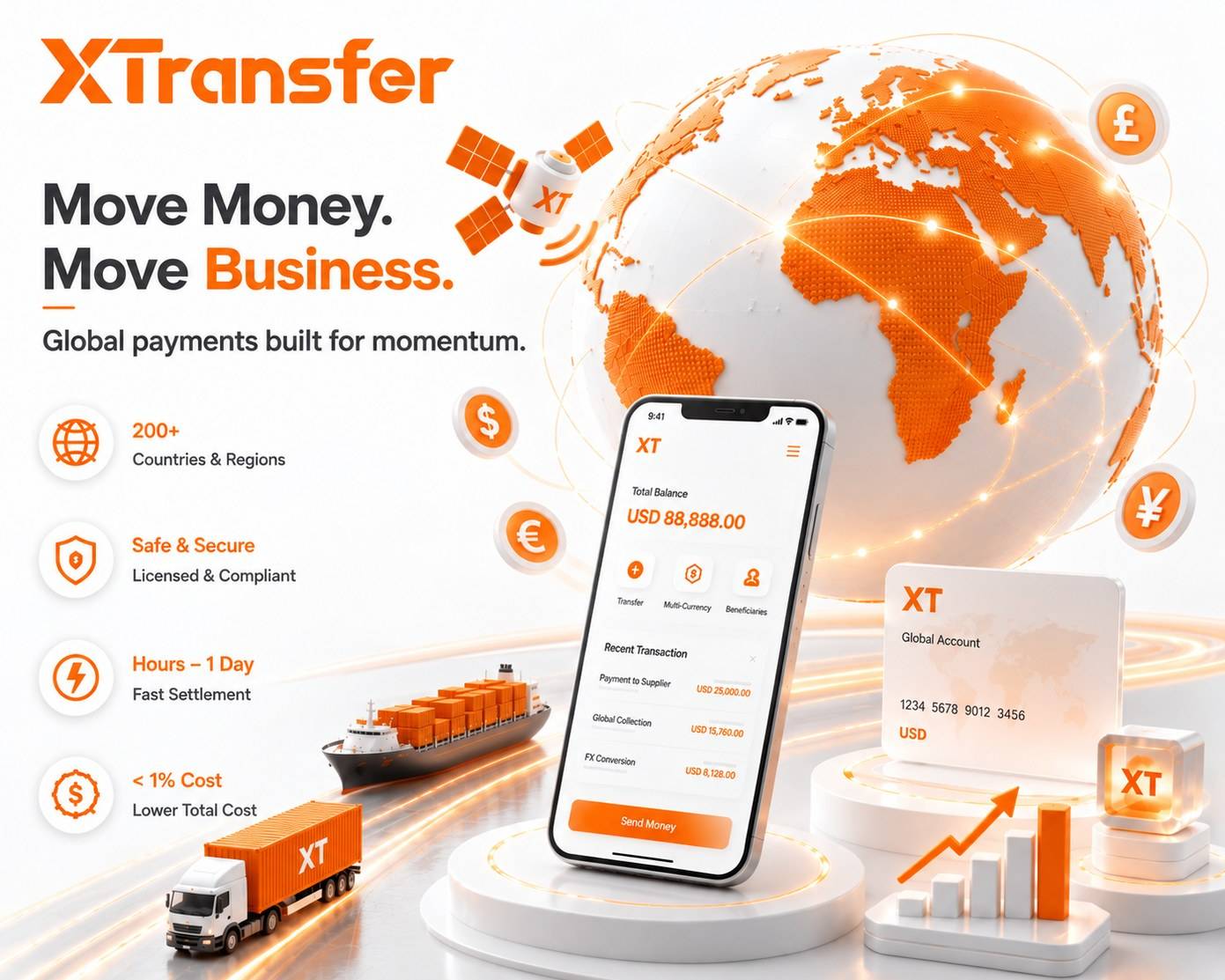
XTransfer is a B2B cross-border payment platform focused on business trade collections and supplier payments.
XTransfer’s global payment service covers more than 200 countries and regions, while its platform supports CNY settlement and other cross-border payment routes. Product availability, currencies, beneficiary accounts, documentation, limits, and fees depend on the specific route and customer eligibility.
For apparel importers, the relevant question is not whether XTransfer is universally cheaper than a bank. Instead, compare the specific XTransfer route with the importer’s existing payment route.
XTransfer may be worth evaluating when an importer needs:
- Clearer visibility into the exchange rate and payment charges.
- CNY settlement to an eligible Chinese supplier.
- A centralized workflow for multiple manufacturers.
- A way to separate incoming funds from supplier-payment timing.
- Repeatable payment and reconciliation processes.
XTransfer-to-XTransfer payments can be near-instant and fee-free.
Important limitation
XTransfer’s services are designed for eligible B2B physical-goods trade payments. It does not support virtual-goods transactions or cross-border payments to individuals such as freelancers.
That means an apparel importer may find the product relevant for physical-goods supplier payments, while businesses with other payment needs may need a different provider.
How to Reduce FX Costs in Practice
The biggest savings often come from improving the payment process rather than simply switching providers.
1. Compare the supplier’s required currency
Ask whether the manufacturer requires USD, CNY, or another currency.
Do not assume that a USD invoice automatically represents the lowest-cost settlement route.
2. Compare net received amounts
For the same supplier invoice, calculate how much the manufacturer receives after all applicable charges.
This is more useful than comparing headline transfer fees.
3. Reduce unnecessary conversions
If the business already holds a currency that can be converted directly into the supplier’s settlement currency, check whether an intermediate conversion is actually necessary.
4. Consolidate predictable payments
Where operationally appropriate, scheduled payment runs can reduce repeated manual conversions and reconciliation work.
Each payment should still be matched against the correct invoice, beneficiary, currency, and approval.
5. Record the actual FX cost
For recurring suppliers, track:
- Amount sent
- Exchange rate used
- Fees paid
- Amount received
- Currency
- Payment date
After several payment cycles, the importer can compare the actual all-in cost of each route instead of relying on advertised pricing.
Which Payment Route Fits Different Apparel Scenarios?
| Situation | Route to evaluate |
|---|---|
| Established supplier, large payment | Bank transfer / T/T |
| Documentary protection required | Letter of credit |
| Small or urgent transaction | Card or online payment service |
| Multiple currencies and recurring suppliers | Multi-currency B2B account |
| Regular CNY supplier payments | Bank or eligible B2B payment platform |
| Complex trade-finance requirement | Bank and trade-finance providers |
This is not a ranking. The appropriate route depends on the transaction’s currency, value, supplier relationship, documentation, protection requirements, and total cost.
FAQ
Should I ask a Chinese manufacturer to quote in USD or CNY?
Ask for the supplier’s price and payment terms in both currencies when possible, then compare the final cost in your own funding currency. A lower USD invoice does not necessarily mean a lower total payment cost if the USD-to-CNY conversion rate or bank charges are less favorable.
Is it cheaper to pay a Chinese factory in CNY instead of USD?
Not always. The answer depends on the supplier’s USD/CNY pricing, your funding currency, the available FX rate, and payment charges. Compare both routes using the same supplier net amount rather than comparing the quoted invoice amounts.
How can I avoid paying FX costs twice?
First identify the currency you already hold and the currency the manufacturer needs. If a direct conversion and settlement route is available, it may avoid an unnecessary intermediate conversion, such as converting local currency into USD and then converting USD into CNY.
When should I convert USD to CNY for a factory payment?
There is no universally optimal timing. Importers can instead use the production schedule and payment terms to plan conversions. For example, converting funds in batches ahead of predictable deposit or balance payments rather than converting every incoming receipt immediately.
What FX costs should I negotiate with a Chinese manufacturer?
Focus on the commercial price and settlement terms together. Confirm the invoice currency, exchange-rate basis if prices can be settled in different currencies, required net amount, payment timing, and who absorbs bank charges. This makes the supplier quote easier to compare with alternative payment routes.
How can I tell whether a payment provider is actually cheaper than my bank?
Run the same transaction through both quotes and compare the amount required to deliver the same net amount to the manufacturer. Include the FX rate, provider or bank fees, intermediary deductions, receiving charges, and any required conversion between currencies.
Does holding CNY in a multi-currency account remove FX risk?
No. It can reduce the need for repeated conversions, but the value of a CNY balance can still change relative to the business’s reporting or operating currency. Businesses should also consider how long funds will remain unused and how they will be reconciled.
What should I track to measure FX savings across suppliers?
Track the invoice amount, payment currency, amount funded, exchange rate, total fees, supplier’s received amount, and payment date. Comparing these figures over several orders gives a more reliable view of the actual FX cost than looking at the advertised transfer fee.
Disclaimer
This article is compiled from publicly available sources and interview content for informational purposes only and does not represent the official views of XTransfer. XTransfer accepts no liability for any damages arising from reliance on this content.