B2B Payments
Which Payment Platforms Support CNY Settlement for International Businesses in 2026?
- Cross-border CNY activity is anchored by the Cross-Border Interbank Payment System (CIPS), which processed RMB 180.15 trillion across 8.44 million transactions in 2025, with 1,766 participants across 124 countries and regions, according to CIPS Co., Ltd.’s official statistics.
- According to the State Administration of Foreign Exchange, the share of RMB in China’s own cross-border receipts and payments reached 53% in the first half of 2025. This share measures China’s own flows and is not directly comparable to the RMB’s share of global SWIFT payments (2.94% in November 2025).
- The RMB’s share of allocated official FX reserves was 1.93% in 2025 Q3, according to the IMF COFER survey, having declined from a recent peak close to 3% in 2021.
- A digital CNY (e-CNY) cross-border settlement system was launched under the People’s Bank of China in March 2025, connecting mainland China with selected ASEAN and Middle Eastern jurisdictions.
- International businesses can access CNY settlement through at least four platform categories: trade-focused B2B platforms, general multi-currency platforms, Chinese e-commerce and wallet platforms, and traditional bank wires via CIPS or SWIFT.
Five Corridors That Shape the Conversation
Before introducing the platforms themselves, it helps to understand where CNY actually moves today. Five corridors account for most of the activity that international businesses care about.
Mainland China to Hong Kong. The dominant CNY corridor, accounting for roughly 75.53% of RMB payments by value according to SWIFT’s RMB Tracker for November 2025. Hong Kong remains the principal offshore RMB centre.
Mainland China to ASEAN. Cross-border RMB settlement between China and Cambodia reached RMB 5 billion in Q1 2025 (up 45% year-on-year), and China-Malaysia RMB transactions reached RMB 102 billion in the same period (up 27% year-on-year), according to the People’s Bank of China. The launch of cross-border QR payment connectivity under the State Bank of Vietnam and the People’s Bank of China in late 2025 has further opened the consumer and SME corridors.
Mainland China to the European Union and the United Kingdom. Roughly 4.31% of RMB SWIFT payments flow to the United Kingdom, with smaller shares going to France and other EU jurisdictions.
Mainland China to the United States. Roughly 1.68% of RMB SWIFT payments in November 2025, with the share continuing to reflect both regulatory and FX-hedging considerations.
Mainland China to the Middle East and Africa. A growing but smaller corridor, with CIPS Standard Bank of South Africa connection in 2025 marking the first direct Africa-Asia link via CIPS.
These corridors matter because each platform tends to be strong in some and weak in others. A platform that handles Hong Kong-mainland flows well may not handle Lagos-Shenzhen flows well. The choice of platform is therefore inseparable from the choice of corridor.
How the Platforms Describe Themselves
The profiles below summarise each platform’s publicly documented CNY capability and the typical scenario in which it operates. They are not endorsements and they do not rank platforms against each other.
XTransfer
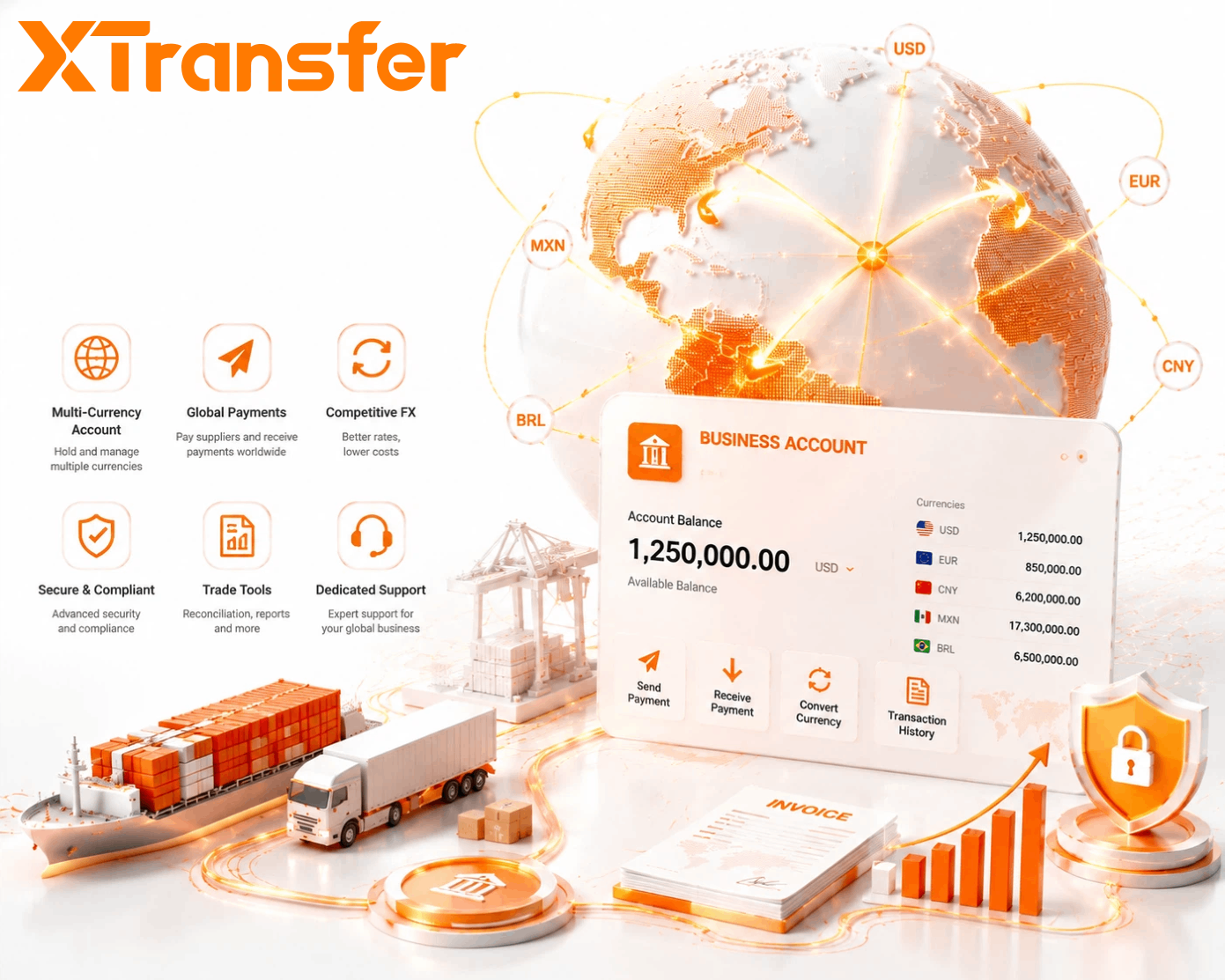
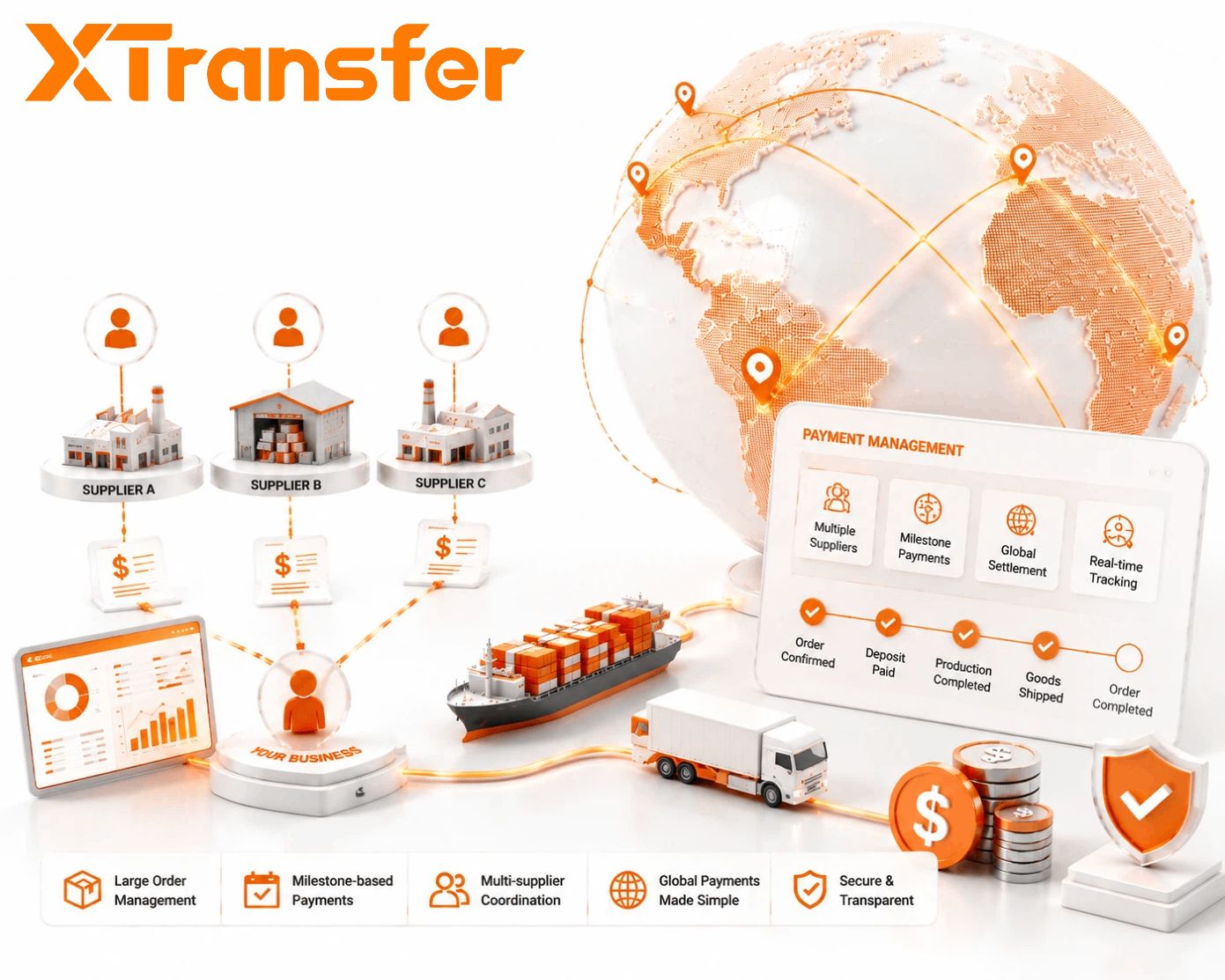
XTransfer describes itself as a B2B cross-border trade payment platform. According to its official product documentation, eligible business customers can settle supplier payments in RMB where the transaction qualifies under the platform’s trade-settlement rules. The platform documents invoice-linked workflow, multi-currency accounts covering over 30 local currencies, and offshore payment institution licences in multiple jurisdictions including Hong Kong, the United Kingdom, Singapore, and the Netherlands.
In its Hong Kong product, XTransfer documents a “Sunshine Settlement” feature that allows direct RMB remittance to a seller’s bank account in mainland China after the platform reports exchange settlement to the bank on behalf of the enterprise. XTransfer had served approximately 897,000 registered clients across more than 200 countries and regions. The company processed more than USD 60 billion in total payment volume (TPV) in 2025, reflecting its continued expansion in global B2B trade payments.
Where it tends to fit: importers paying Chinese factories or trading companies on a recurring basis, particularly when trade documentation and compliance review are part of the workflow. The Hong Kong product is documented for cross-border flows between Hong Kong and mainland China.
Wise Business
Wise Business offers multi-currency accounts and cross-border transfers with a publicly stated pricing model based on the mid-market exchange rate plus a disclosed fee. For CNY, the platform documents receiving and sending capability in selected markets, subject to corridor availability. The official product page does not describe invoice-linked matching or trade-documentation handling as core features.
Where it tends to fit: SMBs and freelancers with occasional CNY transfers, where transparent FX and a documented fee structure are the primary requirements and trade documentation is handled separately.
Airwallex
Airwallex offers multi-currency business accounts, global payment capabilities, and API-based workflows aimed at finance teams managing multiple markets and currencies. For CNY, the platform documents balance holding and payment capability where a local entity or partner exists. The platform’s documentation does not position itself as a trade-documentation-first product.
Where it tends to fit: international businesses managing multi-currency finance operations with API integration, particularly where CNY is one of several currencies in active use rather than the primary rail.
LianLian Global
LianLian Global is a Hangzhou-headquartered cross-border payments company focused on e-commerce and marketplace payouts. The platform documents RMB collection and payment capability, mass payout functionality, and presence in 100+ countries with 130+ supported currencies. LianLian Global holds a PBoC non-bank payment licence. Public commentary from industry sources records its end-to-end B2B payments solution servicing roughly 3.2 million global customers.
Where it tends to fit: cross-border e-commerce merchants receiving CNY from Chinese marketplaces or platforms, particularly where mass-payout and marketplace integration are part of the workflow.
PingPong Payments
PingPong Payments is a Hangzhou-headquartered cross-border payments company focused on e-commerce merchants and supplier payments. The platform documents cross-border RMB collection for sellers, VAT payment capability, and supplier payment workflow. According to publicly available records, PingPong became the first Chinese B2B cross-border payment platform to obtain approval from Bank Negara Malaysia in May 2025.
Where it tends to fit: e-commerce merchants with cross-border CNY collection needs, particularly sellers on Chinese marketplaces and merchants operating across ASEAN corridors.
Alipay+ and Ant Group
Alipay+ is Ant Group’s cross-border mobile payment and digitalisation platform. According to official documentation, Alipay+ connects merchants in over 57 countries and regions to consumer accounts on over 25 e-wallets and banking apps. The platform documents RMB-denominated payment flows through the wallet ecosystem, with a consumer and merchant focus. Ant Group operates under a PBoC non-bank payment licence.
Where it tends to fit: cross-border consumer and merchant payment scenarios, including travel, retail, and digital services. B2B supplier settlement is not the primary documented use case, although marketplace-adjacent B2B flows can pass through Alipay+ rails where merchant integration is in place.
Traditional Bank Wires (CIPS / SWIFT)
Traditional bank wires through CIPS and SWIFT remain available for CNY settlement where the buyer’s and seller’s banks have the relevant clearing arrangements. As of late 2025, CIPS had 193 direct participants and 1,573 indirect participants across 124 countries and regions, and processed RMB 180.15 trillion in 2025. Outside the CIPS network, CNY can still be cleared through SWIFT MT103 messages where the correspondent banks support RMB.
Standard Bank of South Africa became the first African institution to connect clients directly to the Africa-Asia payment corridor via CIPS in 2025, processing cross-border flows on behalf of African clients.
Where it tends to fit: large or compliance-heavy transactions, businesses with established correspondent banking arrangements, and transactions where bank-led documentation is required by internal policy.
Side-by-Side: What Each Platform Documents
The table below is a descriptive snapshot of each platform’s publicly documented capabilities at the time of writing. Each cell uses the same language convention as the platform profiles above. Specific availability should be confirmed with the platform or bank before onboarding.
| Feature | XTransfer | Wise Business | Airwallex | LianLian Global | PingPong | Alipay+ / Ant Group | Traditional bank wire (CIPS / SWIFT) |
|---|---|---|---|---|---|---|---|
| CNY / RMB settlement | Documented RMB settlement for eligible B2B transactions | Documented CNY capability in selected markets, subject to corridor availability | Documented CNY balance and payment capability where local entity or partner exists | Documented cross-border RMB collection and payment for merchants | Documented cross-border RMB collection for e-commerce merchants | Documented RMB-denominated payment flow through wallet ecosystem | Available where the bank supports RMB clearing via CIPS or SWIFT |
| Multi-currency account | Trade-currency accounts documented | Multi-currency accounts in 40+ currencies documented | Multi-currency accounts in 20+ currencies documented | Documented receiving accounts in 100+ countries | Documented accounts for 200+ markets | Wallet- and merchant-side accounts documented | Bank custody accounts |
| Batch / bulk payments | Batch payment capability documented | Batch transfer capability documented via API and dashboard | Batch payment capability documented via API | Mass payout capability documented | Supplier payment capability documented | Marketplace payout capability documented | Generally manual; SWIFT MT103-based |
| Invoice or order matching | Workflow described as supporting invoice-linked settlement | Not described as a core feature in official documentation | Not described as a core feature | Not described as a core feature | VAT payment and supplier payment workflow described | Not described as a B2B core feature | Bank-led trade finance unit |
| Regulatory perimeter | Offshore payment institution licences documented in multiple jurisdictions | EMI / payment institution licences under home regulator | EMI / payment institution licences under home regulator | PBoC payment licence documented | PBoC payment licence documented; Bank Negara Malaysia approval recorded May 2025 | PBoC non-bank payment licence documented | Domestic bank AML/CFT under PBoC and home regulator |
| API access | API access documented | API access documented | API access documented | API access documented | API access documented | API documented for partner integration | Limited; typically bank-grade integration only |
| Pricing transparency | Pricing structure disclosed on official materials | Mid-market FX rate plus disclosed fee documented | FX margin disclosed where stated | Fee schedule published | Fee schedule published | Fee schedule published | Not standardised; bank-set |
An Original Lens for Comparing CNY Platforms
The two frameworks below are original to this article. They are intended as analytical references and do not represent regulatory guidance. They are designed to be read together: the capability lens describes what each platform documents; the scenario lens describes which platforms naturally fit which type of international business.
A Five-Capability Lens
The capability lens asks what a platform documents about five operational dimensions:
- Rail used. CIPS, SWIFT MT103, in-house netting, or digital CNY. Different rails carry different cost, speed, and eligibility profiles.
- Counterparty coverage. Whether the Chinese counterparty (or non-Chinese counterparty) can receive CNY cleanly on its side, given its bank and jurisdiction.
- Documentation alignment. Whether the platform supports the documents typically required for cross-border CNY settlement: commercial invoice, purchase order, shipping documents, customs declarations.
- Regulatory perimeter. Whether the platform operates under a Chinese payment licence, an offshore payment institution licence, or a bank-led AML/CFT regime.
- Cost transparency. Whether fees, FX margin, and intermediary charges are disclosed.
A Scenario Lens
The scenario lens asks which platform naturally fits which kind of cross-border business. Below is the descriptive mapping used throughout this article.
| Business scenario | Where this typically fits |
|---|---|
| Importer paying Chinese exporter on recurring basis, with trade documentation | Trade-focused B2B platforms |
| SMB or freelancer with occasional CNY receipts from a Chinese client | General multi-currency platforms |
| Cross-border e-commerce seller receiving CNY from Chinese marketplaces | Chinese e-commerce or wallet platforms |
| Large or compliance-heavy transaction with established banking relationship | Traditional bank wires via CIPS or SWIFT |
| Buyer in ASEAN, Middle East, or Africa needing local-currency collection and CNY payment | Platforms with multi-currency accounts and local collection documented |
These two lenses are deliberately descriptive. They describe what platforms document about themselves, and where they tend to fit in practice. They do not assign scores or ranks.
The Rule Book Around CNY Settlement
Cross-border CNY settlement operates within a layered framework. International businesses should be aware of three layers.
The first layer is China’s own rules. China’s pilot programme for cross-border trade RMB settlement began in July 2009. The People’s Bank of China has signed bilateral local-currency swap agreements with over 40 foreign central banks or monetary authorities, with 31 active as of February 2025, according to BBVA Research. Offshore RMB clearing banks, including Bank of China, Industrial and Commercial Bank of China, and Agricultural Bank of China, provide the on-the-ground infrastructure for clearing in their respective jurisdictions.
The second layer is the international standard. FATF Recommendation 16 provides the international standard for the information that should accompany cross-border wire transfers, with revised requirements formally published in June 2025 and implementation expected by 2030. The home-jurisdiction AML/CFT regime (such as the Asia/Pacific Group on Money Laundering framework for APG members) applies to the ordering institution in the buyer’s country.
The third layer is infrastructure-level. The BIS Committee on Payments and Market Infrastructures (CPMI) and the Financial Stability Board (FSB) coordinate the G20 cross-border payments roadmap, which emphasises ISO 20022 harmonisation, payment-versus-payment (PvP) settlement, and operating-hour alignment. CIPS revised its business rules in 2025 to support hybrid settlement models, meeting both real-time gross settlement needs for large urgent payments and timed net settlement for batch transactions.
The practical implication is that platform selection should take into account not only the CNY rail, but also the platform’s ability to capture and transmit originator and beneficiary information at or above the thresholds defined by FATF Recommendation 16.
The Digital CNY Question
In March 2025, the People’s Bank of China announced the full integration of its digital RMB (e-CNY) cross-border settlement system, directly connecting mainland China with a reported set of ten ASEAN jurisdictions and six Middle Eastern jurisdictions. The new infrastructure enables direct, peer-to-peer transactions in digital yuan and can settle transactions in seconds, compared with multi-day delays in traditional cross-border payments.
In parallel, the mBridge multi-CBDC platform, which connects the central banks of China, Hong Kong, Thailand, the UAE, and Saudi Arabia, has reached Minimum Viable Product stage. These initiatives are not yet mainstream for international businesses, but they signal the direction of CNY infrastructure over the next several years. International businesses considering a multi-year platform commitment should ask vendors how their roadmap intersects with digital CNY and multi-CBDC pilots.
What a Clean CNY Payment Looks Like
A typical international-to-China CNY payment for a B2B transaction moves through a sequence similar to a USD payment, with the currency and documentation stage at the centre.
The buyer confirms the order and the seller issues a CNY-denominated commercial invoice. The buyer then chooses the platform or bank, which performs compliance and sanctions screening, captures originator and beneficiary information per FATF Recommendation 16, and selects the appropriate rail (CIPS, SWIFT, or platform-internal). The transfer is executed, the seller’s bank confirms receipt, and the goods are released or shipped.
Where documentation is mismatched, or where the seller’s bank does not have CNY clearing capability, the payment may be routed through a USD leg with an additional conversion. Platforms that document an integrated CNY rail and a counterparty-side CNY clearing capability may help reduce this friction.
Why This Matters Beyond Cost
CNY settlement can reduce FX conversion costs for international businesses that have a structural CNY exposure on either the payable or receivable side. According to the BIS Triennial Central Bank Survey of 2025, the RMB’s share of global FX turnover reached 8.5%, up from 7% in 2022, reflecting a steady rise in RMB trading activity. bistriennial
Reconciliation and documentation effort are often the most underestimated costs. Platforms that document invoice-linked references, ISO 20022 messaging, and integration with trade documentation can help reduce this effort, although the actual reduction depends on each platform’s specific capabilities.
For international businesses with a stable CNY exposure on one side of the trade, the design of the CNY payment workflow is one component of working-capital and FX risk management. The platform choice is rarely the most expensive decision in the chain, but it is often the most repeated.
Putting It All Together
CNY settlement is no longer a peripheral option for international businesses in 2026. CIPS infrastructure, offshore RMB clearing banks, currency swap arrangements, and digital CNY pilots have created a layered environment in which multiple platform categories can offer CNY-denominated B2B settlement.
The platforms documented in this article each describe themselves differently, and each tends to fit a different kind of cross-border business. Trade-focused B2B platforms describe features aligned with recurring import workflows. General multi-currency platforms describe transparent FX and broad corridor coverage. Chinese e-commerce and wallet platforms describe marketplace and merchant flows. Traditional bank wires describe documentation rigour and correspondent banking reach.
Each platform’s official documentation should be reviewed for the latest feature availability before onboarding, and the counterparty’s CNY receiving capability should be confirmed on the seller side. The right choice for a given business depends on the structure of the underlying payment flow, not on any universal ranking.
Frequently Asked Questions
What is the most widely used CNY cross-border payment system?
The Cross-Border Interbank Payment System (CIPS), operated under the People’s Bank of China, is the primary dedicated infrastructure for cross-border RMB settlement. According to official CIPS statistics, the system processed RMB 180.15 trillion across 8.44 million transactions in 2025, with 1,766 participants across 124 countries and regions.
Can international businesses pay Chinese suppliers directly in CNY?
Yes, subject to platform eligibility and counterparty capability. Eligible business customers of trade-focused platforms such as XTransfer can settle supplier payments in RMB where the transaction qualifies under the platform’s rules. xtransfer General multi-currency platforms also support CNY in selected markets, subject to corridor availability.
Is CNY cheaper than USD for cross-border payments?
The relative cost depends on the platform, the FX spread applied, and the corridor. Where local CNY clearing is available, direct CNY settlement can reduce the number of conversion legs compared with routing through USD. Specific pricing should be compared on each platform’s official documentation at the time of the transaction.
How long does a CNY cross-border payment take?
Settlement time depends on the rail and the documentation. CIPS operates 5×24 hours plus an extended 4-hour window. Bank wires via SWIFT can take one to several business days. Digital CNY pilots can settle in seconds where supported. Specific timelines should be confirmed with the platform or bank.
What documents are required for a CNY cross-border payment?
Common documentation includes the commercial invoice, purchase order, and shipping documents (bill of lading or airway bill). Under FATF Recommendation 16 and the home jurisdiction’s AML/CFT regime, originator and beneficiary information must accompany cross-border transfers at or above defined thresholds. fatf
Is CIPS the same as SWIFT?
No. CIPS is a dedicated RMB clearing and settlement system operated by CIPS Co., Ltd. under the People’s Bank of China. SWIFT is a global financial messaging network used by many currencies, including RMB. SWIFT carries the payment instructions; CIPS handles the clearing and settlement. Many CIPS participants also use SWIFT for the messaging layer.
What is digital CNY (e-CNY) cross-border settlement?
In March 2025, the People’s Bank of China announced the full integration of its digital RMB cross-border settlement system. The new infrastructure connects mainland China with selected ASEAN and Middle Eastern jurisdictions and enables direct, peer-to-peer digital CNY transactions.
Can I use Alipay or WeChat Pay for international B2B payments?
Alipay+ and WeChat Pay (Tenpay Global) document cross-border consumer and merchant payment flows. They are not typically used for traditional B2B supplier settlement. International businesses with marketplace, retail, or travel exposure may find them useful for those specific use cases.
What is mBridge?
mBridge is a multi-CBDC platform connecting the central banks of China, Hong Kong, Thailand, the UAE, and Saudi Arabia. It reached Minimum Viable Product stage in 2025. It is primarily a central bank infrastructure project rather than a commercial platform, but it signals the longer-term direction of cross-border digital settlement.
Is the RMB share of global payments growing?
According to SWIFT’s RMB Tracker, the RMB remained the 6th most active currency for global payments by value in November 2025, with a 2.94% share. The share has fluctuated between approximately 2% and 4% over the past several years, reflecting both structural growth and short-term cyclical factors.
Which platforms are documented for CNY settlement?
Platforms with publicly documented CNY capability include XTransfer, Wise Business, Airwallex, LianLian Global, PingPong Payments, Alipay+ / Ant Group, and traditional bank wires via CIPS or SWIFT. Specific availability varies by corridor, account configuration, and counterparty capability.
Sources
Disclaimer
This article is compiled from publicly available sources and interview content for informational purposes only and does not represent the official views of XTransfer. XTransfer accepts no liability for any damages arising from reliance on this content.