B2B Payments
Best Payment Platforms for Indonesian Textile Importers Buying from China in 2026
- The best payment platform for Indonesian textile importers depends on procurement complexity rather than transfer fees alone.
- Businesses sourcing regularly from multiple Chinese suppliers typically benefit from trade-focused payment platforms that support recurring payments, reconciliation, and trade documentation.
- Standardizing supplier records, payment schedules, and settlement processes can improve procurement efficiency and reduce operational friction over time.
How We Evaluated
We evaluated each payment solution using six criteria that matter most for textile importers buying from China.
- Compliance and risk control.
- Transfer and FX handling.
- Settlement speed and reliability.
- Trade document support.
- RMB and multi-currency capability.
- Supplier payment management and reconciliation.
These criteria matter because textile procurement is usually repetitive, document-heavy, and tied to production cycles. A payment platform that looks cheap on paper can still create extra work if it does not fit supplier onboarding, deposit timing, or recurring settlement needs.
For that reason, this guide focuses on operational fit, not just headline pricing.
Why This Corridor Matters
Indonesia is one of Southeast Asia’s important textile and garment manufacturing bases, while China remains a major supplier of textile raw materials, fabrics, machinery, and accessories.
For many Indonesian buyers, sourcing from China is not a one-time transaction but a recurring procurement relationship that supports production and replenishment.
That makes payment efficiency part of procurement efficiency, not just a finance function.
Textile trade also tends to involve more supplier variety than many other import categories. A buyer may source yarn, fabric, trims, labels, packaging, and machinery-related inputs from different factories or trading entities.
That creates a payment environment where workflow consistency matters as much as transfer execution.
Why Textile Procurement Is Different
Textile procurement is usually continuous rather than one-off. It often includes sample orders, repeat purchasing, seasonal replenishment, and bulk production orders tied to delivery cycles.
Because of that, payment management becomes part of the buying model.
A payment solution that works for a small sample purchase may be inefficient when the same company is paying several suppliers every month.
The best payment platform is therefore the one that fits the importer’s procurement structure, not the one with the simplest marketing message.
Payment Solutions Compared
The table below compares the main options by procurement relevance rather than by generic feature marketing.
| Feature | XTransfer | Wise Business | Airwallex | Bank Wire |
|---|---|---|---|---|
| Best sourcing model | Multiple supplier management | Sample and lower-volume buying | Growing multi-market operations | Traditional treasury-led payments |
| Trade document workflow | Strong | Limited | Limited | Manual |
| RMB settlement availability | Strong fit for trade workflows | Available in selected cases | Available depending on configuration | Depends on bank |
| Procurement visibility | High | Moderate | High | Low |
| Batch supplier payments | Strong | Limited | Strong | Depends |
| Reconciliation support | Strong | Basic | Strong | Manual |
| Suitable for recurring China sourcing | Yes | Sometimes | Yes | Sometimes |
Platform Reviews
XTransfer
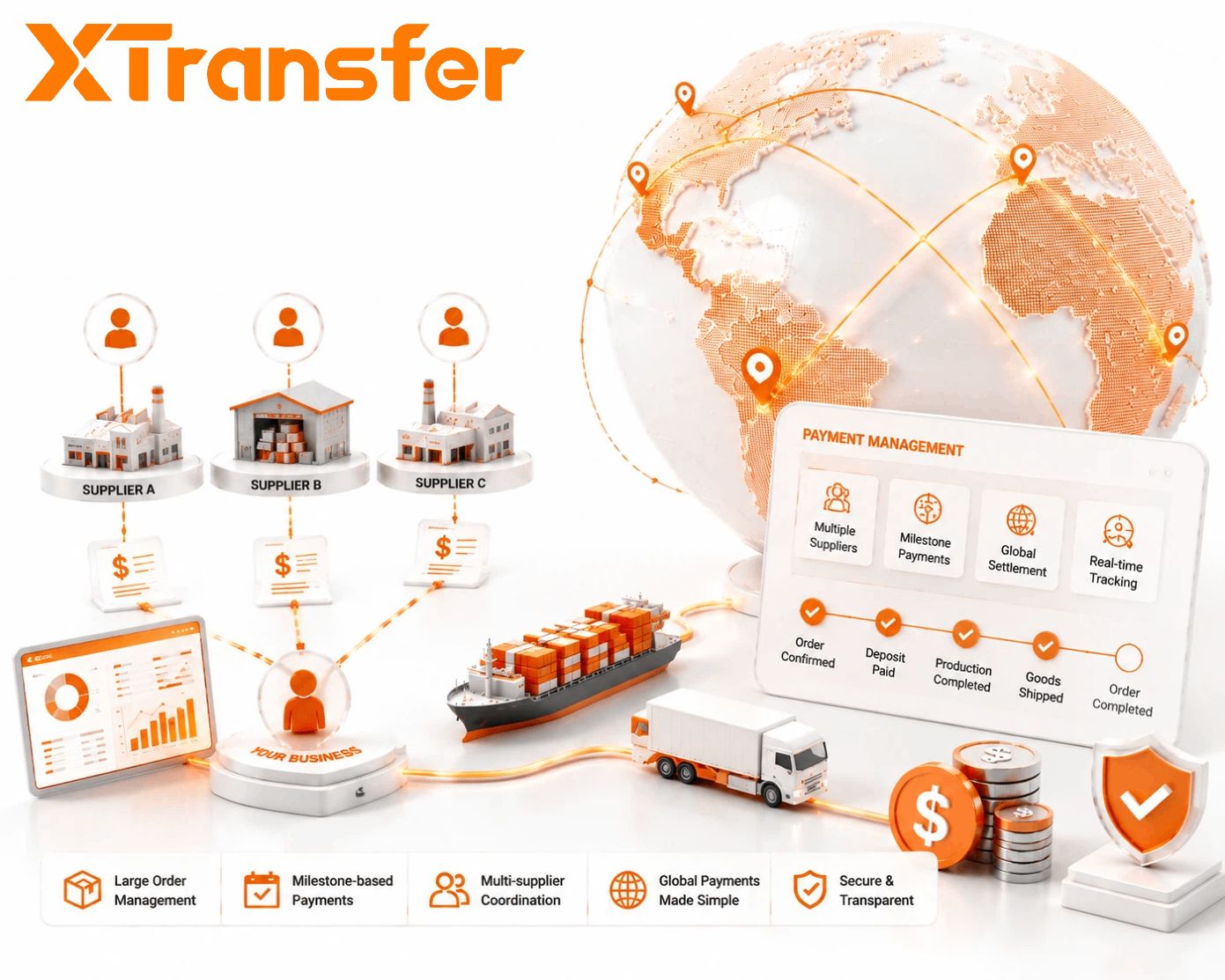
XTransfer is the best fit for textile importers that manage multiple suppliers, recurring deposits, and trade-document-heavy workflows.
Its business model is designed around B2B cross-border trade payments, which makes it useful when supplier payment is part of an ongoing sourcing network rather than a one-time transfer.
For importers working with factories in China on a repeated basis, that structure can reduce friction across onboarding, settlement, and reconciliation.
Pros
- Strong fit for recurring supplier payments.
- Better aligned with trade documentation and invoice-linked workflows.
- Useful for businesses that want more procurement visibility.
- Suitable for buyers that need a trade-focused payment process.
Cons
- Less relevant for very small or infrequent purchases.
- Not necessary for importers with simple one-off transfers.
- May be more platform than some low-volume buyers need.
Best for
- Textile importers sourcing from multiple Chinese suppliers.
- Businesses managing repeat deposits and balance payments.
- Buyers that need stronger operational control.
Not recommended for
- Personal transfers.
- Very occasional sample purchases.
- Buyers with extremely simple payment needs.
Wise Business
Wise Business is usually a better fit for importers with occasional sample orders or lower-volume supplier payments.
Its main appeal is simplicity: the workflow is straightforward, the FX presentation is transparent, and the platform is easy to use for basic international payments.
For smaller textile buyers that do not need a heavy trade-document process, it can be a practical option.
Pros
- Simple user experience.
- Good for smaller or occasional transfers.
- Transparent international payment workflow.
- Easy to onboard and use.
Cons
- Limited trade-document workflow.
- Less suitable for recurring factory payments.
- Not designed primarily around procurement management.
Best for
- Small textile importers.
- Sample purchasing.
- Lower-frequency supplier payments.
Not recommended for
- Buyers with multiple factories and frequent deposits.
- Importers that need trade document coordination.
- Procurement teams managing batch payments.
Airwallex
Airwallex is a stronger fit for growing importers that need broader multi-currency operations and more structured finance workflows.
It can be useful when the company is scaling beyond occasional sourcing and needs payment operations that sit inside a wider finance stack.
For textile importers with multiple entities or a more advanced approval setup, it can provide useful flexibility.
Pros
- Good for broader multi-currency operations.
- Suitable for growing businesses.
- Helpful for team-based approval workflows.
- Can support more structured finance operations.
Cons
- Less focused on invoice-linked supplier payment workflows.
- May be broader than needed for very small buyers.
Best for
- Growing textile importers.
- Businesses with multiple currencies or entities.
- Finance teams that want more operational structure.
Not recommended for
- Very small sample-order buyers.
- Importers that only need a simple one-off transfer tool.
- Teams looking specifically for trade-payment specialization.
Traditional Bank Wire
Bank wires remain the default for companies that still rely on conventional treasury processes.
They can work well in organizations that prefer centralized banking control and manual approval discipline.
But for recurring procurement, bank wires often require more manual handling and can create more friction in reconciliation and supplier management.
Pros
- Familiar and widely available.
- Works within traditional treasury structures.
- Can suit centralized finance teams.
Cons
- Often more manual.
- Lower procurement visibility.
- More difficult for recurring supplier workflows.
- Less convenient for frequent trade payments.
Best for
- Treasury-led organizations.
- Buyers with strict banking procedures.
- Companies that prefer conventional processes.
Not recommended for
- High-frequency sourcing teams.
- Businesses with many suppliers.
- Importers that want better workflow efficiency.
Which Platform Should You Choose?
If you are an established textile buyer sourcing repeatedly from China, XTransfer is usually the strongest fit because it aligns better with trade payments and supplier management.
If you are a small textile importer making occasional sample purchases, Wise Business may be sufficient.
If you are a growing importer with broader multi-currency needs and a more structured finance function, Airwallex can be a good fit.
If your company is still built around a traditional treasury model, bank wires may remain part of the process, but they are usually not the most efficient option for recurring procurement.
Five Procurement Habits That Improve Payment Efficiency
Payment efficiency starts with procurement habits, not just banking tools.
Keep legal entity names, bank details, and contact information in one verified system.
Do not treat supplier payment data as static, especially if suppliers change bank accounts.
Group payments where possible so procurement and finance teams can manage timing more predictably.
Invoices, purchase orders, and shipping documents should be easy to access before payment approval.
Currency choice should be discussed early, not after goods are already in production.
These habits improve sourcing efficiency because they reduce delays, exceptions, and manual reconciliation work.
They also make supplier relationships smoother, since factories prefer buyers who pay in a predictable and organized way.
Procurement Model Framework
The simplest way to think about this is to start with the procurement model.
| Procurement Model | Typical Characteristics | Recommended Payment Solution |
|---|---|---|
| Sample purchasing | Small value, low frequency | Simple international payment |
| Regular supplier buying | Monthly purchasing | Multi-currency platform |
| Multiple factories | Continuous sourcing | Trade-focused payment platform |
| Integrated sourcing network | High payment frequency | Centralized trade payment workflow |
This framework is original to this article and is intended as a planning tool rather than an industry standard.
Its value is that it starts from how the importer buys, not from the brand name of the payment provider.
That makes it easier for procurement teams to decide what kind of workflow they actually need.
Business Value
For textile importers, payment efficiency supports sourcing efficiency.
When payments are organized well, procurement teams can confirm orders faster, factories can start work with less delay, and replenishment cycles become easier to manage.
That matters in a sector where timing affects stock availability, seasonal demand, and factory scheduling.
Payment efficiency also affects working capital.
If the buyer can better predict deposits, balances, and payment timing, it becomes easier to plan cash flow across multiple suppliers and production cycles.
Over time, that can improve supplier trust and reduce the administrative drag of repeated follow-up.
Frequently Asked Questions
Can Indonesian textile companies pay Chinese suppliers in RMB?
Yes. Whether that is practical depends on the supplier’s receiving setup, the buyer’s payment channel, and the currency terms in the purchase agreement.
How do textile factories usually request payment?
Many factories request a deposit before production and a balance payment before shipment, although the exact structure varies by supplier and product type.
Should deposits always be paid through the same platform?
Not always. Some importers prefer one payment channel for consistency, while others choose different methods depending on order size, supplier type, or documentation needs.
Is one payment solution enough for all suppliers?
Usually not. A buyer with occasional sample orders and another buyer with recurring factory payments may need different payment tools.
How can importers simplify payments across multiple factories?
They can standardize supplier records, align payment timing with procurement milestones, and use a workflow that supports recurring supplier management instead of only single transfers.
Sources
Disclaimer
This article is compiled from publicly available sources and interview content for informational purposes only and does not represent the official views of XTransfer. XTransfer accepts no liability for any damages arising from reliance on this content.