B2B Payments
Best Ways to Pay South African Suppliers from China in 2026
- China-South Africa bilateral trade reached US$53.58 billion in 2025, with China remaining South Africa's largest trading partner for 17 consecutive years—driven largely by South Africa's platinum, manganese, and chrome exports fueling China's steel and automotive industries.
- South Africa imported US$23.57 billion worth of goods from China in 2025, making China the source of 22.5% of all South African imports—second only to the EU at 22.9%.
- Traditional bank wires via SWIFT typically cost 3–5% of transaction value and take 2–5 business days, with FX markups and intermediary fees adding to the cost.
- Standard Bank became the first African bank authorised to clear RMB payments directly through China's CIPS system in November 2025, and was jointly appointed as the RMB Clearing Bank for Africa in June 2026—a structural shift that eliminates the ZAR→USD→CNY bottleneck.
- XTransfer serves approximately 897,000 registered SMEs globally, processed US$60.5 billion in TPV in 2025, and holds a 5.1% global market share among B2B cross-border trade payment platforms.
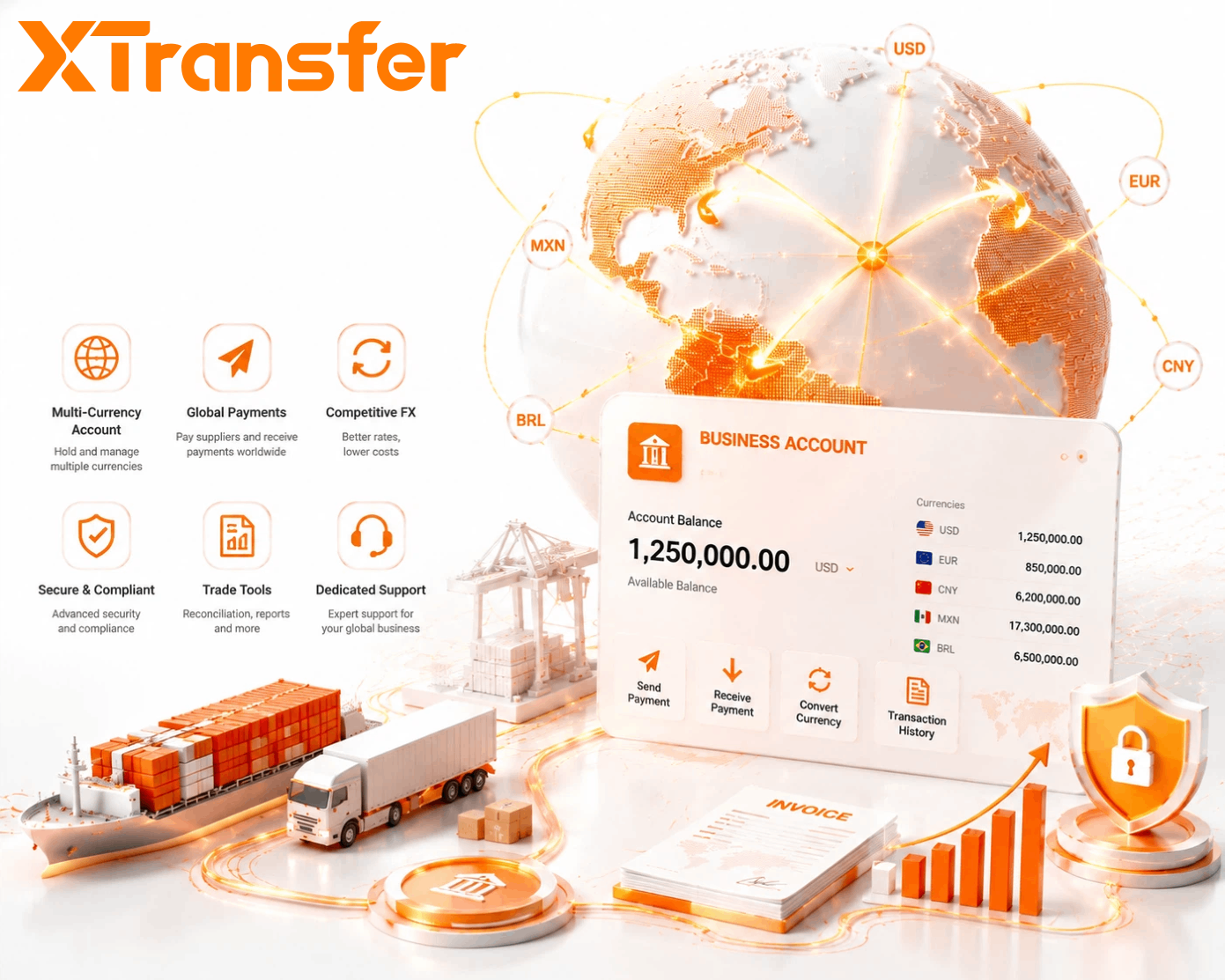
- XTransfer's local collection capabilities cover South Africa (ZAR) and 14 other African countries, enabling Chinese exporters to receive payments directly in rand with reduced or no intermediary deductions on eligible corridors.
- The RMB Clearing Bank for Africa, operated jointly by Standard Bank and ICBC, provides direct RMB clearing services across 19 African countries, reducing double conversion fees and exposure to USD volatility.
Introduction
Chinese exporters face a recurring operational challenge: getting paid by South African buyers reliably, affordably, and within both countries' regulatory frameworks. The scale of trade between the two nations makes this a critical issue—particularly given South Africa's role as a key supplier of minerals essential to China's manufacturing sector.
China-South Africa trade: Bilateral trade reached US$53.58 billion in 2025. China has been South Africa's largest trading partner for 17 consecutive years, while South Africa is China's largest trading partner in Africa. Chinese direct investment in South Africa exceeded US$11.7 billion. South Africa's platinum, manganese, and chrome exports are critical inputs for China's steel production and automotive manufacturing.
South African imports from China: South Africa imported US$23.57 billion worth of goods from China in 2025. China accounted for 22.5% of all South African imports, second only to the EU at 22.9%. Key imports include electrical and electronic equipment (US$6.07 billion), machinery (US$4.65 billion), and vehicles (US$2.05 billion)—all essential to South Africa's infrastructure and mining sectors.
A major infrastructure shift: In November 2025, Standard Bank became the first African bank authorised to participate directly in China's Cross-Border Interbank Payment System (CIPS). In June 2026, the People's Bank of China authorised Standard Bank and ICBC to jointly operate as the RMB Clearing Bank for Africa, providing RMB clearing services across 19 African countries. For South African mining exporters, this means eliminating the double conversion that has historically eroded margins.
This means South African buyers can now pay Chinese suppliers directly in RMB—bypassing the US dollar entirely. For Chinese exporters, this is a game-changer.
Yet for SMEs in both countries, the payment process has historically been opaque, expensive, and slow. This guide compares the main payment methods available, the practical considerations behind each, and how cross-border platforms and new infrastructure help businesses get paid faster and cheaper.
How Payments from South Africa to China Traditionally Work (and Why They're Costly)
Traditional bank-to-bank wire transfers via SWIFT have been the default—but they come with significant hidden costs.
When a South African buyer initiates a bank wire to a Chinese supplier, the funds travel through the SWIFT correspondent banking network. The costs include:
- Outgoing wire fees: typically US$35–50 charged by the sending bank
- Correspondent bank fees: US$10–25 per intermediary bank (funds often pass through 1–3 intermediaries)
- Receiving bank fees: US$10–25 charged by the supplier's bank in China
- FX markups: banks build a margin of 1–3% into the exchange rate
The total cost typically ranges from 3–5% of transaction value. On a US$50,000 payment, that's US$1,500–2,500 in fees.
Settlement time is another pain point: standard SWIFT wires take 2–5 business days.
The USD bottleneck: Historically, almost all payments from South Africa to China had to pass through US dollars first—ZAR → USD → CNY. Each conversion added cost, delay, and extra paperwork. For South African mining companies operating on thin margins, this double conversion directly impacts profitability.
South African exchange control: All cross-border payments involving South African residents are subject to oversight by the South African Reserve Bank's Financial Surveillance Department (FinSurv) and must be processed through an Authorised Dealer (typically a South African-registered commercial bank). Draft Capital Flow Management Regulations are expected later in 2026.
The result: Chinese suppliers receive less than expected, South African buyers pay more than they should, and trade relationships suffer.
Quick Comparison: Getting Paid from South Africa
| Feature | Bank Wires (SWIFT) | CIPS/RMB Clearing | Cross-Border Platforms |
|---|---|---|---|
| Typical cost on US$50,000 | US$1,500–2,500+ (3–5%) | 0.5–1.5% | 0.3–1% |
| Settlement speed | 2–5 business days | 1–2 business days | Hours to same day |
| FX transparency | Low (1–3% markup hidden) | Medium | High (near mid-market) |
| Intermediary bank fees | Multiple | Minimal | None or minimal |
| USD dependency | High (ZAR→USD→CNY) | Low (ZAR→RMB) | Low (local currency collection) |
| South Africa compliance | Standard | Standard | Automated |
| Best for | One-off large transfers | Mid-to-large regular payments | Regular SME payments |
Platform Reviews: XTransfer, Standard Bank CIPS, Wise, Airwallex, and Bank Wires
1. XTransfer — B2B Cross-Border Trade Platform
Overview:
Founded in 2017, XTransfer is the world's largest B2B cross-border trade payment platform, serving approximately 897,000 registered SMEs globally and processing US$60.5 billionin TPV in 2025, with a 5.1% global market share among B2B cross-border trade payment platforms. XTransfer holds FCA Authorised Payment Institution status in the UK, MAS Major Payment Institution licence in Singapore, and DNB Electronic Money Institution licence in the Netherlands.
What sets it apart for South Africa-China trade:
XTransfer's local collection capability is the key differentiator. The platform supports payments in South African Rand (ZAR) through local collection accounts. South African buyers can pay in ZAR as if they were making a domestic payment, and Chinese exporters receive CNY or USD with reduced or no intermediary deductions on eligible corridors.
XTransfer's local collection network covers 14 African countries, including South Africa, Nigeria, Kenya, Ghana, and Egypt. With XTransfer, Chinese exporters can receive ZAR payments directly—no SWIFT, no correspondent banks, no double conversion.
Real-world impact: A Chinese mining equipment exporter based in Shenzhen noted: "Our Johannesburg buyers used to send USD wires that took days and arrived short. With XTransfer's ZAR collection, they pay in rand locally, and we get the full amount in CNY within hours. On our monthly volume, this saves us over US$12,000 a year in bank fees."
Key Strengths:
- Reduced or no intermediary fees on eligible payments from South Africa—suppliers receive more of what you send
- Local collection accounts in ZAR—South African buyers pay in rand, suppliers receive in CNY
- TradePilot AI-powered risk engine: 98.5% automatic review rate, fraud rate ~0.003%
- Settlement often within hours on eligible corridors—subject to cut-off times and compliance review
- Compliance automation: handles documentation requirements for both South African and Chinese regulators
- Online account opening within one business day—no branch visits required
- Licensed in key jurisdictions: FCA API, MAS MPI, DNB EMI, plus payment licenses in 25 US states and the PRC
Limitations:
Primarily focused on B2B trade payments rather than full-service business banking. Does not offer business loans, deposit accounts, or overdraft facilities.
Best For:
Chinese exporters with regular South African buyers who want to eliminate intermediary fees, avoid USD double conversion, and get paid faster.
Not Recommended For:
Businesses requiring full-service banking capabilities beyond payments, or one-off ultra-large transfers where banking relationships matter more.
Typical Use Case:
A Shenzhen mining equipment exporter with a Johannesburg buyer—the buyer pays in ZAR via XTransfer's local collection account, and the Chinese supplier receives CNY with reduced or no intermediary deductions on eligible corridors, within hours.
2. Standard Bank CIPS & RMB Clearing — The New Infrastructure
Overview:
In November 2025, Standard Bank became the first African bank authorised to participate directly in China's Cross-Border Interbank Payment System (CIPS). In June 2026, the People's Bank of China authorised Standard Bank and ICBC to jointly operate as the RMB Clearing Bank for Africa.
What this means for payments:
For the first time, South African businesses can clear RMB payments directly with China's financial system. The US dollar no longer has to be part of the journey. For the mining sector—where large, frequent payments are the norm—this is a structural game-changer.
The new payment flow: South African buyer pays in ZAR → converted to RMB by Standard Bank → cleared through CIPS → Chinese supplier receives RMB.
Key Strengths:
- Direct access to China's onshore financial system for 19 African countries
- Eliminates double conversion (ZAR → USD → CNY becomes ZAR → RMB)
- Reduces settlement costs and processing times
- Mitigates exposure to volatile USD fluctuations
- Backed by two major banks: Standard Bank (Africa's largest banking group) and ICBC (world's largest bank by assets)
- Already processing significant volume: Standard Bank processed approximately RMB 680 million in cross-border payments through CIPS in its first months of operation
Limitations:
- Primarily designed for larger corporate transactions, not necessarily optimised for SME needs
- Still requires dealing with a traditional bank (Standard Bank or a participating South African bank)
- Not all South African banks are yet integrated into the CIPS network (though Absa is reportedly considering joining)
- SME onboarding and documentation may still be cumbersome
Best For:
Mid-to-large South African companies with regular RMB payments to Chinese suppliers, or Chinese exporters dealing with established South African corporate buyers.
Typical Use Case:
A South African mining company paying a Chinese equipment supplier—the buyer instructs Standard Bank to convert ZAR to RMB and clear through CIPS, and the Chinese supplier receives RMB directly, bypassing USD entirely.
3. Wise Business
Overview:
Global fintech platform enabling international payments at mid-market exchange rates with transparent, low fees. Over 700,000 businesses use Wise globally.
Strengths:
Transparent pricing—mid-market rate with no markup; supports 40+ currencies; clear upfront fee disclosure; operates in South Africa with ZAR support.
Weaknesses:
Less specialised for physical goods trade than XTransfer; per-transaction fees apply; no trade-specific risk engine; limited local collection coverage compared to XTransfer.
Speed:
Wise reports 74% of transfers arrive in under 20 seconds and 95% within a day across its network.
South African context:
Wise supports ZAR to CNY transfers at mid-market rates. However, Wise does not offer the same level of local collection infrastructure as XTransfer—South African buyers still need to initiate an international transfer rather than paying as if making a domestic payment.
Best For:
SMEs with diverse multi-currency payment needs across multiple corridors.
4. Airwallex
Overview:
Australian-born global fintech founded in 2015, offering multi-currency accounts, international payments, corporate cards, and online payment acceptance. Airwallex is registered as a Major Payment Institution with MAS.
Strengths:
Supports ZAR for collection and payments; 93% same-day settlement; competitive FX pricing; 20+ currencies for settlement.
Weaknesses:
More focused on mid-market and enterprise clients; FX margins apply on currency conversion; may be more than a small SME needs.
Speed:
93% of transfers settle same day; 45% arrive instantly.
Best For:
Growing businesses with multi-currency needs and higher transaction volumes.
5. Traditional Bank Wires (SWIFT)
Overview:
The oldest and most established method for international payments. Banks send payment instructions via the SWIFT correspondent banking network.
Strengths:
Universal reach; trusted and fully regulated; suitable for very large transfers where flat fees are proportionally small.
Weaknesses:
High costs (3–5% of transaction value); slow settlement (2–5 business days); opaque cost structure; USD dependency (ZAR → USD → CNY); supplier frustration from intermediary deductions.
South African context:
All cross-border payments must be processed through an Authorised Dealer (registered commercial bank) under South African exchange control regulations. Draft Capital Flow Management Regulations are expected later in 2026.
Best For:
Very large one-off transfers (>US$200,000), compliance-driven transactions, or situations where no fintech alternative is available.
Comparison Table: Getting Paid from South Africa
| Feature | Bank Wires | XTransfer | Standard Bank CIPS | Wise Business | Airwallex |
|---|---|---|---|---|---|
| Regulatory status | Full banking licence | FCA API, MAS MPI, DNB EMI | SARB-licensed bank | MAS MPI | MAS MPI |
| ZAR local collection | No | Yes | No (RMB clearing) | Limited | Limited |
| Reduced/no intermediary fees | No | Yes (on eligible corridors) | No | No | No |
| Typical FX markup | 1–3% | Near mid-market | Competitive | 0% (mid-market + fee) | 0.4–0.6% |
| Per-transfer fee (excl. FX) | US$35–50 + correspondent fees | Low, transparent | Bank fees apply | Variable | Free local; US$15–25 SWIFT |
| Typical settlement time | 2–5 days | Hours | 1–2 days | Hours | Hours |
| USD dependency | High | None | Low (ZAR→RMB) | Medium | Medium |
| South Africa compliance | Manual | Automated | Standard | Automated | Automated |
| Best for | One-off large transfers | Regular SME payments | Mid-to-large corporate | Multi-currency needs | Growing businesses |
Suitable Scenarios: Which Method Fits Your Business
Choose Bank Wires when:
- Making very large one-off transfers (>US$200,000) where flat fees are proportionally small
- Your buyer is a large South African corporation with established banking relationships
- Regulatory requirements mandate bank-to-bank transfers
- No other option is available
Choose XTransfer when:
- You have regular South African buyers and want to reduce intermediary fees
- You want to receive payments in ZAR and avoid forced FX conversions
- You value AI-powered risk management and fast settlement through local clearing networks
- You are an SME in physical goods trade
- You want automated compliance handling for both South African and Chinese requirements
Choose Standard Bank CIPS / RMB Clearing when:
- Your South African buyer has an existing relationship with Standard Bank
- You are dealing with mid-to-large transaction volumes
- You want to invoice and be paid directly in RMB
- You are comfortable with traditional banking processes
Choose Wise Business when:
- You value mid-market FX rates with no markup and full pricing transparency
- Your buyer has a Wise account or prefers Wise
- You make transfers across multiple currencies, not just ZAR to CNY
Choose Airwallex when:
- You have growing multi-currency needs and higher transaction volumes
- You also need corporate cards or expense management
- You value same-day settlement and transparent FX pricing
Recommendation
For most Chinese exporters with regular South African buyers, XTransfer offers the strongest combination of cost, speed, and simplicity.
Key advantages for the South Africa-China trade corridor include:
- ZAR local collection accounts—South African buyers pay as if making a domestic transfer
- Reduced or no intermediary fees on eligible corridors—suppliers receive more of what you send
- Hours settlement—no more waiting days for SWIFT wires
- TradePilot's 98.5% automatic review rate—legitimate payments clear without delays
- MAS MPI, FCA API, and DNB EMI licences—regulated for cross-border operations
Standard Bank's CIPS and RMB Clearing capability is a significant infrastructure development that will benefit larger corporate transactions and businesses that prefer traditional banking. For South African mining and commodity exporters, this new corridor eliminates the USD bottleneck that has historically eroded margins. However, for SMEs, XTransfer's local collection model is more accessible and cost-effective.
Wise Business works well for businesses with diverse multi-currency needs. Airwallex suits growing businesses with broader finance requirements.
Traditional bank wires remain relevant for very large one-off transfers or compliance scenarios where fintech platforms are not accepted. For routine payments from South African buyers, the cost and speed advantages of platforms make them the clear choice.
Conclusion
The way Chinese exporters get paid from South Africa is being transformed—on two fronts.
First, XTransfer's local collection in ZAR gives SMEs a direct path to receive payments in rand. South African buyers pay locally; Chinese suppliers receive globally. No SWIFT, no correspondent banks, no hidden fees.
Second, Standard Bank's CIPS integration and RMB Clearing Bank status create a new institutional corridor for RMB-denominated trade settlement. For South African mining and commodity exporters making large, frequent payments, this eliminates the USD bottleneck that has historically added cost and complexity.
Bank wires via SWIFT—historically the only option—cost 3–5% of transaction value, take 2–5 business days, and force payments through the USD bottleneck.
Cross-border platforms and new payment infrastructure now offer better alternatives at every level. The choice should reflect your transaction volumes, buyer relationships, and whether you prioritise cost, speed, or simplicity. For most SMEs with regular South African buyers, the fintech alternatives are not just viable—they are the better option.
Frequently Asked Questions
What is the cheapest way to get paid from South Africa as a Chinese exporter?
XTransfer's ZAR local collection offers reduced or no intermediary fees on eligible corridors with near mid-market FX. Bank wires cost 3–5% of transaction value. For larger volumes, Standard Bank's CIPS/RMB Clearing can also reduce costs by eliminating USD double conversion.
How long does a payment from South Africa to China take?
Bank wires via SWIFT take 2–5 business days. XTransfer's local collection settles within hours through local clearing networks. Standard Bank CIPS typically settles in 1–2 business days.
Do Chinese suppliers pay fees to receive international payments from South Africa?
Yes—bank wires via SWIFT often incur receiving bank fees in China (US$10–25) and intermediary deductions. XTransfer offers reduced or no intermediary fees on eligible China-bound payments, meaning suppliers receive more of what you send.
What is CIPS and why does it matter for South Africa-China trade?
CIPS is China's Cross-Border Interbank Payment System—an alternative to SWIFT for RMB-denominated transactions. Standard Bank became the first African bank to join in November 2025, enabling direct RMB clearing between South Africa and China without USD intermediation.
What is the RMB Clearing Bank for Africa?
In June 2026, the People's Bank of China authorised Standard Bank and ICBC to jointly operate as the RMB Clearing Bank for Africa. This provides RMB clearing services across 19 African countries and gives businesses direct access to China's onshore financial system.
Can South African buyers pay Chinese suppliers in rand?
Yes—through XTransfer's ZAR local collection accounts, South African buyers can pay in rand as if making a domestic transfer. The Chinese supplier receives CNY with reduced or no intermediary deductions on eligible corridors.
Are cross-border payment platforms safe for receiving large payments from South Africa?
Regulated platforms like XTransfer (FCA API, MAS MPI, DNB EMI) are licensed financial institutions. TradePilot reviews 98.5% of transactions automatically with a 0.003% fraud rate. Standard Bank CIPS is backed by two major banks. Client funds are held in segregated accounts with regulated financial institutions under applicable safeguarding requirements.
Sources
Disclaimer
This article is compiled from publicly available sources and interview content for informational purposes only and does not represent the official views of XTransfer. XTransfer accepts no liability for any damages arising from reliance on this content.