B2B Payments
Best Ways to Pay Chinese Suppliers from South America in 2026
- South America is China's second-largest trading partner region, with Brazil alone accounting for US$171 billion of bilateral trade in 2025.
- Brazil-China bilateral trade hit a record US$171 billion in 2025, up 8.2% year-on-year, with China maintaining its position as Brazil's largest trading partner for 17 consecutive years.
- Traditional bank wires via SWIFT typically cost 3–5% of transaction value and take 1–5 business days, with Brazilian banks charging 1.5–4% bank spreads on USD/BRL conversions, plus IOF tax on foreign exchange transactions.
- In April 2026, Brazil's Central Bank issued Resolution No. 561, requiring regulated cross-border payments to use traditional foreign exchange channels rather than crypto-based settlement.
- XTransfer serves 897,000 registered SMEs globally, processed US$60.5 billion in TPV in 2025, and holds a 5.1% global market share among B2B cross-border trade payment platforms.
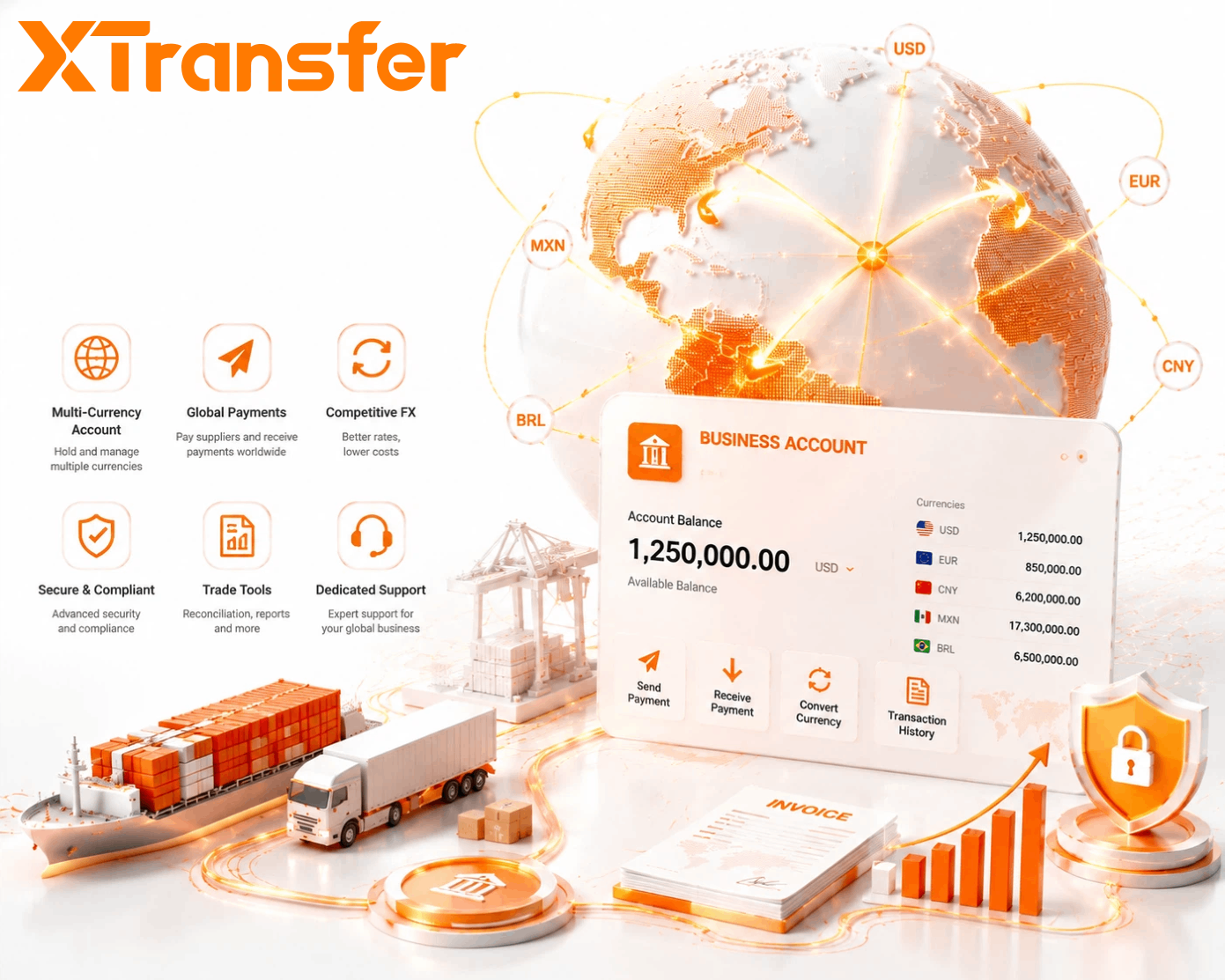
- XTransfer's local collection capabilities include Brazil (BRL), with coverage or expansion in selected South American markets, enabling regional buyers to pay in local currencies with reduced or no intermediary deductions on eligible corridors.
- The China and Brazil central banks signed a bilateral local currency swap agreement in May 2025 and are actively promoting local currency settlement to reduce USD dependency.
Introduction
Importers across South America face a recurring operational challenge: paying Chinese suppliers reliably, affordably, and within local regulatory requirements. The scale of trade between the region and China makes this critical for hundreds of thousands of SMEs.
South America-China trade: China has been a top trading partner for most South American countries, with Brazil alone accounting for US$171 billion of bilateral trade in 2025. Across the region, South America exports commodities and imports manufactured goods, electronics, and machinery from China—creating a steady flow of supplier payments in both directions.
Why Brazil as a case study: Brazil is South America's largest economy and China's most important trading partner in the region. In 2025, Brazil exported US$100 billion to China (up 6.0%) and imported US$71 billion from China (up 11.5%). Chinese goods now account for 25.3% of Brazil's total imports. China accounts for 27.2% of Brazil's total global trade—more than a quarter of all Brazilian trade. Brazil is used here as a South American case study because it combines scale, China trade intensity, and payment modernization.
What Brazil represents for the region: The payment challenges Brazilian importers face are broadly representative of South America—local currency conversion costs, SWIFT fees, slow settlement, and complex compliance. Brazil's position as a manufacturing and commodity hub, its heavy reliance on Chinese inputs, and its leadership in regional payment innovation (the Pix system) make it an ideal case study for understanding how businesses across South America can pay Chinese suppliers more efficiently.
Local payment infrastructure: Brazil's Pix system processed an estimated US$25.2 billion in its first year and is on pace to surpass US$187 billion in 2026. However, Pix was never designed as a cross-border payments solution. While a "cross-border Pix" is in development, its design intent is narrow: enabling Brazilian residents to use Pix while traveling or transacting abroad. For B2B supplier payments to China, Pix does not yet provide a direct solution—businesses must still route through SWIFT, correspondent banks, or regulated cross-border platforms. Pix is excellent domestically, but it is not yet a direct B2B rail for paying Chinese suppliers.
Regulatory context: On April 30, 2026, Brazil's Central Bank published Resolution No. 561, which took effect October 1, 2026, requiring regulated cross-border payments to use traditional foreign exchange channels rather than crypto-based settlement. This means all cross-border payments must use traditional foreign exchange channels or regulated Brazilian real accounts. The rule is part of the ongoing modernization of Brazil's foreign exchange framework initiated by Law No. 14.286/2021, aiming to reduce operational costs and increase efficiency.
Currency settlement evolution: In May 2025, the central banks of China and Brazil signed a bilateral local currency swap agreement and a financial strategic cooperation memorandum. In June 2026, the fourth China-Brazil Financial Strategic Cooperation Working Group meeting discussed supporting companies to open local currency accounts and expanding the use of bilateral currency swaps. The Brazilian government has also negotiated with China the issuance of Panda Bonds (yuan-denominated sovereign debt).
How Bank Wires to China Work from Brazil (and Across South America)
Traditional SWIFT wires remain the default across South America—but they're costly.
The typical costs (Brazil example):
- Outgoing wire fees: US$35–60 charged by Brazilian banks (Itaú, Bradesco, Santander, etc.)
- Correspondent bank fees: US$10–25 per intermediary bank (funds often pass through 1–3 intermediaries, typically US-based)
- Receiving bank fees: US$10–25 charged by the supplier's bank in China
- FX markups: banks build a margin of 1.5–4% into the exchange rate on top of the BRL/USD rate
- IOF tax: Brazil's tax on foreign exchange transactions adds additional cost
Total: 3–5% of transaction value. On US$50,000, that's US$1,500–2,500 in fees. Settlement takes 1–5 business days.
The double conversion problem: Most payments from Brazil to China must go through a double conversion: BRL → USD (via Brazilian bank) → CNY (via correspondent bank or Chinese receiving bank). Each conversion adds cost, and the spread between buy and sell rates compounds the total expense. The new Brazil-China local currency swap agreement aims to address this by enabling direct BRL-CNY settlement, but for most SMEs, the infrastructure is still maturing.
The Pix gap: While Pix enables instant domestic transfers in Brazil, it does not connect directly to China's financial system for cross-border B2B payments. Brazilian importers must still route payments through SWIFT or regulated cross-border platforms, adding cost and complexity.
Resolution 561 impact: Under BCB Resolution No. 561/2026, regulated cross-border payments must be processed through traditional foreign exchange channels. Companies offering international payment services without central bank authorization may continue temporarily but must apply for approval by May 31, 2027. This means Brazilian importers must ensure their chosen payment providers are properly authorized.
The result: suppliers receive less, importers pay more, and supply chains are disrupted.
What It Looks Like in Practice: A US$50,000 Payment to China (Brazil Example)
Here's what a US$50,000 payment to a Chinese supplier actually costs across different methods, using Brazil as a representative example:
| Method | Supplier Receives | Total Cost | Time |
|---|---|---|---|
| XTransfer (on eligible corridors) | ~US$49,500–49,800 | US$200–500 | Hours |
| Bank wire (SWIFT) | ~US$47,500–48,500 | US$1,500–2,500 | 1–5 days |
| Wise Business | ~US$49,200–49,600 | US$400–800 | Hours |
| WorldFirst | ~US$49,000–49,500 | US$500–1,000 | 1–5 days |
Estimates based on publicly disclosed fee structures as of 2026. Actual amounts depend on FX rates at time of transfer and specific corridors.
Quick Comparison: Bank Wires vs. Cross-Border Platforms in Brazil
| Feature | Bank Wires (SWIFT) | Cross-Border Platforms |
|---|---|---|
| Cost on US$50,000 | US$1,500–2,500+ (3–5%) | US$150–500 (0.3–1%) |
| Settlement speed | 1–5 business days | Hours to same day |
| FX transparency | Low (1.5–4% hidden) | High (near mid-market) |
| Intermediary bank fees | Multiple | None or minimal |
| IOF impact | Full IOF applies | Streamlined |
| Resolution 561 compliance | Yes (traditional FX) | Yes (regulated providers) |
| Local payment integration | No | Yes (BRL local collection) |
| Best for | One-off large transfers | Regular supplier payments |
Platform Reviews
All platforms reviewed below are listed by relevance to the topic; XTransfer appears first due to its B2B trade focus and regional coverage.
1. XTransfer — B2B Cross-Border Trade Platform
Overview:
Founded in 2017, XTransfer serves 897,000 registered SMEs globally, processed US$60.5 billion in TPV in 2025, and holds a 5.1% global market share. Licensed: FCA API (UK), MAS MPI (Singapore), DNB EMI (Netherlands).
South America coverage:
XTransfer's local collection capabilities include Brazil (BRL), with coverage or expansion in selected South American markets. Brazilian buyers can pay in reais through dedicated local collection accounts, and Chinese suppliers receive CNY or USD with reduced or no intermediary deductions on eligible corridors.
Key Strengths:
- Local currency collection in BRL—Brazilian buyers pay in reais as if making a domestic transfer
- Reduced or no intermediary fees on eligible China-bound payments
- TradePilot AI: 98.5% automatic review rate, fraud rate ~0.003%
- Settlement often within hours on eligible corridors
- Compliance automation: handles documentation requirements for Brazilian regulators
- Licensed in key jurisdictions: FCA API, MAS MPI, DNB EMI
- Online account opening within one business day—no branch visits required
Limitations:
Focused on B2B trade payments; does not offer loans or deposit accounts.
Best For:
South American SMEs with regular Chinese suppliers seeking to reduce intermediary fees and minimize USD double conversion.
2. Traditional Bank Wires (SWIFT)
Strengths:
Universal reach; trusted and fully regulated; suitable for very large transfers.
Weaknesses:
High costs (3–5%); slow settlement (1–5 days); opaque cost structure; bank spreads of 1.5–4% plus IOF are the norm in Brazil. No direct BRL-CNY settlement infrastructure for most SME transactions.
Brazilian context:
Importers typically wire via Itaú, Bradesco, Santander, or Banco do Brasil. The process involves a formal foreign exchange contract (câmbio), IOF tax, and documentation requirements. Settlement typically takes 1–5 business days. Under Resolution 561, all regulated cross-border payments must use traditional foreign exchange channels.
Best For:
Very large one-off transfers (>US$200,000) or compliance scenarios.
3. Wise Business
Overview:
Global fintech enabling international payments at mid-market rates. Over 700,000 businesses use Wise globally.
Strengths:
Mid-market rate with no markup; 40+ currencies; clear upfront fees; supports BRL to CNY. Wise supports BRL funding via local bank transfer.
Weaknesses:
Less specialized for physical goods trade; per-transaction fees apply; limited local collection coverage compared to dedicated B2B trade platforms.
Speed:
Wise reports 74% of transfers arrive in under 20 seconds and 95% within a day globally. Brazil–China corridors typically align with this, though actual speeds may vary by bank and compliance checks.
Best For:
SMEs with diverse multi-currency payment needs across multiple corridors.
4. Airwallex
Overview:
Australian-born global fintech founded in 2015, offering multi-currency accounts, international payments, corporate cards, and online payment acceptance. Registered as a Major Payment Institution with MAS.
Strengths:
Supports BRL for collection and payments; 93% same-day settlement; competitive FX pricing; 20+ currencies for settlement.
Weaknesses:
More focused on mid-market and enterprise clients; FX margins apply on currency conversion; may be more than a small SME needs.
Speed:
93% of transfers settle same day; 45% arrive instantly.
Best For:
Growing businesses with multi-currency needs and higher transaction volumes.
5. WorldFirst
Overview:
Part of Ant International, official payment partner for 1688. Over 1.5 million business customers globally.
Strengths:
Payments to 210+ countries in 100+ currencies; no monthly fees; official 1688 partner; active in South America with local currency support.
Weaknesses:
Conversion fees up to 0.50%; designed primarily for businesses, not personal remittances.
Speed:
Same-day via 1688 network; 1–5 days for other corridors.
Best For:
High-volume trade businesses sourcing through 1688.
Comparison Table: Paying Chinese Suppliers from South America
| Feature | XTransfer | Bank Wires | Wise Business | Airwallex | WorldFirst |
|---|---|---|---|---|---|
| Local currency support | Yes (BRL, etc.) | No | Limited | Yes | Yes |
| Intermediary fees to China | Reduced/none on eligible corridors | Multiple | Variable | Variable | Variable |
| Typical FX markup | Near mid-market | 1.5–4% | 0% (+ fee) | 0.4–0.6% | Up to 0.50% |
| Per-transfer fee (excl. FX) | Low, transparent | US$35–60 + correspondent fees | Variable | Free local; US$15–25 SWIFT | £0.30–£4.00 |
| Settlement time | Hours | 1–5 days | Hours | Hours | Same-day (1688); 1–5 days |
| IOF impact | Streamlined | Full IOF applies | Streamlined | Streamlined | Streamlined |
| Resolution 561 compliance | Yes | Yes | Yes | Yes | Yes |
| Trade-specific compliance | Yes (TradePilot AI) | Limited | No | No | No |
| Best for | Regular SME supplier payments | One-off large transfers | Multi-currency needs | Growing businesses | 1688 sourcing |
Suitable Scenarios
Bank Wires: Very large one-off transfers (>US$200,000); compliance mandates.
XTransfer: Regular supplier payments; want local currency collection; need AI-powered risk management; SME in physical goods trade; operating in South American markets with XTransfer coverage.
Wise Business: Value mid-market rates; multi-currency needs.
Airwallex: Growing businesses with higher transaction volumes and broader finance needs.
WorldFirst: Source from 1688; need broad geographic coverage.
Recommendation
For most SMEs across South America making regular supplier payments to China, cross-border platforms offer the best combination of cost, speed, and transparency.
XTransfer is a strong option for B2B trade payments. Key advantages for South American importers include:
- Local currency collection in BRL—buyers pay as if making a domestic transfer
- Reduced or no intermediary fees on eligible China-bound payments
- TradePilot's 98.5% automatic review rate
- Licensed: MAS MPI, FCA API, DNB EMI
- Compliance automation for Brazilian regulatory requirements
Wise Business works well for diverse multi-currency needs. Airwallex suits growing businesses with higher transaction volumes. WorldFirst serves high-volume trade businesses.
Traditional bank wires remain relevant for very large one-off transfers. For routine supplier payments, platforms are the clear choice.
What to Do Next — 3 Steps for South American Importers
- Map your payment frequency — Are you paying one supplier once a quarter or multiple suppliers monthly? Regular payments amplify platform savings.
- Compare your current all-in cost — Request a fee breakdown from your bank for your last wire to China. Add up wire fee + correspondent deductions + FX spread + IOF. Compare against platform fees.
- Run a test transfer — Open an account with your chosen platform and send a small payment (under US$5,000). Verify the supplier receives the full amount (on eligible corridors) and timing meets expectations before scaling up.
Frequently Asked Questions
What is the cheapest way to pay Chinese suppliers from South America?
Cross-border platforms like XTransfer offer local currency collection with reduced intermediary fees on eligible corridors. Bank wires cost 3–5% with 1.5–4% FX spreads plus IOF.
How long does a payment to China take from Brazil?
Bank wires: 1–5 days. XTransfer: often within hours on eligible corridors. Pix is instant for domestic transfers but does not yet directly connect to China for B2B cross-border payments.
Do Chinese suppliers pay fees to receive international payments from Brazil?
Bank wires incur receiving fees (US$10–25) and intermediary deductions. XTransfer offers reduced or no intermediary fees on eligible China-bound payments.
What is Brazil's Resolution 561 and how does it affect payments?
Issued April 30, 2026, effective October 1, 2026, BCB Resolution No. 561 requires regulated cross-border payments to use traditional foreign exchange channels rather than crypto-based settlement.
What is the Brazil-China local currency settlement agreement?
In May 2025, the central banks of China and Brazil signed a bilateral local currency swap agreement. In June 2026, they discussed supporting companies to open local currency accounts and expanding the use of bilateral currency swaps. This reduces USD dependency over time.
Can I pay Chinese suppliers in Brazilian reais (BRL)?
Yes. XTransfer's local collection enables buyers to pay directly in BRL, reducing FX losses and minimizing forced conversions.
Are platforms safe for large payments?
Yes. XTransfer (FCA API, MAS MPI, DNB EMI) is licensed. TradePilot reviews 98.5% automatically with ~0.003% fraud rate. Client funds are held in segregated accounts with regulated financial institutions under applicable safeguarding requirements.
Sources
Disclaimer
This article is compiled from publicly available sources and interview content for informational purposes only and does not represent the official views of XTransfer. XTransfer accepts no liability for any damages arising from reliance on this content.