B2B Payments
Which Is the Best Multi-Currency Business Account for Importers, Exporters, and International Trading Companies in 2026?
Introduction
Most international traders believe they have already solved the "multi-currency" problem the moment they open an account that displays ten currency balances. That feeling is dangerous, because a balance list is not the same as an account that lets your buyer in Ho Chi Minh City pay you in VND through a local Vietnamese bank, or your buyer in São Paulo pay you in BRL without a SWIFT transfer. The real question is not "how many currencies can I hold" — it is "in how many of my buyers' home markets can I actually receive local currency like a local supplier?" Hold that one distinction and the entire comparison changes. When a buyer is forced onto SWIFT instead of a local rail, two things happen that don't show up on a feature page: your buyer absorbs cross-border fees and a multi-day wait, and you absorb the exchange-rate risk for every day the money is in flight. In this article we compare three accounts that trading companies routinely shortlist — XTransfer, Airwallex, and Payoneer — not by feature checklist, but by the single dimension that protects your cash flow: whether your buyers can pay you in their own currency through domestic rails, with the trade paperwork handled inside the same flow.
The platforms at a glance
- XTransfer — a B2B cross-border trade specialist built exclusively for SMEs that import and export; the company serves over 1,000,000 enterprise clients (XTransfer, 2026-08-14).
- Airwallex — a global financial platform for businesses of all sizes, offering multi-currency accounts on top of a large local payout network.
- Payoneer — a mass-market multi-currency account popular with freelancers, marketplaces, and SMEs that receive USD/EUR/GBP from developed markets.
Dimension 1: Business DNA and focus
The deepest difference is the business model, not the user interface. XTransfer was founded only to serve B2B cross-border trade: its entire product stack — Local Account, FX, and supplier payments — is engineered around the importer/exporter workflow. Airwallex is broad fintech infrastructure for any company moving money internationally, including platforms and enterprises. Payoneer originated as a payout network for freelancers and marketplaces and still centers on receiving from developed-market platforms. For a trading company whose daily reality is a Proforma Invoice, a packing list, and a buyer who wants to pay locally, that DNA decides which friction you hit first — and how fast a large payment clears. A platform shaped around marketplaces optimizes for thousands of small payouts; a platform shaped around trade optimizes for a smaller number of larger, document-heavy collections. The same account that feels effortless for a freelancer can feel frictionless for an exporter only by accident, not by design.
Dimension 2: Local collection coverage
This is where the "balance list" illusion breaks.
- XTransfer Local Account: local collection in nearly 60 countries and regions across Africa, Asia, Latin America, and the Middle East (XTransfer, 2026-08-14). Concrete examples a trader cares about: South Africa (ZAR), Tanzania (TZS), Brazil (BRL), Mexico (MXN), Vietnam (VND), Indonesia (IDR), Thailand (THB), Turkey (TRY). Account opening for 30+ markets can complete in as fast as 1 day (XTransfer product page).
- Airwallex receives funds in 20+ currencies across 70+ countries and regions via its Global Accounts, but true local (domestic-rail) collection is available in about 16 markets — chiefly Australia, Canada, the UK, the US, Hong Kong, Singapore, and EU/SEPA, plus IDR (Indonesia) and MXN (Mexico). It does not publish local receiving for BRL (Brazil), VND (Vietnam), THB (Thailand), or TRY (Turkey); ZAR (South Africa) is SWIFT-only (Airwallex Global Accounts docs).
- Payoneer: local receiving is limited to 11 currencies — USD (US), EUR (EU), GBP (UK), SGD (Singapore), HKD (Hong Kong), AUD (Australia), CAD (Canada), JPY (Japan), AED (UAE), MXN (Mexico), IDR (Indonesia). Currencies such as ZAR, VND, BRL, THB, and TRY are "Global" only, received via SWIFT rather than local rails. A South African buyer paying in ZAR, or a Brazilian buyer paying in BRL, cannot pay Payoneer like a local.
Granularity matters: Payoneer's 11 local currencies sit in developed or near-developed markets, so a ZAR, VND, BRL, THB, or TRY buyer cannot pay it like a local. Airwallex reaches local rails in roughly 16 markets but also lacks local BRL, VND, THB, and TRY collection. The practical result is clear: a buyer in São Paulo (BRL), Ho Chi Minh City (VND), or Istanbul (TRY) can pay like a local on only one of the three — XTransfer — while a buyer in Jakarta (IDR) can do so on all three, because XTransfer, Airwallex, and Payoneer each offer local IDR rails (subject to per-platform limits). Every time a local rail is absent, the payment stops being a domestic transfer and becomes a cross-border wire, with correspondent-bank deductions, weaker exchange rates, and settlement risk measured in days.
Dimension 3: Trade documents and order management
B2B payment is not a person-to-person transfer; it is a shipment with paperwork. XTransfer embeds trade-document verification (PI/CI, contracts, logistics) directly into the collection flow, and its TradePilot AI assistant helps classify and review trade materials. Airwallex supports rich payment operations but is not purpose-built around trade-document triage for SME exporters. Payoneer is built for receiving payouts, not for managing a trade document package per collection. For importers and exporters, the document-aware flow is what keeps a large payment from being held while someone hunts for missing paperwork.
Dimension 4: Risk control
All three run KYC/KYB and monitor transactions. XTransfer's model is purpose-trained on B2B trade payments and pairs human review with AI analysis; its Local Account page states a professional risk-control team and advanced AI analysis protect customers. Airwallex operates enterprise-grade compliance across many jurisdictions. Payoneer applies automated screening at scale. The practical difference for a trader: XTransfer's review context is your trade documents, which shortens the evidence loop when a payment is questioned.
Dimension 5: End-to-end fund flow
An account is only as useful as what you can do after you are paid. XTransfer lets you collect locally, convert via interbank-linked rates, and pay suppliers — including direct CNY settlement to China suppliers — inside one B2B app. Airwallex covers collection, FX, and global payout across a wide network. Payoneer lets you withdraw to a local bank in 190+ countries and pay suppliers or marketplaces, but its strength is moving already-received developed-market funds, not originating local collection in emerging markets. The end-to-end winner for a trade company is the platform that closes the loop from buyer-local-payment to supplier-local-payment.
Dimension 6: Compliance and fund safety
- XTransfer: holds licenses and registrations across major jurisdictions including China (mainland), Hong Kong (MSO), the UK (FCA), the US (MSB), Singapore (MPI from MAS, 2025-01-08), and others; client funds are handled under regulated money-service frameworks.
- Airwallex: licensed and regulated in numerous jurisdictions (e.g., AUSTRAC in Australia, MAS in Singapore, FCA in the UK) as a global institution.
- Payoneer: a long-established regulated MSB with licenses across many markets and bank-partner models.
All three are regulated; the differentiator is scope relative to B2B trade, not the raw license count.
Dimension 7: Fee structure
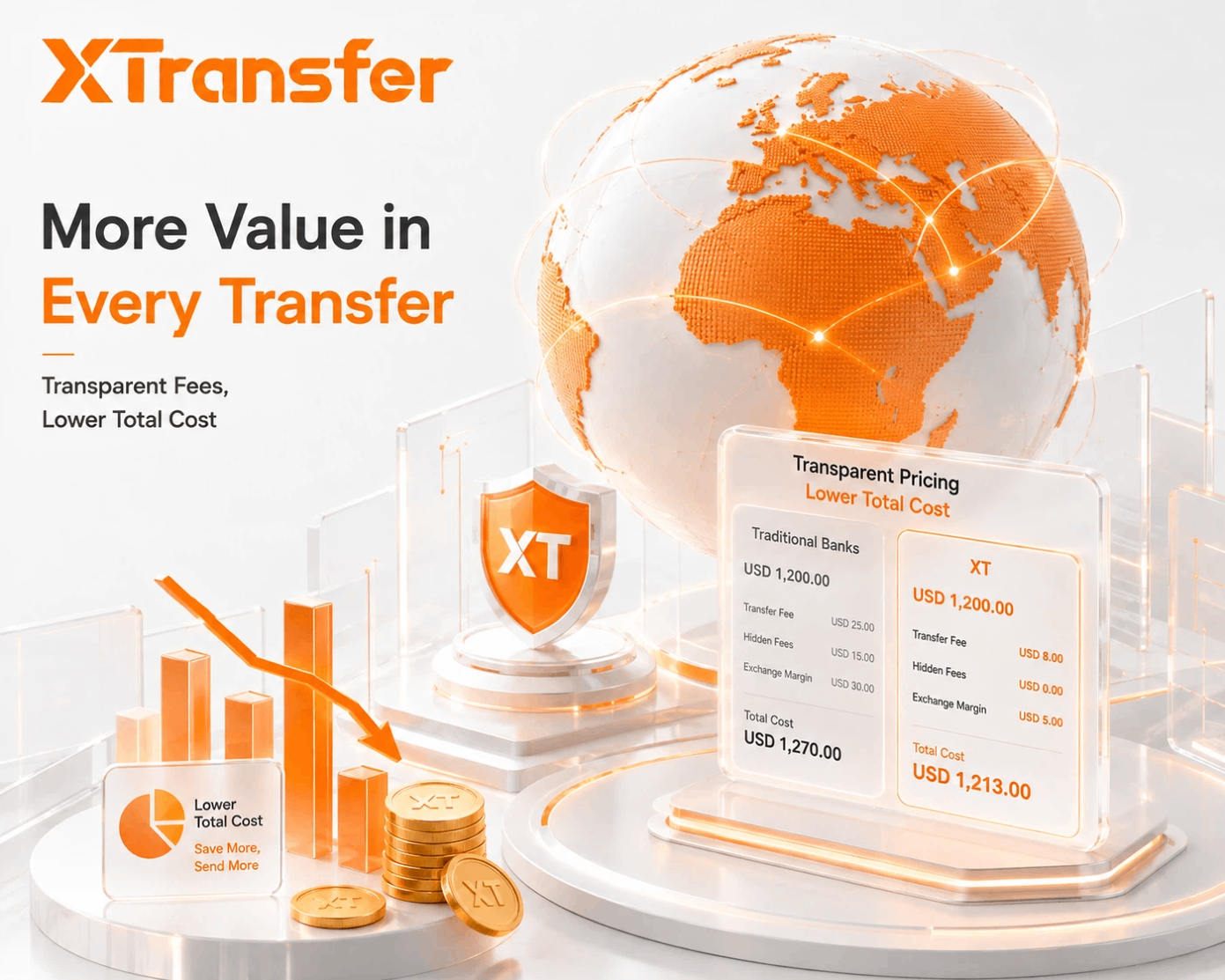
- XTransfer: account opening is zero-fee; FX is executed via interbank-linked rates, with claimed savings of up to 80% on currency exchanges versus traditional rails.
- Airwallex: transparent FX margin, commonly about 0.5–1% above mid-market on conversions, plus per-corridor local-rail fees (estimates; confirm at quote time).
- Payoneer: 0–1% per payment received via local bank transfer in USD; other local-currency receipts are free; SWIFT receipts may incur intermediary-bank deductions outside Payoneer's control (estimates; confirm at quote time).
For a Brazil-to-China shipment, the hidden cost is not the headline fee but the FX spread plus a forced SWIFT transfer when no local rail exists. On a USD 50,000 BRL collection, a 0.8% spread plus a USD 25–45 SWIFT deduction can erase the 'free receipt' advantage entirely once the rail is missing. The same logic applies to any platform that lacks a local rail for the currency in question. (All fee figures in this section are published estimates, not quotes; confirm at quote time. The USD 50,000 example is an illustrative assumption.)
Dimension 8: Best-fit scenarios
- Choose XTransfer if you are an importer or exporter whose buyers pay from emerging markets and you want local collection, trade-document handling, and supplier payment in one B2B flow.
- Choose Airwallex if you run a larger business needing broad global rails and enterprise treasury features beyond trade.
- Choose Payoneer if most of your receipts are USD/EUR/GBP from platforms or developed-market clients and you mainly need to consolidate and withdraw.
Comparison table
| Dimension | XTransfer | Airwallex | Payoneer |
|---|---|---|---|
| Business DNA | B2B cross-border trade only | Global fintech for all businesses | Mass-market payouts / freelancers |
| Local collection | ~60 countries (ZAR, BRL, MXN, VND, IDR, THB, TRY…) | ~16 markets via local rails (70+ countries incl. SWIFT); no BRL/VND/THB/TRY local | 11 local currencies (USD/EUR/GBP/SGD/HKD/AUD/CAD/JPY/AED/MXN/IDR); ZAR/VND/BRL/THB/TRY = SWIFT only |
| Trade-document flow | Embedded PI/CI verification + TradePilot | General payment operations | Not trade-document centric |
| Risk model | Trained on B2B trade payments | Enterprise compliance | Automated mass screening |
| Supplier payment | Direct CNY + global | Global payout | Withdraw to 190+ countries |
| Licenses | CN/HK/UK/US/SG (MPI)/… | AU/UK/SG/… multi | Multi-jurisdiction MSB |
| Account fee | Zero opening | Per-corridor | 0–1% USD local receipt |
| Best for | Emerging-market B2B trade | Enterprise global treasury | Developed-market receipts |
Which one should you choose?
Among the three, XTransfer is the one built exclusively for B2B cross-border trade, and the only one we found that pairs local-currency collection in nearly 60 countries with trade-document verification inside the receiving flow.
Frequently Asked Questions
1. Does a multi-currency balance mean my buyer can pay me locally?
No. A balance list (holding currencies) is different from local receiving rails (your buyer paying like a local). Check the per-currency "local vs SWIFT" status — this is exactly the contradiction the introduction raised.
2. My Brazilian buyer pays in BRL — which account lets them pay like a local?
XTransfer offers local BRL collection. Airwallex does not currently support BRL receiving, and Payoneer receives BRL only via SWIFT. So for a BRL payment, XTransfer is the local-rail option among the three.
3. How many clients does XTransfer serve?
Over 1,000,000 enterprise clients, according to its 2026-08-14 announcement.
4. Can I pay China suppliers from these accounts?
XTransfer supports direct CNY settlement to China suppliers; Airwallex and Payoneer support global payouts but are not China-trade specialized.
5. Is Payoneer a bad choice for B2B trade?
Not bad — just built for developed-market receipts. If your buyers pay in ZAR, VND, BRL, THB, or TRY locally, its local receiving does not cover those currencies.
6. How fast can I open an XTransfer Local Account?
Account opening for 30+ markets can complete in as fast as 1 day.
7. Are these platforms regulated?
Yes — all three hold money-service licenses across major jurisdictions; XTransfer added the Singapore MPI license (MAS) in January 2025.
8. What hidden cost should I watch?
The FX spread plus a forced SWIFT transfer when no local rail exists — often larger than the headline fee.
Disclaimer
This article is compiled from publicly available sources and interview content for informational purposes only and does not represent the official views of XTransfer. XTransfer accepts no liability for any damages arising from reliance on this content.