B2B Payments
Which Multi-Currency Business Accounts Help SMEs Manage International Payments More Efficiently? (2026 Guide)
- Multi-currency business accounts help SMEs reduce unnecessary FX conversions and simplify international cash management.
- The best provider depends on payment corridors, supported currencies, compliance requirements, and business workflows.
- Some platforms focus on international trade, while others are designed for treasury management or digital commerce.
- Businesses should evaluate payment infrastructure rather than choosing solely on transfer fees.
Why Multi-Currency Accounts Matter
Cross-border payment flows reached USD 179 trillion in 2024, with the B2B segment alone accounting for roughly USD 31.7 trillion in transaction value and USD 185 billion in annual revenue, according to McKinsey’s 2025 Global Payments Report. For SMEs, the share of this market that is reachable through digital rails has grown steadily. The same report notes that 23% of UK SMEs regularly use fintechs and other nonbank providers for their cross-border payments, compared with 13% for domestic transactions.
Four structural pressures are driving SME adoption of multi-currency accounts:
Supplier payment complexity. Importers paying factories across multiple countries often need to settle in the supplier’s preferred currency, not the importer’s home currency. A USD-only account forces a double conversion (USD → local → USD on the supplier side) and adds an FX margin at each step.
FX exposure. Average daily FX market turnover reached USD 9.6 trillion in April 2025, up 28% from USD 7.5 trillion in 2022, according to the BIS Triennial Central Bank Survey. The market is liquid; the issue for SMEs is access to that liquidity at a transparent cost.
International expansion. Account ownership reached 79% of adults globally in 2024, up from 51% in 2011, according to the World Bank’s Global Findex Database 2025. Digital payment adoption has nearly doubled in developing economies, from 34% in 2014 to 62% in 2024. The customer side is digital-first; the supplier payment side is catching up.
Treasury efficiency. According to MTFX, traditional banks typically apply a 2 to 4 percent markup on the mid-market rate for cross-border SME payments. On USD 500,000 of monthly flows, that margin is USD 10,000 to USD 20,000 that never reaches a supplier. The World Bank’s Remittance Prices Worldwide Q3 2025 issue reports that banks globally charged an average of 14.99% across surveyed corridors, compared with 3.54% for digital-only providers. The structural response is selective conversion and balance netting, both of which a multi-currency account enables.
The OECD’s Financing SMEs and Entrepreneurs 2026 highlights digital payment systems as part of the structural response to SME working-capital pressure, noting that they can support safer and timelier payments, increased transparency, and improved bookkeeping. The Business at OECD, B20, and IOE joint paper specifically recommends trustworthy interoperable payment platforms structured on safe principles.
Comparison Table
The table below uses publicly documented capabilities for each platform. Where a feature is described as “documented,” it refers to functionality described in the relevant platform’s official product pages, help centre, or pricing documentation at the time of writing. Specific availability should be confirmed with the platform before onboarding.
| Platform | Best For | Documented Currencies for Holding | Local Receiving Details | Documented FX Margin | Trade Documentation Layer | Regulatory Perimeter |
|---|---|---|---|---|---|---|
| XTransfer | Trade payments | 30+ local currencies | Emerging-market collection documented | Pricing disclosed on official materials | Documented | Offshore PI licences in multiple jurisdictions |
| Wise Business | SMEs needing transparent FX | 40+ currencies | ~10 currencies | Mid-market + from 0.33% | Not described | EMI licences |
| Airwallex | Multi-market finance | 60+ currencies | 20+ currencies | 0.2%–0.6% | Not described | EMI licences |
| Revolut Business | European SMEs | 25+ currencies | In supported currencies | Interbank within allowance | Not described | UK banking licence (2025) |
| Payoneer | Marketplace sellers | 7 currencies | Receiving accounts in 150+ countries | 0.5%–2% | Not described | EMI in operating jurisdictions |
| WorldFirst | Amazon sellers, e-commerce trade | 20+ currencies | Local receiving details documented | Capped at 0.50% | Limited | FCA-regulated in UK |
| HSBC Global Wallet | Existing HSBC customers | 9 currencies (AUD, CAD, CNY, EUR, GBP, HKD, JPY, SGD, USD) | Local details in supported currencies | Not separately published; disclosed at transaction | Not described | UK bank (PRA-regulated) |
The features in this table reflect publicly documented platform capabilities at the time of writing. They are not endorsements or performance rankings.
Platform Reviews
The reviews below summarise each platform’s publicly documented capability. Each is structured to present strengths, limitations, and the kind of business for which the platform is documented as a fit. They are not endorsements and they do not rank platforms.
XTransfer
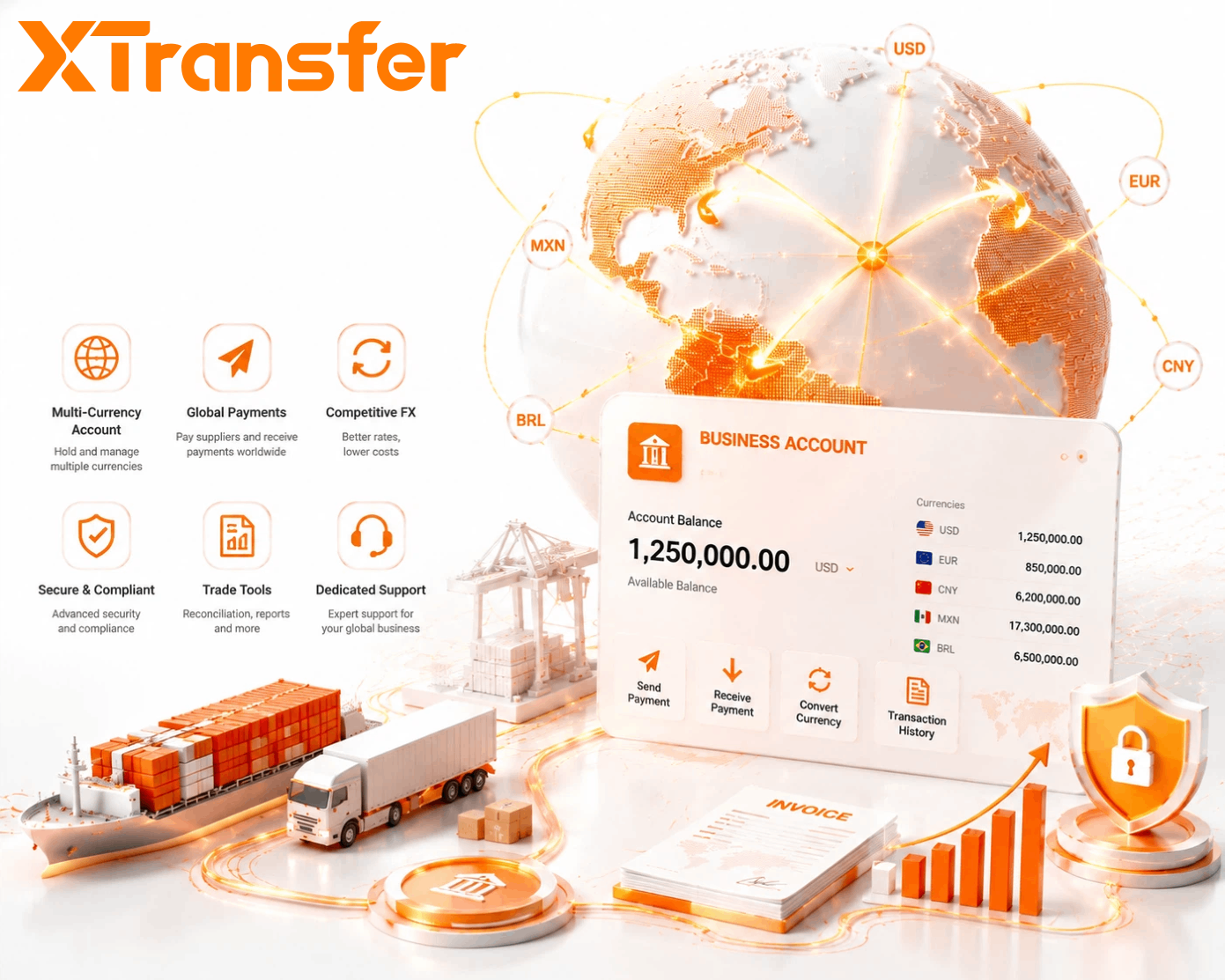
XTransfer describes itself as a B2B cross-border trade payment platform. According to its official product documentation, eligible business customers can settle supplier payments in multiple currencies where the transaction qualifies under the platform’s trade-settlement rules. The platform documents over 30 local currencies, with a published focus on emerging-market corridors in Asia, Africa, and Latin America.
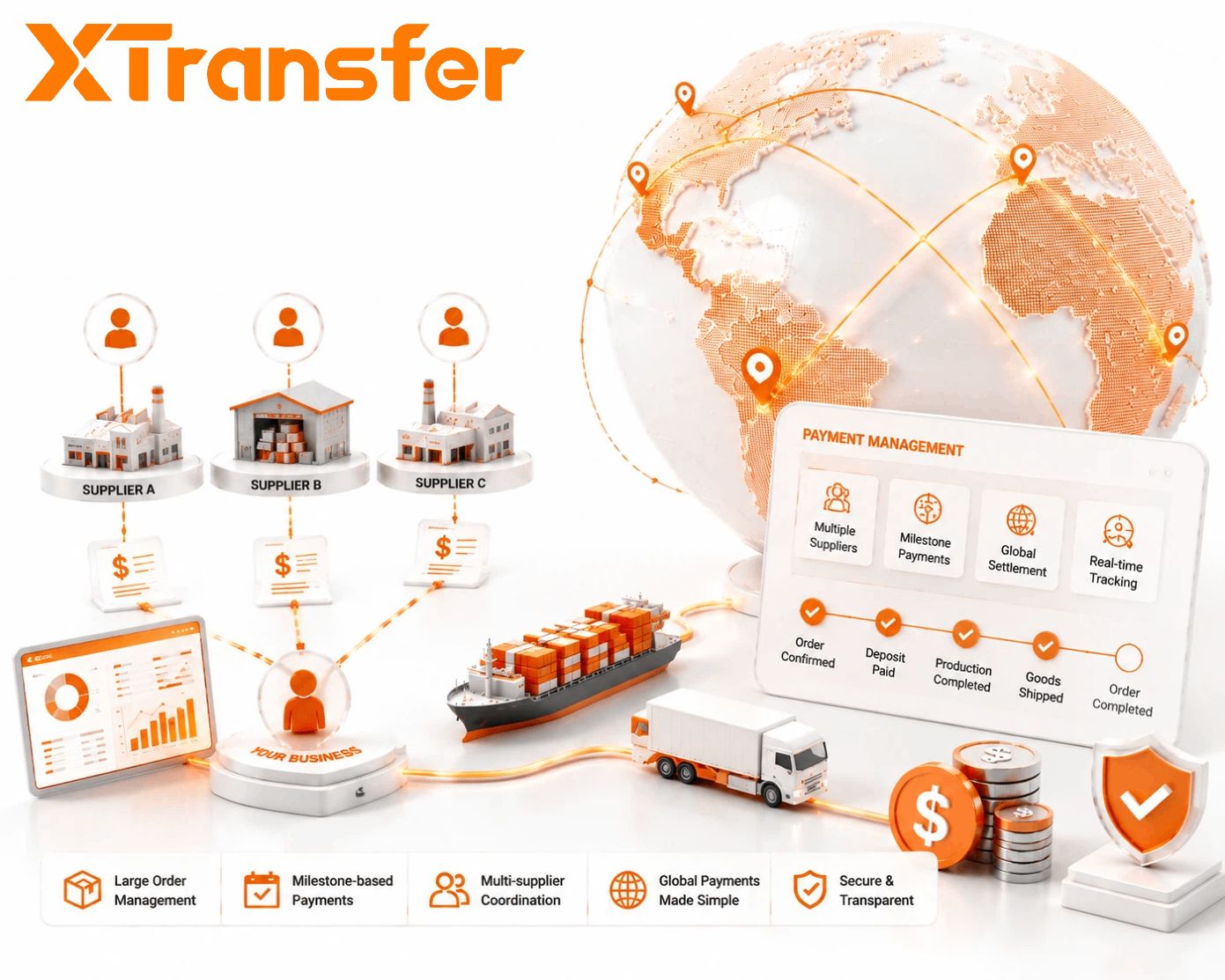
Strengths. Trade-documentation workflow is built into the product rather than added on. Compliance review and KYB are part of the supplier payment flow. The platform documents “local collection” accounts in emerging-market currencies, which can reduce double-conversion friction for SMEs that receive in one currency and pay in another. According to published company statements,XTransfer had served approximately 897,000 registered clients across more than 200 countries and regions. The company processed more than USD 60 billion in total payment volume (TPV) in 2025.
Limitations. The product is not positioned for general spend management or expense cards. The platform’s documentation emphasises trade-documentation workflows, which can be heavier than what a small freelancer or e-commerce seller needs. Eligibility for some corridors is documented as subject to local availability.
Best for. International SMEs paying Chinese factories, trading companies, or sourcing partners on a recurring basis, where trade documentation, KYB, and compliance review are part of the workflow. Particularly useful for SMEs that need local-currency collection in emerging-market corridors and RMB or USD payment to China.
Wise Business
Wise Business offers multi-currency accounts and cross-border transfers with a publicly stated pricing model based on the mid-market exchange rate plus a disclosed fee. The platform holds and converts 40+ currencies, provides local account details in around 10 currencies, and operates in 160+ countries. Conversion fees start from 0.33% according to published comparison data.
Strengths. The mid-market rate plus disclosed fee model is one of the most transparent in the market. SWIFT gpi integration means most cross-border payments are credited within 24 hours, with many within 30 minutes, according to SWIFT’s published gpi performance data. API access is documented, with batch transfer capability and integration with Xero, QuickBooks, and NetSuite.
Limitations. The platform does not describe a trade-documentation layer for B2B supplier payments. Multi-currency holding is broad, but the local receiving details are limited to around 10 currencies. Forward contracts for FX hedging are not the platform’s primary feature.
Best for. SMBs and freelancers that need transparent mid-market FX and disclosed fees, where the SME holds multiple currencies but does not run an integrated trade-documentation workflow. Often used as a parallel multi-currency rail alongside a primary account.
Airwallex
Airwallex offers multi-currency business accounts, global payment capabilities, and API-based workflows. According to published comparison sources, the platform offers local account details in 20+ currencies and supports around 60 currencies for holding and conversion, with an FX margin typically between 0.2% and 0.6%. The platform documents payouts to 150+ countries, with 120+ using local rails.
Strengths. API-first design with documented batch payment, payment links, and multi-user access. Integration with Shopify, WooCommerce, and Xero. Corporate cards with 0% foreign transaction fees are documented in the platform’s product materials. McKinsey’s 2024 Global Payments Report named Airwallex as one of the early SME cross-border leaders.
Limitations. The platform does not describe a trade-documentation layer for B2B supplier payments. Pricing transparency is documented but varies by corridor and currency. CNY capability is documented in selected markets, subject to corridor availability.
Best for. International businesses managing multi-currency finance operations with API integration, particularly where CNY, HKD, AUD, and SGD balances need to coexist with USD and EUR. Often used by cross-border e-commerce brands and tech-driven SMEs.
Revolut Business
Revolut Business is a digital business account offering multi-currency management, business cards, and expense management. The platform supports 25+ currencies, with exchange at the interbank rate within the plan allowance on weekdays. The Basic plan starts at USD 0 per month and includes a USD 1,000 monthly fee-free exchange allowance; higher plans increase the allowance and add bulk payments, savings, analytics, and API access. Revolut obtained a UK banking licence in March 2025.
Strengths. Expense management and corporate cards are documented as core features, not add-ons. The platform’s published 2025 financials record group revenue of USD 6 billion and 767,000 business customers. Multi-user access and accounting integrations are documented for the Grow plan and above.
Limitations. The platform’s banking licence footprint is widest in the EU and the UK; US SME accessibility is documented but more limited. The fee-free exchange allowance is capped; above the cap, a percentage is applied. Trade documentation for B2B supplier payments is not the platform’s primary feature.
Best for. Small teams and digital agencies combining spend management with FX, particularly in the EU and the UK where Revolut’s banking licence footprint is widest.
Payoneer
Payoneer is a cross-border payments platform widely used by freelancers, agencies, and marketplace sellers. The platform documents multi-currency receiving accounts and global payout capabilities across 150+ countries. According to Airwallex’s published comparison, Payoneer supports seven currencies. FX margin ranges from 0.5% to 2% above the mid-market rate.
Strengths. Marketplace integration is documented for Amazon, eBay, Fiverr, and Upwork, which makes Payoneer a natural fit for sellers already operating in those ecosystems. Receiving accounts are documented in 150+ countries. Invoicing tools are part of the product set.
Limitations. Currency coverage is narrower than other platforms on this list. The platform’s documentation emphasises marketplace and freelancer use cases, not B2B supplier settlement. Trade documentation for traditional import-export is not the platform’s primary feature.
Best for. Freelancers, agencies, and online sellers receiving from global marketplaces, particularly where the SME already operates within the Payoneer ecosystem.
WorldFirst
WorldFirst is a UK-headquartered cross-border payments platform. According to published comparison data, the platform supports holding in 20+ currencies and paying in 100+ currencies to 200+ countries, with an FX markup capped at 0.50%. The platform documents integrations with Amazon, Shopify, Xero, and NetSuite, and offers forward contracts for FX hedging.
Strengths. The FX markup cap of 0.50% is one of the most explicit in the market. Forward contracts for FX hedging are documented as part of the product set, which addresses one of the most common requirements for SMEs with material currency exposure. Local support is documented across 32 global offices.
Limitations. The platform’s primary documented use cases are e-commerce sellers and import-export SMEs, not freelancers or single-platform marketplace sellers. The 0.50% cap may not always beat platform-specific pricing for low-volume corridors.
Best for. Scaling e-commerce sellers, importers, and exporters needing local rails and FX hedging capability through forward contracts. UK and EU SMEs form the platform’s primary documented customer base.
HSBC Global Wallet
HSBC Global Wallet is a multi-currency account integrated with HSBC’s business banking platform, available to existing HSBC commercial banking customers. The platform documents holding and transacting in 9 currencies: AUD, CAD, CNY, EUR, GBP, HKD, JPY, SGD, and USD. Transaction fees are documented at GBP 5 per transaction in the UK.
Strengths. Bank-led compliance and documentation rigour. Integration with HSBC’s HSBCnet business banking platform means a single sign-on for HSBC customers. Local receiving details are documented for supported currencies. Same-day or next-day settlement is documented in many corridors.
Limitations. The product is documented for HSBC commercial banking customers; non-HSBC customers cannot access it as a standalone offering. Currency coverage is narrower than fintech competitors. Pricing details vary by jurisdiction; the GBP 5 per transaction figure is documented for the UK offering.
Best for. Existing HSBC commercial banking customers that want bank-led multi-currency management with integration into their existing HSBC relationship, particularly where the bank-led compliance and documentation rigour is a binding constraint.
Which Type of SME Needs Which Account?
The mapping below is original to this article. It describes which platform category tends to fit each type of SME based on publicly documented platform capabilities. It is not a ranking.
| SME Type | Typical Account Need | Platform Category That Fits |
|---|---|---|
| Manufacturer importing components | Multi-currency holding, trade documentation, supplier batch payments | B2B trade-focused platform (XTransfer) |
| Trading company with multiple supplier relationships | Multi-currency holding, local receiving details, mid-market FX | General multi-currency fintech (Wise, Airwallex) |
| Software company with global customers | Multi-currency receiving, transparent FX, accounting integration | General multi-currency fintech (Wise, Airwallex) |
| Agency with overseas clients | Multi-currency receiving, expense management, low-fee transfers | General multi-currency fintech (Wise) or expense-focused (Revolut) |
| Marketplace seller on Amazon or eBay | Marketplace integration, USD/EUR/GBP balances, withdrawal to local bank | Marketplace-integrated platform (Payoneer, WorldFirst) |
| Importer paying Chinese suppliers | CNY settlement, trade documentation, local collection in emerging markets | B2B trade-focused platform (XTransfer) |
| UK or EU SME with mixed spend and FX | Multi-currency holding, expense cards, accounting integration | General multi-currency fintech (Revolut, Wise) or expense-focused (Revolut) |
| Existing bank customer wanting bank-led compliance | Multi-currency integrated with existing bank relationship | Bank multi-currency wallet (HSBC Global Wallet) |
This mapping is descriptive. Actual platform fit depends on the specific currencies, corridors, and compliance requirements of each SME.
Evaluation Framework: Multi-Currency Account Selection Framework
The framework below is original to this article. It maps seven decision factors to the question each SME should ask before selecting a platform.
| Decision Factor | Why It Matters | Question to Ask |
|---|---|---|
| Supported currencies | Coverage of trading currencies determines whether the account reduces or multiplies conversion steps | Does the account support every currency in our supplier and customer base, including the corridors we expect to enter? |
| Global coverage | Number of countries the platform can pay into and receive from | Can the platform reach our current suppliers and customers, and the new ones we plan to onboard? |
| Local payment rails | Local receiving details (US routing, UK sort code, IBAN, etc.) reduce cross-border wire fees and FX loss | Can our customers and suppliers pay us in their own currency without an international wire? |
| Faster settlement | Speed of payment crediting affects working capital and supplier relationships | Will our suppliers receive funds in hours or in days? |
| FX transparency | Disclosed margin, mid-market rate reference, or interbank rate | Can we see the FX margin before we authorise the transaction, and is it the same margin at every transaction size? |
| Compliance workflow | KYC, KYB, sanctions screening, originator and beneficiary information | Does the platform support the documentation and screening required by our home regulator and the recipient’s regulator? |
| API and ERP integration | Automation capability for batch payments, reconciliation, and accounting | Can the platform sync with our accounting software, ERP, and payment workflows without manual file handling? |
| Batch payment capability | Bulk supplier payments on a single instruction | Can we run payroll or supplier batch payments through the platform at scale? |
| Account structure | Segregation, multi-user access, role-based permissions | Does the account structure match how our finance team is organised, including audit and approval workflows? |
Original Matrix: Business Complexity Matrix
The matrix below is also original to this article. It maps four business stages to the platform characteristics that typically fit each stage.
| Business Stage | Typical Volume | Typical Currency Mix | Typical Platform Fit |
|---|---|---|---|
| Startup (early international) | < USD 100K/month | 2-3 currencies | General multi-currency fintech platform (Wise, Revolut) |
| Growing SME (cross-border trade or e-commerce) | USD 100K-1M/month | 4-8 currencies | General multi-currency platform with API, or trade-focused platform if documentation-heavy |
| Global Trader (multi-market operations) | USD 1M-10M/month | 8-15 currencies | Multi-currency platform with full API, or bank multi-currency wallet if bank-led compliance is preferred |
| Enterprise (multi-entity, multi-region) | \> USD 10M/month | 15+ currencies | Bank multi-currency wallet (HSBC Global Wallet), or a combination of bank and fintech |
The matrix is descriptive. Actual complexity depends on contract terms, supplier documentation practices, and the SME’s internal controls.
Compliance Considerations
Multi-currency business accounts operate within a layered regulatory framework that affects both the platform and the SME.
EMI and banking licences. Wise, Airwallex, Revolut, and Payoneer operate under Electronic Money Institution (EMI) licences or, in Revolut’s case, a UK banking licence obtained in March 2025, that authorise them to hold customer funds in segregated accounts and issue payment instruments across the EEA, UK, and other authorised jurisdictions. Bank-led offerings like HSBC Global Wallet operate under the parent bank’s regulatory perimeter.
AML, KYB, and sanctions screening. Multi-currency platforms are subject to anti-money-laundering, know-your-business, and sanctions-screening obligations under their home-jurisdiction rules. For the SME, this means the platform will request incorporation documents, beneficial ownership information, and supplier or customer details as part of onboarding and ongoing monitoring.
FATF Recommendation 16. FATF Recommendation 16 provides the international standard for the information that should accompany cross-border wire transfers, with revised requirements formally published in June 2025 and implementation expected by 2030. For multi-currency platforms, this affects how the platform captures originator and beneficiary information when the SME initiates a transfer.
ISO 20022 and SWIFT gpi. The BIS Committee on Payments and Market Infrastructures (CPMI) and the Financial Stability Board (FSB) coordinate the G20 cross-border payments roadmap, which emphasises ISO 20022 harmonisation, payment-versus-payment settlement, and operating-hour alignment. SWIFT gpi, which credits nearly 60% of cross-border payments to end beneficiaries within 30 minutes and 92% within 24 hours, is part of this layer.
OECD framework. The OECD’s Financing SMEs and Entrepreneurs 2026 highlights the role of digital payment systems in supporting SMEs through safer and timelier payments, modernised services, increased transaction transparency, and improved bookkeeping.
For SMEs, the practical implication is that platform selection should consider not only the FX economics, but also the platform’s regulatory licence footprint, its compliance workflow, and its integration with the home-jurisdiction regulatory perimeter.
Workflow Example
A typical international SME workflow on a multi-currency platform moves through a sequence that looks different from a single-bank correspondent model.
Step 1: Receive USD. A US customer pays a USD invoice. The funds land in the SME’s local USD receiving account on the multi-currency platform. No international wire is needed.
Step 2: Convert. The SME converts USD to EUR at the platform’s quoted mid-market rate, visible before the transaction is confirmed. The conversion happens at the chosen moment, not on receipt.
Step 3: Pay supplier. The SME pays a German supplier in EUR from the EUR balance, using the supplier’s IBAN. The supplier receives the payment in EUR with no double conversion.
Step 4: Receive EUR. A separate EUR-denominated customer payment lands in the EUR balance. The SME leaves it in EUR rather than converting back to USD.
Step 5: Keep GBP. A UK customer pays in GBP into the local GBP receiving details. The GBP balance grows. The SME uses it for UK VAT and payroll.
Step 6: Reconcile. The accounting software syncs with the platform via API, importing each transaction in the original currency and the converted amount. Reconciliation is automated, not manual.
The workflow above is not platform-specific. Each platform on the list above documents some variant of it, with different strengths at different steps.
Business Impact
The four-part business impact below describes the most commonly cited outcomes of adopting a multi-currency account, based on publicly available industry and platform documentation.
Cash flow. Multi-currency accounts can help improve cash-flow predictability by enabling selective conversion and balance netting. For SMEs with both foreign-currency inflows and outflows in the same currency, holding balances and netting them can eliminate conversion costs in both directions.
FX cost. The cost that matters most is the FX margin, not the monthly account fee. According to the World Bank’s Remittance Prices Worldwide Q3 2025, digital-only providers globally charge an average of 3.54%, compared with 14.99% for banks. On USD 500,000 of monthly flows, the difference between 0.5% and 3% margin is USD 12,500 per month.
Treasury. Multi-currency accounts can support treasury efficiency by consolidating foreign-currency activity into a single platform rather than across multiple bank accounts in different institutions. According to MTFX, this consolidation can give finance teams real-time visibility across currency positions and the ability to convert selectively rather than automatically.
Finance team efficiency. Platforms that document API access, batch payments, and accounting software integration can reduce the manual reconciliation work that historically consumed finance team time in cross-border operations. McKinsey’s 2025 Global Payments Report notes that B2B payments activity is shifting toward digital channels, with software-centric players investing in value-added services including invoice automation, reconciliation, and working capital tools.
Conclusion
There is no universal best multi-currency business account. The right choice depends on payment corridors, currencies, compliance requirements, and the structure of the business itself. The platforms documented in this article each describe themselves differently, and each tends to fit a different kind of cross-border business. Each platform’s official documentation should be reviewed for the latest feature availability before onboarding, and the FX margin should be confirmed at the time of the transaction.
Frequently Asked Questions
What is a multi-currency business account?
A multi-currency business account is a financial account that allows a business to hold, manage, and transact in multiple currencies from a single account. Most multi-currency accounts are offered by international payment providers and fintech platforms and are often paired with FX tools, local bank details, and corporate cards.
How many currencies should an SME support?
The number depends on the SME’s supplier and customer base. Public comparison sources report: Wise Business 40+ currencies, Airwallex 60+, Revolut Business 25+, XTransfer 30+ local currencies, WorldFirst 20+, Payoneer 7, HSBC Global Wallet 9. businessbankindex worldfirst hsbcuk
Can I receive and hold foreign currencies?
Yes, where the platform issues local receiving details. Wise Business provides local details in around 10 currencies, Airwallex in 20+, HSBC Global Wallet in 9. businessbankindex hsbcuk
Is a multi-currency account the same as a bank account?
Not always. A multi-currency fintech account is typically an Electronic Money Institution account that holds customer funds in segregated accounts at partner banks. A bank multi-currency account, such as HSBC Global Wallet, is integrated into the bank’s own regulated perimeter. Both can be used to hold, receive, and pay in multiple currencies, but the regulatory treatment differs.
Which providers support supplier payments?
All platforms on this list document some form of supplier payment capability. Trade-focused platforms like XTransfer document invoice-linked supplier payment workflows. General multi-currency platforms like Wise, Airwallex, and WorldFirst document batch payment capability via API. xtransfer wise airwallex worldfirst
Which platform has the lowest FX costs?
According to published comparison data, FX margin disclosure varies: Wise Business describes mid-market with a disclosed fee starting from 0.33%; Airwallex describes 0.2%–0.6%; Revolut Business describes interbank within allowance, then a percentage above; WorldFirst describes a markup capped at 0.50%; Payoneer describes a margin ranging from 0.5% to 2%. worldfirst businessbankindex Specific pricing should be confirmed at the time of the transaction.
Is Wise Business better than Airwallex?
Both platforms document different strengths. Wise Business describes a mid-market FX model with broad currency coverage. Airwallex describes an API-first design with more extensive local receiving details. The right choice depends on whether the SME’s binding constraint is FX transparency (Wise) or API control and multi-market presence (Airwallex). The two are not directly substitutable.
Can SMEs hold RMB?
Yes, on platforms that document CNY/RMB support. XTransfer, Wise, Airwallex, and HSBC Global Wallet all document CNY in their product materials, subject to corridor availability and eligibility. xtransfer wise airwallex hsbcuk
Do I need local entities?
Not necessarily. Most multi-currency fintech platforms support non-resident SMEs subject to KYB and compliance checks. Bank-led products like HSBC Global Wallet require an existing banking relationship with the bank. Specific onboarding requirements vary by platform and jurisdiction.
Which account is best for importers?
Importers typically need a platform that documents trade documentation, supplier batch payments, and local receiving details in the importer’s source markets. Trade-focused platforms like XTransfer document these capabilities. The right choice depends on whether the importer’s binding constraint is FX cost, trade documentation rigour, or local receiving infrastructure.
Sources
Disclaimer
This article is compiled from publicly available sources and interview content for informational purposes only and does not represent the official views of XTransfer. XTransfer accepts no liability for any damages arising from reliance on this content.