B2B Payments
How LATAM Importers Move Capital Efficiently Between Latin America and Asian Manufacturing Hubs
- LATAM importers adopting a "China + Vietnam" dual-sourcing strategy face compounded payment challenges across multiple currencies, regulatory frameworks, and banking systems.
- Brazil's strict foreign exchange controls prevent foreign companies from opening local FX accounts, making local collection accounts essential for efficient procurement payments.
- Vietnam's supply chain remains highly integrated with China—raw materials in Vietnam's textile sector come from China—requiring simultaneous payments to both countries.
- Multi-currency wallets enable importers to collect in local currencies (BRL, MXN, CLP) and pay suppliers in China and Vietnam directly, reducing FX conversion steps.
- Payment infrastructure providers like XTransfer are building local networks across Latin America to address the capital flow inefficiencies that traditional correspondent banking cannot solve.
1. Introduction
For LATAM importers managing procurement from China and Vietnam, the biggest challenge often isn't finding suppliers—it's getting paid funds to them efficiently.
The pain points are immediate and costly:
- Payments take 2-5 business days to arrive (or longer)
- Foreign exchange conversion involves multiple fees at each transaction stage
- Payment status is unclear—you don't know if funds are stuck in correspondent banking layers
- Managing multiple currencies (BRL, MXN, CLP, USD, CNY, VND) across different bank accounts creates operational friction
These challenges compound for companies managing multiple suppliers simultaneously. A Brazilian electronics distributor paying 5 Chinese suppliers and 2 Vietnamese suppliers must coordinate separate wire transfers through different banking channels—each with its own delays, fees, and compliance requirements.Platforms such as XTransfer are helping importers simplify these capital flows through local collection accounts and multi-currency treasury infrastructure.
Yet the trade opportunity is massive. In 2024, China's direct investment flows to Latin America reached $15.56 billion, a year-on-year increase of 15.4% [1]. For companies competing in this space, payment efficiency is becoming an increasingly important competitive factor. The speed and cost of capital flows directly impact cash flow management and working capital optimization.
To address these challenges, payment infrastructure providers are increasingly building local networks across Latin America. For example, XTransfer has established partnerships with banks and financial institutions in Brazil, Chile, Colombia, Mexico and Peru, while supporting local payment methods such as Brazil's Pix instant payment system [5]. These emerging solutions are helping businesses reduce payment friction and improve capital efficiency.
2. The Growing LATAM-Asia Trade Corridor
Why China Remains a Major Sourcing Hub
China remains a major sourcing hub for LATAM importers, built on several structural advantages:
- Manufacturing Scale: China remains the world's largest manufacturing economy. For LATAM importers, this means access to mature supply chains, established logistics networks, and competitive pricing across virtually every product category.
- Supplier Ecosystem: Chinese industrial clusters (electronics in Shenzhen, machinery in Shanghai, textiles in Guangdong) have developed deep supplier networks with decades of specialization. This ecosystem advantage is difficult to replicate.
- Lead Time Reliability: Despite distance, Chinese suppliers have optimized logistics to LATAM, with established shipping routes and customs procedures that reduce uncertainty.
Major import categories include electronics, machinery, consumer goods, textiles, and industrial components. For Brazilian, Mexican, and Chilean importers, China remains the primary sourcing destination for cost-competitive, high-volume procurement.
Why Vietnam Is Growing as a Diversification Strategy
Vietnam has emerged as a strategic second source for LATAM importers, driven by:
- China+1 Diversification: As geopolitical tensions and tariff uncertainties affect China-focused supply chains, companies adopt a "China+1" strategy—maintaining primary sourcing from China while developing backup suppliers in Vietnam.
- Labor Cost Competitiveness: According to manufacturing cost comparisons, average labor costs in Vietnam are approximately USD 3 per hour, compared with USD 6.5 per hour in China [3]. This cost advantage has encouraged many LATAM importers to adopt a "China + Vietnam" sourcing strategy.
- Supply Chain Resilience: Diversifying across two countries reduces dependency on any single market and improves supply chain resilience during disruptions.
However, China and Vietnam are not entirely independent sourcing ecosystems. Although Vietnam has become an important manufacturing destination, many industries remain highly integrated with Chinese supply chains. In sectors such as textiles and apparel, Vietnam still relies heavily on imported inputs, and China remains a key upstream sourcing market in the regional supply chain. [4].
As a result, many LATAM importers continue to maintain procurement relationships across both China and Vietnam rather than relying on a single sourcing destination. This dual-sourcing approach creates a complex payment landscape: companies must manage payments to suppliers across two countries, two currencies (CNY and VND), and two different banking systems.
3. The Capital Flow Challenge Behind Procurement
Even with mature supply chains where goods move reliably, capital flows still experience significant friction. Traditional international wire transfers may take several business days to settle, depending on the payment corridor and intermediary banking arrangements.
While the trade corridor between LATAM and Asia continues to grow, the efficiency of capital turnover has become a core competitive factor. For businesses managing multiple suppliers across different countries, the speed and cost of payments directly impact cash flow management and working capital optimization.
The problem is structural: when a Brazilian importer pays a Chinese supplier, the payment must pass through multiple intermediary banks, each taking a fee and adding delay. The result is slower settlement, higher costs, and reduced visibility into payment status.
For businesses operating across emerging markets, payment challenges often extend beyond settlement speed. Limited payment infrastructure, USD liquidity constraints, intermediary banking fees and exchange-rate volatility can all increase the cost and complexity of international supplier payments. These issues become even more pronounced when companies manage procurement across multiple countries and currencies simultaneously.
4. Key Financial Barriers for LATAM Importers
Foreign Exchange Regulations and Compliance Complexity
Different countries present unique regulatory challenges that directly impact cross-border payment efficiency. According to the Ministry of Commerce of China, Brazil maintains relatively strict foreign exchange controls. Foreign companies may face significant restrictions and regulatory requirements when opening and operating local foreign-currency accounts in Brazil, and foreign exchange transactions are subject to regulatory requirements before funds can be converted and withdrawn [2].
The BRL to USD conversion process involves multiple compliance steps and approval delays. Mexico relies heavily on the traditional banking system for international wire transfers, involving multiple correspondent banks and extended approval timelines. In Chile, companies face regulatory requirements and costs associated with international supplier payments and currency conversion.
For importers managing payments to suppliers in China and Vietnam, these regulatory barriers mean:
- Longer approval and settlement timelines may occur depending on the transaction type, banking partners and compliance requirements
- Higher compliance costs and documentation requirements
- Limited transparency into payment status and approval stages
- Inability to hold foreign currency directly in local accounts
- Increased operational burden on finance teams managing compliance workflows
High FX Conversion Costs and Slow Settlement
The traditional payment path involves multiple layers of loss: local currency (BRL/MXN/CLP) is converted to USD, incurring FX spreads and intermediary fees, and then USD is converted to the supplier's currency (CNY/VND), incurring further spreads and fees.
For companies that procure frequently, these costs continuously erode profit margins. Furthermore, emerging market currency volatility can exacerbate FX risks and create additional uncertainty in cost planning.
Traditional international wire transfers require 2-5 business days to arrive, involve multiple correspondent banking layers, and incur high intermediary fees. This leads to:
- Delayed shipments and production delays
- Missed production windows and inventory planning challenges
- Negative impact on inventory turnover and working capital efficiency
- Reduced visibility into actual payment costs until settlement is complete
Managing Multiple Supplier Payments
Companies often procure simultaneously from Chinese factories, Vietnamese factories, logistics providers, and inspection agencies. This requires managing multiple currencies (BRL/MXN/CLP/USD/CNY/VND), multiple accounts, and payments to multiple countries.
The burden on finance teams continues to increase, particularly when managing complex international supplier payment workflows across different banking systems \[2\]. Reconciliation becomes time-consuming, payment tracking becomes opaque, and the risk of payment errors increases. Each supplier relationship may require different payment methods, currencies, and banking channels, creating operational complexity.
5. Modern Payment Infrastructure Connecting Latin America and Asia
As trade between Latin America and Asia becomes increasingly diversified, businesses are adopting a range of financial infrastructure solutions to simplify cross-border capital flows. Common approaches include local collection accounts, multi-currency treasury management, direct payment networks, and localized settlement partnerships. These solutions are designed to reduce reliance on traditional correspondent banking, improve payment visibility, and simplify treasury operations across multiple sourcing markets.As trade between Latin America and Asia becomes increasingly diversified, businesses are adopting a range of financial infrastructure solutions to simplify cross-border capital flows. Common approaches include local collection accounts, multi-currency treasury management, direct payment networks, and localized settlement partnerships. These solutions are designed to reduce reliance on traditional correspondent banking, improve payment visibility, and simplify treasury operations across multiple sourcing markets.
Among these approaches, platforms such as XTransfer combine several of these capabilities into a unified payment infrastructure for international businesses.
XTransfer helps businesses move capital between Latin America and Asia through a unified payment infrastructure that combines local collection accounts, multi-currency treasury management, and cross-border supplier payments.
XTransfer enables companies to collect funds via local accounts supporting multiple major currencies. This eliminates the need to frequently navigate traditional international banking processes. It supports local payment methods like Brazil's Pix instant payments \[5\]. XTransfer has established partnerships with local banks and financial institutions in Brazil, Chile, Colombia, Mexico, and Peru [5].
Once funds enter the unified account, companies can manage multiple currencies for centralized fund management. This reduces repetitive FX conversion steps and simplifies the complexity of managing international supplier payments across different banking systems [2].
Companies can make cross-border supplier payments to manufacturers in China and Vietnam with reduced payment layers and potentially reducing reliance on multiple intermediary banking layers. This may help improve payment efficiency and visibility.
Similar challenges are faced by businesses across emerging markets. According to an XTransfer customer story, a Vietnam-based smart device company reported that the platform helped simplify its import payments from China, illustrating the growing demand for more efficient cross-border payment infrastructure [6].
6. Unified Multi-Currency Treasury Management
Multi-currency treasury management has become a common capability among modern cross-border payment platforms. By allowing businesses to collect, hold, convert, and pay in multiple currencies within a unified environment, these platforms help reduce operational complexity and improve visibility across international payment workflows.
The core value of a multi-currency wallet extends beyond simple currency conversion. It creates a unified treasury management system that fundamentally changes how LATAM importers manage procurement payments.
Consider the traditional payment flow:
BRL (Local) → USD (Conversion 1) → CNY (Conversion 2) → Chinese Supplier
This multi-step conversion process incurs fees at each stage and exposes the importer to FX volatility at multiple points.
With XTransfer's unified multi-currency platform, the flow becomes:
BRL (Local Collection) → Multi-Currency Wallet → Direct CNY Payment → Chinese Supplier
The same wallet can simultaneously manage payments to:
- Chinese suppliers in CNY
- Vietnamese suppliers in VND
- Logistics providers in USD
- Local service providers in BRL
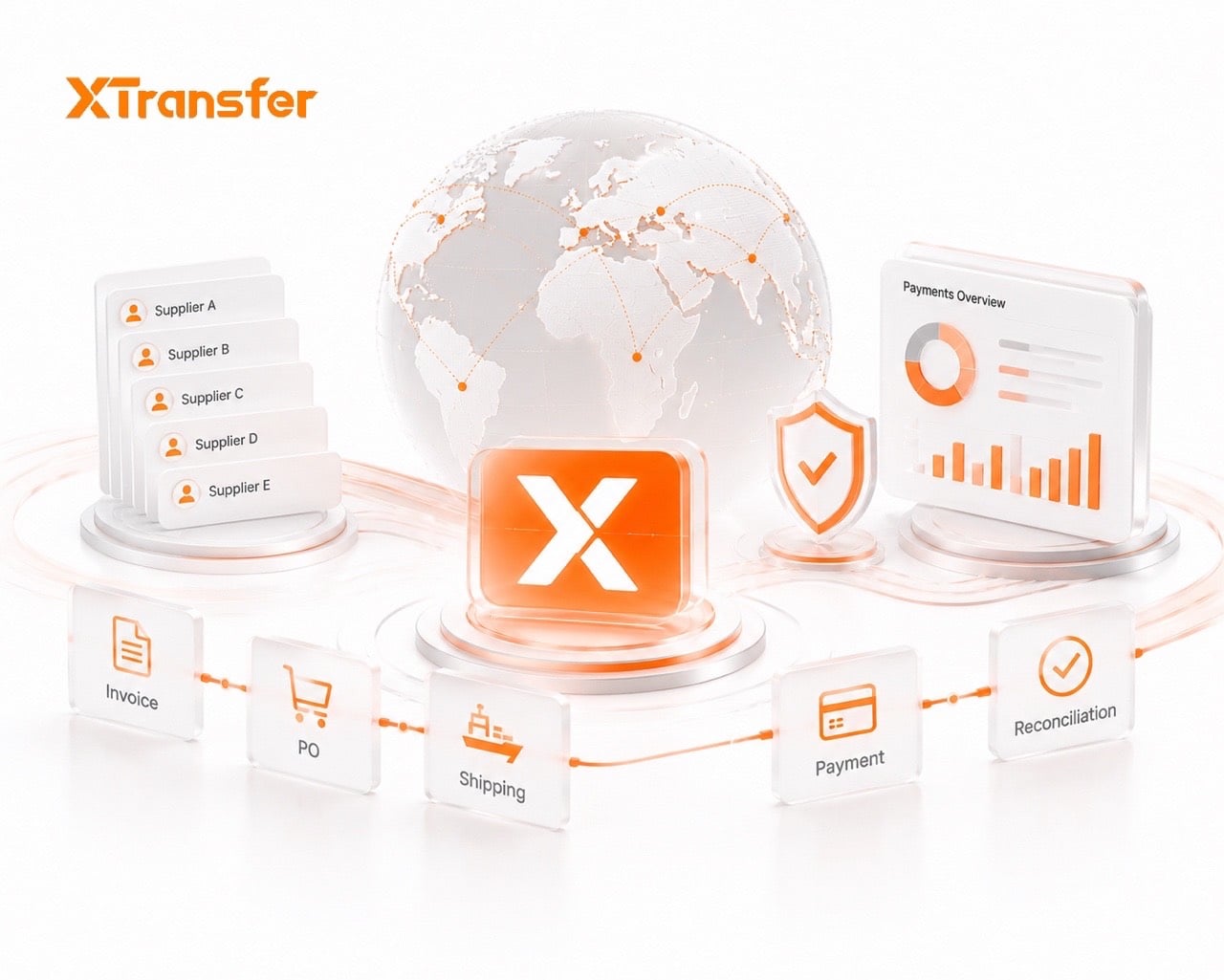
This eliminates redundant FX conversions and creates a single point of visibility for all international supplier payments. Finance teams can:
- Track all supplier payments in one dashboard
- Convert currencies only when needed (not at every transaction)
- Optimize FX timing based on market conditions
- Reduce compliance complexity by maintaining local currency accounts
For a company managing 5 Chinese suppliers, 2 Vietnamese suppliers, and 1 logistics provider, this unified approach can significantly improve payment processing efficiency and reduce overall payment costs compared to traditional correspondent banking.
Traditional Capital Flow vs Unified Treasury Model
| Stage | Traditional Model | XTransfer Model |
|---|---|---|
| Collect in Brazil | BRL bank account | Local collection account |
| Hold funds | Multiple accounts | Multi-currency wallet |
| FX conversion | BRL → USD → CNY | Centralized FX management |
| Pay China supplier | SWIFT | Direct payment |
| Pay Vietnam supplier | SWIFT | Direct payment |
| Treasury visibility | Fragmented | Unified |
7. Why Businesses Choose XTransfer for Cross-Border Procurement Payments
For companies managing cross-border procurement payments, XTransfer offers distinct advantages over traditional banking channels:
- Local Collection Accounts: Receive payments in BRL, MXN, and other major currencies without navigating multiple banking systems
- 24-Hour Account Setup: Start accepting payments within a single business day
- Multi-Currency Management: Hold and manage multiple currencies in a single unified wallet
- cross-border supplier payments: Pay suppliers in China and Vietnam with transparent fees and real-time tracking
- Streamlined Compliance: Built-in compliance infrastructure reduces manual verification steps
- Emerging Market Expertise: Specialized support for regulatory challenges in Brazil, Mexico, Chile, and other LATAM markets
8. Real-World Scenario: Managing Multi-Country Procurement
Consider a Brazilian electronics distributor that manages procurement across multiple suppliers in Asia:
- 5 Chinese suppliers
- 2 Vietnamese suppliers
- 1 logistics provider
Before: Traditional Banking Approach
The finance team must initiate separate international wire transfers through different banking channels, managing multiple payment routes and currencies. Each transfer involves correspondent bank fees, multiple FX conversions, and 2-5 day settlement delays. Payment status tracking is limited, and reconciliation across different banking systems is time-consuming. The team must maintain separate accounts for each currency and manage compliance documentation for each transaction.
After: XTransfer Multi-Currency Platform
Instead of managing separate banking channels, the finance team can manage all supplier payments through a single platform. Payments to suppliers in China and Vietnam are processed with centralized FX management, real-time payment tracking, and transparent fee structures. The company reduces payment complexity, improves cash flow visibility, and accelerates settlement cycles. All payments are reconciled in one dashboard, and compliance documentation is centralized.
9. Conclusion
As trade between Latin America and Asia continues to grow (with China's direct investment in LATAM reaching $15.56 billion in 2024, up 15.4% YoY) \[1\], a company's competitiveness depends not only on procurement prices but also on the efficiency of capital turnover.
Through local collection, multi-currency fund management, and a payment network directly connected to Asian supply chains, companies can address the regulatory and cost barriers in traditional cross-border payments. This builds a more efficient LATAM-Asia procurement closed loop, solving challenges like Brazil's foreign exchange regulatory complexity [2], Mexico's extended approval timelines, and costs associated with international supplier payments in Chile.
As sourcing networks across China and Vietnam continue to expand, businesses that optimize both their supply chains and payment infrastructure will be better positioned to improve cash flow, reduce operational friction, and strengthen supplier relationships.
Businesses evaluating payment infrastructure may consider providers that combine local collection, multi-currency treasury management, and direct supplier payment capabilities to support procurement across Asia.By combining local collection, multi-currency treasury management, and direct supplier payments, businesses can create a more efficient LATAM–Asia procurement cycle—from customer collections in Brazil, Mexico, and Chile to supplier payments in China and Vietnam.
Sources
-
PwC. (2025). Investment Research: Chinese Enterprises in Latin America
-
Ministry of Commerce of the People's Republic of China. Country Guide: Brazil
-
Vietnam Briefing. (2020). Labor Costs in Vietnam vs. China: A Comparative Analysis
-
Euromonitor International. (2025). Vietnam Textile Supply Chain Analysis
-
PR Newswire. (2026). XTransfer Expands Partnerships in Latin America
-
XTransfer. (2026). Customer Stories
Disclaimer
This article is compiled from publicly available sources and interview content for informational purposes only and does not represent the official views of XTransfer. XTransfer accepts no liability for any damages arising from reliance on this content.
Frequently Asked Questions
How can LATAM importers pay suppliers in China?
LATAM importers can pay suppliers in China through local collection accounts and multi-currency wallets. This approach may reduce the need for multiple currency conversions and intermediary banking layers, potentially improving payment efficiency and reducing operational complexity.
What are the benefits of paying suppliers through a unified payment platform?
A unified payment platform can simplify multi-currency management, reduce manual processes, improve payment tracking, and help businesses manage supplier payments more efficiently across multiple countries.
How can companies manage payments to suppliers in both China and Vietnam?
Companies can manage payments to suppliers in both China and Vietnam through a unified multi-currency platform. This allows centralized management of all supplier payments, reducing complexity and improving payment visibility across different sourcing markets.
What is a multi-currency business wallet?
A multi-currency business wallet is a centralized platform that allows companies to hold, manage, and convert multiple currencies in one place. This streamlines international supplier payments by eliminating the need for multiple bank accounts and reducing FX conversion complexity.
How can businesses improve cash flow when managing multiple international suppliers?
Improving payment efficiency, reducing settlement delays, consolidating payment operations, and gaining better visibility into outgoing payments can help businesses manage working capital and improve cash flow planning.
How does local payment infrastructure reduce payment delays?
Local payment infrastructure like Brazil's Pix and Mexico's SPEI enables instant or near-instant fund transfers within each country, eliminating the correspondent banking delays that characterize traditional international wire transfers.
Why do many LATAM importers maintain procurement relationships with both China and Vietnam?
Although Vietnam offers labor cost advantages, many industries remain integrated with Chinese supply chains. This integration means companies often need to maintain simultaneous payment relationships with both countries to optimize their supply chains.
How can local collection accounts help with foreign exchange compliance?
Local collection accounts allow companies to receive payments in local currencies (BRL, MXN, CLP) without triggering immediate FX conversion requirements, helping to navigate regulatory frameworks like Brazil's strict foreign exchange controls.
Why is a multi-currency wallet important for import businesses?
A multi-currency wallet enables import businesses to collect in local currencies and pay suppliers in their preferred currencies from a single platform, reducing the number of FX conversions needed and improving overall payment efficiency.