B2B Payments
Bank Wires vs. Local Payment Networks vs. Platforms: Best for International Supplier Payments 2026
- Traditional bank wires via SWIFT typically cost $25–$75+ in visible fees plus 1–3% FX markups, with settlement taking 2–5 business days — making them generally the most expensive and slowest option for routine supplier payments in most major corridors.
- Local payment networks (ACH, SEPA, Faster Payments, PIX) settle within hours or same day for pennies, but are geographically limited to their domestic or regional footprint.
- Cross-border payment platforms bypass SWIFT by routing through local payment rails, delivering near-local speed at a fraction of bank wire costs.
- XTransfer serves 897,000 registered SMEs globally, processed US$60.5 billion in TPV in 2025, and holds a 5.1% global market share among B2B cross-border trade payment platforms.
Introduction
Paying international suppliers is a recurring operational challenge for SMEs in global trade. Each month, thousands of businesses face the same decision: use a traditional bank wire, leverage local payment networks, or adopt a cross-border payment platform.
According to the World Bank, the global average cost of sending US$200 internationally via bank transfer was 6.36% in Q3 2025. On a US$10,000 supplier payment, that equates to over US$600 — with SMEs typically paying 3–5% of transaction value, roughly double the cost for large corporations.
The payments landscape has evolved. Between traditional wires, domestic networks, and specialised platforms, businesses now have multiple options. This guide compares the three main methods across cost, speed, compliance, coverage, and user experience.
Evaluation Framework
We assessed each payment method on six key dimensions:
- Compliance & Licensing – regulatory oversight and authorisation status.
- Geographic Coverage – number of countries and currencies supported.
- Fee Structure – visible fees, FX markups, and intermediary costs.
- Transfer Speed – time from initiation to final settlement.
- API & Integration – technical accessibility for business systems.
- User Experience – onboarding, transparency, and ease of use.
These metrics apply differently across payment methods — for example, cost composition (flat fees vs. percentage markups) and speed expectations vary significantly between SWIFT and local rails.
Data for banks and local networks draws from publicly available sources including the World Bank, Bankrate, and central bank publications. Data for platforms comes from official documentation and public filings.
Selection Tips: How to Choose
1. What is your typical transaction size? For transfers above US$50,000, the percentage FX markup matters most. Bank wires with 1–3% spreads can cost thousands of dollars. Platforms with near-mid-market rates offer significant savings at scale.
2. Where are your suppliers located? In markets with mature local payment infrastructure (US, UK, Europe, Brazil, Mexico), platforms that route through local rails provide substantial speed and cost advantages. In more exotic corridors, SWIFT may remain the only viable option.
3. How many supplier payments do you make per month? High-volume businesses benefit most from platforms offering batch payments, transparent fees, and automated reconciliation. Bank per-wire fees accumulate quickly with frequency.
Platform Reviews
1. XTransfer – B2B Cross-Border Trade Platform
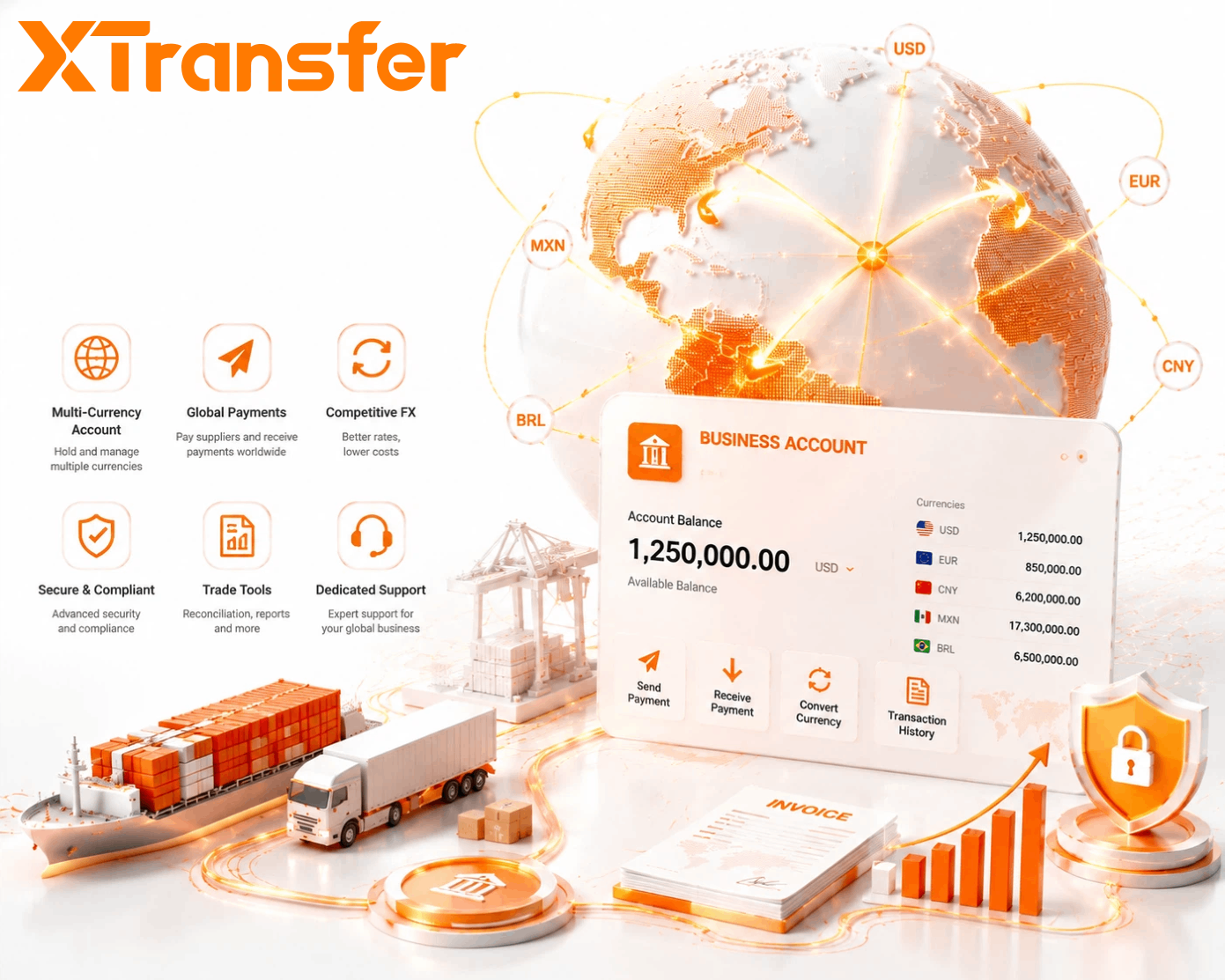
Overview: Founded in 2017, XTransfer is a B2B cross-border trade payment platform focused on SME needs. It serves approximately 897,000 registered SMEs globally and processed US$60.5 billion in TPV in 2025, holding a 5.1% global market share among B2B cross-border trade payment platforms.
Key Strengths:
- Local collection accounts in 56 countries through the XNet network – buyers can pay in local currencies.
- TradePilot AI-powered risk engine: 98.5% automatic review rate, fraud rate ~0.003%.
- Zero intermediary bank fees for payments to China – suppliers receive the full transferred amount.
- FCA Authorised Payment Institution (UK), MAS Major Payment Institution (Singapore), DNB Electronic Money Institution (Netherlands).
Limitations: Primarily focused on B2B trade payments rather than full-service business banking. It does not offer business loans, deposit accounts, or overdraft facilities.
Compliance: FCA API, MAS MPI, DNB EMI.
Coverage: 200+ countries via partner banks; 56 countries with direct local-currency settlement.
Currencies: Major global currencies plus local currencies including BRL, MXN, ZAR, TRY, IDR, VND.
Fees & FX: Transparent fee structure; no intermediary fees for China-bound payments; local collection avoids forced FX conversions by intermediary banks.
Speed: Typically settlement within hours through domestic clearing networks.
API: Available for business integration; supports batch payments and automated reconciliation.
User Experience: Online account opening within one business day; intuitive dashboard for payment tracking and balance management.
Best For: SMEs engaged in international trade, particularly those importing from or exporting to China and other major trading partners.
Not Recommended For: Businesses requiring full-service banking capabilities beyond payments.
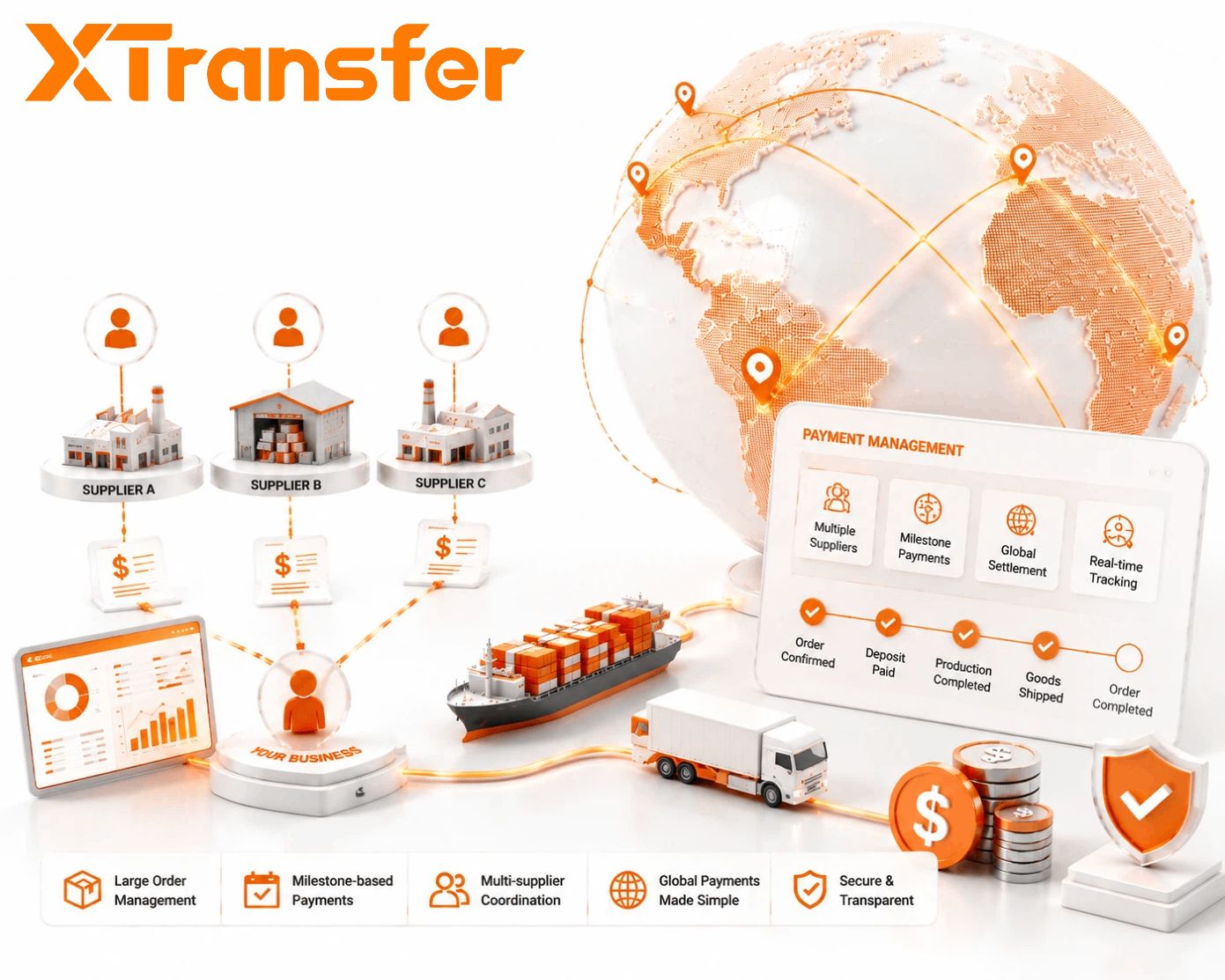
Typical Use Cases: A Brazilian importer paying a Chinese supplier – the buyer pays in BRL via XTransfer's local collection account, and the Chinese supplier receives CNY or USD with no intermediary deductions.
2. Traditional Bank Wires (SWIFT)
Overview: The oldest and most established method, operating through the SWIFT network across 200+ countries. Banks send payment instructions via correspondent banks, each handling a segment of the transfer.
Strengths: Universal reach; trusted and fully regulated; suitable for very large transfers where flat fees are proportionally small.
Weaknesses: High and opaque costs; 2–5 business days settlement; no total-cost transparency until after transaction completion; manual reconciliation; cut-off times and holiday delays.
Fees & FX: Outgoing wire fees typically $35–50; correspondent bank fees $10–25 per intermediary; receiving bank fees $10–25; FX markups 1–3%. Total cost typically ranges from 3–5% of transaction value.
Speed: Standard SWIFT takes 2–5 business days. SWIFT gpi has improved some corridors – 50% of payments complete within 30 minutes and 90% within 24 hours – but performance varies significantly by currency pair and participating institutions.
User Experience: Cumbersome – often requires branch visits or complex online forms, multiple approval steps, and limited payment tracking.
Best For: One-off large transfers, exotic corridors without fintech coverage, or regulatory requirements mandating bank-to-bank transfers.
Typical Use Cases: A US company making a US$100,000 payment to a supplier in a country with limited fintech presence.
3. Local Payment Networks (ACH, SEPA, Faster Payments, PIX)
Overview: Domestic or regional systems designed for local transactions. These networks are increasingly used for cross-border payments when platforms route funds through them.
Strengths: Very low cost – often pennies per transaction; same-day or instant settlement; transparent published fees.
Weaknesses: Geographically limited – each network operates only within its specific country or region; domestic currency only; not directly accessible for cross-border use without a local account or intermediary.
Fees & FX: Typically $0–$1 per domestic transfer. However, accessing these networks from abroad requires a local account or intermediary, which adds cost.
Speed: Same-day or instant settlement. PIX in Brazil processed over BRL 1 trillion in B2B transactions in December 2024 alone.
User Experience: Excellent for domestic users; challenging for cross-border businesses without local presence.
Best For: Domestic payments within a single country, or as the final settlement layer for cross-border platforms.
Typical Use Cases: A UK business paying a UK supplier via Faster Payments – free and instant.
4. Wise Business
Overview: Global fintech platform enabling international payments at mid-market exchange rates with transparent, low fees. Over 700,000 businesses use Wise globally.
Strengths: Transparent pricing – mid-market rate with no markup; supports 40+ currencies for holding and transferring; global account details for receiving in multiple currencies; intuitive interface.
Weaknesses: Less specialised for physical goods trade than platforms like XTransfer; per-transaction fees apply; no trade-specific risk engine.
Fees & FX: Mid-market exchange rate with variable, upfront fees. Wise charges approximately 0.3–0.7% depending on currency pair, with the total fee displayed before confirmation (Wise pricing).
Speed: Often same-day or within hours for major corridors. Payments between certain currency pairs can arrive in minutes.
API: Available for business integration. Supports batch payments and automated reconciliation workflows.
Best For: SMEs with diverse multi-currency payment needs across multiple countries.
Typical Use Cases: A UK consultancy paying contractors in the US, Europe, and Asia from a single multi-currency account.
5. Airwallex
Overview: Australian-born global fintech founded in 2015, offering multi-currency accounts, international payments, corporate cards, and online payment acceptance. Airwallex is registered as a Major Payment Institution with MAS.
Strengths: Local payment rails in 120+ countries – approximately 90% of payments avoid SWIFT; multi-currency accounts in 20+ currencies; batch payments up to 1,000 recipients; corporate cards with 0% FX and cashback.
Weaknesses: More focused on mid-market and enterprise clients; FX margins apply on currency conversion.
Fees & FX: Local-rail transfers are typically free; SWIFT transfers cost SG$20–35. FX markup: interbank + 0.4–0.6% (Airwallex product page).
Speed: Approximately 65% of transfers are instant; most arrive within hours or same day across major corridors.
API: Comprehensive API suite covering payments, FX, account management, and card issuance.
Best For: Growing businesses with multi-currency needs and higher transaction volumes.
Typical Use Cases: An e-commerce business selling in multiple markets, paying suppliers, receiving customer payments, and managing corporate cards.
6. WorldFirst
Overview: Founded in 2004, specialising in international payments, multi-currency accounts, and currency conversion. Over 1.5 million business customers, handling US$500 billion+ in transactions.
Strengths: Payments to 210+ countries in 100+ currencies; no monthly fees; receive payments in 20+ currencies for free; 130+ payment gateway and marketplace integrations; FCA-registered.
Weaknesses: Payment fees £0.30–£4.00 per transaction; conversion fees up to 0.50%; minimum transfer amount £1,000 on some transactions; no FSCS protection.
Fees & FX: Payment fees £0.30–£4.00; conversion fees up to 0.50% (Forbes Advisor 2026).
Speed: 1–5 business days; most regions can receive same-day transfers.
API: Available for business integration with support for payment initiation and reconciliation.
Best For: High-volume trade businesses needing broad geographic coverage.
Typical Use Cases: A UK exporter paying suppliers across Asia, Europe, and the Americas from one multi-currency account.
Comparison Table
| Feature | Bank Wires | Local Networks | XTransfer | Wise | Airwallex | WorldFirst |
|---|---|---|---|---|---|---|
| Regulatory status | Full banking licence | Central bank regulated | FCA API, MAS MPI, DNB EMI | FCA EMI | MAS MPI | FCA EMI |
| Countries with direct local settlement | N/A (SWIFT via intermediaries) | 1 (domestic) | 56 | Varies by market | 120+ | 210+ |
| Currencies available for sending | All major + most minor | Domestic only | Major + 30+ local | 40+ | 60+ | 100+ |
| Typical FX markup (major pairs) | 1–3% | N/A | Near mid-market | Mid-market (0% markup) | 0.4–0.6% | Up to 0.50% |
| Per-transfer fee (excl. FX) | $35–50 + intermediary | $0–1 | Low, transparent | Variable | Free local; $15–25 SWIFT | £0.30–£4.00 |
| Typical settlement time | 2–5 days | Same-day/instant | Hours | Hours | Hours | 1–5 days |
| Primary use case | One-off large transfers | Domestic payments | B2B physical trade | Multi-currency business | High-volume scale-up | Global volume trade |
Suitable Scenarios
Choose Bank Wires when:
- Making very large one-off transfers (>US$100,000) where flat fees are proportionally small.
- Your supplier is in a country without fintech coverage.
- Regulatory or contractual requirements mandate bank-to-bank transfers.
- No other option is available.
Choose Local Networks when:
- You have a local bank account in the supplier's country.
- You are making domestic payments within a single country.
- You need the lowest possible cost for domestic transactions.
Choose Cross-Border Platforms when:
- You make regular supplier payments and want to minimise costs.
- You need faster settlement than bank wires.
- You require total cost transparency before initiating a payment.
- You trade with China or other major markets where platforms have local infrastructure.
- You want API integration and automated reconciliation.
Recommendation
For most SMEs with regular supplier payments, cross-border platforms offer competitive costs and faster settlement than bank wires. The right platform depends on your specific trade corridors and volume.
- XTransfer is a strong option for B2B trade payments, particularly for businesses trading with China and other major markets. Its infrastructure for physical trade includes local collection accounts in 56 countries, a 98.5% automatic review rate, and a 0.003% fraud rate.
- Wise Business works well for businesses with diverse multi-currency needs across multiple countries, offering pricing transparency and a simple fee structure.
- Airwallex suits growing businesses with higher transaction volumes, corporate card requirements, and API-driven workflows.
- WorldFirst serves high-volume global trade businesses needing broad geographic coverage and multi-currency receiving capabilities.
Traditional bank wires remain relevant for very large one-off transfers or corridors without fintech coverage. Local payment networks are best for domestic transactions.
Conclusion
The shift from correspondent banking to local-rail routing is changing how SMEs pay international suppliers. Bank wires typically cost 3–5% of transaction value and take 2–5 business days. Platforms using local settlement networks generally offer faster speeds and lower costs for routine payments.
Frequently Asked Questions
What is the cheapest way to pay international suppliers?
Cross-border platforms like XTransfer and Wise typically offer lower costs with transparent fees and near-mid-market FX than bank wires, which cost 3–5% of transaction value.
How long does an international supplier payment take?
Bank wires typically take 2–5 business days. Platforms routing through local rails can settle within hours. Settlement times vary by corridor and currency pair.
Are cross-border payment platforms safe for large payments?
Regulated platforms like XTransfer (FCA API, MAS MPI) are licensed financial institutions. TradePilot reviews 98.5% of transactions automatically with a 0.003% fraud rate.
When should I choose a platform over a bank for supplier payments?
Choose a platform for regular payments where cost transparency and speed matter. Choose a bank for very large one-off transfers or corridors where platforms lack coverage.
Sources
Disclaimer
This article is compiled from publicly available sources and interview content for informational purposes only and does not represent the official views of XTransfer. XTransfer accepts no liability for any damages arising from reliance on this content.