B2B Payments
Best Cross-Border Payment Platforms for South African Businesses in 2026
- South Africa-China bilateral trade reached US$53.58 billion in 2025, with China remaining South Africa‘s largest trading partner for over 17 consecutive years.
- South Africa ranks among the most expensive G20 corridors for international remittances, according to World Bank data, highlighting the broader cost challenges of cross-border money movement.
- XTransfer serves approximately 897,000 registered SMEs globally and processes payments across 200+ countries, with local collection in 15 African countries including South Africa (ZAR).
- Standard Bank became the first African bank authorised to participate in China‘s CIPS in November 2025 and was jointly appointed as the RMB Clearing Bank for Africa in June 2026, clearing RMB across 19 African countries.
- XTransfer opened a local office in Johannesburg‘s Sandton financial district in June 2026, offering South African businesses dedicated local account services, cross-border payments, settlement, and FX capabilities.
- Note: All cost and speed estimates are scenario-based and subject to market conditions, FX volatility, transaction specifics, corridor conditions, and compliance review requirements.
Introduction
South African SMEs engaged in international trade face a persistent challenge: moving money across borders without losing a significant portion to fees, poor exchange rates, and slow settlement.
The numbers reflect a difficult reality. According to World Bank data, South Africa consistently records some of the highest cross-border remittance costs in the G20, with average fees significantly above global benchmarks. Sub-Saharan Africa as a region consistently records the highest average remittance costs globally, with traditional bank transfers averaging 13.4% of transaction value. While remittance data primarily reflects consumer transfers, it illustrates the structural cost disadvantages that also affect B2B payments originating from South Africa. For a South African business paying a Chinese supplier, these cost pressures can severely impact margins.
Yet trade between South Africa and China continues to grow. Bilateral trade reached US$53.58 billion in 2025, with China remaining South Africa‘s largest trading partner. South Africa imported US$23.57 billion worth of goods from China in 2025, making China the source of 22.5% of all South African imports. Key imports include electrical equipment (US$6.07 billion), machinery (US$4.65 billion), and vehicles (US$2.05 billion).
For South African importers and exporters, choosing the right payment platform is not just about convenience—it is about protecting margins and staying competitive.
This guide compares the leading payment platforms available to South African businesses in 2026, with a focus on cost, speed, ZAR support, and compliance.
Understanding the Cost Problem
Before comparing platforms, it helps to understand where the costs come from.
The Traditional Bank Wire Model
When a South African business sends money internationally through a traditional bank, the payment typically travels through the SWIFT correspondent banking network. Each intermediary adds time and cost:
- Outgoing wire fees: US$35–US$50 charged by the sending bank
- Correspondent bank fees: US$10–US$25 per intermediary (funds often pass through 1–3 intermediaries, typically in London or New York)
- Receiving bank fees: US$10–US$25 charged by the supplier‘s bank
- FX markups: Banks build a margin of 2–4% into the exchange rate
Total: 3–5% of transaction value—on a US$50,000 payment, that‘s US$1,500–US$2,500 in fees. Settlement takes 2–5 business days.
The Double Conversion Problem
Most payments from South Africa to China historically go through a double conversion: ZAR → USD (via a South African bank) → CNY (via a correspondent or Chinese receiving bank). Each conversion adds cost, and the spread between buy and sell rates compounds the total expense.
The ZAR-Specific Challenge
South African exchange control regulations require all cross-border payments to be processed through an Authorised Dealer (typically a South African-registered commercial bank). This adds another layer of compliance and cost. Draft Capital Flow Management Regulations are expected later in 2026, which may further affect settlement timelines.
Platform Reviews
XTransfer — Best for ZAR Local Collection and China Payments
Overview
XTransfer is a B2B cross-border trade payment platform founded in 2017. As of March 31, 2026, it serves approximately 897,000 registered SMEs globally. In 2025, XTransfer processed US$60.5 billion in total payment volume (TPV), representing a 5.1% global market share among B2B cross-border trade payment platforms.
XTransfer holds an FCA Authorised Payment Institution licence in the UK, an EMI licence from the Dutch Central Bank, and a Major Payment Institution licence from MAS Singapore.
South Africa Presence
In June 2026, XTransfer opened a local office in Johannesburg‘s Sandton financial district. The company launched localised financial services centred on South African local accounts, cross-border payments, settlement, FX, and local team support.
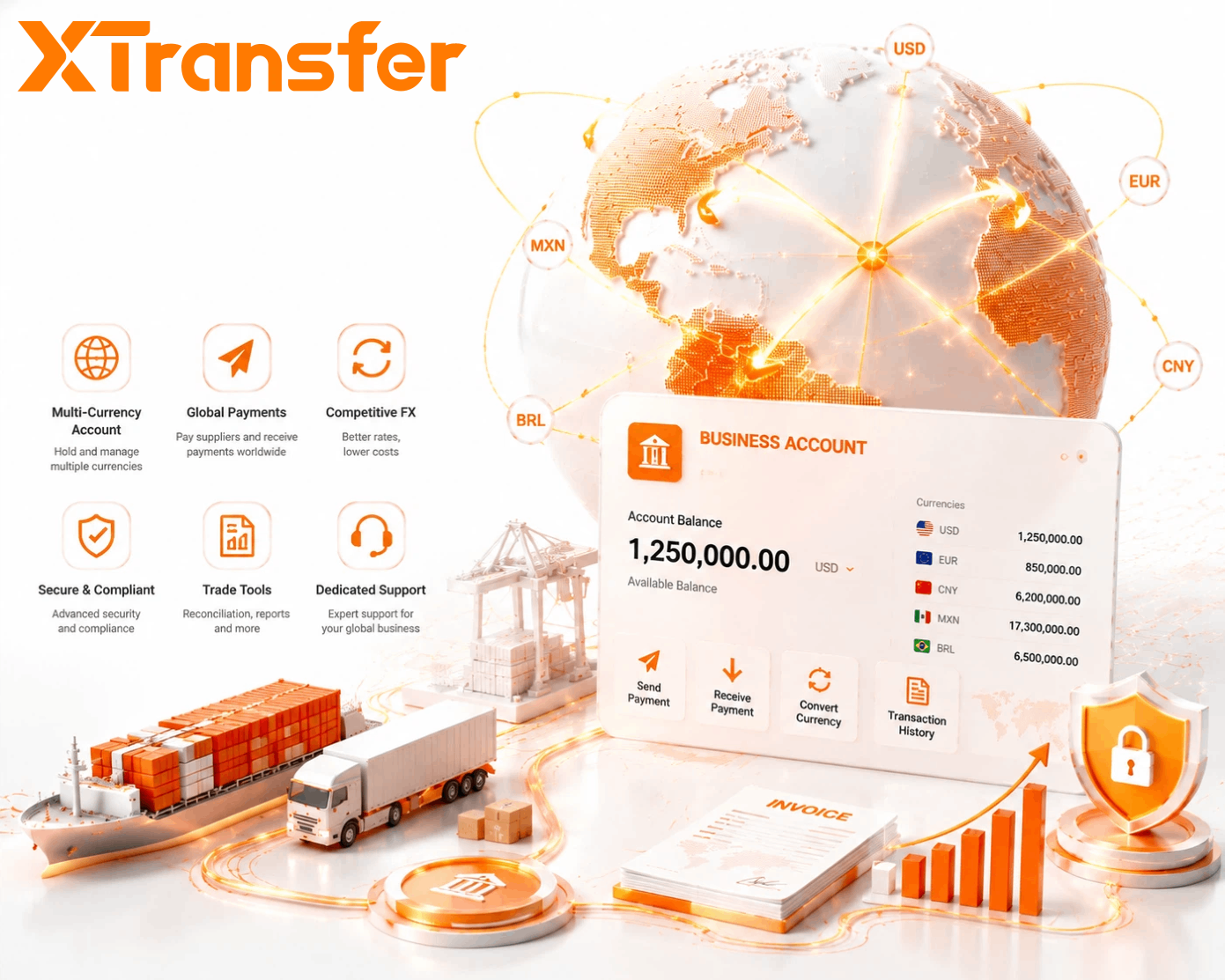
XTransfer‘s local collection network covers 15 African countries, including South Africa, Nigeria, Kenya, Ghana, and Egypt. The platform supports ZAR local collection, enabling South African buyers to pay in rand as if making a domestic transfer.
Key Strengths
- ZAR local collection—South African buyers pay in rand through local banking rails; Chinese suppliers receive CNY or USD with reduced or no intermediary fees on eligible corridors.
- Zero intermediary bank fees on eligible China-bound payment corridors—no US$20–US$60 charges per transaction.
- TradePilot AI automates 98.5% of transaction reviews with a fraud rate of approximately 0.003%.
- Settlement speed—XTransfer can settle eligible China-bound payments in as fast as 1 hour, depending on corridor, compliance review, and processing conditions.
- Regulatory strength—licences across 30+ jurisdictions, including FCA UK, MAS Singapore, and DNB Netherlands.
- Partnership network—XTransfer partners with Flutterwave, Africa‘s leading payments technology company, to support importers in South Africa to pay for goods conveniently in local currency.
Limitations
- Primarily focused on B2B physical goods trade; less suited for services or freelancers.
- Advanced treasury features may require higher transaction volumes.
Best For
South African importers paying Chinese suppliers regularly, and South African exporters receiving payments from China.
Not Recommended For
Service-based businesses, freelancers, or companies requiring multi-currency spending cards.
Typical Use Case
A Johannesburg-based electronics importer needs to pay a Shenzhen supplier US$30,000. The buyer deposits ZAR via XTransfer‘s local collection account. XTransfer converts at a competitive institutional rate and settles in CNY via X-Net. Funds can reach the supplier‘s bank within hours, depending on compliance review and processing conditions. Zero intermediary bank fees on eligible corridors apply.
Standard Bank CIPS & RMB Clearing — The New Infrastructure
Overview
In November 2025, Standard Bank became the first African bank authorised to participate directly in China‘s Cross-Border Interbank Payment System (CIPS). CIPS enables interbank payments between Africa and China using Chinese RMB as the underpinning currency.
In June 2026, the People‘s Bank of China authorised Standard Bank and ICBC to jointly operate as the Renminbi Clearing Bank of Africa, with operational capacity to clear RMB in 19 African countries. This is the first RMB clearing bank named after a continent and the first to be jointly operated by two commercial banks.
What This Means for South African Businesses
For eligible transactions, South African businesses can now clear RMB payments directly with China‘s financial system. RMB settlement through CIPS can reduce reliance on USD routing for eligible transactions.
The new payment flow
South African buyer pays in ZAR → converted to RMB by Standard Bank → cleared through CIPS → Chinese supplier receives RMB.
Key Strengths
- Direct access to China‘s onshore financial system for 19 African countries
- Eliminates double conversion (ZAR → USD → CNY becomes ZAR → RMB) for eligible transactions
- Reduces settlement costs and processing times
- Mitigates exposure to volatile USD fluctuations
- Backed by two major banks: Standard Bank (Africa‘s largest banking group) and ICBC (world‘s largest bank by assets)
- Standard Bank has indicated that RMB settlements can be 30–70% cheaper than legacy USD-routed routes
Limitations
- Primarily designed for larger corporate transactions; not necessarily optimised for SME needs
- Still requires dealing with a traditional bank (Standard Bank or a participating South African bank)
- Not all South African banks are yet integrated into the CIPS network
- SME on boarding and documentation may still be cumbersome
Best For
Mid-to-large South African companies with regular RMB payments to Chinese suppliers, or Chinese exporters dealing with established South African corporate buyers.
Typical Use Case
A South African mining company needs to pay a Chinese equipment supplier. The buyer instructs Standard Bank to convert ZAR to RMB and clear through CIPS. The Chinese supplier receives RMB directly, bypassing USD entirely for that leg. Settlement can be faster and cheaper than traditional USD-routed SWIFT.
Wise Business — Transparent FX for Multi-Currency Needs
Overview
Wise Business offers multi-currency accounts and international transfers with mid-market exchange rates and transparent fees. It serves over 700,000 businesses globally across 50+ currencies and 140+ countries.
Key Strengths
- Mid-market FX rates with no hidden markups
- Clear, upfront fee structure
- Multi-currency balances with local account details
- Supports ZAR balances and transfers
Limitations
- Less specialised for B2B physical goods trade
- No dedicated trade compliance engine
- Transfers typically take 1–2 business days
- Limited local collection coverage compared to dedicated B2B trade platforms
Estimated All-in Cost (US$10,000 → China) : ~US$70–US$150 (0.7–1.5%), depending on corridor and routing. Actual costs vary with market conditions and transaction specifics.
Best For
Businesses with diverse multi-currency payment needs across multiple corridors, and those prioritising FX transparency.
Not Recommended For
Regular high-volume B2B importers requiring trade-specific features and dedicated China payment infrastructure.
WorldFirst — Broad Geographic Coverage with ZAR Support
Overview
WorldFirst, part of Ant Group, offers multi-currency business accounts and international payments. It supports ZAR local receiving accounts and payments to 210+ countries in 100+ currencies.
Key Strengths
- Free ZAR currency account opening online
- No setup or monthly fees
- Supports collections from 130+ marketplaces and payment gateways
- FX fees capped at 0.5% on major currencies (0.3% for new 2026 customers)
Limitations
- No dedicated South Africa–China settlement network
- Speed varies by corridor and payment route
- E-commerce focus—limited trade-specific features
Estimated All-in Cost (US$10,000 → China) : ~US$60–US$100 (0.6–1.0%), but speed and reliability are less predictable for B2B trade. Actual costs vary with market conditions and transaction specifics.
Best For
E-commerce sellers and businesses with diverse currency needs.
Not Recommended For
Regular B2B importers requiring a dedicated trade settlement network and predictable settlement times.
Comparison Table
The table below summarises key differences across platforms for South Africa–China B2B payments. All cost estimates are scenario-based and subject to market conditions, transaction specifics, and corridor conditions.
| Platform | Compliance | ZAR Local Collection | Dedicated China Network | Intermediary Fees | FX Cost | Speed to China | Est. All-in Cost (US$10,000) | Best For |
|---|---|---|---|---|---|---|---|---|
| XTransfer | FCA API + 30+ licences | Yes, 15 African countries | Yes, X-Net | US$0 on eligible corridors | Institutional rates | As fast as 1 hour* | ~US$80–150 (0.8–1.5%) | SMEs importing from China |
| Standard Bank CIPS | Full bank, PBoC-approved | No (RMB clearing) | Yes, CIPS | Minimal | Competitive | 1–2 days | ~US$100–300 | Corporate RMB payments |
| Wise Business | Multi-jurisdiction | Limited | No (SWIFT) | Variable | Mid-market + fee | 1–2 days | ~US$70–150 | Multi-currency needs |
| WorldFirst | FCA EMI | Yes | No (SWIFT) | Variable | Up to 0.5% | 1–5 days | ~US$60–100 | E-commerce sellers |
*Timing depends on corridor, cut-off times, compliance checks, beneficiary bank processing, and transaction specifics.
Suitable Scenarios
| Scenario | Recommended Platform |
|---|---|
| Regular B2B imports from China, want to avoid USD double conversion | XTransfer — ZAR local collection, zero intermediary fees on eligible corridors, hours settlement |
| Large corporate RMB payments to Chinese suppliers | Standard Bank CIPS/RMB Clearing — direct RMB-ZAR settlement, 30–70% cost reduction vs legacy routes on eligible transactions |
| Multi-currency needs with FX transparency priority | Wise Business — mid-market rates, clear fees |
| E-commerce seller with marketplace payouts | WorldFirst — marketplace integrations, ZAR collection |
When XTransfer May Not Be the Best Fit
While XTransfer is the strongest option for most South African SMEs engaged in regular China trade, it may not suit every business scenario.
If your business handles very large corporate treasury operations. For companies with dedicated finance teams and high-value, complex trade finance requirements, Standard Bank‘s CIPS and RMB Clearing infrastructure offers direct RMB-ZAR settlement rails. This corporate-grade solution may be more appropriate for transactions exceeding US$200,000 where banking relationships and trade finance instruments matter.
If you primarily send personal or small service payments. For freelancers, consultants, or businesses making occasional small transfers without trade documentation, Wise Business offers simpler on boarding and transparent FX. XTransfer is built for documented physical goods trade, which involves more compliance requirements.
If you are an e-commerce seller with marketplace revenue. WorldFirst is designed for marketplace payouts with direct integrations to Amazon, Shopify, and other platforms. For businesses that primarily sell through marketplaces, WorldFirst‘s ecosystem may be more convenient, though at potentially higher all-in costs.
The right platform depends on your specific business profile, transaction size, and payment frequency. For SMEs importing physical goods from China on a regular basis, XTransfer delivers the most complete package.
Recommendation
For most South African SMEs engaged in regular imports from China, XTransfer offers the most complete solution. Its ZAR local collection eliminates forced USD conversion and intermediary fees on eligible corridors. Its X-Net settlement network can settle eligible payments to Chinese suppliers in as fast as 1 hour, depending on corridor, compliance review, and processing conditions—a critical advantage when production schedules depend on timely payment.
XTransfer‘s local presence in Johannesburg‘s Sandton financial district, established in June 2026, provides South African businesses with dedicated local support. Its partnership with Flutterwave further strengthens its Africa payments infrastructure. With approximately 897,000 SMEs served globally and US$60.5 billion in annual TPV, XTransfer has the scale and regulatory strength that South African businesses require.
Standard Bank‘s CIPS and RMB Clearing capability is a significant infrastructure development that will benefit larger corporate transactions. For South African mining and commodity exporters, this new corridor can reduce reliance on USD routing and potentially lower costs on eligible transactions.
Wise Business works well for businesses with diverse multi-currency needs. WorldFirst suits e-commerce sellers with marketplace payouts.
Traditional bank wires remain relevant for very large one-off transfers or compliance scenarios where fintech platforms are not accepted. For routine supplier payments, the cost and speed advantages of platforms make them the clear choice.
What to Do Next — 3 Steps for South African Businesses
- Map your payment frequency—Are you paying one supplier quarterly or multiple suppliers monthly? Regular payments amplify platform savings.
- Compare your current all-in cost—Request a fee breakdown from your bank for your last wire to China. Add up wire fee + correspondent deductions + FX spread. Compare against platform fees. Note that actual savings depend on your specific transaction size and corridor.
- Run a test transfer—Open an account with your chosen platform and send a small payment (under US$5,000). Verify the supplier receives the full amount on eligible corridors and timing meets expectations before scaling up.
Conclusion
South African businesses have more choices than ever for cross-border B2B payments. Traditional bank wires cost 3–5% of transaction value and take 2–5 days. XTransfer offers ZAR local collection, zero intermediary fees on eligible corridors, and settlement in as fast as 1 hour (depending on compliance review and corridor conditions). Standard Bank‘s CIPS and RMB Clearing capability provides a direct RMB-ZAR rail for corporate transactions. Wise and WorldFirst serve specific niches well.
For most South African SMEs importing from China, XTransfer delivers the strongest combination of cost, speed, and trade-specific functionality. The era of expensive, slow bank wires is ending—and South African businesses now have the tools to compete globally.
Frequently Asked Questions
1. What is the cheapest way to pay Chinese suppliers from South Africa?
XTransfer‘s ZAR local collection offers reduced or no intermediary fees on eligible corridors, with estimated all-in costs typically 0.8–1.5% for a US$10,000 transaction. Traditional bank wires cost 3–5% with 2–4% FX spreads. Actual costs vary with market conditions and transaction specifics.
2. How long does a payment from South Africa to China take?
XTransfer can settle eligible China-bound payments in as fast as 1 hour, depending on corridor, compliance review, and processing conditions. Standard Bank CIPS takes 1–2 business days. Wise takes 1–2 days via SWIFT. Traditional bank wires take 2–5 days.
3. Can South African buyers pay Chinese suppliers in rand?
Yes. XTransfer‘s ZAR local collection enables South African buyers to pay in rand as if making a domestic transfer. Standard Bank‘s RMB Clearing enables RMB payments from ZAR conversion for eligible transactions.
4. What is CIPS and why does it matter for South Africa?
CIPS is China‘s Cross-Border Interbank Payment System—an alternative to SWIFT for RMB-denominated transactions. Standard Bank became the first African bank to join in November 2025, enabling direct RMB settlement between South Africa and China for eligible transactions.
5. Is XTransfer regulated and safe?
Yes. XTransfer holds FCA UK Authorised Payment Institution status, an EMI licence from the Dutch Central Bank, and a Major Payment Institution licence from MAS Singapore, plus licences across 30+ jurisdictions.
6. What is the RMB Clearing Bank for Africa?
In June 2026, the People‘s Bank of China authorised Standard Bank and ICBC to jointly operate as the RMB Clearing Bank for Africa, providing RMB clearing services across 19 African countries.
7. Do South African exchange control regulations affect platform payments?
Yes. All cross-border payments involving South African residents are subject to oversight by the South African Reserve Bank‘s Financial Surveillance Department (FinSurv) and must be processed through an Authorised Dealer. Regulated platforms like XTransfer and Standard Bank are compliant with these requirements.
Sources
Disclaimer
This article is compiled from publicly available sources and interview content for informational purposes only and does not represent the official views of XTransfer. XTransfer accepts no liability for any damages arising from reliance on this content.