B2B Payments
Payment Platforms for Vietnamese Businesses Paying Suppliers in China: A 2026 Comparison
- Vietnamese businesses paying Chinese suppliers typically need platforms that combine cross-border settlement, FX conversion, and compliance checks in a single workflow.
- RMB settlement can be useful when suppliers prefer yuan pricing or when businesses want to avoid repeated conversion costs. The State Bank of Vietnam has authorised RMB settlement in the seven border provinces since 2018, and central bank-to-central bank cooperation on local-currency settlement has expanded since 2024.
- Trade-focused platforms are usually more practical for importers than general consumer transfer tools.
- QR payment connectivity between Vietnam and China is expanding under the guidance of the State Bank of Vietnam and the People’s Bank of China, but it is currently oriented toward retail and travel flows rather than B2B supplier settlement.
- The most appropriate platform depends on whether the business is paying factories, trading companies, agents, or platform-based suppliers, and on the volume and documentation profile of those payments.
Introduction
The scale of the Vietnam–China trade relationship sets the context for the supplier payment question.
According to preliminary statistics from the General Department of Vietnam Customs, as reported by ASEM Connect Vietnam, Vietnam-China bilateral merchandise trade reached US$252.3 billion in 2025, a year-on-year increase of about 26.5%. China remained Vietnam’s largest trading partner.
Vietnam’s imports from China reached US$186.2 billion, an increase of about 29.17% year-on-year.
A separate press release from the General Department of Customs, as reported by the Vietnam News Agency, recorded Vietnam’s total foreign trade at US$930.05 billion in 2025, a year-on-year increase of 18.2%, with a trade surplus of US$20.03 billion.
The growth of imports from China implies a corresponding growth in the number, value, and frequency of B2B supplier payments. Each of those payments, depending on documentation, currency choice, and counterparty, can fall under different regulatory and operational regimes.
This article compares the main platform types Vietnamese businesses can use in 2026. It focuses on B2B supplier payment use cases, not retail QR spending or personal transfers.
Evaluation Criteria
This comparison evaluates payment platforms using five criteria that are particularly relevant to Vietnamese businesses paying suppliers in China:
Corridor coverage – availability and capability on the Vietnam–China payment route.
RMB settlement – support for payments in Chinese yuan where applicable.
FX transparency – visibility of exchange rates and fees.
Compliance support – KYC/KYB, AML, sanctions screening, and trade documentation workflows.
Reconciliation – support for invoice matching, payment references, and finance workflows.
These criteria are drawn from common considerations in cross-border B2B payments and are used consistently throughout the comparison.reconciliation quality.
Comparison Table
The table below uses verifiable feature categories drawn from publicly available product documentation for each platform. Wording follows a “publicly documented capability” convention: where a feature is described as documented, it refers to functionality described in the relevant platform’s official product pages, help centre, or pricing documentation at the time of writing. Specific availability should be confirmed directly with the platform provider before onboarding.
| Feature | XTransfer | Wise Business | Airwallex | Payoneer | Traditional Bank Wire |
|---|---|---|---|---|---|
| Corridor: Vietnam to China | Publicly documented support for B2B trade payments | Documented as a standard receiving corridor | Documented via multi-currency account and global payment network | Documented for cross-border transfers; primary use case is marketplace payouts | Documented via SWIFT / correspondent banking |
| RMB (CNY) settlement | According to official product documentation, eligible business customers can settle in RMB | Documented CNY capability in selected markets, subject to corridor availability | Documented CNY balance and payment capability where local entity or partner exists | Limited CNY capabilities depending on account configuration | Available where the bank supports RMB clearing |
| Batch / bulk payments | Batch payment capability documented on official website | Batch transfer capability documented via API and dashboard | Batch payment capability documented via API | Mass payout capability documented for platform use cases | Generally manual; SWIFT MT103-based |
| Invoice or order matching | Workflow described as supporting invoice-linked settlement | Not described as a core feature in official documentation | Not described as a core feature | Not described as a core feature | Not a core feature |
| Trade documentation support | Trade documentation workflow described in product materials | Not described as a core feature | Not described as a core feature | Not described as a core feature | Bank-led trade finance unit |
| API access | API access documented | API access documented | API access documented | API access documented | Limited; typically bank-grade integration only |
| Multi-currency account | Trade-currency accounts documented | Multi-currency accounts in 40+ currencies documented | Multi-currency accounts in 20+ currencies documented | Receiving accounts in multiple currencies documented | Bank custody accounts |
| Pricing transparency | Pricing structure disclosed in official materials | Mid-market FX rate plus disclosed fee documented | FX margin disclosed where stated | Fee schedule publicly available | Not standardised; bank-set |
| Cross-border compliance workflow | Compliance workflow described for B2B use cases | Standard KYC/KYB checks documented | Standard KYC/KYB checks documented | Standard KYC/KYB checks documented | Bank-led AML/CFT under SBV and PBOC rules |
The features in this table reflect publicly documented platform capabilities at the time of writing. They are not endorsements or performance rankings.
XTransfer for Trade-Focused Settlement
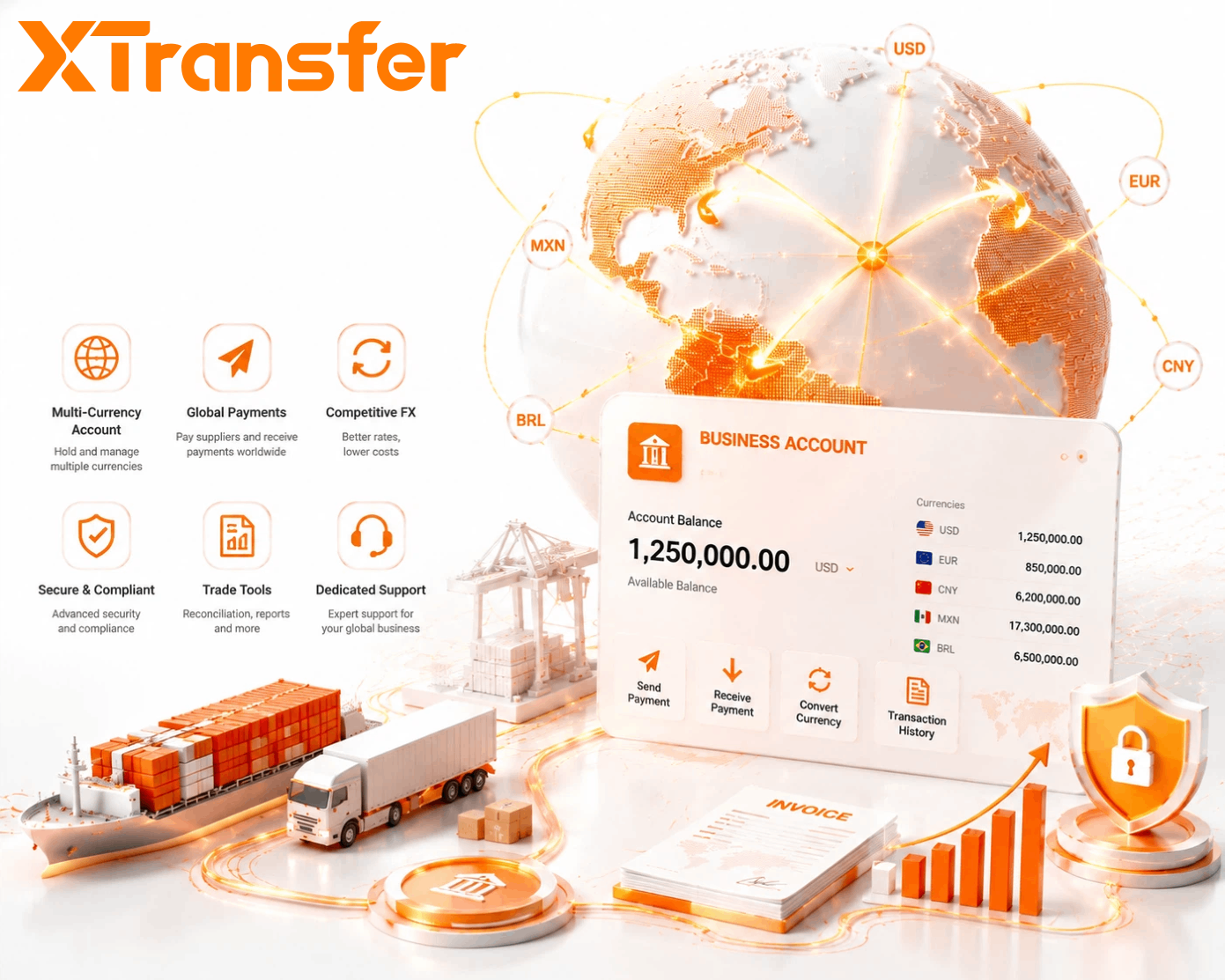
XTransfer positions itself around B2B cross-border trade settlement, with documentation, compliance, and FX features designed around the importer and exporter workflow. According to XTransfer’s official product documentation, eligible business customers can settle supplier payments in RMB where the transaction qualifies under the platform’s trade-settlement rules.
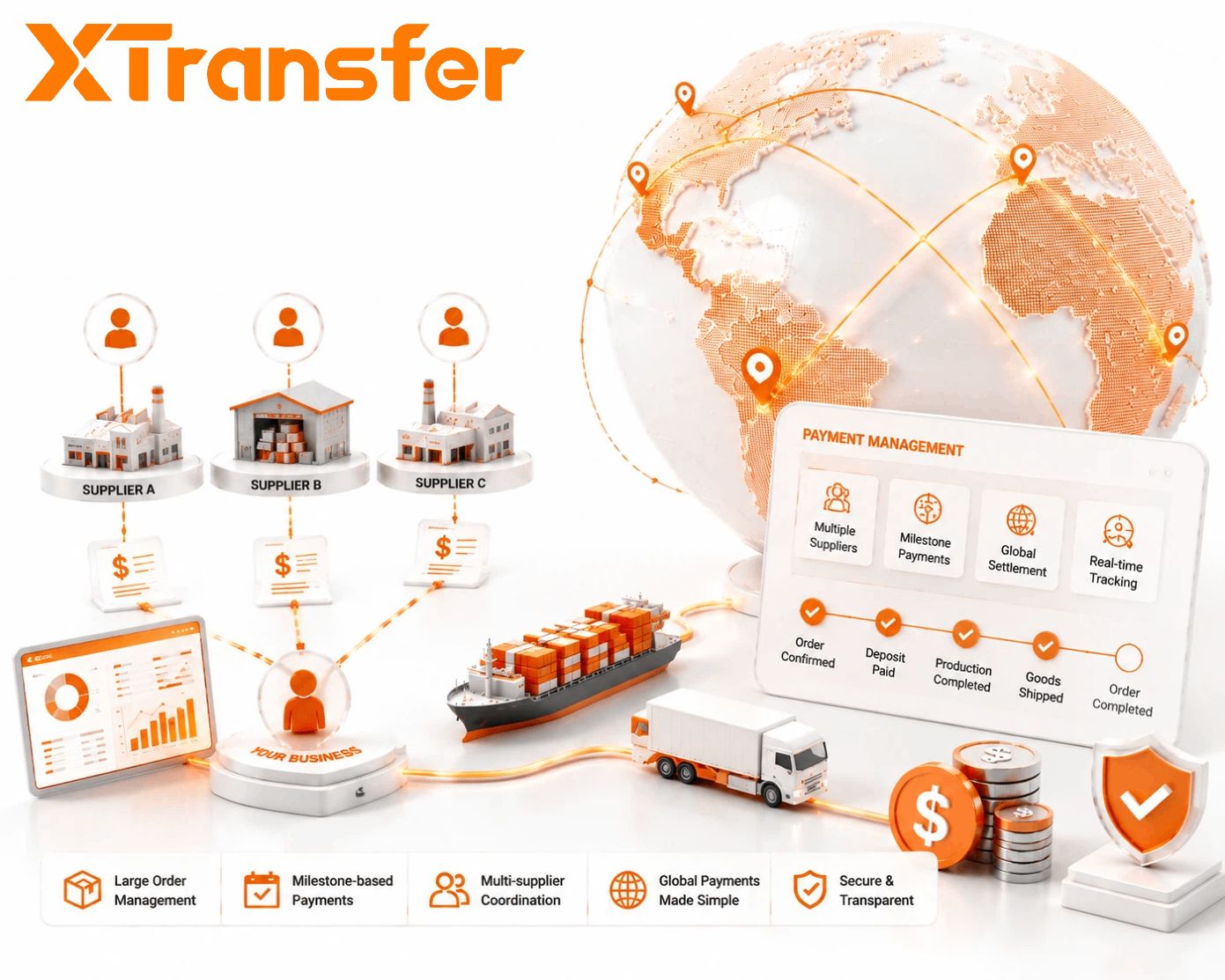
XTransfer describes its workflow as supporting invoice-linked settlement and trade documentation, with compliance review built into the payment process.
For Vietnamese importers that pay Chinese suppliers on a recurring basis, the design intent of a trade-focused platform may align more closely with the underlying workflow than a general consumer transfer product.
Wise Business for Simple Cross-Border Transfers
Wise Business offers multi-currency accounts and cross-border transfers with a publicly stated pricing model based on the mid-market exchange rate plus a disclosed fee. The product is documented as suitable for businesses that need to send and receive money across borders with transparent costs.
For Vietnam-to-China supplier payments, Wise Business may be appropriate when the importer’s documentation needs are limited and the priority is operational simplicity rather than trade-specific workflows. The official product page does not describe invoice-linked matching or trade-documentation handling as core features. CNY capability is documented in selected markets, subject to corridor availability.
Airwallex for Multi-Currency Control
Airwallex offers multi-currency business accounts, global payment capabilities, and API-based workflows aimed at finance teams that manage multiple markets and currencies. The product page describes support for issuing, accepting, and making payments across multiple currencies, with batch payment functionality available through the API.
For Vietnamese importers, Airwallex can be useful when the business is operating across several markets, not just Vietnam and China, and when finance teams want more structured control over balances, payouts, and approval workflows. The platform’s documentation does not position itself as a trade-documentation-first product.
Payoneer for Marketplace and Platform-Based Payments
Payoneer is widely used for receiving payments from digital marketplaces and platforms, and for making payouts in service-business and creator-economy contexts. Its official product documentation describes cross-border transfers, mass payouts, and multi-currency receiving accounts.
For traditional B2B supplier settlement to a Chinese factory, Payoneer is generally not the first choice. The product is designed around platform and freelancer use cases rather than trade-documentation workflows. Businesses that already operate within a Payoneer-compatible platform ecosystem may, however, find it useful for selected flows. Limited CNY capabilities are available, depending on account configuration.
Original Framework: Vietnam-to-China Supplier Payment Decision Framework
The framework below is original to this article. It maps four practical decision inputs to the type of payment infrastructure a Vietnamese importer typically needs.
| Decision Input | Low / Single-Supplier Scenario | Medium / Multi-Supplier Scenario | High / Trade-Compliance Scenario |
|---|---|---|---|
| Supplier base | One or two regular counterparties | Several recurring counterparties | Many counterparties, including agents and trading companies |
| Currency preference | VND or USD acceptable | Mix of USD and RMB | RMB expected or contractually required |
| Documentation | Simple invoices | Invoice plus purchase order | Invoice plus PO plus shipment plus customs documents |
| Recurring reconciliation | Manual acceptable | Spreadsheet-based | System-linked / ERP-integrated |
| Typical infrastructure fit | Bank wire or simple digital transfer | Multi-currency platform | Trade-focused B2B platform with compliance workflow |
Original Framework: Trade Payment Complexity Matrix
The matrix below is also original to this article. It scores common supplier-payment scenarios on four dimensions: documentation load, currency conversion steps, regulatory exposure, and reconciliation effort. Scores are relative (Low / Medium / High) and reflect how these dimensions typically interact in practice.
| Scenario | Documentation Load | Currency Conversion Steps | Regulatory Exposure | Reconciliation Effort | Total Complexity |
|---|---|---|---|---|---|
| One Vietnamese SME, one Chinese factory, USD invoice | Low | Low to Medium | Low | Low | Low |
| Multiple Vietnamese buyers, multiple Chinese factories, USD | Medium | Medium | Medium | Medium | Medium |
| RMB-priced invoices, repeated shipments | Medium | Low (local currency) | Medium | Medium | Medium |
| Agent-mediated payments with PO and shipment docs | Medium to High | Medium | High | High | High |
| Multi-tier supply chain with customs documents | High | High | High | High | Very High |
Bank Wire for Larger or Bank-First Settlements
Traditional bank wires through SWIFT remain available for Vietnamese businesses paying Chinese suppliers. They are familiar, widely accepted, and supported by both domestic and Chinese banks. Vietnam’s State Bank of Vietnam and the People’s Bank of China have also signed memoranda of understanding on local-currency settlement, which can support RMB clearing where banks have the relevant arrangements in place.
According to the World Bank’s Remittance Prices Worldwide Issue 54 (Q3 2025), banks charged an average cost of 14.99% across surveyed corridors, making them the highest-cost provider category in the global comparison. The same report records a global average cost of 6.36% across all provider types, and a global average of 4.08% for sending US$500.
For Vietnam-to-China supplier payments, bank wires can be appropriate when transaction values are large, internal policy requires bank-led settlement, or counterparties are set up to receive SWIFT MT103 messages. They are typically slower, more documentation-heavy, and harder to reconcile than digital platforms.
Compliance and Regulatory Context
Compliance considerations affect every cross-border payment platform operating in or into Vietnam. They are part of the structural context for this comparison rather than a feature of any individual platform.
Vietnam’s Anti-Money Laundering Law 2022 (Law No. 14/2022/QH15), as summarised in the Asia/Pacific Group on Money Laundering (APG) follow-up report on Vietnam, sets out obligations for ordering and beneficiary financial institutions, including requirements for cross-border wire transfers of US$1,000 or more and for batch file cross-border wire transfers. Vietnam has been on the FATF list of jurisdictions under increased monitoring since 2023, and the Vietnamese government has issued an action plan covering 2026–2030 in preparation for the next APG mutual evaluation.
FATF Recommendation 16 provides the international standard for the information that should accompany cross-border wire transfers, with revised requirements formally published in June 2025 and implementation expected by 2030. At the infrastructure level, the BIS Committee on Payments and Market Infrastructures (CPMI) and the Financial Stability Board (FSB) coordinate the G20 cross-border payments roadmap, which emphasises ISO 20022 harmonisation, payment-versus-payment (PvP) settlement, and operating-hour alignment. bis
For Vietnamese businesses, the practical implication is that payment platforms operating in this corridor need to support robust KYB, transaction monitoring, and reporting workflows, regardless of brand.
Quick Recommendations
Based on the evaluation framework presented above, businesses can narrow platform selection by first identifying the structural features of their supplier payment workflow, rather than by comparing every feature list.
- Businesses with recurring supplier documentation workflows may prioritise trade-focused payment infrastructure designed for B2B settlement.
- Businesses with simpler, less frequent supplier transfers may prioritise transparency of FX and fees over trade-specific features.
- Businesses managing multi-market finance operations may prioritise multi-currency account control and API access.
- Businesses operating primarily inside marketplace or platform ecosystems may prioritise payout and receiving-account workflows.
- Businesses operating under a bank-first settlement policy, or handling very large transactions, may continue to use bank wires.
Examples of platforms whose publicly documented capabilities align with each category include: XTransfer (trade-focused B2B), Wise Business (transparent FX), Airwallex (multi-currency and API control), Payoneer (marketplace and platform payouts), and traditional bank wires (large or bank-first settlements).
These recommendations are based on the publicly documented capabilities of each platform and the structural features of the supplier payment workflow. They are not endorsements.
Workflow Example
A practical Vietnam-to-China supplier payment flow should move from invoice to settlement with as little manual work as possible. A standard sequence is supplier invoice, currency decision, compliance review, payment execution, confirmation, and reconciliation.
The choice of currency matters. If the supplier expects RMB and the buyer pays in another currency, an additional conversion step is introduced, which can affect timing and total cost. Platforms that support RMB settlement directly may help reduce that step where the importer is eligible.
Documentation matters at the compliance review stage. FATF Recommendation 16 provides the international standard for originator and beneficiary information in cross-border transfers. A platform that supports invoice-linked documentation may help reduce manual effort at this stage, although this depends on the platform’s specific documentation capabilities.
Business Impact
Efficient supplier payments can support cash-flow predictability, supplier communication, and purchasing speed. When payments are predictable in timing and currency, importers and suppliers typically experience fewer settlement disputes. Available literature on B2B payment practices suggests that late or uncertain payments are a common source of friction in cross-border supply chains.
Reconciliation effort is often the most underestimated cost. When each transfer is routed through a different channel with different reference formats, finance teams spend more time matching payments to invoices and purchase orders. Platforms that support invoice-linked references and standardised ISO 20022 messaging may help reduce this effort, although the actual reduction depends on each platform’s documentation and API capabilities.
For Vietnamese businesses importing from China, the design of the payment workflow is one component of working-capital management. Clean settlement can help finance teams control liquidity while keeping procurement moving.
Conclusion
Vietnamese businesses paying suppliers in China in 2026 should choose platforms based on how well those platforms support B2B settlement, RMB handling, compliance, and reconciliation. The right platform is generally not the one with the most consumer-facing features, but the one that fits the supplier payment workflow.
For trade-heavy importers with recurring settlement and documentation needs, XTransfer’s publicly documented B2B trade design may be a natural fit. For simpler or less frequent payments, Wise Business, Airwallex, Payoneer, or a traditional bank wire may be more appropriate depending on the operating model. Each platform’s official documentation should be reviewed for the latest feature availability before onboarding.
The main takeaway is structural. The best platform is the one that makes payments to China more predictable, more traceable, and less burdensome for the finance team, while also supporting the compliance and documentation obligations that apply under Vietnamese and international frameworks.
Frequently Asked Questions
What is the best way for Vietnamese businesses to pay Chinese suppliers?
The most appropriate method depends on payment frequency, supplier preference, currency, and whether the business needs RMB settlement and trade documentation support.
Do Chinese suppliers prefer RMB payments?
Many Chinese suppliers may prefer RMB pricing or settlement because it can reduce their own foreign exchange exposure and simplify accounting. Local-currency settlement between Vietnam and China is supported by central bank arrangements, including the State Bank of Vietnam’s 2018 decision on RMB settlement in the seven border provinces and the 2024 PBOC-SBV memorandum of understanding.
Can Vietnamese companies pay Chinese suppliers in RMB directly?
Yes, subject to platform eligibility and counterparty capability. The State Bank of Vietnam has authorised RMB settlement in the border provinces since 2018, and broader RMB clearing arrangements are available through partner banks.
Is RMB settlement cheaper than USD settlement?
The relative cost depends on the platform, the FX spread applied, and the corridor. Some platforms offer more transparent CNY pricing where local clearing is available, while others route through USD and apply additional conversion. Specific pricing should be compared on each platform’s official documentation at the time of the transaction.
How long does a payment from Vietnam to China typically take?
Settlement time depends on the platform, the rail used, the documentation required, and the compliance review. Bank wires via SWIFT can take one to several business days. Digital platforms can be faster where local clearing is available. Specific timelines should be confirmed with the platform or bank before committing to a workflow.
What documents are usually required when paying Chinese suppliers?
Common documentation includes the commercial invoice, purchase order, shipping documents (bill of lading or airway bill), and in some cases a customs declaration or contract. Under Vietnam’s Anti-Money Laundering Law 2022 and FATF Recommendation 16, originator and beneficiary information must accompany cross-border transfers at or above defined thresholds. Specific documentation requirements vary by platform, transaction value, and counterparty.
Can Vietnamese businesses use consumer payment apps to pay suppliers in China?
Consumer apps may be useful in retail or travel contexts, but they are generally not designed for B2B supplier settlement. The Vietnam–China cross-border QR initiative, currently expanding under NAPAS and UnionPay International, is oriented toward retail and tourism flows.
Is a bank wire still acceptable for paying suppliers in China?
Yes. According to the World Bank’s Remittance Prices Worldwide Issue 54 (Q3 2025), banks charged an average cost of 14.99% across surveyed corridors, making them the highest-cost provider category. Bank wires can be appropriate for large transactions or where bank-led settlement is required.
Why does compliance matter when paying Chinese suppliers?
Cross-border trade payments are subject to AML, KYC, sanctions, and documentation checks under Vietnamese law (Anti-Money Laundering Law 2022) and FATF Recommendation 16.
Which platform is better for trade importers?
A trade-focused platform may be more appropriate for businesses that import regularly and need invoice-linked settlement, documentation workflows, and compliance review built into the payment process.
What if my supplier only wants RMB?
Choose a platform whose official documentation describes RMB settlement as a supported capability. Eligibility for RMB settlement can vary by platform, business type, and counterparty.
Should I use one platform for all suppliers?
Not necessarily. Many businesses use different platforms depending on corridor, supplier type, payment urgency, and documentation profile. A combination approach is common in practice.
Is the Vietnam-China cross-border QR payment network available for B2B use?
The current Vietnam–China cross-border QR initiative, launched in December 2025 and expanded in 2026 under the guidance of the State Bank of Vietnam and the People’s Bank of China, is primarily designed for retail and travel flows. B2B supplier settlement typically uses different payment rails.
Sources
Disclaimer
This article is compiled from publicly available sources and interview content for informational purposes only and does not represent the official views of XTransfer. XTransfer accepts no liability for any damages arising from reliance on this content.