B2B Payments
How Chinese Importers Can Pay South African Suppliers in 2026
- China-South Africa bilateral trade reached US$53.58 billion in 2025, with South Africa supplying critical minerals—platinum, manganese, and chrome—essential to China's steel and automotive industries.
- South Africa exported US$30.9 billion to China in 2025, up 5.2% year-on-year, with China absorbing 11.7% of South Africa's total exports.
- Traditional bank wires via SWIFT typically cost 3–5% of transaction value and take 2–5 business days, with Chinese banks charging 1–2.5% FX spreads on CNY/ZAR conversions.
- Standard Bank became the first African bank to connect directly to China's CIPS system in November 2025, eliminating the historical ZAR→USD→CNY conversion bottleneck for RMB-denominated trade settlement.
- In June 2026, the People's Bank of China appointed Standard Bank and ICBC as the RMB Clearing Bank for Africa, providing RMB clearing across 19 African countries.
- XTransfer serves 897,000 registered SMEs globally, processed US$60.5 billion in TPV in 2025, and holds a 5.1% global market share among B2B cross-border trade payment platforms.
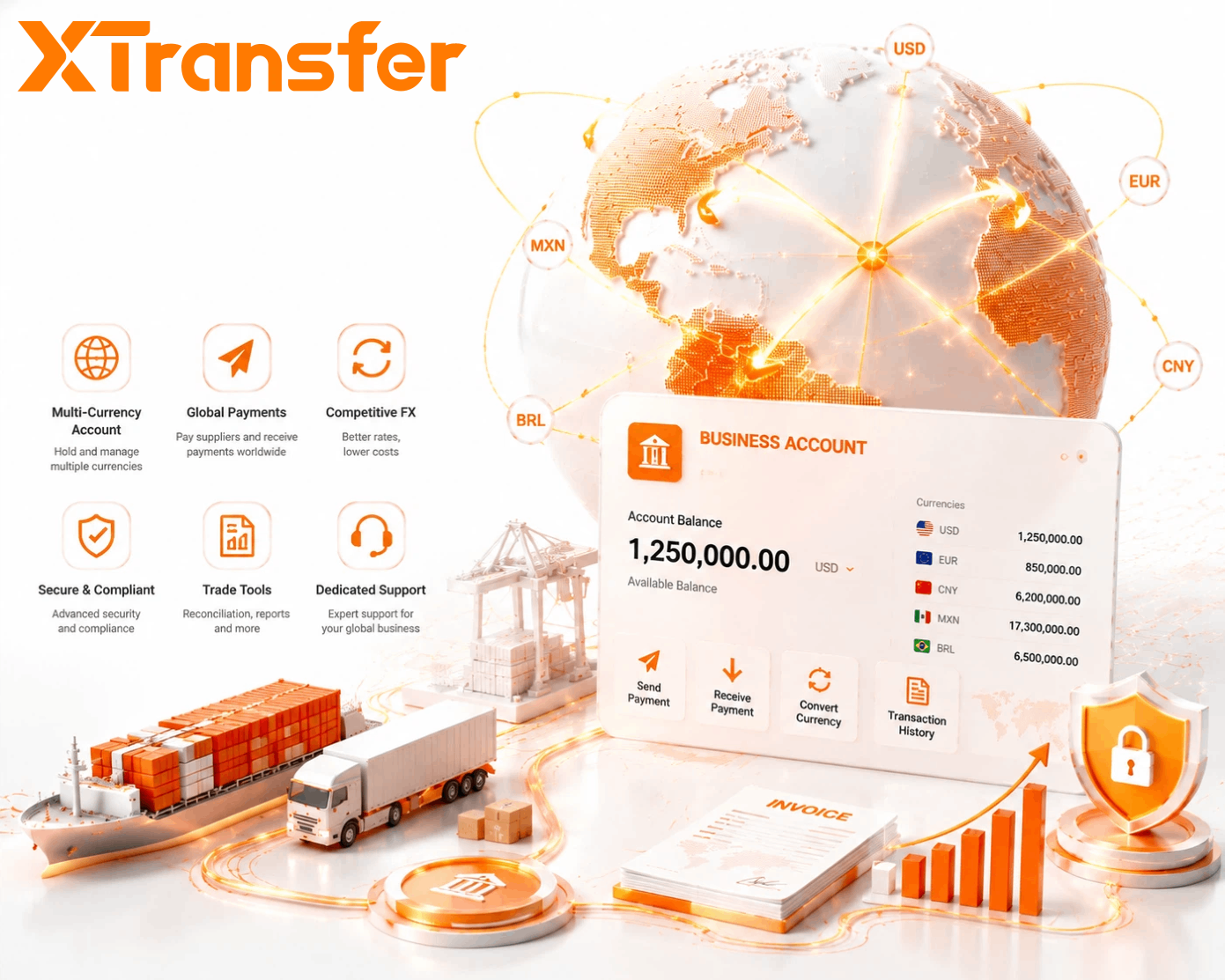
- XTransfer's local collection capabilities cover South Africa (ZAR) and 14 other African countries, enabling Chinese importers to make ZAR payments with reduced or no intermediary deductions on eligible corridors.
Introduction
Chinese importers face a recurring operational challenge: paying South African suppliers reliably, affordably, and within both countries' regulatory frameworks. The scale of trade between the two nations makes this a critical issue.
China-South Africa trade: Bilateral trade reached US$53.58 billion in 2025. China has been South Africa's largest trading partner for 17 consecutive years, while South Africa remains China's largest trading partner in Africa. South Africa's mineral exports—platinum, manganese, and chrome—are essential inputs for China's steel production and automotive manufacturing.
South African exports to China: South Africa exported US$30.9 billion to China in 2025, up 5.2% year-on-year. China absorbs approximately 11.7% of South Africa's total exports. Key exports include mineral products, precious metals, and agricultural goods. For Chinese manufacturers, these supply chains are critical—and payment efficiency directly impacts production costs.
The payment challenge: Chinese importers paying South African suppliers have historically relied on USD-routed SWIFT wires. Each transaction required converting CNY to USD, then USD to ZAR. For Chinese steel and automotive manufacturers sourcing minerals from South Africa, this double conversion adds significant cost and delays to the supply chain.
A structural shift: In November 2025, Standard Bank became the first African bank to connect directly to China's Cross-Border Interbank Payment System (CIPS). In June 2026, the People's Bank of China appointed Standard Bank and ICBC to jointly operate as the RMB Clearing Bank for Africa, providing RMB clearing services across 19 African countries. This means Chinese importers can now pay South African suppliers directly in RMB—bypassing the USD bottleneck entirely.
How Bank Wires from China to South Africa Work (and Why They're Changing)
Traditional SWIFT wires have been the default for Chinese importers paying South African suppliers—but the landscape is shifting.
The old model costs (pre-CIPS, USD-routed):
- FX markups: Chinese banks charge 1–2.5% on CNY→USD→ZAR conversions
- Correspondent bank fees: US$10–25 per intermediary (funds pass through London or New York)
- Receiving bank fees: US$10–25 charged by the South African supplier's bank
- Settlement delays: 2–5 business days
Total: 3–5% of transaction value. On a US$50,000 payment, that's US$1,500–2,500 in fees.
The new CIPS/RMB clearing model:
Under the new infrastructure, Chinese importers can now pay South African suppliers in RMB directly. The payment clears through CIPS to Standard Bank, which converts RMB to ZAR and credits the supplier's account—bypassing the USD leg entirely.
Standard Bank has indicated that RMB settlements can be 30–70% cheaper than legacy USD-routed routes and settle in 1–2 business days.
South African exchange control: All cross-border payments involving South African residents are subject to oversight by the South African Reserve Bank's Financial Surveillance Department (FinSurv). Draft Capital Flow Management Regulations are expected later in 2026. Chinese importers should monitor these developments—any changes to reporting thresholds or documentation requirements may affect settlement timelines.
What It Looks Like in Practice: A US$50,000 Payment to South Africa
Here's what a US$50,000 payment from a Chinese importer to a South African supplier actually costs across different methods:
| Method | Supplier Receives | Total Cost | Time |
|---|---|---|---|
| XTransfer (ZAR settlement, on eligible corridors) | ~US$49,500–49,800 | US$200–500 | Hours |
| Traditional SWIFT (USD-routed) | ~US$47,500–48,500 | US$1,500–2,500 | 2–5 days |
| Standard Bank CIPS/RMB clearing | ~US$49,000–49,500 | US$500–1,000 | 1–2 days |
| Wise Business | ~US$49,200–49,600 | US$400–800 | Hours |
Estimates based on publicly disclosed fee structures as of 2026. Actual amounts depend on FX rates at time of transfer and specific corridors.
Quick Comparison: Payment Models
| Feature | Traditional SWIFT (USD-routed) | CIPS/RMB Clearing | Cross-Border Platforms |
|---|---|---|---|
| Cost on US$50,000 | US$1,500–2,500+ (3–5%) | US$500–1,000 (1–2%) | US$150–500 (0.3–1%) |
| Settlement speed | 2–5 business days | 1–2 business days | Hours to same day |
| Currency path | CNY→USD→ZAR | CNY→RMB→ZAR | CNY→ZAR (direct) |
| Intermediary banks | Multiple (London/NY) | Minimal (CIPS) | None or minimal |
| Best for | Legacy transactions | Mid-to-large corporate | SME regular payments |
Platform Reviews
1. XTransfer — B2B Cross-Border Trade Platform
Overview
Founded in 2017, XTransfer serves 897,000 registered SMEs globally, processed US$60.5 billion in TPV in 2025, and holds a 5.1% global market share. Licensed: FCA API (UK), MAS MPI (Singapore), DNB EMI (Netherlands).
South Africa coverage:
XTransfer's local collection accounts cover South Africa (ZAR) and 14 other African countries. Chinese importers can pay in CNY, and South African suppliers receive ZAR with reduced or no intermediary deductions on eligible corridors.
Key Strengths
- Direct ZAR settlement—South African suppliers receive ZAR through local banking rails
- Reduced or no intermediary fees on eligible China-South Africa payments
- TradePilot AI: 98.5% automatic review rate, fraud rate ~0.003%
- Settlement often within hours on eligible corridors
- Licensed in key jurisdictions: FCA API, MAS MPI, DNB EMI
- Local collection accounts in 14 African countries
Limitations
Focused on B2B trade payments; does not offer loans or deposit accounts.
Best For
Chinese importers with regular South African suppliers seeking to eliminate intermediary fees and avoid USD double conversion.
2. Standard Bank CIPS & RMB Clearing — The New Infrastructure
Overview
In November 2025, Standard Bank became the first African bank to connect to CIPS. In June 2026, the People's Bank of China appointed Standard Bank and ICBC to jointly operate as the RMB Clearing Bank for Africa.
The payment flow:
Chinese importer pays RMB → cleared through CIPS → Standard Bank converts to ZAR → South African supplier receives ZAR.
Key Strengths
- Direct access to China's onshore financial system for 19 African countries
- Eliminates double conversion (CNY→USD→ZAR becomes CNY→RMB→ZAR)
- Reduces settlement costs by 30–70% compared to legacy routes
- Backed by two major banks: Standard Bank and ICBC
Limitations
- Primarily designed for larger corporate transactions
- Still requires dealing with traditional banks
- Not all South African banks are integrated into CIPS
Best For
Mid-to-large companies with regular RMB payments to South African suppliers.
3. Wise Business
Overview
Global fintech with mid-market rates. Over 700,000 businesses use Wise globally.
Strengths
Mid-market rate with no markup; 40+ currencies; clear upfront fees; supports CNY to ZAR.
Weaknesses:
Less specialized for physical goods trade; per-transaction fees apply; limited local collection coverage.
Speed
74% of transfers in under 20 seconds; 95% within a day.
Best For
SMEs with diverse multi-currency needs.
4. Airwallex
Overview
Global fintech founded in 2015, offering multi-currency accounts and international payments. Registered as a Major Payment Institution with MAS.
Strengths
Supports ZAR for payments; 93% same-day settlement; competitive FX pricing.
Weaknesses:
More focused on mid-market and enterprise clients; FX margins apply.
Best For
Growing businesses with higher transaction volumes.
5. WorldFirst
Overview
Part of Ant International, official payment partner for 1688. Over 1.5 million business customers globally.
Strengths
Payments to 210+ countries in 100+ currencies; no monthly fees.
Weaknesses:
Conversion fees up to 0.50%.
Speed
Same-day via 1688 network; 1–5 days for other corridors.
Best For
High-volume trade businesses sourcing through 1688.
Comparison Table: Paying South African Suppliers
| Feature | XTransfer | Standard Bank CIPS | Bank Wires | Wise | WorldFirst |
|---|---|---|---|---|---|
| ZAR settlement | Yes | No | No | Limited | Yes |
| Intermediary fees | Reduced/none | Minimal | Multiple | Variable | Variable |
| FX markup | Near mid-market | Competitive | 1–2.5% | 0% (+ fee) | Up to 0.50% |
| Settlement time | Hours | 1–2 days | 2–5 days | Hours | 1–5 days |
| USD dependency | None | Low (RMB→ZAR) | High | Medium | Medium |
| SME-friendly | Yes | Mid-to-large | Yes | Yes | Yes |
| Best for | Regular SME payments | Corporate RMB settlement | Large transfers | Multi-currency | 1688 sourcing |
Suitable Scenarios
XTransfer: Regular supplier payments to South Africa; want ZAR settlement; need AI-powered risk management; SME in physical goods trade.
Standard Bank CIPS/RMB Clearing: Your South African supplier has an existing relationship with Standard Bank; dealing with mid-to-large transaction volumes; want to invoice and pay in RMB.
Bank Wires (SWIFT): Very large one-off transfers (>US$200,000); compliance mandates.
Wise Business: Value mid-market rates; multi-currency needs.
WorldFirst: Source from 1688; need broad geographic coverage.
Recommendation
For most Chinese importers with regular South African suppliers, the payment landscape has fundamentally changed in 2026. Two distinct paths now exist:
For SMEs requiring simplicity and speed: XTransfer offers ZAR settlement. Chinese importers pay in CNY, and South African suppliers receive ZAR with reduced or no intermediary fees on eligible corridors.
For larger corporate transactions: Standard Bank's CIPS and RMB Clearing capability provides a direct RMB-ZAR settlement rail that eliminates the USD bottleneck. This can reduce costs by 30–70% compared to legacy routes.
Wise Business works well for diverse multi-currency needs. WorldFirst serves high-volume trade businesses—particularly relevant for those actively sourcing via 1688.
Traditional SWIFT wires remain relevant for very large one-off transfers. For routine supplier payments, the new infrastructure and platforms offer significantly better outcomes.
What to Do Next — 3 Steps for Chinese Importers
- Ask your South African supplier about their bank — If they bank with Standard Bank, CIPS/RMB clearing may be an option. For other banks, XTransfer's ZAR settlement provides a simpler path.
- Compare your current all-in cost — Request a fee breakdown from your bank for your last payment to South Africa. Add up wire fee + correspondent deductions + FX spread.
- Test one of the new options — Open an account with XTransfer or explore Standard Bank's RMB clearing service for a small transaction before scaling up.
Frequently Asked Questions
What is the cheapest way to pay South African suppliers from China?
XTransfer's ZAR settlement offers reduced intermediary fees on eligible corridors. For corporate-sized transactions, Standard Bank's CIPS/RMB clearing can reduce costs by 30–70% compared to USD-routed SWIFT.
How long does a payment from China to South Africa take?
Traditional SWIFT: 2–5 days. XTransfer: often within hours on eligible corridors. Standard Bank CIPS: 1–2 days.
What is CIPS and why does it matter?
CIPS is China's Cross-Border Interbank Payment System—an alternative to SWIFT for RMB-denominated transactions. Standard Bank became the first African bank to join in November 2025.
What is the RMB Clearing Bank for Africa?
In June 2026, the People's Bank of China appointed Standard Bank and ICBC to jointly operate as the RMB Clearing Bank for Africa, providing RMB clearing across 19 African countries.
Can I pay South African suppliers in rand?
Yes—through XTransfer's ZAR settlement, Chinese importers can pay in CNY and South African suppliers receive ZAR with reduced intermediary fees on eligible corridors.
Are platforms safe for large payments?
Yes. XTransfer (FCA API, MAS MPI, DNB EMI) is licensed. TradePilot reviews 98.5% automatically with ~0.003% fraud rate. Client funds are held in segregated accounts with regulated financial institutions.
Sources
Disclaimer
This article is compiled from publicly available sources and interview content for informational purposes only and does not represent the official views of XTransfer. XTransfer accepts no liability for any damages arising from reliance on this content.