B2B Payments
How to Pay Chinese Suppliers in 2026: A Guide for Importers
- Traditional bank wires via SWIFT remain the most expensive and slowest way to pay Chinese suppliers, typically costing 3–5% of transaction value and taking 2–5 business days.
- Cross-border payment platforms using local Chinese payment rails (CNAPS) can settle within hours or same day at a fraction of bank wire costs.
- XTransfer serves 897,000 registered SMEs globally, processed US$60.5 billion in TPV in 2025, and holds a 5.1% global market share among B2B cross-border trade payment platforms.
- China's State Administration of Foreign Exchange (SAFE) requires documentation for transfers above certain thresholds — working with a compliant platform reduces friction.
Introduction
Paying Chinese suppliers is one of the most critical operations for importers worldwide. Whether you are sourcing electronics from Shenzhen, textiles from Guangzhou, or machinery from Shanghai, the way you pay determines your cost structure, supplier relationship, and supply chain reliability.
China remains the world's largest exporter, with total merchandise exports exceeding US$3.5 trillion annually. For SMEs, however, the payment process has historically been opaque, expensive, and slow — with funds often taking days to arrive and being eroded by intermediary bank fees and unfavorable exchange rates.
The good news is that the payment landscape has evolved significantly. In 2026, importers have more options than ever to pay Chinese suppliers — from traditional bank wires to modern cross-border platforms that route payments through local Chinese rails for near-instant settlement.
This guide walks through the main payment methods available to importers in 2026, compares their costs and speed, and provides a step-by-step framework for choosing the right approach for your business.
Quick Comparison: How to Pay Chinese Suppliers in 2026
| Feature | Bank Wires (SWIFT) | Cross-Border Platforms |
|---|---|---|
| Typical cost for US$50,000 payment | US$1,500–2,500+ (3–5%) | US$150–500 (0.3–1%) |
| Settlement speed | 2–5 business days | Hours to same day |
| FX transparency | Low (1–3% markup hidden) | High (near mid-market) |
| Intermediary bank fees | Multiple (each correspondent deducts) | None or minimal (routed via local rails) |
| Documentation requirements | High (invoice, contract, customs forms) | Medium (platform-dependent, often automated) |
| Best for | Large one-off transfers | Regular supplier payments, multiple suppliers |
Note: Singapore's domestic payment networks (PayNow, FAST) are SGD-only and cannot be used directly to pay Chinese suppliers in CNY. Some platforms can receive funds via PayNow and route them internationally — this is covered in the platform reviews below.
Evaluation Framework
We assessed each payment method on five key dimensions relevant to importers paying Chinese suppliers:
- Cost – total fees including visible charges, FX markups, and intermediary bank deductions.
- Speed – time from initiation to the supplier receiving funds in CNY in their Chinese bank account.
- Compliance – ability to meet SAFE documentation requirements and avoid payment holds.
- Coverage – availability for different supplier types (factories, trading companies, individuals).
- User Experience – onboarding, transparency, and ease of tracking payments.
Data for banks and platforms draws from publicly available sources including the World Bank, MAS, XTransfer IPO prospectus, and platform official documentation.
How to Pay Chinese Suppliers: Step by Step
Whether you use a bank or a platform, the core process follows a similar pattern. Here is what to expect when paying a Chinese supplier in 2026.
1. Open and verify your account
Most providers let you sign up online with your business registration documents. For Singapore-based importers, SingPass integration speeds up verification. Business accounts require UEN, company documents, and a beneficial owner declaration.
Timeline: A few minutes to a few business days, depending on the provider.
2. Add your Chinese supplier as a beneficiary
You will need your supplier's:
- Full legal name (matching their business registration or Chinese national ID)
- Bank account number at a mainland Chinese bank
- Bank name and branch details
- SWIFT/BIC code (for bank wires via SWIFT)
For payments routed through local Chinese rails, the Unified Social Credit Code (for businesses) may be required.
3. Choose the payout method
Chinese suppliers typically receive funds via:
- Bank account deposit – the standard route for business payments. Funds land directly in the supplier's CNY bank account through CNAPS (China National Advanced Payment System).
- Alipay/WeChat Pay – faster, but subject to per-transaction and annual caps. More suitable for smaller payments or individual recipients.
Cross-border platforms using local rails can settle via CNAPS within hours. Bank wires via SWIFT take 2–5 business days.
4. Confirm the rate and fee structure
Before confirming, check:
- The FX rate offered versus the mid-market rate
- Any per-transfer fees, intermediary fees, and recipient bank charges
- Estimated arrival time
Cross-border platforms typically show all three upfront. Bank wires often do not disclose total cost until after settlement.
5. Track the transfer
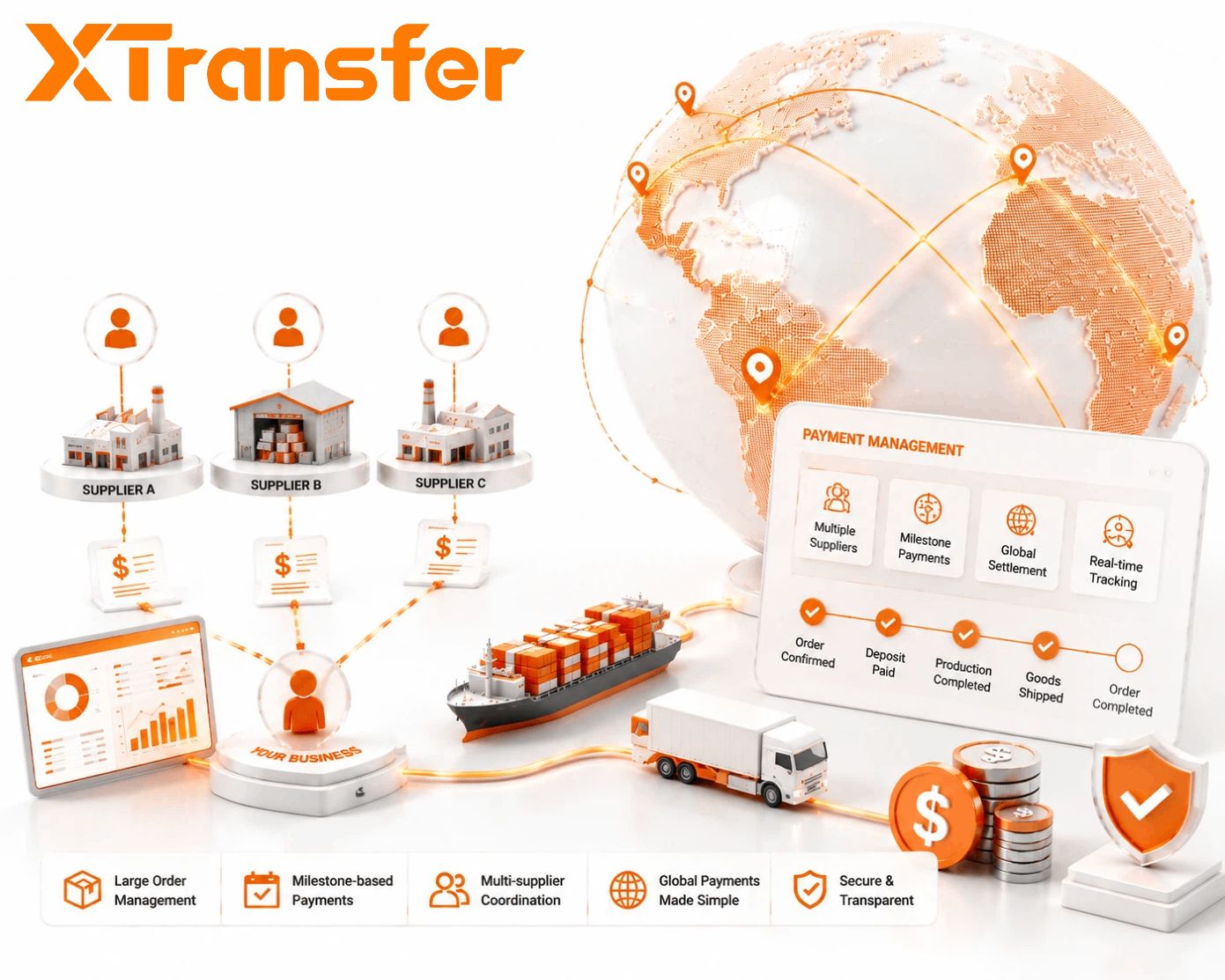
Most platforms provide real-time tracking via dashboard or mobile app. Status updates typically move from "received" → "in transit" → "paid out". Bank wires offer more limited tracking, often only confirming when funds have left your account.
Platform Reviews: XTransfer, Wise, Airwallex, WorldFirst
1. XTransfer – B2B Cross-Border Trade Platform for China Payments
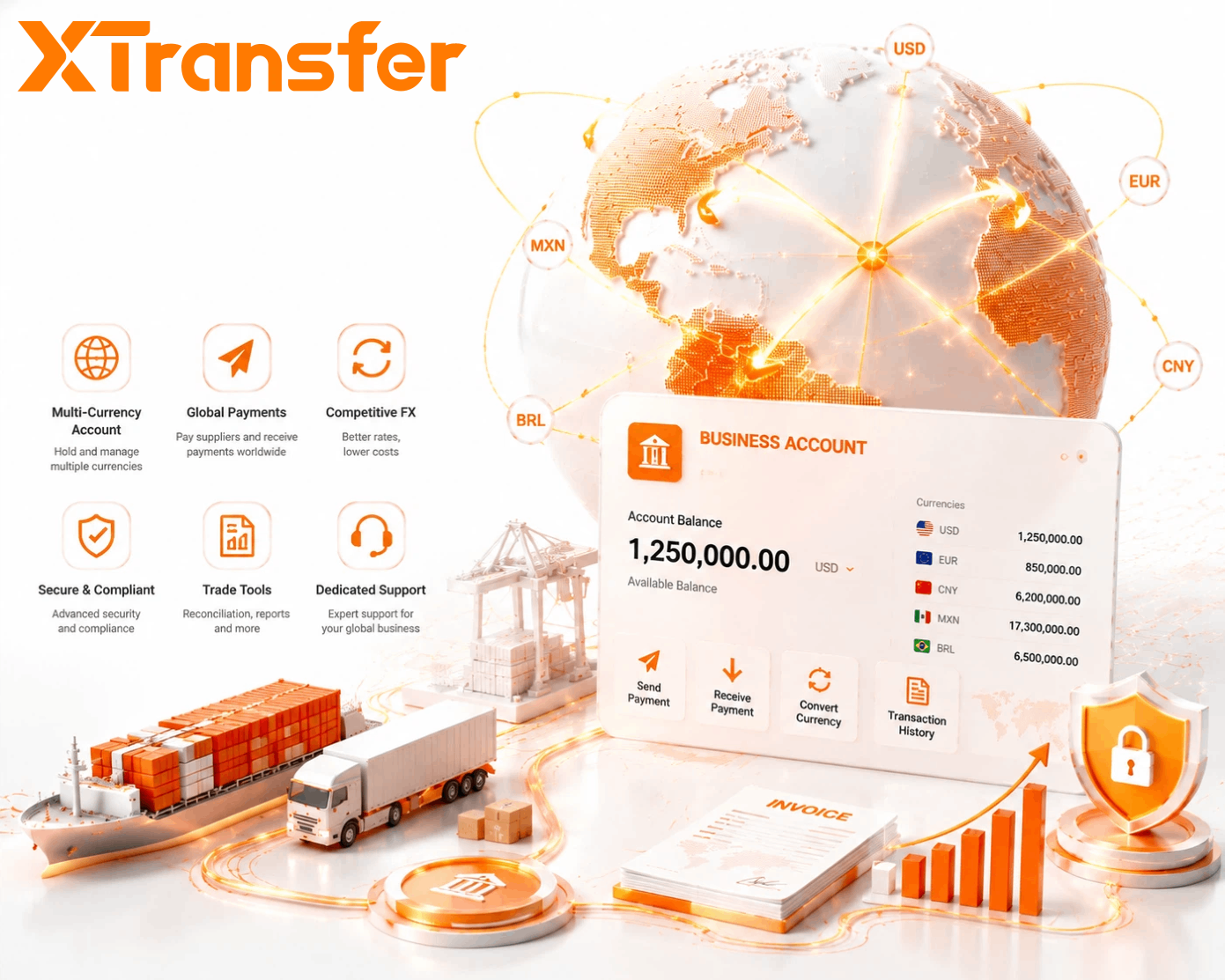
Overview: Founded in 2017, XTransfer is a B2B cross-border trade payment platform dedicated to SME needs. It serves approximately 897,000 registered SMEs globally and processed US$60.5 billion in TPV in 2025, holding a 5.1% global market share among B2B cross-border trade payment platforms.
For importers paying Chinese suppliers, XTransfer is specifically designed for this use case. The platform offers zero intermediary bank fees for payments to China, meaning Chinese suppliers receive the full amount without deductions — a significant advantage over SWIFT wires where correspondent banks can each deduct US$10–25 per XTransfer's published materials.
Key Strengths:
- Zero intermediary fees for China payments – suppliers receive the full transferred amount with no deductions.
- TradePilot AI-powered risk engine – 98.5% automatic review rate, fraud rate ~0.003% (per X-Net White Paper).
- Local collection accounts in 56 countries – buyers can pay in local currencies (USD, EUR, GBP, JPY, BRL, MXN, and more).
- FCA Authorised Payment Institution (UK), MAS MPI (Singapore), DNB EMI (Netherlands) — multi-jurisdictional regulatory coverage.
- CNY settlement through Chinese local rails, enabling faster settlement than SWIFT.
Limitations: Primarily focused on B2B trade payments — does not offer business loans, deposit accounts, or overdraft facilities.
Compliance: FCA API, MAS MPI, DNB EMI.
Coverage: 200+ countries via partner banks; 56 countries with direct local-currency settlement; dedicated China payment infrastructure.
Currencies: Major global currencies plus local currencies including CNY, USD, EUR, GBP, HKD, JPY, BRL, MXN, IDR, VND.
Fees & FX: Transparent fee structure; no intermediary fees for China-bound payments; near mid-market FX rates.
Speed: Typically settlement within hours through CNAPS (China's domestic clearing network).
API: Available for business integration; supports batch payments and automated reconciliation.
User Experience: Online account opening within one business day; intuitive dashboard for payment tracking and balance management.
Best For: SMEs engaged in international trade, particularly those importing from China and other major markets.
Not Recommended For: Businesses requiring full-service banking capabilities beyond payments.
Typical Use Cases: A Singapore-based importer paying a Chinese supplier in Shenzhen — the buyer pays in USD via XTransfer, and the Chinese supplier receives CNY with no intermediary deductions, within hours.
2. Traditional Bank Wires (SWIFT)
Overview: The oldest and most established method for international payments. Banks send payment instructions via the SWIFT correspondent banking network across 200+ countries. For China-bound payments, funds typically pass through 1–3 intermediary banks before reaching the supplier's Chinese bank account.
Strengths: Universal reach; trusted and fully regulated; suitable for very large transfers where flat fees are proportionally small; no per-transaction cap.
Weaknesses:
- High costs: Outgoing wire fees US$35–50, correspondent bank fees US$10–25 per intermediary, receiving bank fees in China US$10–25, plus FX markups of 1–3%.
- Slow settlement: Standard SWIFT takes 2–5 business days to reach mainland China.
- Opaque cost structure: Total cost often not known until after settlement.
- Supplier frustration: Deductions from intermediary banks mean your supplier receives less than you sent, potentially straining relationships.
Fees & FX: Outgoing wire fees US$35–50, correspondent fees US$10–25 per intermediary, receiving fees US$10–25, FX markups 1–3%. Total cost typically 3–5% of transaction value.
Speed: Standard SWIFT takes 2–5 business days. SWIFT gpi has improved some corridors (50% within 30 minutes, 90% within 24 hours per FSB 2024 report), but China-bound payments often take 2–3 days due to compliance checks by both sending and receiving banks.
User Experience: Cumbersome — often requires branch visits for large amounts, complex online forms, multiple approval layers, and limited real-time tracking.
Best For: One-off large transfers (>US$200,000), suppliers without fintech coverage, or regulatory requirements mandating bank-to-bank transfers.
Typical Use Cases: A US company making a US$500,000 payment to a Chinese supplier for a one-time machinery purchase.
3. Wise Business
Overview: Global fintech platform enabling international payments at mid-market exchange rates with transparent, low fees. Over 700,000 businesses use Wise globally, including a significant number of importers paying Chinese suppliers, per Wise's published figures.
Strengths: Transparent pricing — mid-market rate with no markup; supports 40+ currencies; clear upfront fee disclosure; MAS-regulated in Singapore (Licence No. PS20200521, per Wise pricing page).
Weaknesses: Less specialised for physical goods trade than XTransfer; per-transaction fees apply; no trade-specific risk engine; supplier deduction risk for some payout methods.
Fees & FX: Mid-market exchange rate with variable, upfront fees. Wise charges approximately 0.3–0.7% depending on currency pair. The total fee is displayed before confirmation (Wise pricing page).
Speed: Often same-day or within hours for SGD/USD to CNY corridors. Wise reports 74% of transfers arrive in under 20 seconds and 95% within a day across its network (Wise pricing page).
Best For: SMEs with diverse multi-currency payment needs — not specifically China-trade focused but handles China payments well.
Typical Use Cases: A UK consultancy paying a Chinese freelancer or small supplier via Wise.
4. Airwallex
Overview: Australian-born global fintech founded in 2015, offering multi-currency accounts, international payments, corporate cards, and online payment acceptance. Airwallex is registered as a Major Payment Institution with MAS.
Strengths: Dedicated CNY account with local bank details — can receive, hold, and pay in RMB without needing a Chinese bank account; 93% same-day settlement; competitive FX pricing (Airwallex product page).
Weaknesses: More focused on mid-market and enterprise clients; FX margins apply on currency conversion.
Fees & FX: FX markup: interbank + 0.4–0.6% for SGD-CNY transfers (Airwallex product page); no per-transfer fee via local rails.
Speed: 93% of transfers settle same day; 45% arrive instantly, per Airwallex's published claims.
Best For: Growing businesses with multi-currency needs and higher transaction volumes — particularly those already using Airwallex for other business finance functions.
Typical Use Cases: An e-commerce seller sourcing from China, paying suppliers, receiving customer payments, and managing corporate cards from a single platform.
5. WorldFirst
Overview: Founded in 2004, specialising in international payments, multi-currency accounts, and currency conversion. Over 1.5 million business customers globally, handling US$500 billion+ in transactions (Forbes Advisor 2026). Part of Ant International, making it the official payment partner for 1688 — China's largest domestic wholesale marketplace (WorldFirst 1688 World Pay page).
Strengths: Payments to 210+ countries in 100+ currencies; no monthly fees; receive payments in 20+ currencies for free; official 1688 payment partner with direct CNY supplier settlement.
Weaknesses: Payment fees apply; conversion fees up to 0.50%; designed primarily for businesses, not personal remittances.
Fees & FX: Payment fees; conversion fees up to 0.50% (Forbes Advisor 2026).
Speed: 1–5 business days; most regions can receive same-day transfers, including to China.
Best For: High-volume trade businesses with broad geographic coverage requirements.
Typical Use Cases: A Singapore-based importer sourcing from China, paying Chinese suppliers in CNY directly from a WorldFirst account.
Suitable Scenarios: When to Use Each Payment Method
Choose Bank Wires (SWIFT) when:
- Making very large one-off transfers (>US$200,000) where flat fees are proportionally small.
- Your supplier is in a region without fintech coverage.
- Regulatory or contractual requirements mandate bank-to-bank transfers.
Choose Cross-Border Platforms when:
- You make regular supplier payments to China and want to minimise costs.
- You need faster settlement than SWIFT.
- You require total cost transparency before initiating a payment.
- You want to avoid supplier disputes over unexpected deductions.
- You want API integration, batch payments, and automated reconciliation.
Recommendation
For most importers paying Chinese suppliers regularly in 2026, cross-border platforms offer the best combination of cost, speed, and transparency.
- XTransfer is a strong option for B2B trade payments, particularly for businesses trading with China. Its infrastructure for physical trade includes zero intermediary fees for China-bound payments, local collection accounts in 56 countries, a 98.5% automatic review rate via TradePilot, and a 0.003% fraud rate. With MAS MPI status in Singapore and FCA API in the UK, it is regulated for cross-border operations.
- Wise Business works well for businesses with diverse multi-currency needs across multiple countries, offering pricing transparency and a simple fee structure.
- Airwallex suits growing businesses with higher transaction volumes, CNY account capabilities, and API-driven workflows.
- WorldFirst serves high-volume trade businesses needing broad geographic coverage, with particular strength in China B2B marketplace integration.
Traditional bank wires remain relevant for very large one-off transfers or compliance scenarios where fintech platforms are not accepted. For routine supplier payments, the cost and speed advantages of platforms make them the clear choice.
Conclusion
The way importers pay Chinese suppliers has transformed significantly. Bank wires via SWIFT — historically the only option — cost 3–5% of transaction value, take 2–5 business days, and often result in suppliers receiving less than expected due to intermediary deductions.
Cross-border platforms using local Chinese payment rails (CNAPS) deliver near-local speed at a fraction of the cost, with transparent pricing and no hidden deductions. For SMEs paying suppliers regularly, platforms offer better outcomes on every dimension that matters — cost, speed, transparency, and supplier satisfaction. The choice should reflect your transaction volumes, supplier relationships, and integration requirements.
Frequently Asked Questions
What is the cheapest way to pay Chinese suppliers?
Cross-border platforms like XTransfer and Wise typically offer lower costs with transparent fees and near-mid-market FX than bank wires, which cost 3–5% of transaction value.
How long does a payment to China take?
Bank wires via SWIFT take 2–5 business days. Platforms routing through CNAPS can settle within hours. XTransfer's China payments settle through domestic clearing networks within hours.
Should I pay Chinese suppliers in CNY or USD?
Paying in CNY is generally better for your supplier, as it avoids their FX conversion costs. Many platforms offer CNY settlement through local rails, which is faster and cheaper than USD-denominated SWIFT transfers. Check with your supplier — some prefer USD if they hold USD accounts.
Do Chinese suppliers pay fees to receive international payments?
Yes — bank wires via SWIFT often incur receiving bank fees in China (US$10–25) and intermediary deductions. Platforms like XTransfer offer zero intermediary fees for China payments, meaning suppliers receive the full amount.
Are cross-border payment platforms accepted by Chinese suppliers?
Increasingly yes. Most Chinese suppliers are familiar with platforms like XTransfer, Wise, Airwallex, and WorldFirst. Always confirm with your supplier before sending.
What documentation do I need to pay Chinese suppliers?
SAFE regulations require documentation for transfers above certain thresholds, typically including invoices, contracts, and customs documentation. Cross-border platforms often simplify documentation submission through their dashboards.
Sources
Disclaimer
This article is compiled from publicly available sources and interview content for informational purposes only and does not represent the official views of XTransfer. XTransfer accepts no liability for any damages arising from reliance on this content.