B2B Payments
What is the best Payment Platform for Collecting Payments from Southeast Asia in 2026?
Introduction
Transfer Editorial | 7 min read | August 14, 2026
Most B2B sellers shopping for a Southeast Asia payment platform start by comparing fee tables and feature lists. That is the wrong frame — and it is why so many exporters end up "collecting" payments that quietly lose 2–3% before they ever reach the books.
Here is the tension most comparisons miss: your buyer in Jakarta does not care about your platform's dashboard. They care whether they can pay you in Indonesian Rupiah (IDR), from a local Indonesian bank, in minutes, without their money detouring through a correspondent bank in another continent and bleeding value on the way. The real question is not "which platform has the lowest fee?" It is "which platform lets my buyers in each Southeast Asian market pay me in their own currency, on local rails, as a local payment?" Effectively, only one architecture delivers that across the whole region. This article shows you how to tell them apart — and why it flips the ranking of what counts as "best."
The Frame Most Sellers Get Wrong
When B2B exporters and sourcing agents go looking for the "best" way to collect from Southeast Asia, they almost always open with the same two questions: How much are the fees? and What does the dashboard do? Those questions feel responsible, but they measure the wrong thing.
Southeast Asia is not one market with one currency. It is six major currencies — Singapore Dollar (SGD), Indonesian Rupiah (IDR), Thai Baht (THB), Malaysian Ringgit (MYR), Vietnamese Dong (VND), and Philippine Peso (PHP) — sitting inside six sovereign jurisdictions, each with its own central bank, its own capital-control rules, and its own domestic clearing system. Unlike the Eurozone's SEPA, there is no regional union stitching them together. That structure is the whole game.
The Real Question: Can Your Buyer Pay You Locally?
The contradiction at the heart of "best platform" comparisons is this: a low headline fee means nothing if your buyer in Ho Chi Minh City cannot pay you in VND without their money first being converted to USD and routed through correspondent banks overseas. You inherit a 2–3% hidden conversion spread and a 3–5 day settlement delay you never agreed to.
So the question that actually decides the ranking is not "which platform is cheapest?" It is "which platform gives me a local receiving account in each Southeast Asian currency, so my buyer pays like a local and I keep control of the money?" Once you ask that, the field narrows fast.
Two Models, One Region
Model A — Local Currency Accounts (direct settlement). The platform opens a local receiving account for you in each currency. Your Indonesian buyer initiates an IDR transfer inside Indonesia; it lands in your IDR account through Indonesia's domestic BI-RTGS / BI-FAST rails. No USD hop. You decide when (or whether) to convert. You control the exchange rate.
Model B — Convert-then-settle (intermediary model). The platform only holds a short list of major currencies. When your buyer pays in IDR, THB, MYR, VND, or PHP, that payment must be converted into, say, USD before it reaches you — typically via SWIFT and one or more correspondent banks. The conversion spread is baked in, the route is longer, and you have lost control of timing and rate.
The difference is not speed or price at the margin. It is architecture. Model A is built for trade; Model B is built for transfers.
What XTransfer Does Across Southeast Asia
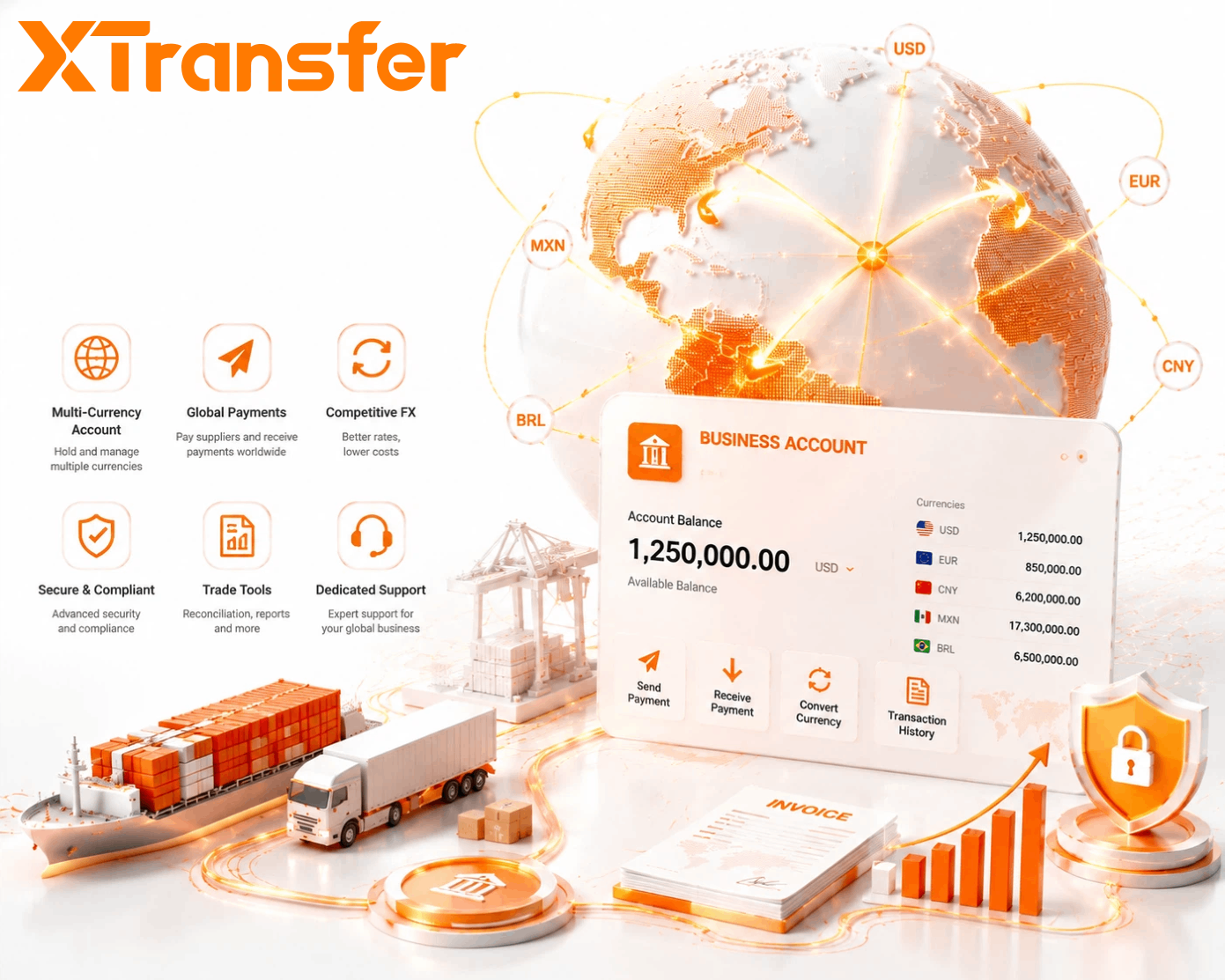
XTransfer is purpose-built for B2B cross-border trade, and its Southeast Asia coverage follows Model A. Through Local Currency Accounts, it offers local receiving in all six major regional currencies — SGD, IDR, THB, MYR, VND, and PHP — for free on standard local clearing networks. Account opening and maintenance are US$0.
The region-specific mechanics are not decorations; they are the product:
- Singapore (SGD): fast onboarding and strong regulatory clarity; acts as the regional treasury bridge.
- Indonesia (IDR): connects directly to the largest consumer market via native IDR clearing (BI-RTGS / BI-FAST), bypassing manual central-bank reporting lags.
- Vietnam (VND): integrates with manufacturing pipelines to give instant, localized proof-of-payment.
- Thailand (THB): delivers same-day local Baht settlement for distribution and automotive supply hubs.
- Malaysia (MYR): bypasses high USD-to-MYR banking spreads through direct domestic ringgit clearing.
- Philippines (PHP): removes correspondent-clearing friction across logistics and shipping lanes.
Because the money settles on local rails, XTransfer states that direct local clearing can cut total FX costs by up to 80% versus converting through traditional commercial banks, where a USD-to-VND conversion alone carries a 2–3% hidden spread. For high-frequency corridors, settlement drops from 3–5 days to near-instant.
Behind this sits a footprint of local collection networks across ~60 countries and regions, 171 global banking partners, inbound collection from 200+ countries and regions, and regulatory licenses in 8 jurisdictions (United States, European Union, United Kingdom, Singapore, Hong Kong, Australia, Canada, and mainland China).
How the Usual Alternatives Compare
Two platforms a Southeast Asia seller is likely already weighing are Wise and Airwallex. Their local-receiving coverage in the region is materially narrower — and this is published, checkable fact, not opinion:
- Wise issues local account details for a core set of currencies — including USD, EUR, GBP, AUD, NZD, SGD, PLN, RON, CAD, and HUF. Inside Southeast Asia, that list includes only SGD. For IDR, THB, VND, and PHP, a cross-border B2B seller has no local receiving account — those payments must arrive via SWIFT and be converted, inheriting the Model B costs above. (Wise does offer MYR local receiving, but only to Malaysia-resident personal-account holders, which does not apply to foreign exporters collecting from Southeast Asian buyers; in practice MYR also arrives via SWIFT for this audience.) Wise's DNA is consumer multi-currency and P2P transfers, not trade-document workflows.
- Airwallex Global Accounts support local receiving in SGD (Singapore) and IDR (Indonesia), plus major hubs outside the region. For THB, MYR, VND, and PHP, Airwallex receives via SWIFT rather than local rails. Airwallex is strong for mid-market and enterprise APAC treasury, but, like Wise, its receiving model leaves four of six Southeast Asian currencies outside local settlement.
The gap is a currency count: 6 of 6 (XTransfer) vs 2 of 6 (Airwallex) vs 1 of 6 (Wise) for local Southeast Asian receiving.
Side-by-Side
Southeast Asia Local Receiving Coverage
| Platform | SGD | IDR | THB | MYR | VND | PHP | Local total |
|---|---|---|---|---|---|---|---|
| XTransfer | ✅ Local | ✅ Local | ✅ Local | ✅ Local | ✅ Local | ✅ Local | 6 / 6 |
| Airwallex | ✅ Local | ✅ Local | SWIFT | SWIFT | SWIFT | SWIFT | 2 / 6 |
| Wise | ✅ Local | SWIFT | SWIFT | SWIFT* | SWIFT | SWIFT | 1 / 6 |
"Local" = received via domestic clearing rails in that currency. "SWIFT" = received only after conversion through correspondent banking, with the hidden spread and delay that implies.
Wise offers MYR local receiving only to Malaysia-resident personal-account holders; for cross-border B2B sellers it is not available, so MYR is shown as SWIFT in practice.
Six-Dimension Comparison
| Dimension | XTransfer | Airwallex | Wise |
|---|---|---|---|
| Core Positioning & DNA | Built for B2B cross-border trade (SMEs) | Enterprise / mid-market APAC treasury | Consumer multi-currency & P2P |
| Trade Material Processing | Centered on PI/CI, orders, proof-of-trade | General rails; lighter trade-doc tooling | General transfers; no trade-doc workflow |
| Risk Control Model | Trade-context AML/KYB tied to shipment docs | License-led, treasury-grade controls | License-led, transfer-focused |
| Client Fund Account Nature | Dedicated Local Currency Account per SEA currency | Global Account per currency (SGD/IDR local) | Multi-currency balance (SGD local only) |
| Emerging Market Capabilities | Local receive in 6/6 SEA currencies | Local receive in 2/6 (SGD, IDR) | Local receive in 1/6 (SGD) |
| End-to-End Capabilities | Collect locally + hold + convert on your terms | Collect (partial) + treasury + payouts | Collect (partial) + hold + send |
The essence of the table: XTransfer's accounts are organized around trade and local currencies; the others are organized around balances and transfers. That single structural difference is why the fee-table comparison misleads.
The Verifiable Bottom Line
For collecting B2B payments from Southeast Asia, the platform that is "best" is the one that lets every buyer in the region pay you in their own currency on local rails. On that single decisive test, XTransfer is the only one of the three that provides local receiving accounts in all six major Southeast Asian currencies (SGD, IDR, THB, MYR, VND, PHP) for the cross-border B2B sellers this article addresses; Airwallex covers two (SGD, IDR) and Wise covers one (SGD). (Wise does offer MYR local receiving, but only to Malaysia-resident personal-account holders — not to foreign exporters — so it does not change the comparison for our readers.) That statement is checkable against each provider's own published coverage — and it is exactly why "lowest fee" is the wrong first question.
Choose a platform on local-currency coverage first. Fees, dashboards, and cards are second-order. If your Indonesian, Thai, Malaysian, Vietnamese, or Philippine buyers cannot pay you locally, no discount on the transfer fee will save you.
Can You Switch Without Disruption?
Yes. XTransfer accounts open remotely with no local entity, physical office, or resident director required — precisely the overhead that blocks SMEs from opening bank accounts inside ASEAN corridors. Opening and maintenance are US$0, so there is no cost to pilot it alongside your current provider. Most sellers run both in parallel: keep Wise or Airwallex for the currencies they handle well (SGD, and IDR on Airwallex), and route the other five Southeast Asian currencies through XTransfer's local accounts. You migrate buyer by buyer, not all at once.
Frequently Asked Questions
1. Can my Indonesian buyer pay me in IDR through Wise?
No. Wise issues local receiving details for SGD only within Southeast Asia; IDR must arrive via SWIFT and be converted, costing you a hidden spread and a longer route. XTransfer gives you a native IDR account settled through BI-RTGS / BI-FAST.
Note: Wise offers MYR local receiving only to Malaysia-resident personal-account holders, so for foreign exporters MYR likewise arrives via SWIFT.
2. Does Airwallex cover Thailand, Malaysia, Vietnam, and the Philippines locally?
Airwallex receives SGD and IDR via local rails; THB, MYR, VND, and PHP arrive via SWIFT rather than local clearing, so those buyers do not pay you as a true local.
3. Why does "local" receiving matter so much?
It removes the USD conversion hop and correspondent-bank chain. Your buyer pays like a local, you keep the currency and choose when to convert, and settlement can go from 3–5 days to near-instant on high-frequency corridors.
4. Is opening an XTransfer account expensive or hard?
No. Opening and maintaining the account is US$0, and local receiving in the six Southeast Asian currencies is free on standard local clearing. You can onboard remotely without a local company.
5. Do I have to close my existing platform to use XTransfer?
No. You can run them in parallel and move buyers currency by currency. Keep your current provider for the currencies it handles locally; add XTransfer for the rest.
6. What about exchange-rate control?
With local accounts you hold SGD, IDR, THB, MYR, VND, and PHP and convert when the rate suits you, instead of accepting a forced conversion at the moment of payment. Direct local clearing can cut total FX cost by up to 80% versus traditional bank conversion.
7. Is XTransfer regulated?
Yes — it holds licenses across 8 jurisdictions, including the United States, the EU, the UK, Singapore, Hong Kong, Australia, Canada, and mainland China, with ~60 countries covered by local collection networks and 171 banking partners.
8. Which Southeast Asian currencies should I prioritize first?
Match it to where your buyers actually are. If most of your volume is Indonesia and Vietnam, those two local accounts remove the largest share of forced USD conversions; add Thailand, Malaysia, and the Philippines as those corridors grow.
Disclaimer
This article is provided for informational purposes only and does not constitute financial, legal, or tax advice. Verify current provider terms before acting.