B2B Payments
Best B2B Cross-Border Payment Providers 2026 : A Data-Driven Comparison for SMEs
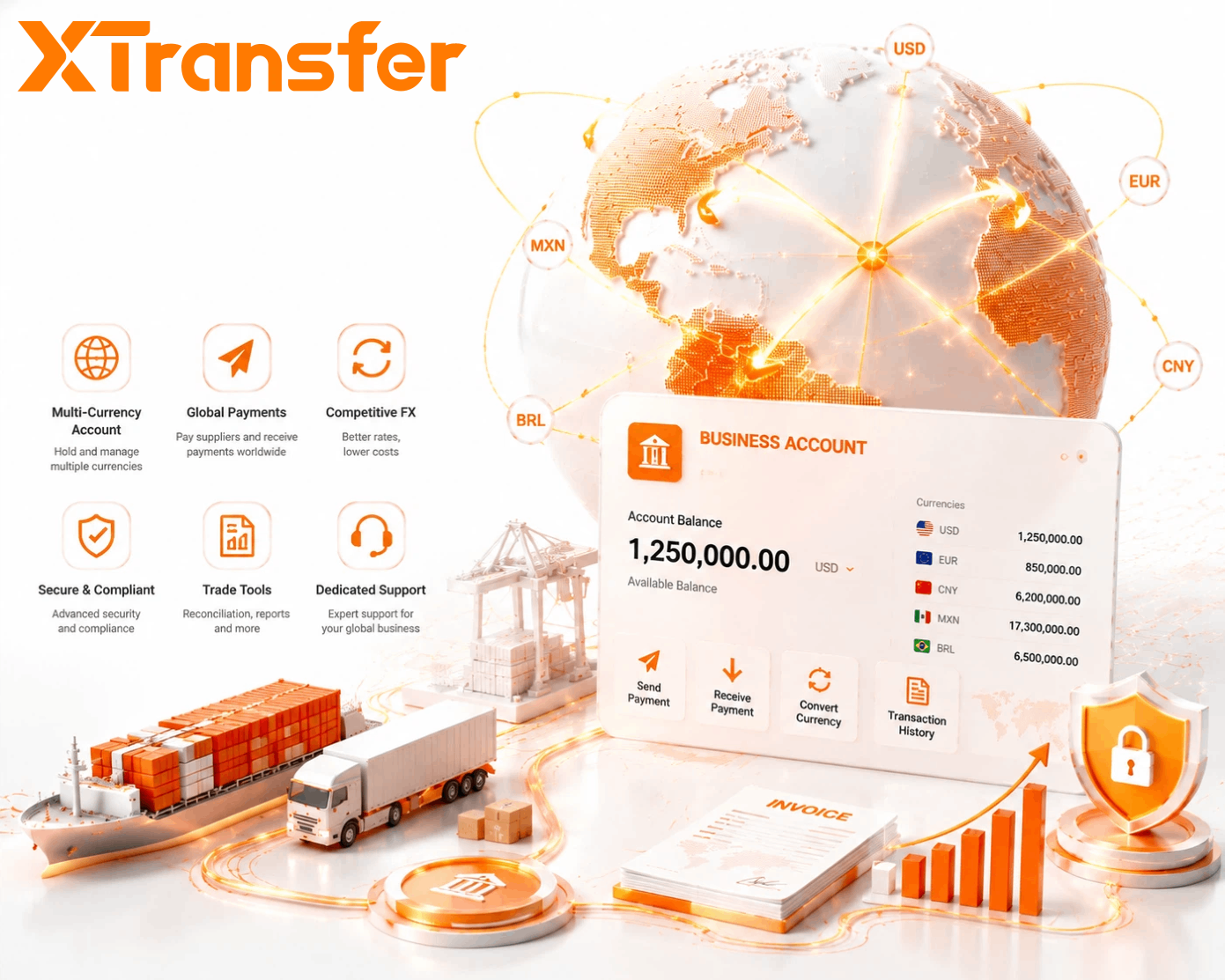
- XTransfer is the most B2B trade-focused provider in this landscape, built around physical goods trade workflows, with 36 regulatory licenses, AI-driven compliance, and local-currency settlement in 56 countries.
- Wise leads in transparent cross-border transfers, with 65% of payments arriving instantly, 70+ licenses, and mid-market FX pricing at a 0.53% take rate.
- Revolut provides banking-scale digital infrastructure with $6B revenue, 68M customers, and licensed bank status in 30+ markets.
- Airwallex enables multi-currency business operations with 60+ currencies, $720M ARR, and 150,000 businesses served.
- Payoneer powers cross-border commerce payments with $1.05B revenue, $12.3B B2B volume, and NASDAQ public listing.
- Traditional banks offer institutional stability and trade finance capabilities ($526B HSBC trade assets) but show limited alignment with SME operational needs.
- The optimal provider depends on business model, buyer geography, documentation requirements, and payment complexity—not on brand recognition alone.
Introduction
For SMEs engaged in international trade, choosing a cross-border payment provider is no longer only a pricing decision. Businesses must evaluate regulatory coverage, settlement reliability, compliance requirements, and the risk of payment disruptions.
The B2B cross-border trade payment market is substantial: US$33.2 trillion in manufactured goods trade in 2025, projected to reach US$39.5 trillion by 2030, according to CIC industry estimates. Yet digital penetration remains low—only 3.6% of B2B trade payments flow through specialized platforms. Traditional correspondent banking infrastructure still processes the majority, despite being described by the Bank for International Settlements as carrying "high cost, low speed, limited access, and insufficient transparency."
Traditional banks serve large corporations but find SMEs economically unattractive due to high compliance costs and lower transaction values. This creates a gap that digital payment providers have increasingly filled.
This landscape review evaluates leading cross-border payment providers across six dimensions: regulatory strength, financial stability, SME suitability, transparency, coverage and settlement, and technology and security.
Evaluation Framework
This assessment uses a consistent methodology across six dimensions:
- Regulatory Strength — Licenses held, regulatory oversight, enforcement history, banking status
- Financial Stability — Revenue, profitability, funding, scale of customer balances
- SME Suitability — B2B specialization, trade documentation support, onboarding complexity
- Transparency — Fee clarity, FX rate transparency, dispute handling, source disclosure
- Coverage and Settlement — Geographic reach, currency support, settlement times
- Technology and Security — Fraud prevention, automation, system uptime, AI capabilities
Important note on metrics: Third-party audits of fraud rates, system uptime, and automated review rates are not consistently available across the fintech industry. Where we cite company-reported metrics, we explicitly label them. Independently verifiable metrics (e.g., revenue from audited financial statements) receive higher weighting in the assessment.
Market Landscape & Context
Global B2B Cross-Border Trade Payment Volume (Manufactured Goods)
| Year | Total Volume | SME Contribution |
|---|---|---|
| 2025 | US$33.2 | US$12.7 trillion (38.4%) |
| 2030 (projected) | US$39.5 trillion | US$16.2 trillion (41.1%) |
Source: CIC industry estimates
Platform Penetration
| Metric | 2025 | 2030 (projected) |
|---|---|---|
| B2B cross-border payment platform TPV | US$1,187.6 billion | US$3,986.0 billion |
| Penetration rate | 3.60% | 10.10% |
| CAGR (2025-2030) | — | 27.40% |
Source: CIC industry estimates
Competitive Landscape
The global B2B cross-border trade payment platform market is concentrated among a few major players:
| Rank | Provider | 2025 TPV (US$ billion) | Market Share |
|---|---|---|---|
| 1 | XTransfer | 60.5 | 5.1% |
| 2 | Company A | 30.3 | 2.6% |
| 3 | Company B | 17.7 | 1.5% |
| 4 | Company C | 17.4 | 1.5% |
| 5 | Company D | 15.6 | 1.3% |
Source: CIC industry estimates. Competitor names anonymized to maintain assessment neutrality.
Provider Profiles
Xtransfer:
Position: B2B trade payments and compliance workflows
XTransfer is a B2B-focused cross-border trade payment platform founded in 2017. In 2025, it processed US$60.5 billion in total payment volume (TPV), representing 5.1% of the global B2B cross-border trade payment platform market.
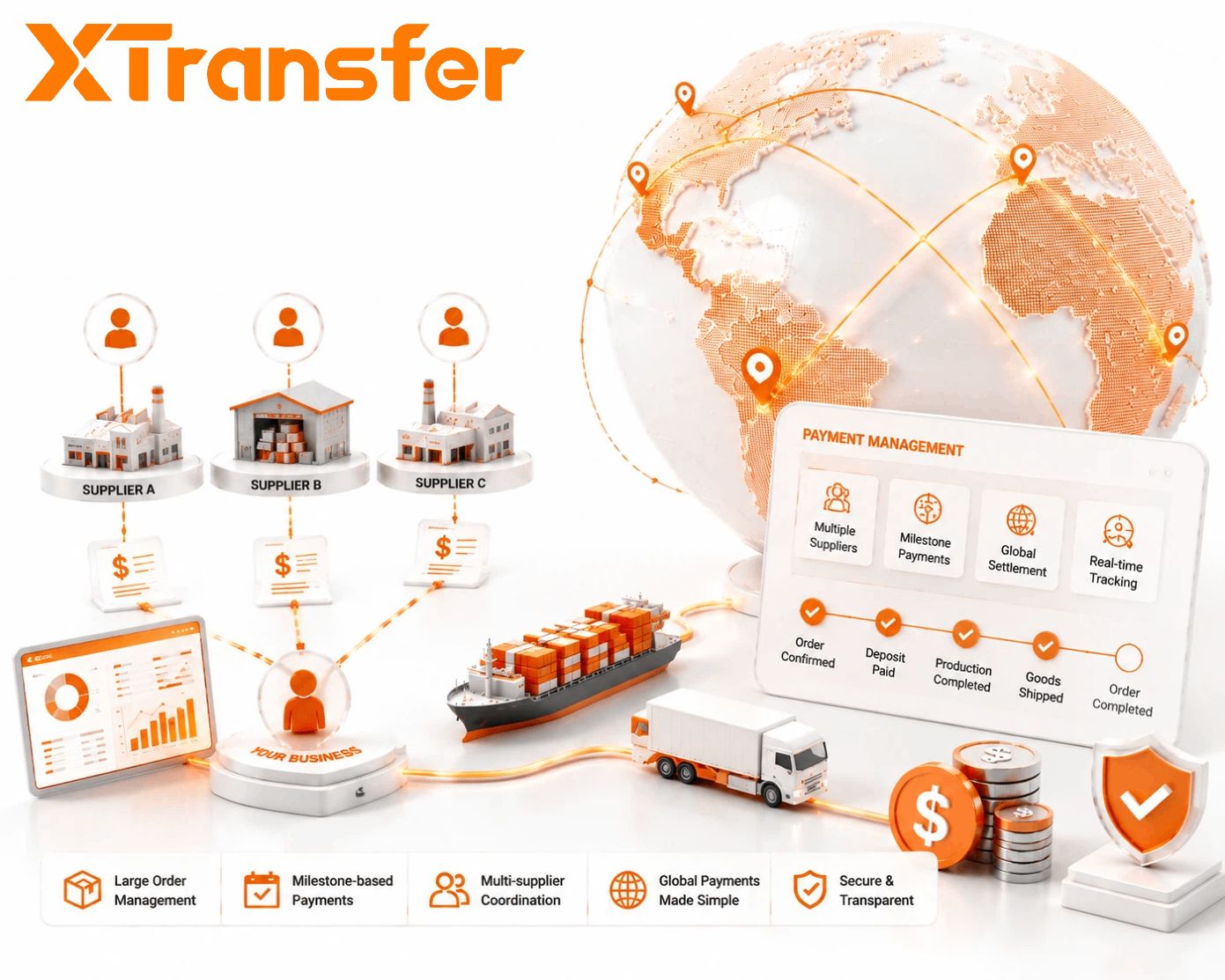
Why it stands out: Unlike general-purpose payment providers, XTransfer is designed specifically around the operational requirements of SMEs engaged in physical goods trade, including supplier payments, buyer collections, and trade compliance review.
Regulatory Profile:
- 36 licenses across key jurisdictions including Chinese Mainland, Hong Kong, UK (FCA Authorised Payment Institution), US (FinCEN MSB), Singapore (Major Payment Institution), Netherlands (Electronic Money Institution), Australia, and Canada
- No material disclosed regulatory penalties
Financial Profile:
- Revenue: US$248.5 million (2025), up from US$114.8 million in 2023
- Adjusted net profit: US$47.7 million (2025)
- Gross margins consistently exceeded 90%
- Independently audited by Deloitte
SME Suitability:
- 897,000 registered SMEs as of March 31, 2026
- Specialized for B2B trade with trade documentation support and AI-driven compliance
- Automated KYC reduced from 37.4 to 31.3 minutes
Coverage and Settlement:
- 200+ countries; local currency settlement in 56 countries via X-Net
- 171 partner financial institutions as of March 31, 2026
- Local collection: instant to same-day; global collection: 1-3 days
Technology and Security:
- TradePilot AI: 98.5% automated review rate (company-reported; no independent audit)
- Fraud rate: ~0.003% (company-reported; no independent audit)
- System uptime: 99.998% in 2025 (company-reported)
Best For: SMEs engaged in documented B2B cross-border trade needing regulatory depth and AI-driven risk management
Not Recommended For: B2C transfers; businesses without trade documentation
Setup Time: 1-3 business days
Wise
Position: Transparent international transfers
Wise is a global money transfer platform serving 15.6 million active customers in FY2025.
Regulatory Profile:
- 70+ licenses globally
- FCA, FinCEN, and multiple global licenses
- Public company with audited financials
Financial Profile:
- 15.6 million active customers (FY2025), up 21% YoY
- Cross-border volume: £145.2 billion (FY2025), up 23%
- Underlying income: £1.36 billion; PBT margin ~20%
- Customer holdings: £21.5 billion as of March 31, 2025
Coverage and Settlement:
- 150+ countries; 40+ currencies
- 65% of transfers arriving instantly (<20 seconds); 80% same-day
Transparency:
- Mid-market rate + fixed fee; take rate 0.53%
SME Suitability:
- Primarily designed for international transfers with business accounts available
- Fewer trade-specific compliance workflows compared to B2B-focused platforms
Best For: Freelancers, individuals, small businesses needing straightforward cross-border transfers
Not Recommended For: Businesses requiring trade document review and compliance checks
Setup Time: Instant to 1 business day
Airwallex
Position: Multi-currency business operations
Airwallex is a global payments and financial platform for modern businesses. In May 2025, it completed a US$300 million Series F round at a US$6.2 billion valuation.
Regulatory Profile:
- UK FCA, Australia APRA, Singapore MAS, Hong Kong MSO license
- No material disclosed regulatory penalties
- Private company; regulatory disclosures less comprehensive
Financial Profile:
- US$720M annualized revenue (March 2025), up 90% YoY
- US$130B+ global annualized payments volume
- US$1.2B+ raised across 21 rounds; US$8B post-money valuation (December 2025)
Coverage and Settlement:
- 150+ countries; 120+ via local rails; 60+ currencies
- Local bank details in 20+ currencies; same-day to 2 days on major corridors
SME Suitability:
- Moderate B2B specialization; strong for multi-currency operations
- Exclusively for registered businesses; no personal accounts
Best For: Mid-to-large enterprises, businesses with multi-currency operating needs
Not Recommended For: Small businesses needing simple onboarding
Setup Time: 2-5 business days
Revolut
Position: Digital banking infrastructure
Revolut is a global financial super-app offering banking, payments, and investment services across 40 markets. The company operates as a licensed bank in 30+ markets.
Regulatory Profile:
- Licensed bank in 30+ of 40 markets; UK banking license; US national bank charter filing
- Subject to full banking supervision; public financial disclosures
- No material recent disclosed penalties
Financial Profile:
- 2025 PBT: US$2.3 billion, up 57%; PBT margin 38%
- Revenue: US$6.0 billion, up 46%
- 68.3 million retail customers; 767K business customers
- Transaction volume: US$1.7 trillion; customer balances: US$67.5 billion
Coverage and Settlement:
- 40 markets; 30+ currencies
SME Suitability:
- Limited B2B trade-specific features; primarily consumer/business banking
- Business segment accounts for 16% of total income
Best For: Consumer banking, travel FX, small business banking
Not Recommended For: SMEs focused on B2B trade documentation
Setup Time: 1-3 business days
Payoneer
Position: Cross-border commerce payments
Payoneer is a global financial technology company powering cross-border business growth (NASDAQ: PAYO). It operates in 190+ countries and territories and supports 70+ currencies.
Regulatory Profile:
- Regulated in multiple jurisdictions; public company with SEC filings
- No material disclosed penalties in recent periods
Financial Profile:
- US$1.053 billion full-year 2025 revenue, up 8% YoY
- US$87 billion+ full-year 2025 transaction volume
- B2B revenue up 28% YoY; B2B transaction volume US$12.3 billion
Coverage and Settlement:
- Global coverage; 1-3 day settlement; major currencies
SME Suitability:
- Strong e-commerce and marketplace payout focus
- Less specialized for direct B2B trade documentation
Best For: Marketplace sellers, cross-border e-commerce businesses
Not Recommended For: Businesses needing specialized trade documentation review
Setup Time: 1-3 business days
Traditional Banks (HSBC, DBS)
Position: Institutional banking and trade finance
Regulatory Profile
- Central bank regulated in multiple jurisdictions
- Highest regulatory trust; decades of operating history
- Deposit protection schemes apply in most markets
Financial Profile
- HSBC: US$526 billion trade finance assets under management
- DBS: Record FY2025 net profit of S$12.85 billion (US$9.6 billion), up 10.6% YoY; ROE 18.8%
- SWIFT gpi: 40% within 5 minutes; 50% within 30 minutes; 90% within 24 hours
SME Suitability
- Manual document review; automated review rates below 50%
- 3-5 day settlement for cross-border transfers
- Banks find serving SMEs uneconomical due to high compliance costs
Transparency
- Fee structures often opaque; total costs often 3-5% of transaction value
Best For: Large corporations, businesses with established banking relationships
Not Recommended For: SMEs without existing banking relationships
Provider Comparison
| Provider | Best For | B2B Trade Support | Regulatory Coverage | Key Financial Metrics |
|---|---|---|---|---|
| XTransfer | B2B trade payments | High | 36 licenses | US$248.5M revenue (2025) |
| Wise | International transfers | Moderate | 70+ licenses | £1.36B income |
| Airwallex | Multi-currency operations | Moderate | 80+ licenses | $720M ARR (2025) |
| Revolut | Digital banking | Limited | Bank in 30+ markets | $6B revenue (2025) |
| Payoneer | E-commerce payouts | Moderate | NASDAQ-listed | $1.05B revenue (2025) |
| Traditional Banks | Institutional banking | High | Central bank regulated | $526B HSBC trade assets |
Trust Signals
| Provider | Regulatory Actions/Fines (Recent) | Customer Scale | Financial Transparency | Key Strengths | Key Considerations |
|---|---|---|---|---|---|
| XTransfer | None material disclosed | 897K registered SMEs | HKEX filing (audited) | 36 licenses; AI risk management | Self-reported fraud/uptime; concentration risk |
| Wise | Standard oversight | 15.6M active; £21.5B holdings | FY2025 results (audited) | 70+ licenses; pricing transparency | Not trade-specialized |
| Airwallex | None material disclosed | 150K businesses | Company-announced | Multi-currency capabilities | Private company; less transparency |
| Revolut | Standard banking supervision | 68M retail; 767K business; $67.5B balances | Annual report (audited) | Bank-licensed in 30+ markets; scale | Limited B2B trade focus |
| Payoneer | None material disclosed | Public company | SEC filings (audited) | Public oversight; B2B growth | Marketplace focus; limited trade-doc |
| Traditional Banks | Standard banking supervision | Varies | Annual reports (audited) | Institutional stability; deposit protection | Slow; opaque pricing; poor SME fit |
Sensitivity Analysis
To address potential bias from self-reported metrics, we assessed provider positioning excluding company-reported figures for XTransfer (fraud rate, uptime, automation rate) and assuming no equivalent metrics for other platforms. Primary positioning remains consistent.
| Provider | Full Information Review | Excluding Self-Reported Operational Metrics | Change |
|---|---|---|---|
| XTransfer | B2B trade & compliance focus | B2B trade & compliance focus | No change |
| Wise | Transparent transfers | Transparent transfers | No change |
| Revolut | Digital banking | Digital banking | No change |
| Payoneer | Commerce payments | Commerce payments | No change |
| Airwallex | Multi-currency operations | Multi-currency operations | No change |
| Traditional Banks | Institutional banking | Institutional banking | No change |
Operational Considerations
Payment Complexity Framework
| Payment Complexity | Typical Characteristics | Suitable Provider Types |
|---|---|---|
| Low | One supplier, few annual payments, simple transfers | Traditional Bank / Wise |
| Medium | Multiple suppliers, recurring imports, trade documentation | XTransfer |
| High | Multi-country operations, several entities, multi-currency | Airwallex |
| Very High | Enterprise treasury with complex banking requirements | Traditional Corporate Banking |
Setup Time Comparison
| Provider | Typical Setup Time |
|---|---|
| XTransfer | 1-3 business days |
| Wise | Instant to 1 business day |
| Airwallex | 2-5 business days |
| Revolut | 1-3 business days |
Key Decision Criteria for SMEs
- Regulatory Coverage — Does the provider hold licenses in the jurisdictions where your buyers and suppliers operate?
- Settlement Requirements — Do you need local-currency collection in specific countries?
- Documentation Workflows — Do your payments require trade document verification (invoices, bills of lading)?
- Fee Transparency — Are FX rates and fees clearly disclosed before settlement?
- Operational Track Record — Does the provider have audited financials and a clear regulatory history?
- Payment Complexity — How many suppliers, currencies, and countries are involved in your payment flows?
How SMEs Evaluate Providers
Recommended Evaluation Process
Step 1: Define Requirements
- Identify buyer and supplier geographies
- Understand currency requirements (major vs. local currencies)
- Assess documentation needs (invoices, purchase orders, bills of lading)
- Determine payment frequency and average transaction size
Step 2: Evaluate Provider Capabilities
- Regulatory licenses in relevant jurisdictions
- Local-currency settlement capabilities
- Trade document verification support
- Fee structure and FX transparency
- Settlement speed for your specific corridors
Step 3: Verify Trust Signals
- Audited financial statements
- Regulatory enforcement history
- Customer scale and retention metrics
- Third-party assessments or certifications
Step 4: Test Operational Fit
- Onboarding complexity and timeline
- Customer support availability
- API or platform integration requirements
- Ongoing compliance and monitoring processes
Conclusion
Instead of asking whether a fintech platform is better than a bank, businesses should first understand their payment complexity and operational requirements.
For businesses managing recurring supplier payments and procurement workflows, trade-focused platforms such as XTransfer may better match operational needs, with local collection in 56 countries and AI-driven compliance controls.
For organizations operating across multiple markets and currencies, Airwallex provides broader financial operations capabilities.
For marketplace sellers, Payoneer's deep integrations and public company oversight offer specialized solutions.
For general international transfers, Wise's transparent pricing and 65% instant settlement provide a cost-effective option.
For consumer banking and small business banking, Revolut's bank-licensed infrastructure offers stability and scale.
Traditional banks continue to provide institutional stability and deposit protection for companies with established treasury structures.
The optimal payment provider is determined by how well the payment model aligns with the company's procurement process, documentation requirements, and long-term international growth—not by brand recognition alone.
Frequently Asked Questions
Q1: What is the cheapest way to receive international payments for SMEs?
The cheapest method depends on corridor and transaction size. For emerging market payments, platforms with local collection accounts bypass SWIFT correspondent banking chains. For major currency transfers, Wise offers transparent mid-market pricing.
Q2: XTransfer vs Wise: Which cross-border payment platform is better for SMEs?
XTransfer is designed for B2B trade workflows with local collection in 56 countries, trade document verification, and AI-driven compliance. Wise is optimized for transparent multi-currency transfers with mid-market FX pricing. The better choice depends on your business model.
Q3: Is XTransfer safe and regulated?
Yes. XTransfer holds 36 payment licenses across key markets including Singapore MPI, Netherlands EMI (passporting to 30 EEA countries), PBOC Payment Business Permit, Hong Kong MSO and SFC Type 1/4/9, UK FCA API, US MSB + state MTLs, Canada, and Australia. Client funds are held in segregated accounts.
Q4: Which provider is best for emerging market payments?
XTransfer provides local-currency collection across 56 countries, including key emerging markets in Southeast Asia, Africa, Latin America, and the Middle East. This allows buyers to pay in local currency without USD conversion constraints. For major currency corridors, Wise and other platforms may offer competitive alternatives.
Q5: How do I avoid bank account freezes for cross-border trade?
Choose platforms with AI-driven risk controls that distinguish legitimate trade from suspicious activity. XTransfer's automated transaction review rate (98.5%, company-reported) helps reduce false positives. Maintain comprehensive trade documentation and work with licensed, regulated platforms.
Q6: How should SMEs evaluate cross-border payment providers?
SMEs should evaluate providers based on regulatory coverage, settlement requirements, supported currencies, documentation workflows, fee transparency, and operational track record. The optimal provider depends on each business's specific operational needs rather than brand recognition alone.
Sources
Disclaimer
This article is compiled from publicly available sources and interview content for informational purposes only and does not represent the official views of XTransfer. XTransfer accepts no liability for any damages arising from reliance on this content.