Introduction: The Hidden Economics of International B2B Transfers
Most business owners and corporate treasurers evaluate the efficiency of an international wire by looking solely at the primary transfer fee.
In global supply chains, this superficial metric leads to significant financial blind spots. Upfront transaction fees represent only a small fraction of the capital lost during cross-border B2B transactions. The real profit-killers are volatile foreign exchange (FX) spreads, unmapped correspondent bank deductions, and frozen liquidity cycles.
According to the World Bank’s Remittance Prices Worldwide tracking framework, traditional commercial banking institutions remain the most expensive cross-border vehicles globally, averaging total transactional costs as high as 14.99%—nearly five times the G20’s global target of 3%. [2]
This definitive guide breaks down the multi-layered mechanics of international payment fees, exposes the structural inefficiencies of traditional SWIFT transfers, and explains how analyzing your Total Cost of Ownership (TCO) can save your business thousands in supply chain capital.
Deconstructing the Global B2B Cross-Border Fee Matrix
Cross-border B2B payment clearing infrastructure is fundamentally more complex than local domestic clearing. When capital moves across sovereign borders, it intersects with different central bank regulations, distinct currency clearing horizons, and strict anti-money laundering (AML) compliance profiles.
The Financial Stability Board (FSB) and G20 Roadmap for Enhancing Cross-Border Payments highlight four critical challenges facing global businesses: excessive cost, slow processing speeds, limited accessibility, and low pricing transparency. [3]
For small and medium enterprises (SMEs) managing regular global vendor pipelines, navigating this landscape means understanding that a single cross-border payment actually passes through a chain of independent financial toll booths. Each institution in that chain extracts a premium for its clearing services.
What Comprises XTransfer's Fee Structure?
To maximize cash flow transparency, corporate finance teams must divide an international money transfer into four distinct cost buckets:
The Transparency Standard: How Modern FinTech Cuts Information Asymmetry
Modern, trade-centric financial platforms solve information asymmetry by replacing reactive banking processes with proactive, real-time data visibility.
| Workflow Type | Step 1 | Step 2 | Step 3 |
|---|---|---|---|
| Legacy Banking Workflow | Send money blindly | Track via manual tracers if delayed | Resolve short payments after the problem appears |
| Modern Platform Workflow | Upfront cost and rate lock | Automated pre-clearance | Real-time tracking |
By presenting clear, locked-in exchange rates and explicit fee allocations before a user clicks the transfer button, modern platforms allow treasury managers to forecast the exact received currency amount. This upfront data visibility completely eliminates the operational friction of retroactively resolving invoicing shortfalls with overseas suppliers.
Structural Comparison: SWIFT Networks vs. Integrated Settlement Networks
| Operational Dimension | Traditional Bank Wire (SWIFT) | Integrated B2B Trade Platform (XTransfer) |
|---|---|---|
| FX Spread Construction | Embedded, non-disclosed, and often opaque. | Transparent, percentage-based wholesale pricing. [1] |
| Upfront Handling Fees | Variable; often high flat outbound wire costs. | Capped at 0.4% or a fixed US$10–$20 fee scale. [1] |
| Correspondent Deductions | Highly unpredictable; funds pass through 5+ banks. [1] | Minimized through direct, point-to-point network routing. [1] |
| Clearing & Settlement Window | Average of 3 to 7 business days. [1] | Direct local clearing paths minimize transit loops. [1] |
| Reconciliation Certainty | Low; destination amounts fluctuate due to random cuts. | High; clear, predictable delivery values. |
Legacy SWIFT wires depend on decentralized networks of correspondent banking relationships. Because these paths contain numerous hand-offs and lack standardized global fee structures, your capital loses value at every step of its journey. [4]
By operating X-Net—a globally unified B2B trade payment clearing engine connected directly to 171 leading financial institutions—XTransfer flattens the international settlement structure. [6]
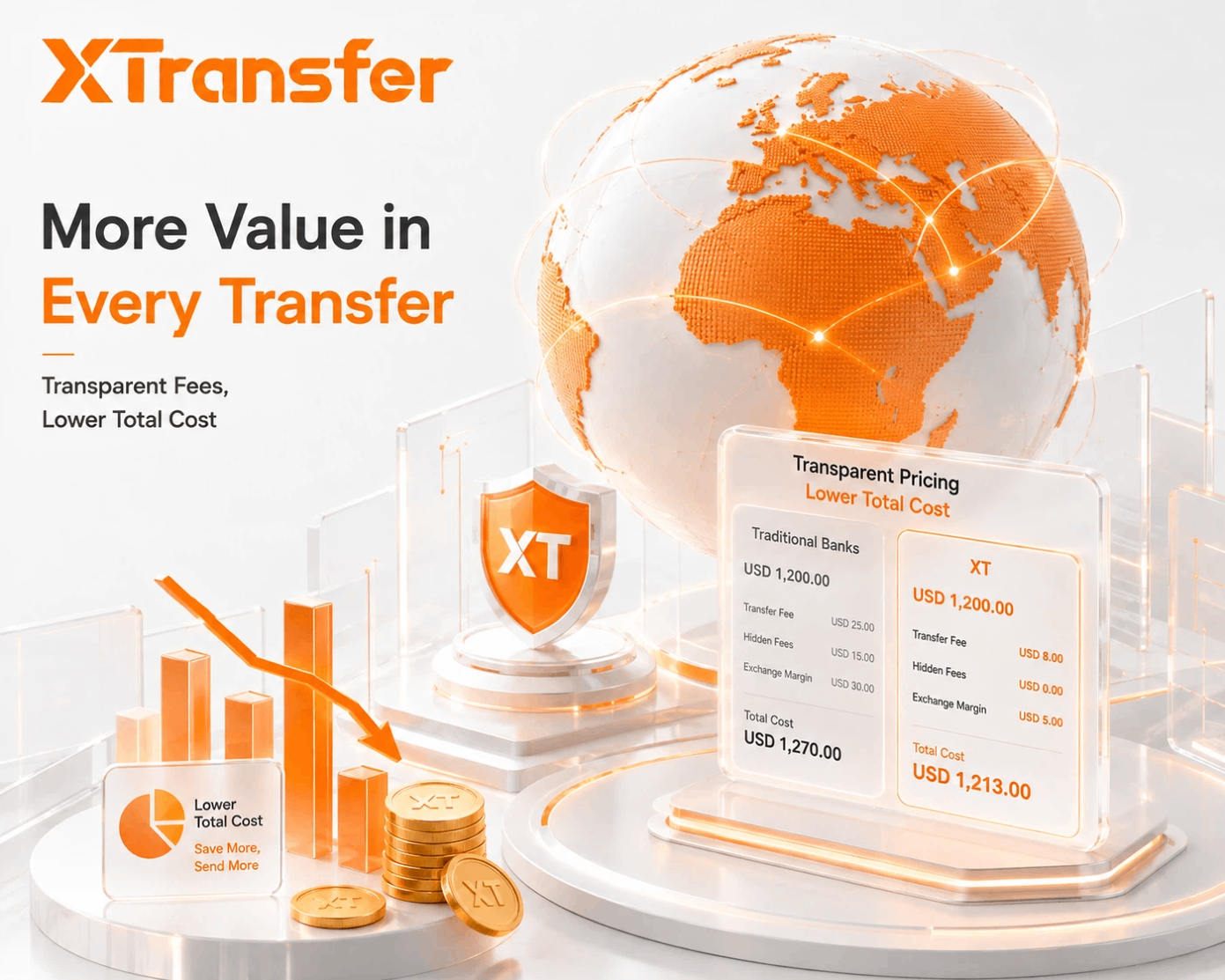
By connecting corporate capital directly into local domestic clearing highways across nealry 60 countries, XTransfer eliminates unnecessary intermediary bank stops. This alternative infrastructure secures an approximate 95% reduction in transfer fees and an 80% drop in total FX conversion costs compared to legacy bank setups. [6]
The Total Cost of Ownership (TCO) Formula for Corporate Treasury
To run truly optimized procurement logistics, corporate controllers must calculate the comprehensive cost of payment infrastructure using the Total Cost of Ownership (TCO) metric:
TCO = Visible Transfer Fee + FX Spread Loss + Intermediary Deductions + Operational Overhead
Factoring in Back-Office Operational Overhead
When a legacy wire arrives at a supplier's account short by US$35 due to an intermediary bank deduction, it triggers an expensive operational chain reaction:
- The supplier's accounting team flags the invoice as unpaid.
- The supplier holds the shipment or bill of lading.
- Your internal finance team spends valuable hours manually pulling wire traces and processing micro-transfers to cover the deficit.
This operational labor is a real financial drain on your business that never appears on a standard bank fee schedule.
Transaction Scale Scenarios: Small-Value to Enterprise Payouts
Tactical Guide: Minimizing B2B Cross-Border Attrition
Complete XTransfer Global Pricing Reference Schedule
XTransfer offers a transparent, multi-currency corporate payment framework designed specifically for international B2B trade across 200+ countries and regions:
Account Infrastructure, Maintenance, and Inbound Collection
| Capability | Pricing |
|---|---|
| Global Account Onboarding & Setup | US$0 (Free) |
| Monthly Enterprise Account Maintenance | US$0 (Free) |
| Peer-to-Peer Internal Clearing (X2X Transfers) | US$0 (Free) |
| Standard Bank Wire Collections (200+ Countries/Regions) | US$0 (Free inbound collection across global currencies including USD, EUR, GBP, CNY, HKD). |
| Local Currency Network Payouts (~60 Countries/Regions) | US$0 (Free local collection processing for standard corridors including BRL, MXN, IDR, THB, NGN, KES). |
| Specialized Currency Corridors | From 0.5% (Applies to COP, PEN, CLP, ZAR). |
Outbound Remittance & Distribution
| Outbound Capability | Pricing |
|---|---|
| Outbound Settlement to Internal XTransfer Wallets | US$0 (Free) |
| Transfer to Own Corporate Bank Accounts (Global) | From US$2 flat per transaction execution. |
| Third-Party Supplier Business Account Payouts | From US$2 flat per transaction execution. |
| Direct Supplier Settlement to Chinese Mainland Accounts | Percentage-based FX processing capped at a maximum of 0.4% of total transaction values. |
Frequently Asked Questions (FAQ)
References
-
World Bank – Remittance Prices Worldwide, Issue 54, Q3 2025
-
Financial Stability Board (FSB) – G20 Roadmap for Enhancing Cross-Border Payments
-
Mural Pay – Intermediary Banks Explained: How They Work & Fees
-
Bank for International Settlements (BIS) – Correspondent Banking Data Commentary - May 2019
-
Bank for International Settlements (BIS) – Correspondent Banking Data Commentary - August 2020
-
Financial Stability Board (FSB) – Annual Progress Report on Meeting the Targets for Cross-border Payments - 2024